Blogs
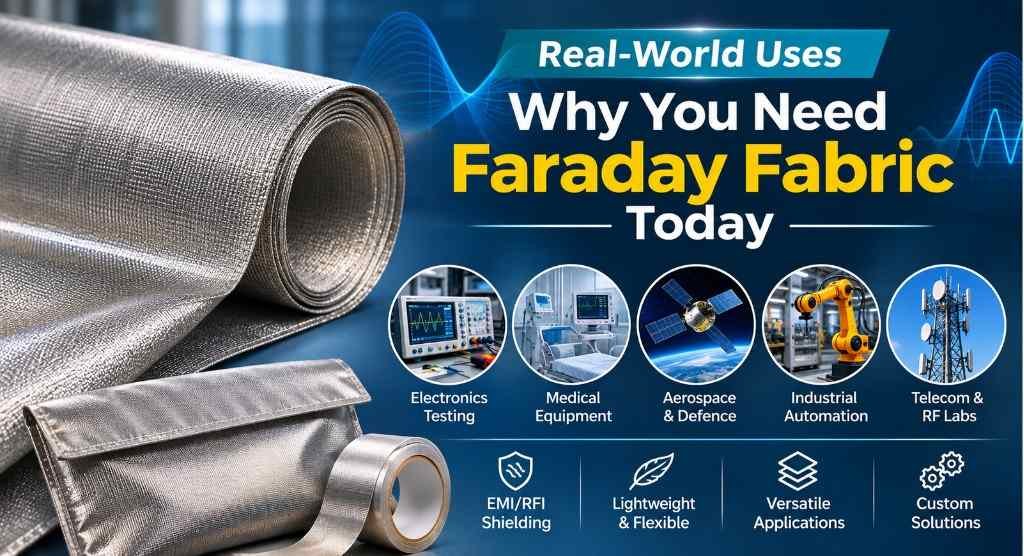
Real-World Uses of Faraday Fabric: 9 Powerful Reasons You Need It Today
Faraday Fabric Applications are becoming increasingly important as modern industries depend on wireless communication, sensitive electronics, connected equipment, and reliable electromagnetic shielding.
A hospital experiences interference with sensitive electronic equipment. A research laboratory struggles with unwanted electromagnetic noise. An electronics manufacturer discovers that external radio-frequency signals are affecting test results.
These situations may appear unrelated, but they share one important challenge: unwanted electromagnetic energy can interfere with electronic systems and sensitive measurements.
This is where Faraday Fabric Applications become valuable.
Unlike conventional rigid metal enclosures, conductive shielding fabrics provide flexible, lightweight, and adaptable solutions for selected electromagnetic interference (EMI) and radio-frequency interference (RFI) applications.
From aerospace engineering and telecommunications to industrial automation and electronics testing, Faraday Fabric Applications offer opportunities to protect equipment, improve signal control, and create more reliable operating environments.
As industries continue to adopt advanced electronic technologies, the demand for effective, flexible, and reliable electromagnetic shielding solutions is becoming increasingly important.
In this detailed DOMADIA™ guide, we explore nine practical Faraday Fabric Applications, chemical compositions, technical properties, shielding standards, available forms, and important considerations when selecting conductive fabric for industrial applications.
Focus keyword usage: 4 times, naturally integrated for SEO optimisation.
1. What Is Faraday Fabric and How Does It Work?
Faraday fabric is a conductive textile designed to reduce the transmission of electromagnetic energy through a material or enclosure.
It is typically manufactured using conductive metal coatings, metallic fibres, or a combination of textile substrates and conductive materials.
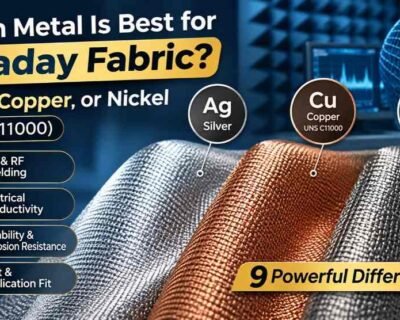
Common conductive constituents include:
- Copper
- Nickel
- Silver
- Stainless steel
- Silver-coated nylon or polyester
- Copper-nickel-coated polyester
When electromagnetic waves encounter a conductive fabric, some energy is reflected, some is absorbed, and some may pass through.
The shielding performance depends on several factors, including material conductivity, frequency, fabric construction, coating thickness, continuity, and installation quality.
A conductive fabric can also form part of a Faraday enclosure when appropriately designed with electrically continuous seams, overlaps, and closures.
However, a piece of Faraday fabric alone does not automatically create a complete Faraday cage.
2. Faraday Fabric Applications: 9 Real-World Uses

1. Electronics Manufacturing and Testing
One of the most important Faraday Fabric Applications is electronics manufacturing and testing. Electronic manufacturers use conductive shielding materials to reduce unwanted RF coupling during testing, prototyping, and troubleshooting. Faraday fabric can support temporary test covers, shielded workspaces, and selected equipment enclosures.
Key benefit: More controlled electromagnetic testing conditions.
2. Medical Equipment and Healthcare Electronics
Medical electronic systems require careful electromagnetic compatibility design. Faraday Fabric Applications in healthcare include suitable conductive textiles incorporated into equipment housings, curtains, or specialized shielding assemblies.
Key benefit: Additional EMI management where validated for the specific medical environment.
3. Aerospace and Defence Systems
Aircraft, satellites, and defence electronics contain sensitive communication, navigation, and control systems. Faraday Fabric Applications in aerospace and defence include lightweight shielding covers, cable assemblies, and selected electronic compartments.
Key benefit: Flexible shielding options where mass and packaging constraints matter.
4. Industrial Automation and Robotics
Factories contain motors, variable-frequency drives, switching equipment, and wireless systems. Faraday fabric may be used as part of an engineered shielding solution around sensitive electronic assemblies.
Key benefit: Reduced electromagnetic coupling that could otherwise affect control electronics.
5. Telecommunications and RF Laboratories
Faraday Fabric Applications in telecommunications and RF laboratories can help isolate equipment from nearby transmitters or limit signal leakage from experimental setups. Conductive textile enclosures provide flexible alternatives for certain test arrangements.
Key benefit: Better control over the RF testing environment.
6. RFID and Wireless Signal Isolation
Portable signal isolation is another practical example of Faraday Fabric Applications. Conductive pouches and bags can be designed to attenuate RFID, NFC, cellular, or other wireless signals within specified frequency bands.
Key benefit: Portable signal isolation for compatible devices, subject to tested closure and enclosure performance.
7. Scientific Research and Precision Measurement
Sensitive measurement systems may require protection against external RF noise. Conductive fabric can support localized shielding around experimental equipment and measurement fixtures.
Key benefit: Reduced external electromagnetic interference in suitable experimental setups.
8. Automotive and Electric Vehicle Electronics
Modern vehicles contain sensors, controllers, power converters, and communication modules. Faraday Fabric Applications in automotive engineering include selected EMI shielding components and protective covers designed to support electromagnetic compatibility.
Key benefit: Additional design flexibility for automotive electromagnetic compatibility.
9. Shielded Rooms, Curtains, and Temporary Enclosures
Conductive fabrics can be used to construct RF curtains, temporary shielding partitions, and portable enclosures.
Key benefit: Reconfigurable shielding structures without always requiring rigid metal walls.
These real-world Faraday Fabric Applications demonstrate that the value of conductive shielding fabric lies not simply in blocking signals, but in controlling electromagnetic interactions where they matter most.
Focus keyword usage: Exactly 7 times in the content, naturally integrated for SEO optimisation while maintaining technical accuracy and readability.
3. Chemical Composition of Faraday Fabric
Faraday fabric does not have one universal chemical formula. Its composition depends on the conductive coating, textile substrate, and intended application.
| Material | Composition | Main advantage |
| Copper-coated fabric | Copper (Cu) on textile | High electrical conductivity |
| Nickel-coated fabric | Nickel (Ni) on textile | Conductive surface with useful wear resistance |
| Silver-coated fabric | Silver (Ag) on textile | Excellent electrical conductivity |
| Copper-nickel fabric | Cu/Ni coating on polyester or nylon | Combination of conductivity and surface protection |
| Stainless steel fabric | Iron-based alloy containing chromium, often nickel | Mechanical durability and corrosion resistance |
| Silver-plated nylon | Silver coating on polyamide fibres | Flexible conductive textile |
The exact percentage of each metal varies by manufacturer and product construction.
For example, a copper-nickel-coated polyester textile may contain a polyester core with conductive metal layers deposited onto its surface.
For procurement and engineering evaluation, DOMADIA™ recommends requesting the manufacturer’s composition details, coating specifications, and shielding test data rather than assuming that all conductive fabrics perform equally.
4. Important Properties of Faraday Fabric
EMI/RFI Shielding
One of the primary benefits of Faraday Fabric Applications is reducing electromagnetic transmission and unwanted signal interference over tested frequency ranges.
Electrical Conductivity
Conductive coatings or fibres provide electrical current paths, making them essential for effective Faraday Fabric Applications in electronic shielding.
Flexibility
The material can be folded, wrapped, sewn, or integrated into assemblies, making Faraday Fabric Applications suitable for complex shielding designs.
Lightweight Construction
Often lighter and easier to handle than rigid metal panels, conductive fabrics make Faraday Fabric Applications particularly valuable in weight-sensitive industries.
Corrosion Resistance
Corrosion resistance depends on the metal coating and exposure conditions, influencing the long-term reliability of Faraday Fabric Applications.
Fabrication Options
Conductive fabrics can be tailored into pouches, covers, curtains, and liners, supporting various industrial shielding requirements.
An important consideration is that repeated folding, abrasion, washing, or chemical exposure may damage conductive coatings and reduce shielding performance.
Therefore, durability testing is particularly important for reusable industrial Faraday Fabric Applications to ensure consistent shielding performance and long-term reliability.
5. Technical Specifications of Faraday Fabric
Engineers should evaluate conductive fabric using measurable technical parameters rather than marketing claims alone.
| Parameter | Typical specification consideration |
| Shielding effectiveness | Expressed in decibels (dB), at specified frequencies |
| Frequency range | May cover kHz, MHz, or GHz bands depending on design and test method |
| Surface resistance | Specified in Ω/sq or other appropriate resistance units |
| Thickness | Often fractions of a millimetre, depending on textile construction |
| Fabric weight | Usually expressed in g/m² |
| Tensile strength | Depends on substrate and fabric construction |
| Operating temperature | Limited by textile fibres, coatings, and finishes |
| Corrosion resistance | Depends on metal composition and environmental exposure |
| Flex durability | Evaluated after bending, folding, or repeated handling |
These are specification categories, not guaranteed values for every Faraday fabric.
Understanding Shielding Effectiveness
Shielding effectiveness is commonly expressed as:
\[ SE_{\mathrm{dB}}=20\log_{10}\left(\frac{E_i}{E_t}\right) \]
Where:
- \(E_i\) = incident electric field magnitude
- \(E_t\) = transmitted electric field magnitude
For a simplified field-amplitude comparison, assuming consistent measurement conditions:
A fabric showing 60 dB attenuation in a controlled laboratory test does not necessarily provide 60 dB shielding after being installed in a pouch, curtain, or enclosure.
Openings, seams, conductive contact, and closure quality can substantially influence final performance.
6. International Standards for Faraday Fabric
There is no single international standard that certifies every Faraday fabric for all applications.
Relevant test methods and standards include:
| Standard | Relevance |
| ASTM D4935 | Shielding effectiveness of planar materials using a coaxial transmission-line method |
| IEEE Std 299 | Shielding effectiveness of electromagnetic shielding enclosures |
| IEEE Std 299.1 | Shielding effectiveness of enclosures and boxes with dimensions between 0.1 m and 2 m |
| IEC 61000-4-3 | Radiated radio-frequency electromagnetic field immunity testing |
| IEC 61000-4-6 | Immunity to conducted disturbances induced by RF fields |
| MIL-STD-461 | Electromagnetic interference requirements for applicable military equipment and subsystems |
| ISO 9001 | Quality management system requirements |
Important: IEC 61000-4-3, IEC 61000-4-6, and MIL-STD-461 address equipment-level EMC requirements or tests; they do not directly certify a fabric’s shielding effectiveness.
Likewise, ISO 9001 concerns quality management, not a material’s EMI attenuation.
Engineers should match the test method to the material, frequency range, and finished application.
7. Available Shapes and Forms of Faraday Fabric
One major advantage of conductive shielding textiles is their adaptability.
Fabric Rolls
For industrial cutting, fabrication, and large-area coverage.
Sheets and Cut Pieces
For localized shielding, covers, and prototype assemblies.
Conductive Tapes
For selected seam treatments, overlaps, and electrical connections.
Custom Pouches and Covers
For device isolation and equipment protection applications.
Additional configurations may include conductive mesh, laminated textiles, shielding curtains, and custom-fabricated enclosure components.
Availability depends on the material grade, supplier, dimensions, and manufacturing requirements.
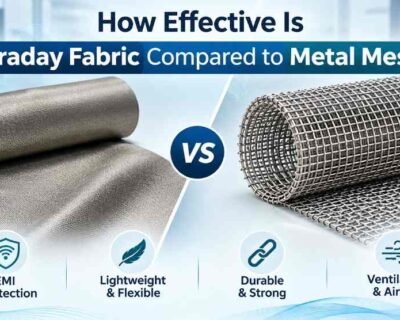
8. Faraday Fabric vs Traditional Metal Shielding
Why select conductive fabric when aluminium, copper, and steel shielding materials already exist?
The answer depends on application requirements.
| Feature | Faraday fabric | Rigid metal shielding |
| Flexibility | High | Low |
| Weight | Often lightweight | Depends on metal and thickness |
| Fabrication | Cutting, sewing, bonding | Forming, machining, welding |
| Structural strength | Limited | Generally higher |
| Portable applications | Often convenient | Less adaptable |
| Shielding consistency | Sensitive to seams and wear | Also dependent on joints and openings |
| Mechanical durability | Depends on coating and substrate | Often stronger in harsh environments |
| Typical applications | Pouches, curtains, covers | Cabinets, housings, enclosures |
Faraday fabric is not automatically superior to rigid metal shielding.
For permanent industrial enclosures requiring mechanical strength, thermal resistance, or structural protection, metal panels may be more suitable.
However, when the project requires flexibility, portability, or customized textile integration, conductive fabrics can offer a practical advantage.
9. Why Do You Need Faraday Fabric Today?
Modern electronic systems increasingly operate in environments containing multiple sources of electromagnetic energy.
Wireless networks, switching power supplies, industrial drives, communication equipment, and densely packed electronic components can create complex EMC challenges.
Three developments make conductive shielding fabrics particularly relevant.
Growing Electronic Complexity
Modern systems integrate more sensors, processors, communication modules, and power electronics into compact assemblies.
As electronic density increases, engineers must pay closer attention to electromagnetic compatibility.
Greater Demand for Flexible Designs
Traditional shielding enclosures may not suit every product geometry.
Conductive fabric offers opportunities to protect irregularly shaped components and create removable or reconfigurable shielding solutions.
Increasing Importance of Reliable Testing
In research laboratories and manufacturing facilities, unwanted RF coupling can complicate measurements and troubleshooting.
Properly designed shielding assemblies can help create more repeatable testing environments.
The central lesson is simple: effective electromagnetic shielding is no longer just about selecting a conductive metal. It is about designing a complete shielding system.
10. How to Choose the Right Faraday Fabric
Before purchasing a conductive shielding textile, consider these seven factors:
- Identify the interference frequency. Determine whether the application involves RFID, cellular, Wi-Fi, industrial RF, or another frequency band.
- Define the required shielding effectiveness. Establish an attenuation target supported by an appropriate test method.
- Choose the conductive material. Compare copper, nickel, silver, and stainless steel constructions.
- Check mechanical requirements. Consider folding, abrasion, tensile strength, and expected service life.
- Evaluate environmental exposure. Review humidity, corrosion, temperature, and chemical compatibility.
- Design the complete enclosure. Include seams, openings, closures, overlaps, and electrical continuity.
- Request technical documentation. Verify composition, resistance, shielding test results, and available dimensions.
For low-frequency magnetic fields, conventional thin conductive fabrics may provide limited shielding. High-permeability materials such as suitable Mu-Metal alloys may be more appropriate, depending on field strength, frequency, and geometry.
Also, RF shielding fabric should not be treated as a substitute for certified ionizing-radiation protection, electrical insulation, or protective grounding systems.
11. Why Choose DOMADIA™ for Faraday Fabric Requirements?
Selecting the right material for Faraday Fabric Applications involves more than comparing prices or choosing the most conductive metal.
Manufacturers need to consider frequency, material construction, shielding performance, installation methods, and long-term operating conditions.
DOMADIA™ supports industrial material sourcing discussions for specialized engineering applications.
Material Selection Support
Explore copper, nickel, silver-coated, and other conductive textile options based on the specific requirements of different Faraday Fabric Applications.
Industrial Application Understanding
Understand material requirements for electronics, aerospace, defence, telecommunications, and research industries where Faraday Fabric Applications can support effective electromagnetic shielding.
Technical Specification Focus
Evaluate material forms, dimensions, conductivity, and shielding test documentation where available to support informed material selection.
Specialized Material Sourcing
Discuss sourcing requirements for conductive fabrics and related industrial shielding materials suitable for demanding engineering environments.
The objective of DOMADIA™ is to help customers identify suitable materials for their Faraday Fabric Applications, with final shielding performance and reliability verified through appropriate testing.
Conclusion: Faraday Fabric Is a Practical Tool for Modern EMI Shielding
Faraday Fabric Applications demonstrate how conductive textiles can support modern electronics, industrial automation, telecommunications, research laboratories, aerospace engineering, and portable shielding systems.
Their main advantages include flexibility, lightweight construction, adaptable fabrication, and the ability to provide effective electromagnetic attenuation when properly selected and installed.
However, successful Faraday Fabric Applications require more than choosing a fabric with an impressive dB rating.
Engineers must evaluate operating frequency, conductive composition, mechanical durability, seams, enclosure design, and applicable test methods.
As electronic systems become increasingly complex, Faraday fabric offers a valuable additional option alongside conventional metal shielding.
For reliable Faraday Fabric Applications, DOMADIA™ can help you explore suitable conductive textiles, industrial shielding materials, and technical specifications tailored to your engineering requirements.
Looking for Faraday Fabric for Your Next Project?
Explore conductive shielding fabric options with DOMADIA™ for EMI/RFI protection, electronic equipment, industrial applications, and customized shielding requirements.
Connect with DOMADIA™ to discuss material composition, dimensions, frequency requirements, and sourcing needs.
Talk to: Er.Pankaj Domadia | Kairav Domadia | Aadil Domadia | Pragati Sanap | Pooja N N
#FaradayFabric #FaradayFabricApplications #EMIShielding #RFIShielding #ElectromagneticShielding #ConductiveFabric #IndustrialElectronics #AerospaceMaterials #DOMADIA
Directly whatsapp us for an Enquiry: https://wa.link/kairav
We’ve delivered to Bengaluru, Mysuru, Mangaluru, Hubballi, and Belagavi—covering Karnataka, Telangana, Tamil Nadu, Kerala, and Andhra Pradesh, with exports to Australia, New Zealand, Singapore, Malaysia, and Indonesia.