Blogs
Faraday Fabric Sewing: 9 Proven Tips for Using a Regular Sewing Machine
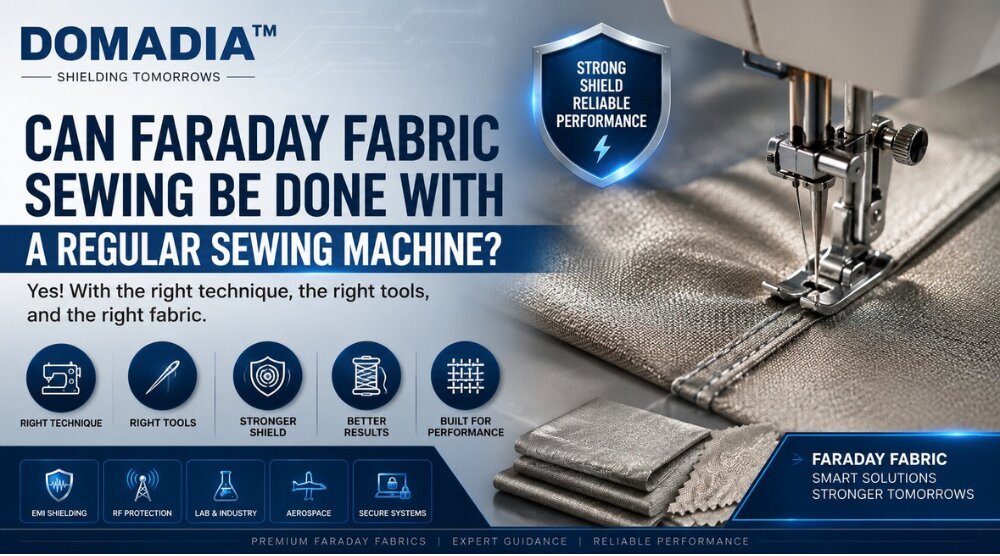
Can Faraday Fabric Sewing Be Done with a Regular Sewing Machine?
Many engineers, researchers, hobbyists, and manufacturers purchase conductive shielding fabrics only to ask one important question: Can I sew Faraday fabric with a regular sewing machine?
The simple answer is yes—in most cases, you can. However, successful Faraday Fabric Sewing depends on choosing the right needle, thread, stitch pattern, and handling technique. Unlike ordinary textiles, Faraday fabrics contain conductive metals such as nickel, copper, silver, stainless steel, or combinations of these materials. These metallic fibers provide excellent EMI and RF shielding but also require extra care during fabrication. Using proper Faraday Fabric Sewing techniques helps preserve conductivity, improves seam durability, and ensures the finished product continues to deliver reliable shielding performance.
Whether you’re building EMI shielding curtains, RF enclosures, laboratory tents, military equipment covers, wearable shielding garments, or custom electronic projects, understanding how to sew conductive fabric properly helps preserve both mechanical durability and shielding effectiveness. By following proven Faraday Fabric Sewing practices, you can minimize damage to the conductive layer and maximize the long-term reliability of your shielding solution.
At DOMADIA™, we supply premium-quality Faraday fabrics suitable for industrial, laboratory, aerospace, defense, and electronics applications, while also helping customers understand the best fabrication practices. Our technical experts can guide you in selecting the right conductive fabric and recommend the most effective Faraday Fabric Sewing methods for your specific application.
What Is Faraday Fabric?
Faraday fabric is a conductive textile designed to block or attenuate electromagnetic interference (EMI), radio frequency (RF) signals, static electricity, and electromagnetic radiation.
Unlike decorative fabrics, these materials combine flexible textile fibers with conductive metals to create lightweight shielding solutions.
Common constructions include:
- Nickel Copper Polyester
- Silver-Plated Fabric
- Stainless Steel Fabric
- Copper Nickel Mesh
- Conductive Woven Fabric
- Conductive Non-Woven Fabric
Can a Regular Sewing Machine Handle Faraday Fabric?
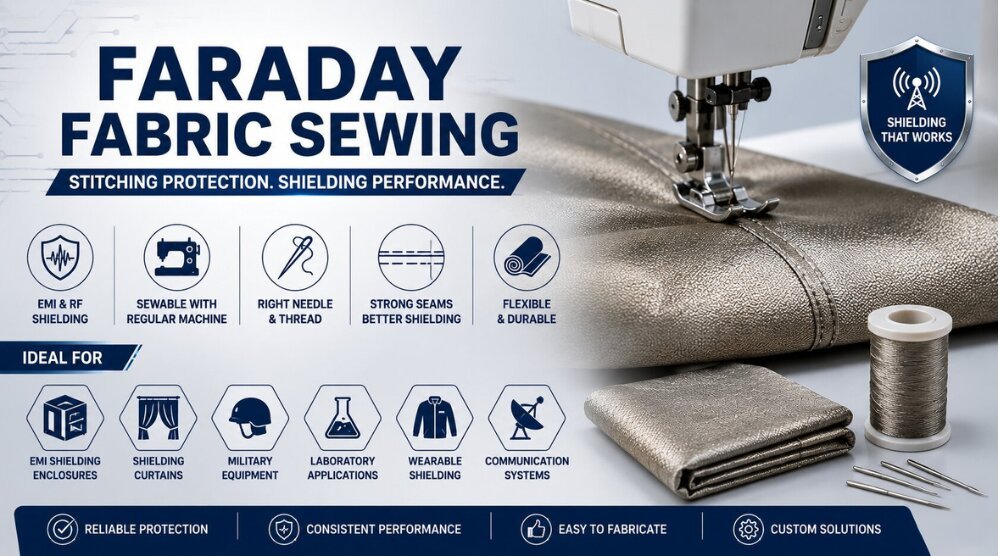
Yes.
Most household and industrial sewing machines can stitch Faraday fabric successfully.
However, results depend on several factors:
- Fabric thickness
- Metal coating
- Fabric flexibility
- Needle selection
- Sewing speed
- Thread quality
- Stitch density
Thin shielding fabrics generally sew almost like medium-weight woven fabric, while heavy conductive textiles require slower stitching and stronger needles.
9 Proven Tips for Sewing Faraday Fabric Successfully
1. Use a Sharp Needle
A new universal or microtex needle produces cleaner holes and reduces damage to conductive fibers.
Avoid dull needles that may snag metallic yarns.
2. Select the Correct Thread
Polyester thread is commonly recommended because it offers:
- High strength
- Excellent flexibility
- Low moisture absorption
- Long service life
Conductive thread can also be used where electrical continuity is required.
3. Reduce Sewing Speed
Metal-coated fabrics behave differently than cotton.
Lower sewing speeds help:
- Prevent skipped stitches
- Improve stitch consistency
- Reduce needle heating
- Minimize coating damage
4. Avoid Excessive Needle Holes
Every needle penetration creates a small interruption in the conductive surface.
Large stitch densities may slightly reduce shielding performance.
Use moderate stitch lengths whenever practical.
5. Test on Scrap Material First
Before beginning production:
- Check stitch quality
- Evaluate fabric feeding
- Inspect conductive coating
- Verify seam appearance
Testing prevents expensive mistakes.
6. Minimize Fabric Stretching
Pulling conductive fabric during sewing can distort both textile fibers and conductive layers.
Allow the machine feed dogs to move the material naturally.
7. Keep Fabric Clean
Dust, oils, and contaminants may reduce conductivity over time.
Always handle shielding fabrics using clean work surfaces.
8. Use Proper Seam Design
Overlap seams generally provide better shielding continuity than large open gaps.
Depending on the application, conductive tapes or additional shielding layers may also be incorporated.
9. Verify Shielding After Assembly
Critical applications should always undergo shielding effectiveness testing after sewing.
Professional testing confirms:
- RF attenuation
- EMI performance
- Electrical continuity
- Overall shielding integrity
Does Sewing Reduce Shielding Performance?
In most practical applications, properly sewn Faraday fabric retains excellent shielding performance.
Minor reductions may occur because stitching introduces tiny openings through the conductive layer. However, careful seam design minimizes these effects.
Applications such as:
- Shielded curtains
- EMI tents
- Laboratory enclosures
- Equipment covers
typically maintain excellent overall shielding when correctly fabricated.
Chemical Composition
The exact composition depends on the fabric grade, but common conductive constructions include:
| Material | Typical Function |
| Polyester | Base textile structure |
| Nickel | Corrosion resistance and conductivity |
| Copper | Excellent electrical conductivity |
| Silver | Superior RF shielding performance |
| Stainless Steel | Mechanical strength and durability |
Properties
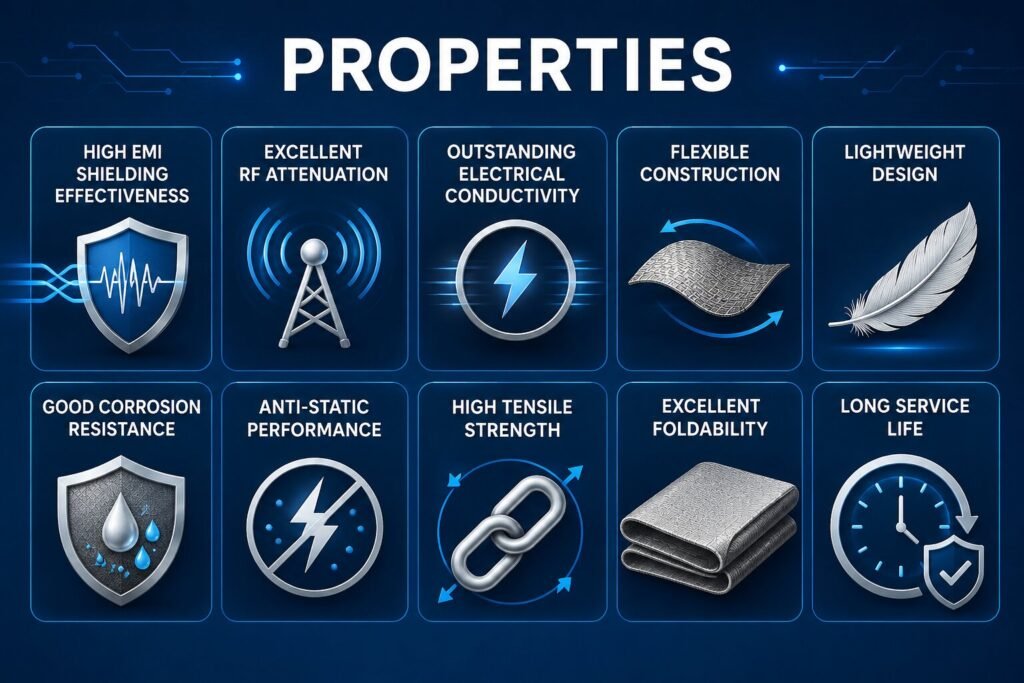
High EMI Shielding Effectiveness
The conductive materials used in Faraday Fabric Sewing provide excellent EMI shielding effectiveness, helping protect sensitive electronic equipment from unwanted electromagnetic interference.
Excellent RF Attenuation
Products manufactured through Faraday Fabric Sewing effectively reduce radio frequency signals, making them suitable for laboratories, defense systems, and secure communication environments.
Outstanding Electrical Conductivity
The conductive fibers incorporated during Faraday Fabric Sewing ensure stable electrical conductivity, allowing reliable performance in EMI and RF shielding applications.
Flexible Construction
One of the major advantages of Faraday Fabric Sewing is the ability to create flexible shielding solutions that easily conform to complex shapes without sacrificing performance.
Lightweight Design
Materials used in Faraday Fabric Sewing are lightweight, making them ideal for portable shielding products, wearable applications, and aerospace components where weight reduction is critical.
Good Corrosion Resistance
High-quality conductive fabrics used for Faraday Fabric Sewing offer good corrosion resistance, ensuring dependable shielding performance even in demanding industrial environments.
Anti-Static Performance
The conductive construction achieved through Faraday Fabric Sewing helps dissipate static electricity, protecting sensitive electronic components from electrostatic discharge (ESD).
High Tensile Strength
Premium fabrics designed for Faraday Fabric Sewing provide excellent tensile strength, allowing them to withstand repeated handling, installation, and long-term industrial use.
Excellent Foldability
Products created using Faraday Fabric Sewing maintain excellent foldability, allowing easy transportation, storage, and installation without significantly affecting shielding performance.
Long Service Life
With proper Faraday Fabric Sewing techniques and quality conductive materials, finished products deliver a long operational life, reducing maintenance requirements and replacement costs over time.
Technical Specifications
Typical specifications include:
- Shielding Effectiveness: Up to 60–100 dB (depending on construction)
- Surface Resistivity: Low resistance conductive surface
- Operating Temperature: Varies by material system
- Fabric Weight: Multiple GSM options available
- Roll Width: Custom widths available
- Color Options: Silver, grey, black and custom finishes
- Conductive Coating: Nickel, copper, silver, stainless steel or hybrid coatings
Standards
Quality Faraday fabrics are commonly manufactured or tested according to:
- ASTM D5034 (Tensile Strength)
- ASTM D3776 (Fabric Weight)
- ASTM D1777 (Fabric Thickness)
- MIL-STD-285
- IEEE 299
- IEC 61000 Series
- RoHS Compliance
- REACH Compliance
Applications
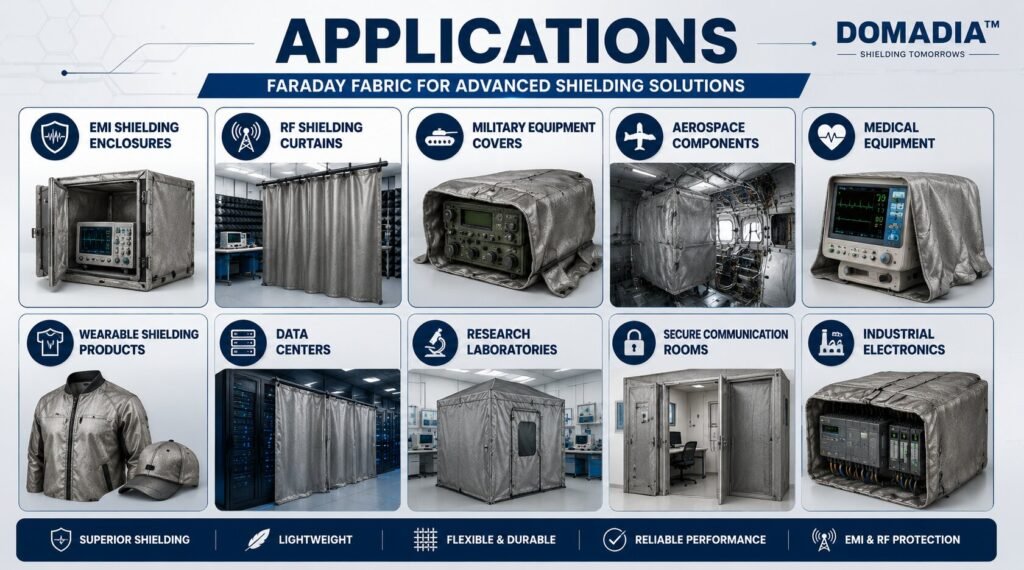
EMI Shielding Enclosures
Faraday Fabric Sewing enables the fabrication of custom EMI shielding enclosures that protect sensitive electronic equipment from electromagnetic interference while maintaining flexible and durable construction.
RF Shielding Curtains
Proper Faraday Fabric Sewing techniques are used to manufacture RF shielding curtains that help reduce radio frequency leakage in laboratories, testing facilities, and secure environments.
Military Equipment Covers
Using Faraday Fabric Sewing, durable protective covers can be produced to shield sensitive military electronics and communication systems from external electromagnetic interference.
Aerospace Components
Precision Faraday Fabric Sewing supports the production of lightweight shielding solutions that protect avionics, navigation equipment, and aerospace communication systems.
Medical Equipment
Reliable Faraday Fabric Sewing allows conductive fabrics to be integrated into medical equipment covers, improving electromagnetic compatibility around sensitive diagnostic devices.
Wearable Shielding Products
Advanced Faraday Fabric Sewing techniques help create protective garments, wearable shielding accessories, and personal protection products that remain flexible and comfortable.
Data Centers
Custom shielding solutions produced through Faraday Fabric Sewing help minimize electromagnetic interference around servers, networking equipment, and critical communication infrastructure.
Research Laboratories
Researchers utilize Faraday Fabric Sewing to manufacture custom shielding tents, chambers, and laboratory enclosures for precise electromagnetic testing and experimentation.
Secure Communication Rooms
Professional Faraday Fabric Sewing enables the creation of shielding curtains and enclosure systems that provide controlled environments for secure communications and sensitive data protection.
Industrial Electronics
High-quality Faraday Fabric Sewing supports the manufacture of protective covers and shielding assemblies that improve the reliability of industrial electronics operating in electrically noisy environments.
Shapes Available
DOMADIA™ supplies Faraday fabric in multiple forms:
- Fabric Rolls
- Custom Cut Sheets
- Conductive Tapes
- Laminated Fabric
- Mesh Fabric
- Shielding Curtains
- Custom Sewn Components
- OEM Fabrication Solutions
Why DOMADIA™
Choosing the right shielding material requires more than simply purchasing conductive fabric. At DOMADIA™, we provide high-quality Faraday fabrics engineered for reliable EMI and RF shielding across industrial, aerospace, defense, medical, and research applications. Our experienced team assists customers in selecting the appropriate material, shielding performance, dimensions, and fabrication approach to ensure dependable results. With consistent product quality, technical guidance, competitive pricing, custom sizes, global logistics, and responsive support, DOMADIA™ helps organizations build effective shielding solutions with confidence.
Conclusion
Faraday Fabric Sewing is entirely possible with a regular sewing machine when proper techniques are followed. Using the correct needle, thread, stitch length, and seam design helps preserve both the mechanical strength and shielding effectiveness of the fabric. While specialized equipment may benefit high-volume manufacturing, most laboratory, industrial, and prototype projects can be completed successfully with standard sewing machines. By selecting premium conductive fabrics and following proven fabrication practices, users can create durable EMI and RF shielding products that perform reliably for years. With its broad range of shielding materials and technical expertise, DOMADIA™ supports customers in developing high-performance Faraday fabric solutions for demanding applications.
Need High-Performance Faraday Fabric for Your Shielding Project?
DOMADIA™ offers premium-quality conductive fabrics in various constructions, sizes, and shielding levels to meet the requirements of aerospace, defense, medical, industrial, telecommunications, and research applications.
Contact DOMADIA™ today to discuss your Faraday fabric requirements and discover the ideal shielding solution for your application.
Talk to: Er.Pankaj Domadia | Kairav Domadia | Aadil Domadia | Pragati Sanap | Pooja N N
#FaradayFabric #ConductiveFabric #EMIShielding #RFShielding #FaradayCage #TechnicalTextiles #IndustrialMaterials #DOMADIA
Directly whatsapp us for an Enquiry: https://wa.link/kairav
Our materials have reached Kolhapur, Sangli, Satara, Ratnagiri, and Sindhudurg across Maharashtra, Goa, Karnataka, and MP, exporting to Japan, South Korea, Taiwan, Hong Kong, and China.