Blogs
Faraday Fabric Testing: 9 Proven Ways to Verify Shielding Performance
Modern electronics operate in environments filled with electromagnetic signals from Wi-Fi routers, mobile phones, Bluetooth devices, industrial equipment, power lines, and radio transmitters. While conductive fabrics are widely used to reduce electromagnetic interference (EMI), many engineers, researchers, and buyers ask one important question:
How can you verify that a Faraday fabric actually performs as claimed?
Faraday Fabric Testing is the only reliable way to confirm whether a conductive fabric provides the required level of EMI and RF shielding. Simply measuring conductivity with a multimeter is not enough. Proper testing evaluates how effectively the material attenuates electromagnetic waves across different frequencies.
At DOMADIA™, we supply high-performance conductive shielding fabrics designed for demanding industrial, defense, aerospace, medical, and research applications where verified shielding performance is essential.
Why Testing Matters
Not every conductive fabric delivers the same shielding effectiveness.
Performance depends on numerous factors including:
- Conductive coating material
- Fabric construction
- Frequency range
- Number of layers
- Surface continuity
- Grounding method
- Installation quality
- Environmental conditions
Without proper verification, a shielding solution may fail to protect sensitive equipment.
How Does Faraday Fabric Block EMI?
Conductive fibers create a continuous electrically conductive surface.
When electromagnetic waves strike the fabric, the conductive layer:
- Reflects part of the incoming energy
- Absorbs some energy
- Redirects electrical currents
- Reduces signal penetration
The result is lower electromagnetic interference reaching protected equipment.
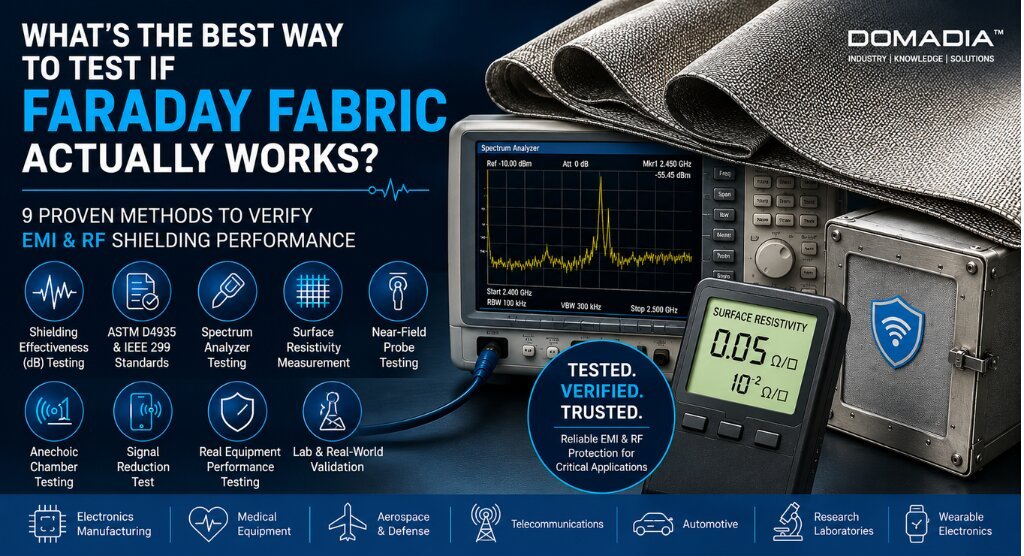
9 Best Ways to Test Faraday Fabric
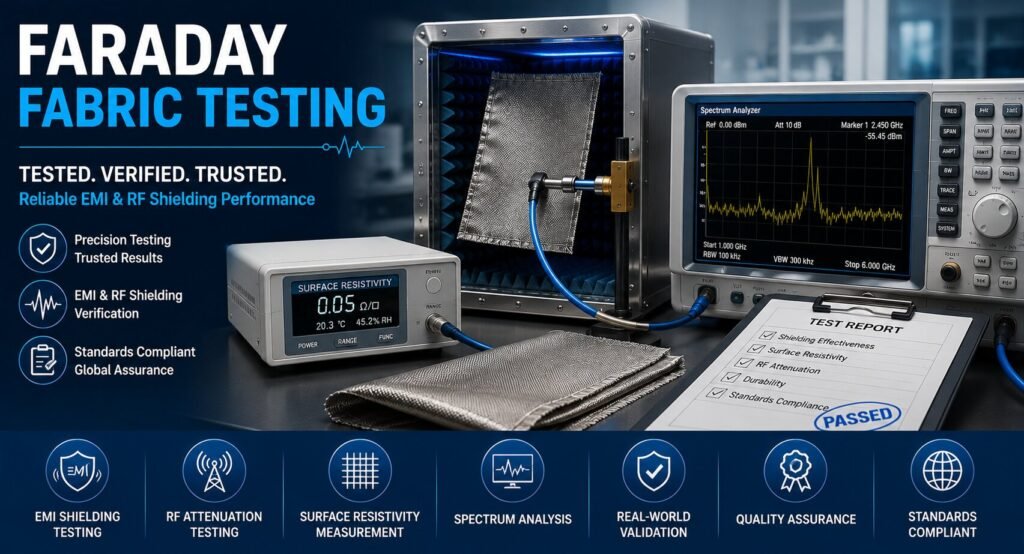
1. Shielding Effectiveness (SE) Testing
This is the industry-standard method.
Specialized laboratories measure how much electromagnetic energy passes through the material.
Results are expressed in:
Shielding Effectiveness (dB)
Typical ranges include:
- 30 dB
- 50 dB
- 70 dB
- 90 dB+
Higher dB values indicate better protection.
2. ASTM D4935 Testing
ASTM D4935 is among the most recognized standards for conductive fabrics.
It evaluates:
- EMI attenuation
- RF shielding
- Frequency response
- Material consistency
Manufacturers frequently use this method to validate shielding performance.
3. IEEE 299 Testing
IEEE 299 evaluates shielding performance for complete enclosures, rooms, and large shielding systems.
It helps determine how effectively installed shielding blocks electromagnetic fields in real operating environments.
4. Surface Resistivity Measurement
A four-point probe or surface resistance meter measures electrical resistance.
Lower surface resistivity generally indicates:
- Better electrical conductivity
- More uniform conductive coating
- Improved shielding consistency
Although useful, resistivity alone cannot determine shielding effectiveness.
5. Spectrum Analyzer Testing
Engineers often compare RF signal strength before and after placing shielding material between the transmitter and receiver.
This demonstrates real-world attenuation at selected frequencies.
6. Near-Field Probe Testing
Near-field probes detect localized electromagnetic leakage.
They are commonly used for:
- PCB shielding
- Electronic enclosures
- Medical devices
- Prototype evaluation
This method helps identify weak points in shielding designs.
7. Anechoic Chamber Testing
Highly controlled test chambers eliminate reflections from surrounding surfaces.
Advantages include:
- Accurate RF measurements
- Repeatable testing
- Multiple frequency evaluations
- Professional certification
This method provides highly reliable shielding data.
8. Mobile Signal Reduction Test
A simple demonstration involves wrapping a mobile phone with conductive fabric.
If signals drop significantly, the fabric is blocking some RF energy.
However, this is only a basic demonstration and should never replace laboratory testing because modern phones use multiple frequency bands and adaptive power control.
9. Real Equipment Performance Testing
The most practical validation is observing equipment performance after shielding is installed.
Examples include:
- Reduced EMI
- Lower signal noise
- Improved sensor accuracy
- Stable communication
- Better EMC compliance
Real-world improvements confirm successful shielding implementation.
Factors That Affect Test Results
Several variables influence measured shielding performance.
Fabric Quality
Higher-quality conductive coatings provide more consistent shielding.
Frequency Range
Some materials perform better at low frequencies, while others are optimized for higher RF frequencies.
Number of Layers
Additional layers can increase attenuation.
Installation Quality
Small openings, gaps, or poor seams reduce shielding effectiveness.
Grounding
Certain applications require proper grounding to achieve optimal performance.
Chemical Composition
Faraday fabrics are manufactured using conductive fibers or textiles coated with highly conductive metals.
Typical materials include:
- Nickel
- Copper
- Silver
- Tin
- Stainless Steel
- Nickel-Copper blends
- Silver-plated nylon
- Conductive polyester fabrics
The selected composition depends on shielding requirements, flexibility, corrosion resistance, and operating environment.
Properties
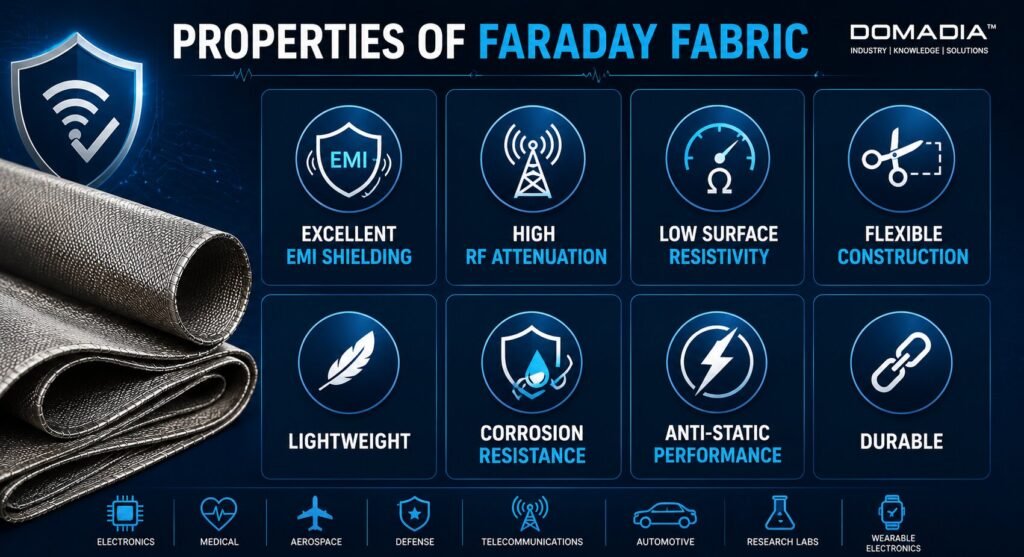
Excellent EMI Shielding
Faraday Fabric Testing consistently demonstrates excellent EMI shielding performance by effectively reducing electromagnetic interference across a broad frequency spectrum, helping protect sensitive electronic systems.
High RF Attenuation
Through Faraday Fabric Testing, these conductive fabrics are verified to block unwanted radio-frequency (RF) signals, improving equipment reliability and signal integrity in demanding environments.
Low Surface Resistivity
Low surface resistivity provides outstanding electrical conductivity, and Faraday Fabric Testing helps confirm consistent shielding effectiveness across the material.
Flexible Construction
Designed for versatility, the fabric can be cut, sewn, laminated, and fabricated into custom shielding solutions without compromising the performance validated through Faraday Fabric Testing.
Lightweight
Despite its lightweight construction, the material delivers high shielding efficiency. Faraday Fabric Testing verifies that minimal weight does not come at the expense of dependable EMI and RF protection.
Corrosion Resistance
Engineered conductive coatings resist oxidation and environmental degradation, ensuring long-term durability and shielding performance validated by Faraday Fabric Testing.
Anti-Static Performance
Safely dissipates electrostatic charges to protect sensitive electronic components while supporting stable electromagnetic shielding in critical applications.
Durable
Built to withstand repeated handling, installation, and industrial use, the material maintains reliable shielding performance over time, with Faraday Fabric Testing confirming consistent performance throughout its service life.
Technical Specifications
| Property | Typical Value |
| Shielding Effectiveness | 30–100+ dB |
| Surface Resistivity | Low (application dependent) |
| Conductive Coating | Nickel, Copper, Silver, Stainless Steel |
| Operating Frequency | kHz to GHz range |
| Fabric Type | Woven / Non-Woven / Knitted |
| Flexibility | Excellent |
| Corrosion Resistance | High |
| Custom Fabrication | Available |
Standards
High-quality conductive shielding fabrics are commonly evaluated using:
- ASTM D4935
- IEEE 299
- MIL-STD-285
- IEC 61000 Series
- CISPR EMC Standards
- RoHS Compliance
- REACH Compliance
Applicable standards depend on the intended application and certification requirements.
Applications
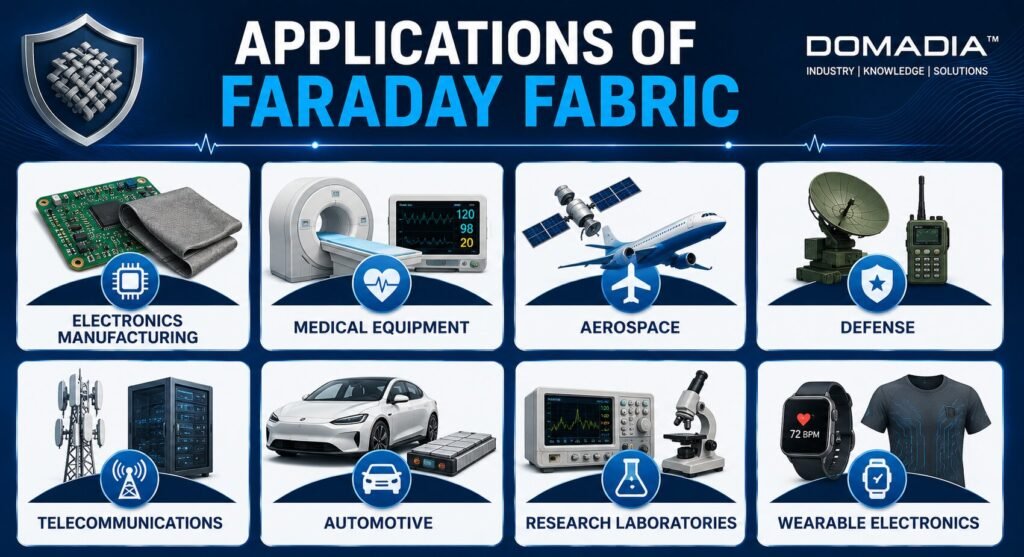
Electronics Manufacturing
Faraday Fabric Testing helps verify the shielding performance of conductive fabrics used to protect sensitive circuit boards, electronic assemblies, and precision manufacturing equipment from electromagnetic interference (EMI).
Medical Equipment
MRI facilities, diagnostic instruments, patient monitoring systems, and precision medical electronics rely on materials validated through Faraday Fabric Testing to ensure dependable EMI and RF shielding.
Aerospace
Aircraft avionics, satellites, navigation systems, and aerospace electronics use shielding materials whose effectiveness is confirmed through Faraday Fabric Testing for reliable operation in mission-critical environments.
Defense
Secure communication systems, radar equipment, military electronics, and tactical devices benefit from conductive fabrics whose shielding capabilities are proven through Faraday Fabric Testing.
Telecommunications
Communication cabinets, antennas, RF equipment, and network infrastructure utilize shielding materials that undergo Faraday Fabric Testing to maintain signal integrity and minimize electromagnetic interference.
Automotive
Electric vehicles (EVs), battery management systems, electronic control units (ECUs), and ADAS technologies depend on conductive fabrics validated by Faraday Fabric Testing for reliable electromagnetic protection.
Research Laboratories
Scientific laboratories, EMC testing facilities, and precision research environments use shielding materials verified through Faraday Fabric Testing to create controlled electromagnetic conditions for accurate measurements.
Wearable Electronics
Flexible sensors, smart garments, health-monitoring devices, and wearable electronics incorporate lightweight conductive fabrics that have passed Faraday Fabric Testing to deliver dependable EMI protection without sacrificing flexibility.
Shapes Available
DOMADIA™ supplies conductive shielding materials in multiple forms, including:
- Fabric Rolls
- Sheets
- Conductive Tapes
- Laminated Fabrics
- Adhesive-Backed Fabric
- Die-Cut Components
- Custom Covers
- Sewn Shielding Enclosures
Why DOMADIA™
Choosing the right shielding material is as important as verifying its performance.
DOMADIA™ provides:
- Premium-quality conductive fabrics
- Consistent shielding performance
- Custom fabrication support
- Technical material selection assistance
- Industrial-grade quality control
- Multiple shielding material options
- Reliable worldwide supply
- Expert support for EMI and RF shielding applications
Conclusion
Faraday Fabric Testing is essential for confirming that conductive shielding materials deliver the level of EMI and RF protection required for demanding applications. Laboratory methods such as ASTM D4935, IEEE 299, shielding effectiveness measurements, spectrum analysis, and real-world equipment validation provide far more reliable results than simple demonstrations alone. Regular Faraday Fabric Testing also helps manufacturers maintain consistent product quality and ensures shielding materials continue to meet industry performance standards.
By selecting high-quality conductive materials and verifying their performance through recognized testing methods, engineers can build dependable shielding solutions that improve equipment reliability, electromagnetic compatibility, and long-term operational performance. Faraday Fabric Testing ultimately helps ensure that every shielding solution performs exactly as intended. Investing in certified materials backed by comprehensive Faraday Fabric Testing gives engineers, designers, and manufacturers greater confidence in the long-term performance of their EMI and RF shielding solutions.
Test Your EMI Shielding with Confidence
DOMADIA™ supplies high-performance Faraday fabrics and conductive shielding materials engineered for reliable EMI and RF protection across industrial, medical, aerospace, defense, and research applications.
Talk to our experts today to find the right shielding solution for your application.
Talk to: Er.Pankaj Domadia | Kairav Domadia | Aadil Domadia | Pragati Sanap | Pooja N N
#FaradayFabricTesting #FaradayFabric #EMIShielding #RFShielding #ConductiveFabric #Electronics #IndustrialMaterials #EMC #DOMADIA
Directly whatsapp us for an Enquiry: https://wa.link/kairav
We’ve supplied to Mumbai, Pune, Indore, Jaipur, and Surat—serving industries across Maharashtra, Madhya Pradesh, Rajasthan, Gujarat, and Goa, with exports to Germany, USA, Japan, South Korea, and Italy.