Blogs
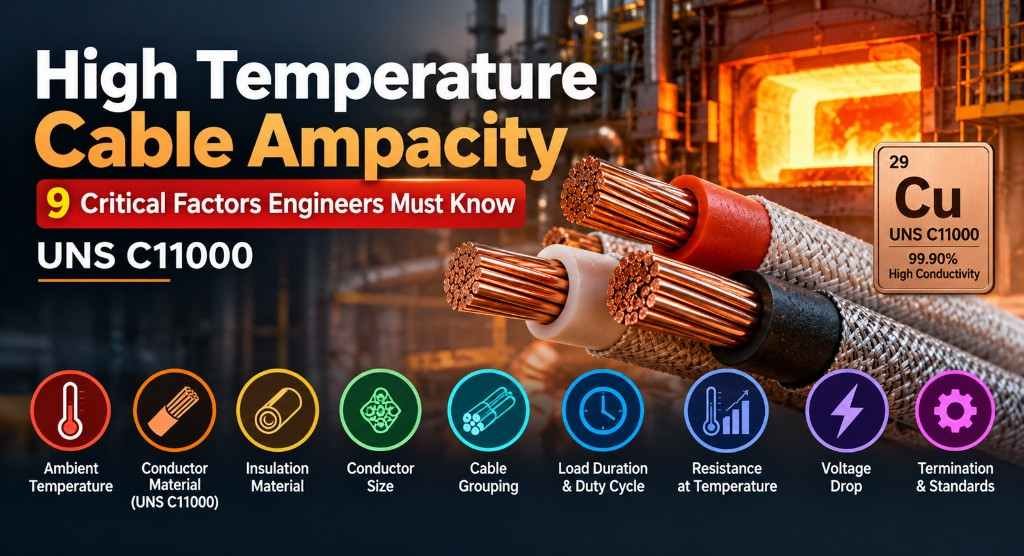
High Temperature Cable Ampacity: 9 Critical Factors Engineers Must Know – UNS C11000
High Temperature Cable Ampacity is a critical engineering factor when selecting electrical conductors for industrial furnaces, aerospace systems, power distribution, and demanding manufacturing environments. Understanding High Temperature Cable Ampacity helps engineers ensure electrical safety, thermal stability, and reliable long-term performance.
A cable rated for 200°C or 250°C does not automatically carry more current. As ambient temperatures increase, heat dissipation becomes less effective, reducing permissible current capacity. Incorrect High Temperature Cable Ampacity calculations can lead to conductor overheating, increased electrical resistance, and premature cable failure.
Consider an industrial furnace where a cable performs normally during initial operation but gradually overheats under continuous electrical load. The issue may not be cable quality but improper current-carrying capacity selection. Accurate High Temperature Cable Ampacity assessment must consider conductor material, insulation ratings, ambient temperature, installation conditions, and applicable electrical standards.
At DOMADIA™, we understand the importance of combining temperature-resistant insulation with properly specified electrical conductors. This technical guide explores nine essential factors affecting cable ampacity, with particular attention to UNS C11000 copper conductors, helping engineers achieve safer, more efficient, and reliable electrical installations.
What Is High Temperature Cable Ampacity?
High Temperature Cable Ampacity refers to the maximum continuous electrical current a cable can carry under specified installation and operating conditions without exceeding its allowable temperature limit.
Ampacity is generally expressed in amperes (A).
It is influenced by the balance between heat generated inside the conductor and heat dissipated into the surrounding environment.
Electrical current flowing through a conductor produces resistive heating.
The fundamental relationship is:
\[ P=I^2R \]
Where:
- \(P\) = electrical power converted into heat (W)
- \(I\) = electrical current (A)
- \(R\) = conductor resistance (Ω)
This relationship reveals an important engineering reality.
If current doubles, resistive heat generation increases approximately four times, assuming resistance remains constant.
Furthermore, copper resistance increases with temperature. Therefore, higher operating temperatures can create additional electrical losses.
A cable’s permissible current must consequently be established using its actual thermal and installation conditions rather than its insulation rating alone.
9 Critical Factors Affecting High Temperature Cable Ampacity

1. Conductor Material and Electrical Conductivity
The first factor is the electrical conductivity of the conductor itself.
Copper is widely used in electrical cables because of its high conductivity, ductility, and suitability for various industrial conductor constructions.
Among copper grades, UNS C11000, commonly known as Electrolytic Tough Pitch (ETP) copper, is an important material for electrical applications.
It typically provides conductivity of approximately 100% IACS in the annealed condition, subject to the applicable product specification.
The International Annealed Copper Standard (IACS) provides a reference for comparing electrical conductivity.
Higher conductivity generally means lower electrical resistance for a given conductor geometry and temperature.
Lower resistance reduces electrical heat generation.
This makes conductor material selection particularly important in applications involving continuous electrical loading.
However, even highly conductive copper cannot compensate for inadequate conductor cross-section, excessive ambient temperature, or poor heat dissipation.
Engineering takeaway: Select conductor material based on verified electrical properties, operating temperature, mechanical requirements, and the applicable conductor specification.
2. Ambient Operating Temperature
Ambient temperature is one of the most influential variables in cable ampacity calculations.
Consider two identical copper cables carrying the same current.
One operates in an electrical cabinet at 30°C.
The other operates near an industrial furnace at 90°C.
Although their conductor sizes and insulation materials are identical, their permissible current capacities may differ significantly.
The cable operating at the higher ambient temperature has less thermal headroom before reaching its maximum allowable conductor temperature.
Consequently, ampacity correction factors are often required.
For a simplified thermal illustration:
\[ I_2=I_1\sqrt{\frac{T_{\max}-T_{a2}}{T_{\max}-T_{a1}}} \]
Where:
- \(I_1\) = reference current
- \(I_2\) = estimated current at the new ambient temperature
- \(T_{\max}\) = maximum permissible conductor temperature
- \(T_{a1}\) = reference ambient temperature
- \(T_{a2}\) = new ambient temperature
This simplified relationship assumes comparable thermal resistance and approximately constant conductor resistance. It is not a substitute for standard ampacity calculations or manufacturer derating tables.
For example, consider a cable with a maximum conductor temperature of 200°C.
Actual values depend on conductor resistance at temperature, cable construction, installation, and applicable standards.
Engineering takeaway: Always verify the reference ambient temperature used in a cable’s published ampacity rating.
3. Insulation Material and Maximum Temperature Rating
High-temperature insulation is essential for maintaining electrical integrity in demanding thermal environments.
However, different insulation materials have different temperature limits, dielectric properties, flexibility, and chemical resistance.
Common options include:
| Insulation material | Typical temperature capability* |
| PVC | 70–105°C |
| XLPE | Often 90°C continuous |
| Silicone rubber | Often 180–200°C |
| ETFE | Often 150°C |
| FEP | Often 200°C |
| PTFE | Often 260°C |
| PFA | Often 260°C |
| Fiberglass-based systems | Construction-dependent; some exceed 260°C |
These are indicative values, not universal ratings. Actual limits depend on the compound, insulation system, approvals, and complete cable construction.
PTFE and PFA can be particularly useful in severe industrial environments because of their elevated-temperature capability and chemical resistance.
Silicone-insulated cables are often selected where flexibility is important.
Fiberglass and other specialised constructions may be considered for furnace wiring, heating equipment, and certain extremely high-temperature installations.
Nevertheless, insulation temperature resistance does not establish ampacity independently.
A 260°C-rated insulation system does not automatically allow a copper conductor to operate continuously at 260°C without additional engineering evaluation.
Engineering takeaway: Evaluate the complete cable system, including insulation, conductor, terminals, connectors, protective coverings, and installation conditions.
4. Conductor Cross-Sectional Area
Conductor size directly influences electrical resistance and heat generation.
For a uniform conductor, resistance can be estimated using:
\[ R=\rho\frac{L}{A} \]
Where:
- \(\rho\) = electrical resistivity
- \(L\) = conductor length
- \(A\) = conductor cross-sectional area
Increasing conductor area generally decreases electrical resistance.
For example, under comparable conditions, a 10 mm² copper conductor has approximately half the resistance of a 5 mm² conductor of the same length and material.
However, this does not mean its ampacity is automatically twice as high.
Heat dissipation depends on conductor geometry, insulation, surrounding materials, and installation method.
Larger conductors may also experience different thermal behaviour in enclosed or grouped installations.
When selecting conductor sizes, engineers should consider voltage drop, short-circuit withstand capability, continuous current, and thermal operating conditions.
Engineering takeaway: Use conductor cross-section as part of a complete thermal and electrical design rather than relying on current density alone.
5. Cable Grouping and Installation Method
One cable installed in open air behaves differently from ten cables tightly bundled together.
When multiple loaded cables are grouped, heat generated by neighbouring conductors can increase the local operating temperature.
This reduces the ability of each cable to dissipate heat.
Common installation arrangements include:
- Single cables installed in free air
- Multicore cables
- Cables installed inside conduits
- Cables installed in cable trays
- Tightly bundled wiring harnesses
- Cables installed inside enclosed machinery
A cable that operates safely at a particular current in open air may require significant derating when installed in a crowded conduit or tightly packed industrial enclosure.
Grouping correction factors depend on the number of loaded conductors, cable spacing, installation geometry, and applicable standard.
Engineering takeaway: Never transfer a published free-air ampacity rating directly to a bundled or enclosed installation without checking the appropriate correction factors.
6. Continuous Load Duration and Duty Cycle
Electrical loads may operate continuously or intermittently, directly affecting High Temperature Cable Ampacity. Short-duration loads generate heat for limited periods, while continuous operation can gradually increase conductor temperature toward its thermal limit.
Continuous-duty applications include industrial furnaces, heating systems, and power distribution, while intermittent-duty applications include actuators and switching equipment. Proper High Temperature Cable Ampacity calculations must consider load duration, peak current, cooling intervals, and thermal behaviour.
Engineering Takeaway: Accurate High Temperature Cable Ampacity selection requires evaluating operating cycles to prevent overheating and ensure long-term electrical safety.
7. Conductor Resistance at Elevated Temperature
Copper is an excellent electrical conductor, but its resistance increases as temperature rises.
For a practical approximation over a moderate temperature range:
\[ R_T=R_{20}[1+\alpha_{20}(T-20)] \]
Where:
- \(R_T\) = conductor resistance at temperature \(T\)
- \(R_{20}\) = conductor resistance at 20°C
- \(\alpha_{20}\) = temperature coefficient of resistance at 20°C
- \(T\) = conductor temperature in °C
For annealed copper, the temperature coefficient near 20°C is approximately 0.00393/°C.
This means a conductor operating at elevated temperature may experience substantially greater electrical resistance than at room temperature.
At 200°C, this simplified calculation indicates approximately 71% greater resistance than at 20°C.
For a fixed current, higher resistance produces greater resistive losses.
This reinforces the importance of thermal design when selecting high-temperature conductors.
Engineering takeaway: Use conductor resistance at the relevant operating temperature rather than relying exclusively on room-temperature electrical data.
8. Voltage Drop and Cable Length
Cable ampacity and voltage drop are related but distinct engineering requirements.
A cable may be thermally capable of carrying the required current while still producing excessive voltage drop over a long installation.
For a simple DC two-wire copper circuit, voltage drop can be estimated as:
\[ \Delta V=\frac{2\rho LI}{A} \]
Where \(L\) is the one-way cable length, and the factor of two accounts for the outgoing and return conductors.
For AC systems, impedance, reactance, power factor, phase configuration, and conductor operating temperature may also need consideration.
Excessive voltage drop can affect equipment performance, motor starting, heating systems, and sensitive electrical devices.
Increasing conductor cross-section can reduce voltage drop and conductor losses.
However, conductor sizing should also account for installation conditions and the applicable electrical code.
Engineering takeaway: Check both thermal ampacity and permissible voltage drop before finalising cable dimensions.
9. Termination Temperature, Standards, and Safety Margins
A high-temperature cable is only as reliable as its complete electrical connection system.
Terminals, connectors, cable glands, insulating sleeves, and protective accessories may have lower temperature limits than the cable insulation.
For example, a cable with a high-temperature insulation rating may be connected to a terminal designed for a much lower operating temperature.
In that case, the termination may become the limiting component.
Engineers must also evaluate:
- Terminal temperature ratings
- Contact resistance
- Connection pressure and mechanical stability
- Oxidation and corrosion
- Thermal cycling
- Short-circuit protection
- Equipment certification requirements
- Applicable electrical installation standards
Loose or deteriorating connections can generate localised heating even when the cable itself operates within its nominal current rating.
This is particularly important in high-temperature industrial equipment where repeated heating and cooling cycles may affect mechanical connections.
Engineering takeaway: Verify the lowest applicable temperature limit in the complete circuit, including the conductor, insulation, accessories, and equipment terminals.
UNS C11000 Copper: Chemical Composition and Technical Properties
UNS C11000 is an electrolytic tough pitch copper grade recognised for its excellent electrical and thermal conductivity.
It is widely used in electrical conductors, busbars, terminals, transformer components, and other conductive products.
According to Copper Development Association data, C11000 contains at least 99.90% copper, including silver where applicable.
C11000 Alloy+1
Chemical Composition of UNS C11000
| Element | Composition |
| Copper (Cu), including Ag | Minimum 99.90% |
| Oxygen (O) | Maximum 0.040% |
| Other trace elements | Controlled according to the applicable specification |
The presence of oxygen is an important characteristic of ETP copper.
Although C11000 provides excellent electrical performance, its oxygen content makes it less suitable for certain high-temperature processing operations in reducing or hydrogen-containing atmospheres.
Where hydrogen embrittlement during heating or joining is a concern, oxygen-free copper grades such as UNS C10100 or C10200 may be more appropriate.
Technical Specifications of UNS C11000
| Property | Typical value |
| UNS designation | C11000 |
| Material name | Electrolytic Tough Pitch Copper |
| European designation | Cu-ETP / CW004A |
| Copper content | ≥99.90% |
| Electrical conductivity | Approximately 100% IACS, annealed |
| Electrical conductivity at 20°C | Approximately 58 MS/m |
| Electrical resistivity at 20°C | Approximately 0.01724 Ω·mm²/m |
| Thermal conductivity | Approximately 390–400 W/m·K |
| Density | Approximately 8.9 g/cm³ |
| Melting temperature | Approximately 1083°C |
| Modulus of elasticity | Approximately 110–130 GPa, depending on product and condition |
These are representative material properties, not guaranteed values for every finished cable. Actual values depend on temper, processing, and the governing material standard.
KEMPER+2
A particularly important distinction is that the melting temperature of copper is not its permissible continuous operating temperature in an electrical cable.
Conductor annealing, oxidation, connection integrity, insulation ageing, and mechanical strength can limit practical operating temperatures long before melting occurs.
High Temperature Cable Ampacity: Standards Engineers Should Know
Cable selection should be supported by applicable national and international electrical standards.
Different standards address different aspects of cable design, conductor construction, current ratings, and electrical installation safety.
| Standard | Relevance |
| IEC 60287 | Calculation of cable current ratings and electrical losses |
| IEC 60364-5-52 | Wiring systems, current-carrying capacity and installation considerations |
| IEC 60228 | Conductors of insulated cables |
| IEC 60853 | Cyclic and emergency current rating calculations |
| ASTM B3 | Soft or annealed copper wire |
| ASTM B8 | Concentric-lay-stranded copper conductors |
| ASTM B170 | Oxygen-free electrolytic copper for electrical applications |
| NFPA 70 / NEC | Electrical installation requirements, including ampacity rules in applicable US installations |
The IEC 60287-1-1:2023 standard provides methods for calculating steady-state cable current ratings and losses, taking conductor and installation conditions into account.
IEC
Engineers should verify the correct edition and applicability of each standard before using it.
ASTM B170 is listed for comparison with oxygen-free copper; it should not be treated as a specification for UNS C11000 ETP copper.
For Indian projects, the applicable IS standards, adopted IEC provisions, statutory requirements, and equipment specifications should also be reviewed.
Applications of High-Temperature Copper Cables

1. Industrial Furnaces and Heating Systems
Specialised high-temperature cables connect heating elements, sensors, and control systems in demanding industrial environments. High Temperature Cable Ampacity must account for radiant heat, continuous operation, and enclosure temperatures to ensure safe and reliable performance.
2. Electrical Power Distribution
Copper conductors and busbars ensure efficient electrical current transmission in industrial systems. Proper High Temperature Cable Ampacity selection helps minimise conductor heating, voltage drop, and electrical losses while maintaining safe and reliable performance.
3. Motors and Transformers
Copper winding conductors offer excellent electrical conductivity for efficient power transmission. Proper High Temperature Cable Ampacity assessment must consider winding insulation classes, cooling arrangements, and operating duty to ensure thermal stability and reliable performance.
4. Automotive and Electric Vehicles
Copper winding conductors offer excellent electrical conductivity for efficient power transmission in automotive and electric vehicle systems. Proper High Temperature Cable Ampacity assessment must consider insulation classes, cooling arrangements, and operating duty. Accurate High Temperature Cable Ampacity selection helps prevent overheating, improve electrical efficiency, and ensure long-term reliability.
5. Aerospace and Defence Equipment
Specialised wiring systems require reliable electrical performance under extreme heat, vibration, weight, and environmental conditions. Proper High Temperature Cable Ampacity selection ensures thermal stability, while accurate High Temperature Cable Ampacity calculations help prevent overheating and maintain long-term operational safety.
6. Chemical and Process Industries
Industrial cables often face elevated temperatures, chemicals, moisture, and corrosive environments. Proper High Temperature Cable Ampacity selection must consider both electrical capacity and material compatibility to prevent overheating, ensure durability, and maintain reliable performance.
Available Conductor Shapes and Cable Configurations
UNS C11000 copper is available in several conductor and semi-finished product forms, depending on manufacturing processes and procurement requirements.
Common forms include:
- Solid round wire: Used for electrical conductors and certain fixed wiring applications.
- Stranded copper conductors: Multiple wires combined to provide improved flexibility.
- Fine-stranded flexible conductors: Suitable for applications requiring repeated movement or tight routing, subject to fatigue design.
- Flat copper strips: Used in electrical connections, busbars, and conductive assemblies.
- Copper rods: Used as raw material for wire drawing and other electrical products.
- Copper busbars: Used for distributing high electrical currents in equipment and power systems.
- Special conductor constructions: Custom geometries or stranded configurations manufactured to application requirements.
Not every form is suitable for every cable design, and availability of a particular UNS grade, strand class, or insulation system must be confirmed with the supplier.
How to Calculate High Temperature Cable Ampacity
Calculating cable ampacity is essential for selecting a conductor that can safely carry electrical current under actual operating conditions.
A cable rated for 100 amperes under standard conditions may carry significantly less current when exposed to high ambient temperatures, cable grouping, or restricted ventilation.
Engineers can estimate the adjusted current-carrying capacity using the following method.
Step 1: Identify the Reference Ampacity
Start with the manufacturer’s published current rating for the specific conductor size, insulation material, cable construction, and installation method. Accurate High Temperature Cable Ampacity calculations require these reference values to ensure safe conductor selection.
For example, consider a UNS C11000 copper conductor with an illustrative reference ampacity of 100 A. Proper High Temperature Cable Ampacity assessment must account for actual operating conditions, while verified High Temperature Cable Ampacity calculations help prevent overheating and ensure reliable electrical performance.
Step 2: Apply the Correction Factors
Cable ampacity may need to be adjusted for ambient temperature, cable grouping, and installation conditions.
The simplified formula is:
\[ I_{\text{adjusted}}=I_{\text{rated}}\times K_a\times K_g\times K_i \]
Where:
- \(I_{\text{rated}}\) = Reference cable ampacity (A)
- \(K_a\) = Ambient temperature correction factor
- \(K_g\) = Cable grouping correction factor
- \(K_i\) = Additional installation correction factor
Step 3: Calculate the Adjusted Ampacity
Consider the following illustrative values:
| Parameter | Value |
| Reference cable ampacity | 100 A |
| Ambient temperature factor | 0.85 |
| Cable grouping factor | 0.80 |
| Installation factor | 0.95 |
Step 4: Verify the Final Cable Selection
After calculating the adjusted High Temperature Cable Ampacity, engineers must verify that the cable can safely carry the expected electrical load. Proper High Temperature Cable Ampacity assessment should also consider conductor temperature, voltage drop, terminal ratings, short-circuit protection, and installation requirements.
Important: The adjusted High Temperature Cable Ampacity must be at least equal to the design current, while meeting applicable electrical codes and protective-device coordination requirements.
Key Engineering Takeaway
A cable rated at 100 A may have an adjusted capacity of only 64.6 A under specific installation conditions. This highlights why High Temperature Cable Ampacity must be calculated using actual operating temperatures and installation factors.
Accurate High Temperature Cable Ampacity calculations help prevent overheating, electrical losses, and premature cable failure. For demanding industrial applications, engineers should evaluate High Temperature Cable Ampacity using relevant IEC standards, manufacturer specifications, and verified thermal calculations to ensure safe and reliable conductor selection.
Common Engineering Mistakes to Avoid
Even experienced engineers can make cable-selection mistakes when critical operating conditions are overlooked. A common error is assuming that higher insulation temperature ratings automatically increase High Temperature Cable Ampacity, without considering actual conductor temperatures and installation conditions.
Other mistakes include ignoring cable grouping, relying on room-temperature resistance values, overlooking terminal temperature limits, and underestimating voltage drop. Incorrect correction factors and long-term thermal ageing can also affect High Temperature Cable Ampacity and overall electrical reliability.
To avoid these problems, engineers should evaluate the complete electrical and thermal system before installation. Accurate High Temperature Cable Ampacity calculations help ensure proper conductor sizing, prevent overheating, and improve long-term operational safety.
Why DOMADIA™ for High-Temperature Cable and Copper Conductor Requirements?
Selecting specialised electrical materials requires a clear understanding of the operating environment and the technical requirements of the application.
At DOMADIA™, our approach emphasises material suitability, specification clarity, and application-oriented selection.
1. Understanding of Specialised Materials
DOMADIA™ supports specialised industrial material requirements where electrical conductivity, temperature resistance, dimensional accuracy, and material compatibility are essential. Understanding High Temperature Cable Ampacity helps ensure proper conductor selection, while accurate High Temperature Cable Ampacity assessment supports electrical efficiency, thermal stability, and long-term reliability.
2. Application-Focused Material Selection
Different industrial installations require specific conductor materials, insulation systems, and cable configurations. Proper High Temperature Cable Ampacity selection must consider operating temperatures, electrical loads, and environmental conditions. For example, industrial furnace cables require different thermal performance characteristics than automotive wiring, making accurate High Temperature Cable Ampacity assessment essential for safety and reliability.
3. Technical Specification Support
Engineers and procurement teams can share their conductor grade, dimensions, operating temperature range, and applicable standards with DOMADIA™ to explore suitable material options. Proper High Temperature Cable Ampacity assessment helps ensure safe conductor selection, electrical efficiency, and reliable performance in demanding industrial applications.
4. Industrial Procurement Perspective
Beyond initial material cost, engineers should consider electrical losses, service life, maintenance requirements, replacement intervals, and downtime exposure.
5. Long-Term Performance Considerations
Selecting a properly specified cable can help reduce premature replacements and avoidable material waste.
Where longer service life is achieved through appropriate design, fewer replacements may also reduce resource consumption and the environmental impact associated with manufacturing and disposal.
Actual environmental benefits depend on service life, manufacturing processes, energy losses, and end-of-life recovery.
Conclusion
High Temperature Cable Ampacity is not determined by conductor size or insulation temperature rating alone.
It is the result of several interacting electrical and thermal factors.
Engineers must consider conductor material, ambient temperature, insulation system, cross-sectional area, cable grouping, duty cycle, conductor resistance, voltage drop, and termination limitations.
UNS C11000 copper remains an important electrical material because of its high conductivity and suitability for numerous conductor applications.
However, even high-conductivity copper must be used within the operating limits of the complete cable system.
The most reliable engineering decisions come from combining accurate material data, appropriate electrical standards, verified manufacturer ratings, and realistic installation conditions.
For specialised copper conductor and high-temperature cable requirements, DOMADIA™ can be contacted with the relevant material specifications, operating temperatures, conductor dimensions, and application details to discuss suitable options.
Choose the right conductor. Verify the actual ampacity. Engineer for long-term reliability.
Choose the Right High-Temperature Cable with DOMADIA™
Ensure electrical safety, reliable performance, and efficient current-carrying capacity with DOMADIA™. Explore high-temperature cable solutions and UNS C11000 copper conductors suited to demanding industrial applications.
Contact DOMADIA™ today to discuss your technical requirements and find the right material for your application.
Talk to: Er.Pankaj Domadia | Kairav Domadia | Aadil Domadia | Pragati Sanap | Pooja N N
#HighTemperatureCables #CableAmpacity #UNSC11000 #CopperConductors #ElectricalEngineering #CableDerating #IndustrialCables #ElectricalSafety #DOMADIA
Directly whatsapp us for an Enquiry: https://wa.link/kairav
Our materials have reached Nagpur, Aurangabad, Nashik, Kolhapur, and Solapur—strengthening Maharashtra, Goa, Karnataka, MP, and Gujarat industries, with exports to South Africa, Kenya, Egypt, Morocco, and Nigeria.