Blogs
High Temperature Cable Vibration: 9 Powerful Insights for UNS C11000
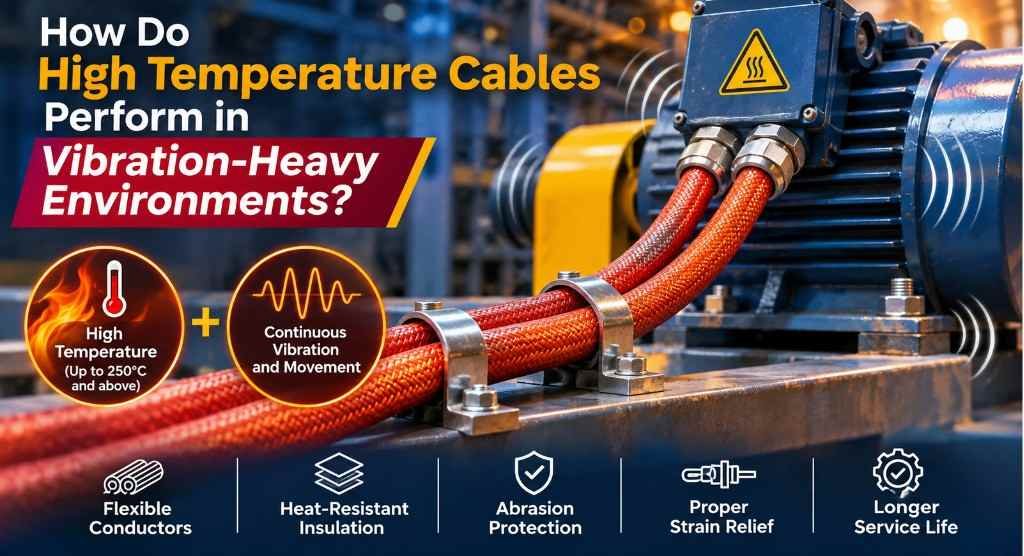
High Temperature Cable Vibration is a major challenge in industrial environments where cables must withstand extreme heat, continuous movement, and mechanical stress while maintaining reliable electrical performance.
Even cables rated for 200°C or 250°C can experience premature failure when repeated vibration damages conductor strands, insulation, or electrical connections. Understanding High Temperature Cable Vibration is essential for preventing unexpected downtime and costly maintenance.
For example, a cable installed near a vibrating industrial motor may initially perform well but eventually develop broken conductor strands due to mechanical fatigue rather than excessive temperature.
Heat resistance does not automatically guarantee vibration resistance.
In this DOMADIA™ guide, we explore nine powerful insights into High Temperature Cable Vibration, covering UNS C11000 copper conductors, insulation materials, fatigue resistance, international standards, industrial applications, and practical ways to improve cable durability.
1. Understanding High Temperature Cables in Vibration-Heavy Environments
High-temperature cables are electrical cables designed to maintain specified electrical and mechanical performance at temperatures beyond those suitable for conventional cable constructions.
Depending on the materials and design, they may be used in environments operating at approximately 150°C, 200°C, 250°C, or substantially higher temperatures.
However, temperature resistance is only one part of the engineering challenge.
In vibration-heavy environments, cables must also tolerate repeated mechanical loading.
Common sources of vibration include:
- Industrial motors and generators
- Automotive engines and exhaust systems
- Aerospace propulsion equipment
- Railway traction systems
- Heavy manufacturing machinery
- Compressors and industrial pumps
- Turbines and power-generation equipment
- Robotics and automated manufacturing systems
These applications may expose cables to continuous oscillation, acceleration, resonance, and repeated bending.
Over time, mechanical stress can damage conductors, insulation, shielding, or terminations.
The key distinction is between a cable designed for a stationary hot environment and one engineered for simultaneous thermal and mechanical loading.
What makes vibration particularly dangerous?
Vibration can cause microscopic movements within the cable assembly.
Repeated movement may lead to:
- Conductor strand fatigue
- Insulation abrasion
- Shielding wire breakage
- Connector loosening
- Stress concentration near terminations
- Intermittent electrical continuity
- Premature cable replacement
Consequently, manufacturers must evaluate the complete cable construction rather than relying exclusively on the insulation temperature rating.
2. How Vibration Affects High Temperature Cable Performance

The effect of vibration depends on its frequency, amplitude, acceleration, direction, duration, and interaction with the cable installation.
A cable that performs well under occasional movement may not survive continuous high-frequency vibration.
A. Conductor Fatigue
High Temperature Cable Vibration creates repeated mechanical stress that can cause microscopic cracks and conductor strand breakage. Fine-stranded conductors can improve flexibility and fatigue performance when properly designed.
B. Insulation Cracking
Continuous heat exposure can reduce insulation flexibility. When combined with High Temperature Cable Vibration, this may cause cracking, particularly around sharp bends and unsupported cable sections.
C. Abrasion and Wear
High Temperature Cable Vibration can cause repeated rubbing against metal brackets, machine frames, or nearby components. Over time, friction may damage even heat-resistant insulation.
D. Connector and Termination Failures
High Temperature Cable Vibration often concentrates mechanical stress near connectors and terminations. Proper strain relief, secure connections, and cable support help prevent premature failures.
3. Chemical Composition of High Temperature Cable Materials
High-temperature cable performance depends on the combination of conductor metals, insulation polymers, reinforcement materials, and protective layers.
Each component contributes differently to thermal and mechanical reliability.
A. Conductor materials
| Material | Chemical composition | Important characteristics |
| Copper, UNS C11000 | Minimum 99.90% Cu | High electrical conductivity and useful ductility |
| Silver-plated copper | Copper conductor with silver surface coating | High conductivity and improved surface performance at elevated temperatures |
| Nickel-plated copper | Copper conductor with nickel surface coating | Improved resistance to conductor surface oxidation |
| Nickel conductor | Predominantly Ni | Suitable for certain high-temperature electrical applications |
| Nickel-chromium alloy | Primarily Ni and Cr, composition varies by grade | High electrical resistance and oxidation resistance for heating elements |
UNS C11000 copper is widely used as a conductor material because of its excellent electrical conductivity.
Its conductivity is approximately 100% IACS in the annealed condition, depending on the applicable material specification and condition.
However, copper’s electrical conductivity does not make it automatically suitable for every vibration-heavy application.
Conductor flexibility, stranding, plating, temperature, and mechanical support must also be considered.
B. Insulation materials
| Insulation | Typical chemical structure | Common thermal characteristics |
| PTFE | (C₂F₄)n | Often rated up to approximately 260°C |
| FEP | Fluorinated ethylene propylene copolymer | Commonly up to approximately 200°C |
| PFA | Perfluoroalkoxy fluoropolymer | Often rated up to approximately 260°C |
| ETFE | Ethylene-tetrafluoroethylene copolymer | Commonly 150–200°C, depending on formulation |
| Silicone rubber | Polysiloxane elastomer | Often 180–200°C, with specialized grades higher |
| Fiberglass insulation | Primarily silica-based glass fibers | Can be used in elevated-temperature cable constructions |
| Ceramic fiber | Inorganic ceramic fiber composition varies | Used in specialized extreme-temperature insulation systems |
These are representative material capabilities, not universal finished-cable ratings. Actual operating limits depend on the complete construction, approvals, and service conditions.
Which insulation is better for vibration?
There is no universally superior insulation.
Silicone rubber can provide valuable flexibility in suitable constructions.
PTFE offers excellent thermal and chemical resistance but may require careful design where repeated flexing and abrasion are involved.
ETFE provides useful mechanical toughness and abrasion resistance.
Fiberglass and ceramic insulation can withstand severe temperatures but may need additional mechanical protection where vibration is substantial.
The best choice depends on the combined temperature, movement, abrasion, electrical, and environmental requirements.
4. Nine Powerful Factors That Determine Cable Reliability Under Vibration

1. Conductor Flexibility
Fine-stranded conductors are often preferable to solid conductors where repeated bending occurs. In High Temperature Cable Vibration applications, the correct strand diameter, lay length, and conductor construction help reduce localized mechanical stress.
2. Insulation Flexibility
Insulation must maintain sufficient mechanical integrity at operating temperature. High Temperature Cable Vibration can accelerate insulation damage when materials lose flexibility during prolonged thermal exposure.
3. Protective Braiding
Fiberglass, metal braiding, or other protective coverings can improve resistance to abrasion and mechanical damage. Their suitability depends on flexibility, installation conditions, and electrical requirements.
4. Strain Relief
Properly designed strain relief prevents High Temperature Cable Vibration from concentrating mechanical stress directly at electrical terminations and connector interfaces, reducing the risk of premature failure.
5. Vibration Frequency and Amplitude
Low-frequency movement with large displacement may create significant bending, while high-frequency vibration produces numerous fatigue cycles. Both conditions require careful evaluation to ensure reliable High Temperature Cable Vibration performance.
6. Operating Temperature
Higher temperatures can affect conductor strength, insulation flexibility, and protective material durability. Effective High Temperature Cable Vibration management requires evaluating simultaneous thermal and mechanical stress.
7. Bend Radius
Excessively tight bends increase mechanical strain and accelerate fatigue. Manufacturers should specify minimum static and, where applicable, dynamic bend radii to support long-term cable reliability.
8. Installation and Support
Unsupported cable lengths can amplify movement and cause abrasion against surrounding components. Proper clamps, supports, and routing help minimize High Temperature Cable Vibration damage and improve operational reliability.
9. Maintenance and Inspection
Regular inspections help identify conductor fatigue, damaged insulation, loose connectors, and worn protective coverings. Preventive maintenance is essential for managing High Temperature Cable Vibration and avoiding unexpected electrical failures.
5. Technical Specifications of High Temperature Cables
When evaluating High Temperature Cables in Vibration-Heavy Environments, procurement teams should request technical specifications that describe both thermal performance and mechanical endurance.
The following table provides representative engineering considerations.
| Parameter | Typical consideration |
| Conductor | Copper, plated copper, nickel, or specialized alloy |
| Conductor construction | Solid, stranded, or fine-stranded |
| Temperature rating | Often 150–260°C for polymer-insulated designs; higher for specialized constructions |
| Voltage rating | Application-specific, such as 300 V, 600 V, or higher |
| Insulation | PTFE, FEP, PFA, ETFE, silicone, fiberglass, or ceramic |
| Shielding | Copper braid, tinned copper braid, nickel-plated braid, or other specified construction |
| Mechanical protection | Braiding, sleeving, conduit, or protective jacket |
| Vibration endurance | Must be demonstrated under defined test conditions |
| Bend radius | Manufacturer- and application-specific |
| Electrical resistance | Based on conductor material, size, and temperature |
| Service life | Depends on the actual operating environment and qualification results |
These specifications are not interchangeable across all cable types.
For example, a cable rated for 260°C does not necessarily maintain its full mechanical flexibility throughout that temperature range.
Similarly, a cable with excellent electrical conductivity may still require mechanical reinforcement.
How should vibration performance be specified?
A useful vibration test specification should define:
- Frequency range in hertz (Hz)
- Acceleration in g or displacement amplitude
- Test duration
- Cable orientation and mounting arrangement
- Operating temperature during testing
- Electrical loading or continuity monitoring
- Acceptance criteria after testing
Without these details, a claim such as vibration-resistant cable provides limited engineering value.
6. International Standards for High Temperature and Vibration-Resistant Cables
International standards help manufacturers and engineers evaluate cable performance using recognized methods.
However, no single standard automatically qualifies every high-temperature cable for all vibration-heavy environments.
| Standard | Relevant application |
| IEC 60228 | Conductors of insulated cables |
| IEC 60811 series | Test methods for non-metallic cable materials |
| IEC 60068-2-6 | Sinusoidal vibration testing |
| IEC 60068-2-64 | Broadband random vibration testing |
| IEC 60068-2-14 | Change-of-temperature testing |
| IEC 60332 series | Fire performance tests for specified cable constructions |
| UL 758 | Appliance wiring materials |
| SAE AS22759 | Selected aerospace electrical wire constructions |
| MIL-STD-810 | Environmental engineering considerations and laboratory tests for equipment, including vibration |
It is important to distinguish between conductor specifications, material test methods, finished-wire standards, and equipment-level environmental tests.
For example, IEC 60068-2-6 provides a vibration test method, but it does not independently establish a universal service-life rating for every cable.
Similarly, UL 758 addresses appliance wiring materials and should not be interpreted as a general vibration qualification.
Engineers should confirm the applicable standard, edition, test conditions, and certification scope before specifying a cable.
7. Industrial Applications of High Temperature Cables in Vibration-Heavy Environments

1. Automotive and Electric Vehicles
High Temperature Cable Vibration is a major consideration in wiring near engines, motors, inverters, sensors, and power electronics. These environments involve heat, vibration, fluid exposure, and restricted routing. Proper conductor selection and secure installation are essential.
2. Aerospace and Aviation
Aircraft electrical systems experience vibration, thermal cycling, altitude-related conditions, and strict weight limitations. Managing High Temperature Cable Vibration requires qualified aerospace wire constructions and reliable installation practices.
3. Industrial Motors and Compressors
Motors, compressors, and pumps transmit continuous vibration into connected cable assemblies. Effective High Temperature Cable Vibration protection involves flexible conductors, proper strain relief, and securely supported cable runs to minimize mechanical fatigue.
4. Railway and Transportation
Traction systems and onboard electrical equipment experience vibration, shock, and temperature variations. High Temperature Cable Vibration resistance is important for reliable electrical performance, alongside compliance with applicable railway fire-safety requirements.
5. Industrial Furnaces and Heating Equipment
Furnace wiring may require fiberglass, ceramic, nickel, or other specialized cable constructions. In vibrating equipment, High Temperature Cable Vibration protection becomes essential to prevent mechanical damage and maintain reliable electrical connections.
Other important applications include power-generation equipment, marine machinery, industrial robotics, heavy-duty manufacturing, and specialized testing equipment.
8. Available Shapes and Forms of High Temperature Cables
DOMADIA™ can discuss sourcing requirements for specialized high-temperature cable constructions according to customer specifications and availability.
Common forms include:
| Cable form | Typical application |
| Single-core wire | Internal equipment wiring |
| Multi-core cable | Industrial control and power connections |
| Fine-stranded flexible cable | Applications involving repeated movement |
| Braided protective cable | Abrasion-prone installations |
| Shielded cable | Signal transmission requiring electromagnetic interference control |
| Fiberglass-insulated wire | Elevated-temperature equipment |
| Ceramic-insulated construction | Specialized extreme-temperature installations |
| Custom cable assemblies | Application-specific connectors, lengths, and protection |
For vibration-heavy environments, the selection of cable form is as important as the insulation chemistry.
A flexible multi-stranded cable with suitable protection and strain relief may provide better reliability than a mechanically rigid construction in an installation involving repeated movement.
However, dynamic performance should be verified rather than assumed.
9. How to Improve the Lifespan of High Temperature Cables
Cable replacement can involve much more than the purchase price of the cable itself.
Industrial downtime, maintenance labor, equipment access, troubleshooting, and production interruptions may significantly increase the overall cost of failure.
Therefore, selecting a cable solely on its initial price can be misleading.
A Practical High Temperature Cable Vibration Reliability Checklist: 8 Essential Steps
Selecting reliable cables for vibration-heavy environments requires careful consideration of thermal resistance and mechanical durability. Proper High Temperature Cable Vibration management can improve equipment reliability and reduce unexpected failures.
1. Check Operating Temperature: Identify maximum continuous and peak temperatures. High Temperature Cable Vibration performance depends on maintaining conductor and insulation integrity under heat.
2. Evaluate Vibration Conditions: Understand vibration frequency, intensity, and duration to minimize mechanical fatigue and premature cable damage.
3. Choose Flexible Conductors: Select suitable stranded copper or specialized conductors designed to withstand High Temperature Cable Vibration and repeated mechanical movement.
4.Select Heat-Resistant Insulation: Consider PTFE, silicone, ETFE, or other suitable materials based on operating temperature, flexibility, and durability requirements.
5.Maintain Proper Bend Radius: Avoid sharp bends that increase mechanical stress. Proper routing improves High Temperature Cable Vibration resistance and conductor longevity.
6. Provide Mechanical Protection: Use protective sleeving, cable clamps, and strain relief to reduce abrasion, unwanted movement, and vibration-related damage.
7.Verify Testing Standards: Review applicable IEC, UL, SAE, or other relevant standards. Confirm that High Temperature Cable Vibration performance has been evaluated under appropriate testing conditions.
8. Schedule Regular Inspections: Check for insulation cracks, loose connections, abrasion, and conductor damage to prevent unexpected electrical failures.
Key Takeaway: Effective High Temperature Cable Vibration management combines proper material selection, secure installation, mechanical protection, and preventive maintenance to improve reliability and minimize costly downtime.
At DOMADIA™, we help industries explore specialized high-temperature cable materials and constructions suitable for demanding operating conditions, supporting long-term performance and industrial reliability.
Why proper cable selection reduces long-term costs
Consider two hypothetical cable assemblies installed in a vibration-heavy industrial machine.
| Cost factor | Basic cable assembly | Application-qualified cable assembly |
| Initial purchase cost | Lower | Potentially higher |
| Thermal suitability | May meet temperature requirements | Selected for combined thermal demands |
| Vibration performance | Not necessarily validated | Tested against specified vibration conditions |
| Installation protection | May be limited | Appropriate strain relief and support |
| Replacement risk | Potentially higher | Potentially lower |
| Downtime exposure | Depends on failure frequency | Can be reduced through suitable design |
The actual economic benefit must be established using service-life data, test results, maintenance costs, and equipment operating conditions.
A more expensive cable is not automatically better. But a correctly engineered cable assembly can offer greater value when it prevents repeated failures.
Environmental benefits of longer cable service life
Premature cable replacement also has environmental implications. Poor High Temperature Cable Vibration resistance can lead to frequent replacements, increasing the demand for conductor metals, insulation materials, transportation, maintenance resources, and waste processing.
Improving High Temperature Cable Vibration performance can extend cable service life, potentially reducing material consumption, replacement-related waste, and environmental impact. However, the overall benefits depend on manufacturing, transportation, recyclability, and disposal.
At DOMADIA™, we support technically appropriate material selection to help industries achieve reliable, durable, and resource-efficient operations.
10. Common Mistakes When Selecting Vibration-Resistant High Temperature Cables
Even experienced engineering teams can overlook important cable-selection details.
One frequent mistake is choosing a cable based only on its maximum temperature rating.
Another is assuming that flexible insulation automatically means the conductor will withstand repeated bending.
Other problems include using inadequate strain relief, routing cables over sharp edges, allowing excessive unsupported movement, and failing to test the cable assembly under realistic conditions.
An especially costly mistake is treating a laboratory temperature rating as proof of real-world durability.
A successful cable design must withstand the complete operating environment, not just one isolated test condition.
11. Why DOMADIA™ for Specialized High Temperature Cable Requirements?
Selecting high-performance industrial cables requires an understanding of material characteristics, application conditions, and relevant technical specifications.
DOMADIA™ supports industrial customers seeking specialized materials and cable solutions for demanding operating environments.
Key considerations in discussions with DOMADIA™ include:
- Material selection: Evaluating conductor materials and insulation systems appropriate to the intended application.
- Technical requirements: Reviewing operating temperatures, voltage, conductor size, flexibility, and mechanical conditions.
- Specialized applications: Discussing requirements for industrial machinery, aerospace, automotive, power-generation, and other technical environments.
- Available constructions: Exploring suitable cable forms, protective coverings, and specification-based sourcing options.
- Long-term reliability: Helping customers focus on application suitability rather than temperature ratings alone.
For projects involving vibration, thermal cycling, and demanding electrical conditions, providing complete operating specifications helps identify appropriate material options.
Conclusion: Can High Temperature Cables Survive Continuous Vibration?
High Temperature Cable Vibration performance depends on selecting the right conductor construction, insulation, protective layers, and installation methods to withstand demanding thermal and mechanical conditions.
However, high-temperature resistance alone is not sufficient. Continuous vibration can cause conductor fatigue, insulation abrasion, connector damage, and premature electrical failure.
For engineers and manufacturers, evaluating High Temperature Cable Vibration alongside temperature resistance is essential for long-term reliability. Proper conductor stranding, insulation materials, bend radius, protective coverings, strain relief, and qualification testing can significantly improve cable durability.
The real objective is not simply to select a cable that survives heat, but to ensure reliable High Temperature Cable Vibration performance throughout its intended operating life.
At DOMADIA™, we help industries explore durable high-temperature cable solutions designed for demanding industrial applications.
Protect Your Connections with DOMADIA™ High Temperature Cable Solutions!
For specialized high-temperature cable requirements, DOMADIA™ can assist customers in discussing appropriate materials, available constructions, and application-specific technical specifications.
Contact DOMADIA™to discuss your high-temperature cable requirements and explore suitable solutions for demanding industrial environments.
Talk to: Er.Pankaj Domadia | Kairav Domadia | Aadil Domadia | Pragati Sanap | Pooja N N
#HighTemperatureCables #VibrationResistantCables #IndustrialCables #CableEngineering #ThermalResistance #ElectricalEngineering #UNSC11000 #IndustrialReliability #CableSafety #DOMADIA
Directly whatsapp us for an Enquiry: https://wa.link/kairav
We’ve delivered to Bengaluru, Mysuru, Mangaluru, Hubballi, and Belagavi—covering Karnataka, Telangana, Tamil Nadu, Kerala, and Andhra Pradesh, with exports to Australia, New Zealand, Singapore, Malaysia, and Indonesia.