
Blogs
MuMetal Annealing Process Guide | UNS N14080 | DOMADIA™
MuMetal Annealing Process: Why Permeability Depends on It
A precision electronics lab once faced repeated EMI failures—even after installing MuMetal shields. The alloy composition was correct. The design was sound. Yet performance remained inconsistent.
The root cause wasn’t design.
It was improper annealing.
The MuMetal Annealing Process is not an optional step—it is the defining factor that determines whether UNS N14080 delivers world-class magnetic permeability or behaves like an ordinary nickel alloy.
At DOMADIA™, we treat annealing as a performance science, not a routine heat cycle.
What Happens to MuMetal Before Annealing?
MuMetal (UNS N14080) is extremely sensitive to:
- Cold working
- Bending and forming
- Cutting, stamping, and welding
These processes introduce mechanical stress and lattice distortion, locking magnetic domains in random orientations. The result?
❌ Drastically reduced permeability
❌ Poor shielding effectiveness
❌ Unpredictable EMI leakage
The MuMetal Annealing Process exists to reverse this damage completely.
What Is the MuMetal Annealing Process?
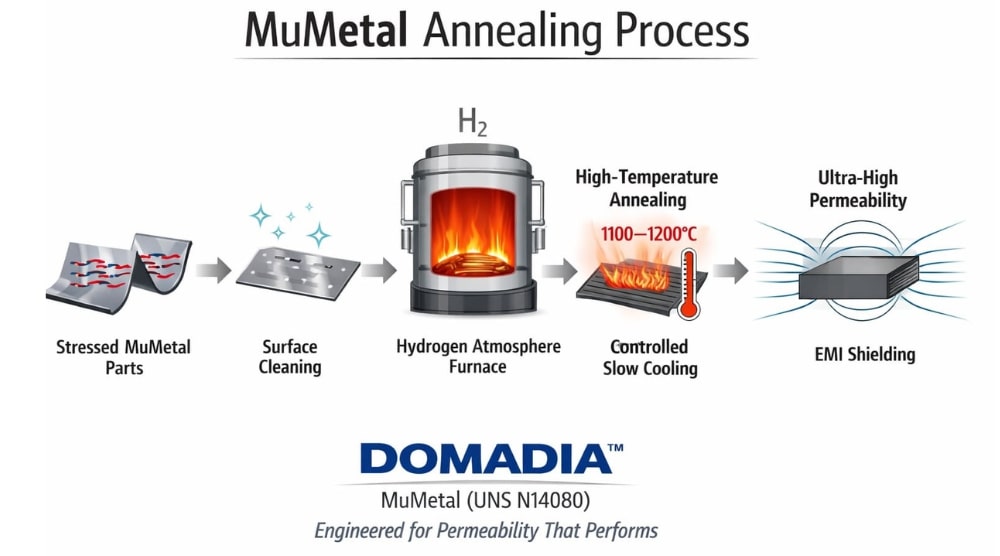
Annealing is a controlled heat treatment performed in a hydrogen atmosphere that restores the alloy’s crystal structure and aligns magnetic domains for effortless magnetization.
When done correctly, annealing can increase permeability by hundreds of times compared to the as-fabricated condition.
Step-by-Step MuMetal Annealing Process (Industry-Proven)
1. Pre-Annealing Cleaning
Before heating, MuMetal must be:
- Free from oil, grease, fingerprints
- Free from oxides or contaminants
Even minor surface contamination can degrade permeability during annealing.
2. Controlled Hydrogen Atmosphere
Annealing must be carried out in:
- Dry hydrogen or vacuum environment
- Oxygen content kept near zero
Why hydrogen?
- Prevents oxidation
- Reduces existing oxides
- Promotes clean grain boundaries
This step is critical for achieving ultra-high permeability.
3. Precise Temperature Control
Typical annealing temperature for MuMetal:
- 1100°C to 1200°C
This range allows:
- Stress relief
- Grain growth
- Magnetic domain realignment
Exceeding or undershooting this range can permanently reduce performance.
4. Soaking Time
The material is held at peak temperature long enough to:
- Fully relax internal stresses
- Achieve uniform grain structure
Thickness, shape, and geometry determine soak duration.
5. Controlled Cooling (Non-Negotiable)
Cooling must be:
- Slow
- Uniform
- Hydrogen-protected
Rapid cooling reintroduces stress and negates the entire process.
Why Improper Annealing Ruins MuMetal Performance
Many shielding failures occur because:
- Annealing is skipped entirely
- Atmosphere control is poor
- Cooling rates are rushed
- Post-annealing handling is careless
Even a perfectly annealed MuMetal sheet can lose permeability if bent or drilled afterward.
That’s why DOMADIA™ provides annealing guidance matched to real-world fabrication needs.
Key Properties Achieved After Proper MuMetal Annealing
| Property | Result |
| Magnetic Permeability | Extremely High |
| Coercivity | Ultra-Low |
| Shielding Effectiveness | Maximum |
| Magnetic Loss | Minimal |
| Stability | Long-Term |
The MuMetal Annealing Process transforms UNS N14080 from a sensitive alloy into a reliable shielding solution.
Standards Engineers Trust
Proper annealing aligns MuMetal performance with:
- ASTM material practices
- Aerospace EMI shielding norms
- Medical and metrology compliance requirements
DOMADIA™ ensures materials are supplied annealing-ready, with composition consistency critical for repeatable results.
Applications That Depend on Proper Annealing
Without correct annealing, these applications fail:

- Medical imaging and diagnostics
- Calibration and metrology equipment
- Audio and signal processing electronics
- Aerospace navigation systems
- Quantum and research instruments
In these environments, shielding is not optional—it is signal insurance
Shapes Available for Annealing | DOMADIA™
DOMADIA™ supplies MuMetal in forms suitable for post-fabrication annealing:
- Sheets and plates
- Foils
- Strips
- Cylinders
- Custom-formed enclosures
Each geometry requires tailored annealing parameters for optimal permeability.
Environmental Perspective: Annealing Done Right Lasts Longer
Improperly annealed MuMetal:
- Fails sooner
- Requires replacement
- Increases scrap and recycling cycles
High-performance annealing extends service life—reducing material waste and environmental impact.
At DOMADIA™, longevity is part of sustainability.
Final Takeaway: MuMetal Annealing Process Defines Performance
The MuMetal Annealing Process is the decisive factor that separates theoretical material properties from real-world magnetic shielding success. It is not a routine heat treatment or a box to be checked during fabrication. Proper annealing is a precision-controlled operation that directly determines magnetic permeability, shielding effectiveness, regulatory compliance, and long-term reliability in critical applications.
Choosing MuMetal without understanding its annealing requirements risks compromised performance and costly failures. Selecting materials that are compositionally correct, annealing-ready, and supported by technical expertise ensures consistent results in demanding environments. Choose materials prepared for success. Choose standards trusted by engineers. Choose DOMADIA™ MuMetal (UNS N14080)—engineered for permeability that performs where precision matters most.
Shielding performance doesn’t come from alloy names—it comes from how the material is prepared.
Choose DOMADIA™ MuMetal.
📩 Contact us today to get custom sizes and specifications for your project.
Talk to: Er.Pankaj Domadia | Kairav Domadia | Aadil Domadia | Pragati Sanap | Pooja N N
#MuMetalAnnealingProcess #MuMetalUNSN14080 #MagneticShielding #EMIShielding #DOMADIA #HighPermeabilityAlloy
Directly whatsapp us for an Enquiry: https://wa.link/kairav


