Blogs
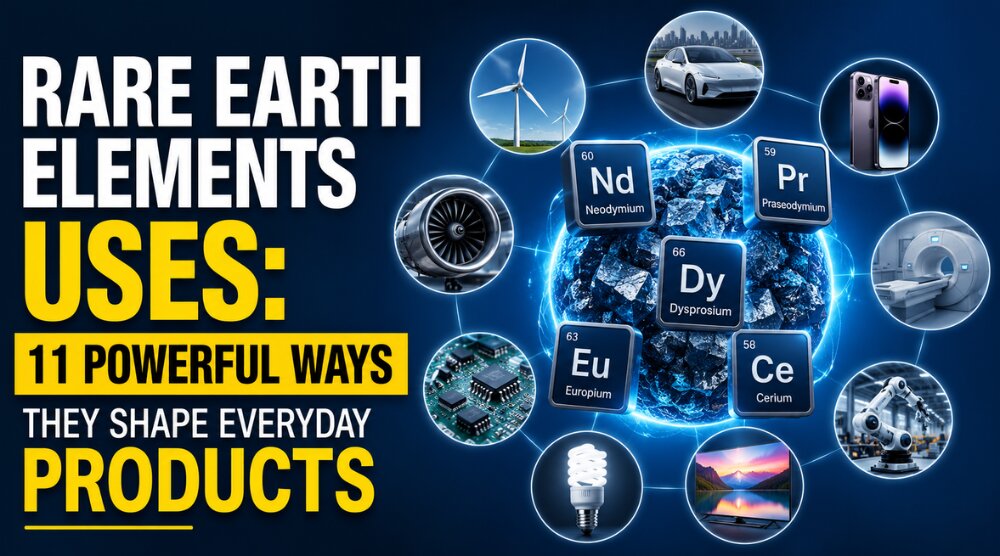
Rare Earth Elements Uses: 11 Powerful Ways They Shape Everyday Products
Modern technology depends on materials that most people have never seen, yet they are present in devices used every single day. Rare Earth Elements Uses extend far beyond laboratories and advanced manufacturing—they help power smartphones, electric vehicles, televisions, medical equipment, renewable energy systems, and countless consumer products.
Despite their name, rare earth elements are relatively abundant in the Earth’s crust. The challenge lies in extracting and refining them economically because they are rarely found in concentrated deposits. As global demand for advanced technologies continues to grow, Rare Earth Elements Uses are becoming increasingly important across industries seeking higher efficiency, reliability, and performance.
These seventeen metallic elements possess exceptional magnetic, optical, electrical, and catalytic properties that make them indispensable for today’s high-performance technologies. The expanding range of Rare Earth Elements Uses continues to drive innovation in electronics, aerospace, clean energy, healthcare, and industrial manufacturing.
At DOMADIA™, we supply high-quality rare earth metals, oxides, powders, alloys, and specialty materials that support industries ranging from electronics and aerospace to medical technology and renewable energy
What Are Rare Earth Elements?
Rare earth elements (REEs) consist of:
- The 15 Lanthanide elements
- Scandium (Sc)
- Yttrium (Y)
Although chemically similar, each element offers unique performance characteristics that enable different industrial applications.
Some of the most widely used rare earth elements include:
- Neodymium (Nd)
- Praseodymium (Pr)
- Dysprosium (Dy)
- Terbium (Tb)
- Cerium (Ce)
- Lanthanum (La)
- Samarium (Sm)
- Europium (Eu)
- Gadolinium (Gd)
- Yttrium (Y)
Chemical Composition
Rare earth elements are individual metallic elements rather than a single alloy. Their compositions vary depending on the element or compound supplied.
| Element | Symbol | Atomic Number | Common Forms |
| Lanthanum | La | 57 | Metal, Oxide |
| Cerium | Ce | 58 | Metal, Oxide |
| Praseodymium | Pr | 59 | Metal, Oxide |
| Neodymium | Nd | 60 | Metal, Oxide |
| Samarium | Sm | 62 | Metal, Oxide |
| Europium | Eu | 63 | Oxide |
| Gadolinium | Gd | 64 | Metal, Oxide |
| Terbium | Tb | 65 | Oxide |
| Dysprosium | Dy | 66 | Metal, Oxide |
| Yttrium | Y | 39 | Metal, Oxide |
11 Powerful Rare Earth Elements Uses in Everyday Products
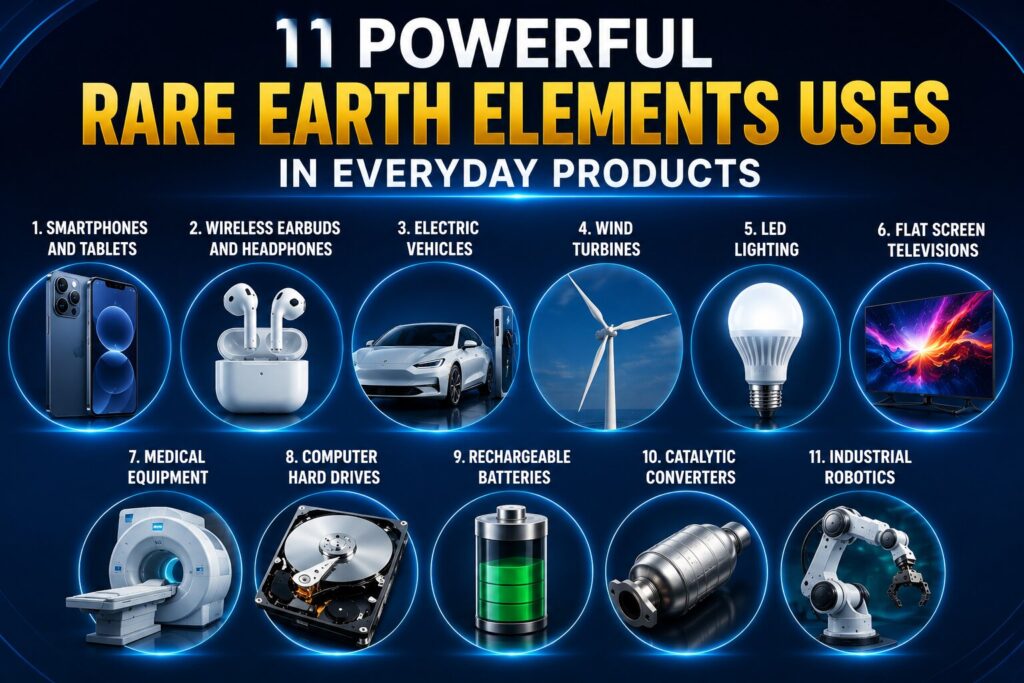
1. Smartphones and Tablets
Every smartphone contains multiple rare earth materials.
They are used in:
- Powerful miniature speakers
- Microphones
- Camera autofocus systems
- Vibration motors
- Display technologies
Neodymium magnets allow devices to become smaller while delivering stronger performance.
2. Wireless Earbuds and Headphones
High-quality audio depends heavily on permanent magnets.
Neodymium and dysprosium help produce:
- Compact speakers
- Clear sound
- Higher efficiency
- Improved bass response
- Longer durability
3. Electric Vehicles
Electric vehicles rely extensively on rare earth technology.
Applications include:
- Permanent magnet motors
- Battery systems
- Power steering
- Regenerative braking
- Electric compressors
These materials improve motor efficiency while reducing size and weight.
4. Wind Turbines
Renewable energy installations require reliable permanent magnets.
Large offshore wind turbines commonly use neodymium-iron-boron magnets enhanced with dysprosium for:
- High torque
- Excellent efficiency
- Long operational life
- Reduced maintenance
5. LED Lighting
Many modern lighting systems use rare earth phosphors.
Europium, terbium, and yttrium help generate:
- Bright white light
- Accurate color rendering
- Higher efficiency
- Longer lamp life
6. Flat Screen Televisions
Modern displays use rare earth phosphors to produce vivid colors.
Applications include:
- LED televisions
- OLED displays
- LCD backlighting
- High-definition monitors
7. Medical Equipment
Healthcare technology depends on several rare earth materials.
Typical applications include:
- MRI systems
- CT scanners
- PET imaging
- Surgical lasers
- Diagnostic instruments
These materials improve image quality and equipment reliability.
8. Computer Hard Drives
Although solid-state drives continue to grow, many data centers still rely on magnetic hard drives.
Rare earth magnets provide:
- Faster data access
- Compact drive designs
- High-speed spindle motors
- Reliable long-term operation
9. Rechargeable Batteries
Hybrid vehicles and specialized battery technologies utilize lanthanum and other rare earth elements.
They help improve:
- Energy storage
- Charge efficiency
- Battery lifespan
- Operating stability
10. Catalytic Converters
Cerium oxide plays an essential role in automotive emission control.
Benefits include:
- Improved oxygen storage
- Lower harmful emissions
- Enhanced catalyst performance
- Better fuel efficiency
11. Industrial Robotics
Industrial automation increasingly depends on compact high-performance motors.
Rare earth magnets enable:
- Precision positioning
- Faster robotic movement
- Reduced energy consumption
- Higher production efficiency
Key Properties of Rare Earth Elements
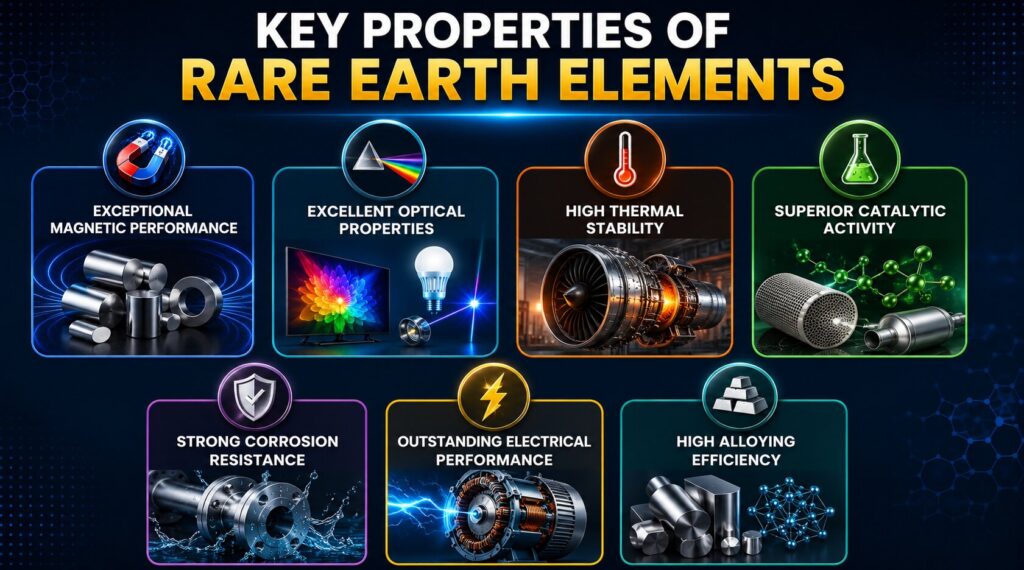
Exceptional Magnetic Performance
Neodymium, samarium, and dysprosium create some of the world’s strongest permanent magnets, enabling compact motors, speakers, and precision electronic devices.
Excellent Optical Properties
Europium, terbium, and yttrium produce vibrant colors and high brightness in LED lighting, television displays, laser systems, and advanced optical technologies, showcasing important Rare Earth Elements Uses in modern lighting and display applications.
High Thermal Stability
Several rare earth elements retain their performance at elevated temperatures, making them suitable for aerospace, electric vehicles, and demanding industrial environments.
Superior Catalytic Activity
Cerium and lanthanum significantly improve catalytic reactions used in automotive emission control, petroleum refining, and numerous industrial chemical processes.
Strong Corrosion Resistance
Many rare earth compounds offer excellent oxidation and corrosion resistance, contributing to longer service life in harsh operating conditions and expanding Rare Earth Elements Uses across demanding industrial, aerospace, and energy applications.
Outstanding Electrical Performance
Rare earth materials enhance electrical efficiency in permanent magnet motors, generators, sensors, and advanced electronic components.
High Alloying Efficiency
Small additions of rare earth elements can substantially improve the mechanical strength, grain refinement, wear resistance, and overall durability of specialty alloys.
Technical Specifications
| Property | Typical Value |
| Atomic Numbers | 21, 39, 57–71 |
| Forms Available | Metals, Oxides, Powders, Granules, Alloys |
| Purity | Up to 99.99% |
| Particle Sizes | Nano to coarse powders |
| Density | Varies by element |
| Melting Points | Approximately 798°C–1663°C |
| Magnetic Properties | Element dependent |
| Electrical Properties | Moderate to high depending on composition |
Standards
Rare earth materials are commonly manufactured according to internationally recognized quality requirements, including:
- ASTM Standards
- ISO 9001 Manufacturing Systems
- RoHS Compliance (where applicable)
- REACH Compliance
- Customer-specific industrial specifications
- Aerospace and electronics material standards where required
Shapes Available
Metal Ingots
Supplied for alloy production, remelting, and various industrial manufacturing applications.
Metal Pieces
Available in convenient sizes for research, processing, and specialty material applications.
Rods
Suitable for machining, fabrication, and custom engineering components.
Plates
Used in industrial processing, equipment manufacturing, and precision fabrication projects.
Discs
Ideal for machining, research applications, and specialized industrial components.
Granules
Commonly used for alloy preparation, melting, and powder metallurgy processes.
Powders
Available in various particle sizes for additive manufacturing, thermal spraying, and advanced material applications.
Nano Powders
Designed for nanotechnology, electronics, catalysts, and high-performance research applications.
Oxides
Widely used in ceramics, catalysts, optical materials, electronics, and polishing compounds.
Alloys
Engineered to provide enhanced mechanical, magnetic, electrical, or thermal properties for demanding industries.
Custom Shapes
Manufactured according to customer drawings and specific application requirements.
Sputtering Targets
Produced for thin-film deposition in semiconductor, electronics, and optical coating applications.
Pellets
Suitable for evaporation, laboratory research, material processing, and thin-film coating applications.
Applications of Rare Earth Elements
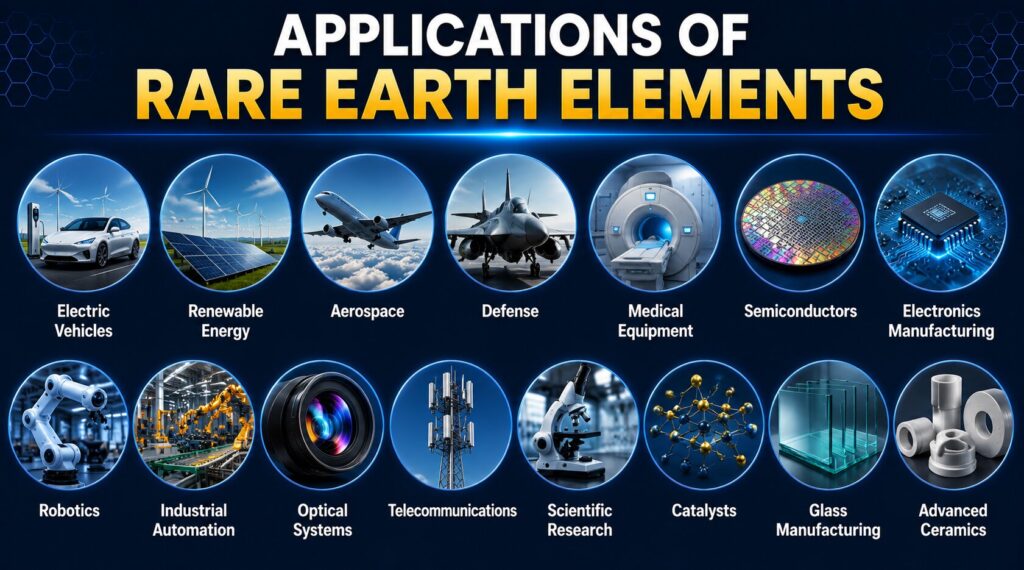
Electric Vehicles
Rare Earth Elements Uses in electric vehicles include permanent magnet motors that improve efficiency, increase driving range, and reduce overall vehicle weight.
Renewable Energy
Wind turbines use rare earth magnets to deliver high torque, improved energy generation, and long-term reliability in renewable power systems, highlighting one of the fastest-growing Rare Earth Elements Uses in the global clean energy sector.
Aerospace
Rare earth materials enhance aircraft engines, avionics, sensors, and satellite systems by providing excellent thermal stability and magnetic performance, demonstrating the critical Rare Earth Elements Uses that support modern aerospace and defense technologies.
Defense
Rare Earth Elements Uses are critical in radar systems, guided missiles, secure communications, night vision equipment, and advanced defense electronics.
Medical Equipment
Medical imaging systems such as MRI, CT scanners, and surgical lasers rely on Rare Earth Elements Uses to improve precision, image quality, and equipment performance.
Semiconductors
Rare Earth Elements Uses support semiconductor manufacturing through polishing compounds, sputtering materials, and high-purity electronic components.
Electronics Manufacturing
Consumer electronics, smartphones, speakers, sensors, and display technologies utilize Rare Earth Elements Uses to achieve compact designs and superior performance.
Robotics
Industrial robots depend on powerful rare earth magnets for accurate positioning, faster movement, and energy-efficient operation, making them one of the most valuable Rare Earth Elements Uses in advanced automation and smart manufacturing.
Industrial Automation
Rare Earth Elements Uses enable precision motors, encoders, actuators, and automation systems used in modern manufacturing facilities.
Optical Systems
Rare earth phosphors and optical materials improve laser technology, fiber optics, display systems, and high-performance imaging equipment.
Telecommunications
High-speed communication networks utilize rare earth materials in fiber optic amplifiers, signal processing equipment, and wireless infrastructure.
Scientific Research
Research laboratories use rare earth materials in analytical instruments, spectroscopy systems, particle accelerators, and advanced experimental equipment.
Catalysts
Rare earth oxides improve catalytic efficiency in automotive emission control, petroleum refining, and numerous industrial chemical processes, demonstrating some of the most important Rare Earth Elements Uses in modern manufacturing and environmental protection.
Glass Manufacturing
Specialty glass manufacturers use rare earth elements to enhance polishing performance, optical clarity, UV resistance, and color control.
Advanced Ceramics
Rare earth additives improve the mechanical strength, thermal resistance, wear performance, and durability of high-performance engineering ceramics.
Why DOMADIA™
Choosing the right supplier is just as important as selecting the right material. DOMADIA™ offers:
- Extensive range of rare earth metals, oxides, powders, and specialty materials
- High-purity materials for demanding industrial applications
- Consistent quality with strict inspection standards
- Custom particle sizes and tailored specifications
- Technical support for material selection
- Reliable domestic and international supply network
- Fast response for prototype and production requirements
Conclusion
As industries continue moving toward electrification, renewable energy, automation, and advanced electronics, Rare Earth Elements Uses will become even more significant. From the smartphone in your pocket to the electric vehicle on the road and the wind turbine generating clean energy, these remarkable materials quietly enable technologies that define modern life. The growing scope of Rare Earth Elements Uses is driving innovation across aerospace, defense, electronics, healthcare, and clean energy, making these materials essential for next-generation industrial development.
Whether your project requires rare earth metals, oxides, powders, alloys, or custom-engineered materials, DOMADIA™ delivers dependable solutions designed to meet the evolving needs of high-performance industries. With extensive expertise and a reliable global supply network, DOMADIA™ helps manufacturers leverage Rare Earth Elements Uses to improve performance, efficiency, and long-term reliability in the world’s most demanding applications.
Power Your Innovation with Premium Rare Earth Materials
From high-purity rare earth metals and oxides to custom powders and specialty alloys,DOMADIA™ delivers reliable material solutions for electronics, renewable energy, aerospace, medical, and advanced manufacturing industries.
Looking for premium rare earth materials for your next innovation? Get in Touch with Us today and let DOMADIA™ help you find the right solution for your application.
Talk to: Er.Pankaj Domadia | Kairav Domadia | Aadil Domadia | Pragati Sanap | Pooja N N
#RareEarthElements #RareEarthElementsUses #RareEarthMetals #Neodymium #RenewableEnergy #ElectricVehicles #Electronics #AdvancedMaterials #IndustrialMaterials #DOMADIA
Directly whatsapp us for an Enquiry: https://wa.link/kairav
We’ve supplied to Mumbai, Pune, Indore, Jaipur, and Surat—serving industries across Maharashtra, Madhya Pradesh, Rajasthan, Gujarat, and Goa, with exports to Germany, USA, Japan, South Korea, and Italy.