Blogs
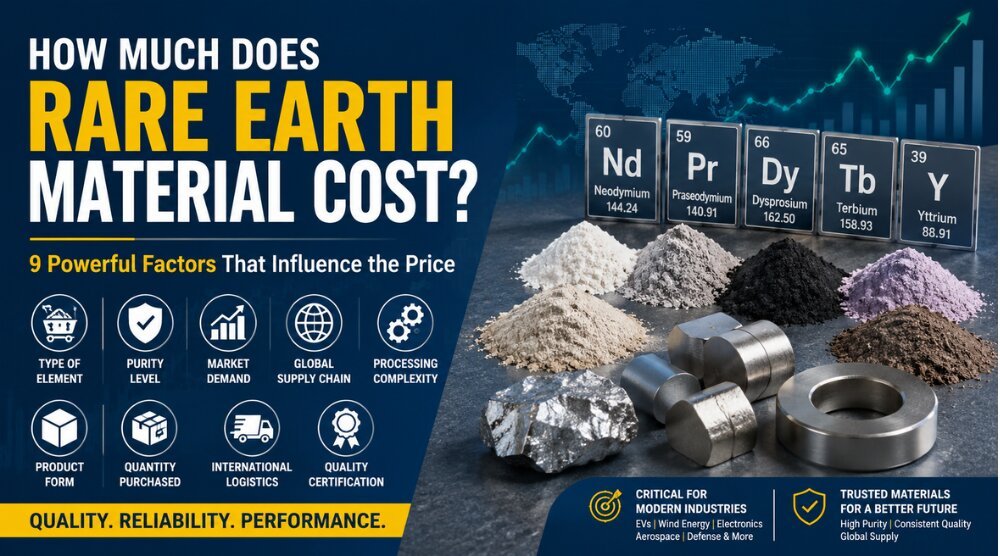
How Much Does Rare Earth Material Cost? 9 Powerful Factors That Influence the Price
How Much Does Rare Earth Material Cost?
A simple question often receives a complicated answer.
Many buyers expect Rare Earth Material Cost to be similar to common industrial metals. However, rare earth materials follow a completely different pricing pattern. Rare Earth Material Cost can fluctuate significantly because of mining capacity, refining complexity, geopolitical factors, purity levels, and global demand from industries such as electric vehicles, renewable energy, aerospace, electronics, and defense.
Unlike steel or aluminum, rare earth materials undergo complex extraction and purification processes before becoming usable in industrial applications. Consequently, two materials with similar weights can have dramatically different values depending on their composition, purity, and processing requirements, all of which directly influence Rare Earth Material Cost.
Understanding the factors that drive Rare Earth Material Cost helps purchasing teams make better long-term decisions rather than focusing only on the initial purchase price. By evaluating performance, quality, and lifecycle value alongside pricing, businesses can select materials that deliver greater reliability and lower total ownership costs.
What Are Rare Earth Materials?
Rare earth materials consist of seventeen metallic elements, including the fifteen lanthanides along with scandium and yttrium. Although these elements are relatively abundant in the Earth’s crust, economically viable deposits are limited and difficult to process.
Common rare earth elements include:
- Neodymium (Nd)
- Praseodymium (Pr)
- Dysprosium (Dy)
- Terbium (Tb)
- Samarium (Sm)
- Europium (Eu)
- Gadolinium (Gd)
- Cerium (Ce)
- Lanthanum (La)
Each element offers unique magnetic, electrical, optical, catalytic, or thermal characteristics that make them indispensable in modern technology.
9 Powerful Factors That Affect Rare Earth Material Cost
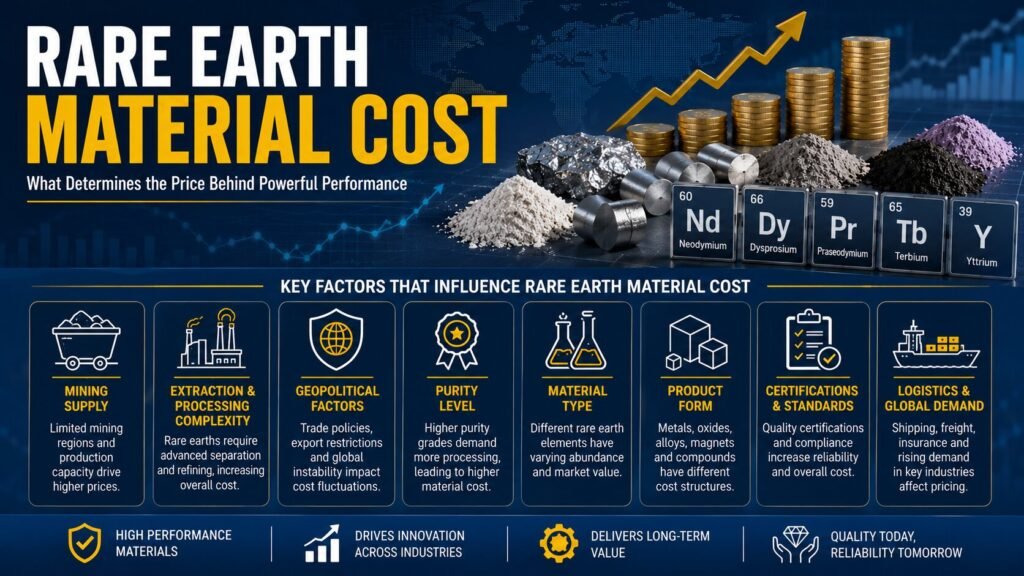
1. Type of Rare Earth Element
Not every rare earth element has the same market value.
Heavy rare earth elements such as Dysprosium and Terbium generally command much higher prices than light rare earth elements because of limited production and higher industrial demand.
2. Purity Level
Industrial-grade materials typically cost less than ultra-high-purity materials used in semiconductor manufacturing, aerospace, or scientific applications.
Higher purity requires additional refining, increasing production costs.
3. Market Demand
Growing demand from electric vehicles, wind turbines, robotics, and electronics continuously influences pricing.
Rapid increases in EV production frequently lead to higher prices for magnetic rare earth elements.
4. Global Supply Chain
A significant portion of global rare earth refining capacity is concentrated in a few countries.
Changes in export policies, trade regulations, or geopolitical developments can quickly affect worldwide pricing.
5. Processing Complexity
Mining rare earth ore represents only the beginning.
Separation, purification, oxidation, alloying, and quality testing require advanced processing technologies that substantially increase manufacturing costs.
6. Product Form
Pricing also varies depending on whether the material is supplied as:
- Oxides
- Metals
- Alloys
- Powders
- Magnets
- Sputtering Targets
- Pellets
- Custom Components
Finished products generally cost more than raw materials because of additional processing.
7. Quantity Purchased
Bulk industrial orders often receive better pricing than laboratory or prototype quantities.
Large-volume purchasing reduces production and logistics costs.
8. International Logistics
Freight charges, insurance, customs duties, packaging requirements, and transportation methods all influence the final delivered price.
9. Quality Certification
Materials accompanied by detailed quality reports, chemical analysis, and international certifications typically command premium pricing while providing greater consistency and reliability.
Typical Price Range
Because pricing changes frequently, it is difficult to provide one fixed figure.
Approximate market pricing may range from:
- Common rare earth oxides: tens of dollars per kilogram
- High-purity oxides: significantly higher depending on purity
- Specialty alloys: premium pricing
- Permanent magnet grades: vary according to neodymium, dysprosium, and terbium content
Industrial buyers should always request current quotations based on specification, purity, quantity, and delivery location.
Chemical Composition
Rare earth materials consist primarily of:
- Lanthanum (La)
- Cerium (Ce)
- Praseodymium (Pr)
- Neodymium (Nd)
- Samarium (Sm)
- Europium (Eu)
- Gadolinium (Gd)
- Terbium (Tb)
- Dysprosium (Dy)
- Holmium (Ho)
- Erbium (Er)
- Thulium (Tm)
- Ytterbium (Yb)
- Lutetium (Lu)
- Scandium (Sc)
- Yttrium (Y)
Exact compositions vary depending on the specific alloy, oxide, or application.
Properties That Influence Rare Earth Material Cost and Industrial Performance
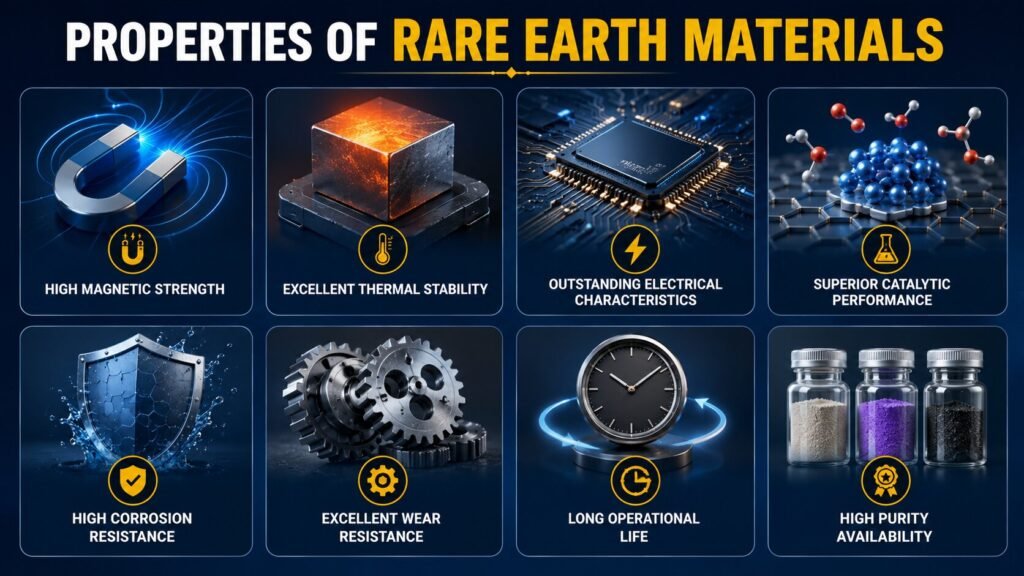
High Magnetic Strength
Rare earth materials are known for producing exceptionally powerful magnetic fields, making them essential for high-performance permanent magnets used in electric vehicles, wind turbines, and precision motors. Despite fluctuations in Rare Earth Material Cost, this remarkable magnetic strength delivers outstanding efficiency and long-term value in demanding industrial applications.
Excellent Thermal Stability
Rare earth materials maintain their structural integrity and magnetic performance even under elevated operating temperatures. This thermal stability helps justify Rare Earth Material Cost by ensuring dependable operation in aerospace, automotive, energy, and high-temperature industrial environments where consistent performance is critical.
Outstanding Electrical Characteristics
With excellent electrical and magnetic properties, rare earth materials support advanced electronic devices, sensors, semiconductors, and communication equipment. Businesses often consider Rare Earth Material Cost a worthwhile investment because these materials improve reliability, precision, and overall system performance.
Superior Catalytic Performance
Many rare earth compounds exhibit exceptional catalytic properties, making them valuable in petroleum refining, automotive catalytic converters, and environmental emission-control systems. Although Rare Earth Material Cost may be higher than conventional materials, their catalytic efficiency contributes to cleaner industrial processes and improved operational productivity.
High Corrosion Resistance
Rare earth materials offer excellent resistance to oxidation and environmental degradation, allowing components to withstand harsh industrial conditions for extended periods. Investing in Rare Earth Material Cost often results in lower maintenance requirements and longer equipment life, reducing overall ownership costs.
Excellent Wear Resistance
Engineered for demanding applications, rare earth materials provide superior resistance to mechanical wear, abrasion, and continuous operational stress. The long-lasting durability achieved through Rare Earth Material Cost helps manufacturers reduce replacement frequency, maintenance downtime, and production interruptions.
Long Operational Life
Components manufactured using rare earth materials deliver reliable performance throughout extended service cycles without significant degradation. This extended lifespan makes Rare Earth Material Cost more economical over time, as fewer replacements and reduced maintenance contribute to lower lifecycle expenses.
High Purity Availability
Rare earth materials are available in multiple purity grades, ranging from industrial-quality products to ultra-high-purity materials for semiconductor, medical, and research applications. While higher purity can increase Rare Earth Material Cost, it ensures superior consistency, precision, and performance for specialized, high-technology industries.
Industrial Applications That Make Rare Earth Material Cost Worth the Investment
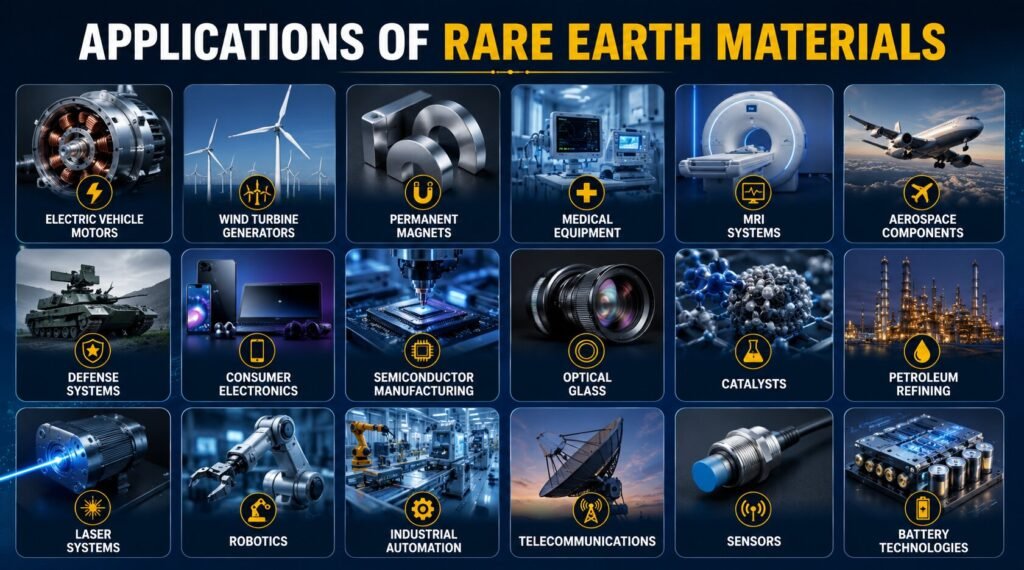
Electric Vehicle Motors
Rare earth materials provide powerful magnetic performance that improves EV motor efficiency, making Rare Earth Material Cost a worthwhile investment for long-lasting electric mobility solutions.
Wind Turbine Generators
High-performance permanent magnets manufactured from rare earth materials enhance energy generation efficiency, demonstrating how Rare Earth Material Cost delivers long-term value in renewable energy.
Permanent Magnets
Rare earth materials produce exceptionally strong permanent magnets for industrial machinery, where Rare Earth Material Cost is justified by superior magnetic strength and durability.
Medical Equipment
Advanced diagnostic and healthcare devices rely on rare earth materials for precision performance, making Rare Earth Material Cost essential for reliable medical technology.
MRI Systems
Rare earth materials contribute to high-performance magnetic systems in MRI equipment, where Rare Earth Material Cost supports accurate imaging and dependable healthcare operations.
Aerospace Components
Aircraft and spacecraft utilize rare earth materials for lightweight, high-performance components, making Rare Earth Material Cost valuable for demanding aerospace applications.
Defense Systems
Rare earth materials improve radar, navigation, communication, and defense technologies, proving that Rare Earth Material Cost supports mission-critical military performance.
Consumer Electronics
Smartphones, laptops, speakers, and wearable devices depend on rare earth materials, where Rare Earth Material Cost enables compact, efficient, and high-quality electronic products.
Semiconductor Manufacturing
Precision semiconductor equipment uses rare earth materials to achieve exceptional manufacturing accuracy, making Rare Earth Material Cost an investment in advanced electronics production.
Optical Glass
Rare earth materials enhance optical clarity and light transmission in specialty glass, demonstrating how Rare Earth Material Cost benefits scientific and industrial optics.
Catalysts
Industrial and automotive catalysts utilize rare earth materials to improve chemical reactions and reduce emissions, making Rare Earth Material Cost valuable for cleaner manufacturing.
Petroleum Refining
Refineries use rare earth catalysts to increase processing efficiency and fuel quality, where Rare Earth Material Cost contributes to higher operational productivity.
Laser Systems
Rare earth materials provide stable optical properties for industrial and medical laser systems, making Rare Earth Material Cost worthwhile for precision laser technology.
Robotics
Modern robotic systems rely on rare earth materials for powerful motors and sensors, proving that Rare Earth Material Cost supports automation and precision engineering.
Industrial Automation
Rare earth materials improve the efficiency of industrial automation equipment through advanced magnetic components, making Rare Earth Material Cost beneficial for smart manufacturing.
Telecommunications
Communication networks use rare earth materials in filters, amplifiers, and electronic components, where Rare Earth Material Cost ensures reliable and high-speed connectivity.
Sensors
High-precision sensors incorporate rare earth materials for improved sensitivity and accuracy, making Rare Earth Material Cost an important factor in advanced sensing technologies.
Battery Technologies
Rare earth materials support next-generation battery development for electric vehicles and energy storage systems, demonstrating how Rare Earth Material Cost contributes to improved energy performance and longer service life.
Technical Specifications
Typical specifications include:
- Purity: 99% to 99.999%
- Forms: Oxides, Metals, Powders, Alloys, Magnets
- Particle Size: Customizable
- Density: Depends on element
- Melting Point: Element specific
- Magnetic Properties: Vary by composition
- Thermal Stability: Excellent
- Electrical Performance: High precision grades available
Applicable Standards
Depending on the product and application:
- ASTM Standards
- ISO Quality Standards
- RoHS Compliance
- REACH Compliance
- Customer-specific Industrial Specifications
Shapes Available
DOMADIA™ supplies rare earth materials in multiple forms including:
- Powders
- Oxides
- Metals
- Alloys
- Pellets
- Rods
- Ingots
- Sputtering Targets
- Granules
- Custom Machined Components
Why Choose DOMADIA™?
Selecting the right supplier is just as important as selecting the right material.
DOMADIA™ supports industries with:
- Reliable global sourcing
- Consistent material quality
- Multiple purity grades
- Technical assistance
- Custom specifications
- Competitive pricing
- Timely deliveries
- Industrial documentation support
- Flexible order quantities
- Dedicated customer service
Whether your requirement involves research quantities or high-volume industrial production, DOMADIA™ helps customers source dependable rare earth materials with confidence.
Conclusion
Understanding Rare Earth Material Cost involves much more than comparing price per kilogram. Material type, purity, processing complexity, product form, certifications, logistics, and global supply conditions all contribute to the final investment. Evaluating Rare Earth Material Cost based on long-term performance rather than initial purchase price helps businesses reduce downtime, improve reliability, and maximize return on investment.
With extensive sourcing expertise and a commitment to quality, DOMADIA™ supplies high-performance rare earth materials that meet the demanding requirements of manufacturers, researchers, and industrial users worldwide. By delivering consistent quality, customized solutions, and dependable technical support, DOMADIA™ helps customers achieve greater value from their Rare Earth Material Cost while ensuring reliable performance across the most challenging industrial applications.
Need High-Quality Rare Earth Materials for Your Next Project?
DOMADIA™ supplies premium-quality Rare Earth Materials in various purity grades, forms, and custom specifications to meet the needs of research laboratories, manufacturers, and global industries.
Get in touch with DOMADIA™ today and request a customized quotation for your Rare Earth Material requirements.
Talk to: Er.Pankaj Domadia | Kairav Domadia | Aadil Domadia | Pragati Sanap | Pooja N N
#RareEarthMaterialCost #RareEarthMaterials #RareEarthElements #IndustrialMaterials #PermanentMagnets #AdvancedManufacturing #DOMADIA #Engineering #SpecialMetals #Manufacturing
Directly whatsapp us for an Enquiry: https://wa.link/kairav
Our materials have reached Tiruppur, Erode, Salem, Namakkal, and Karur across Tamil Nadu, Karnataka, Kerala, Andhra Pradesh, and Telangana, with exports to Italy, Turkey, Tunisia, Morocco, and Algeria.