Blogs
Mu Metal WiFi Shielding: 7 Powerful Facts You Need to Know
Can Mu Metal Block WiFi and Cell Signals?
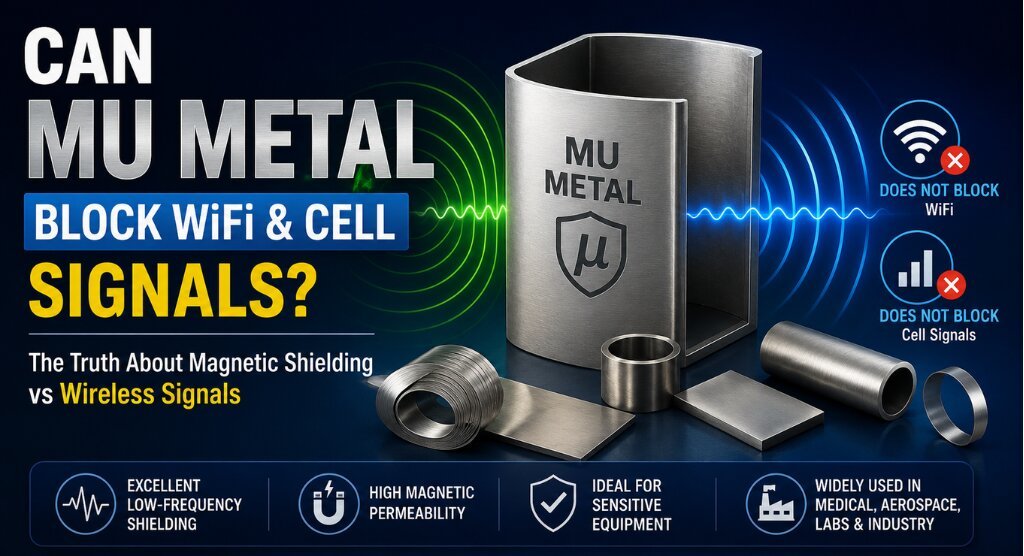
Many engineers assume that if a material blocks magnetic fields, it should also stop WiFi and mobile phone signals. It sounds logical—but it isn’t true. Mu Metal WiFi Shielding is specifically designed for controlling magnetic fields, not high-frequency wireless communications.
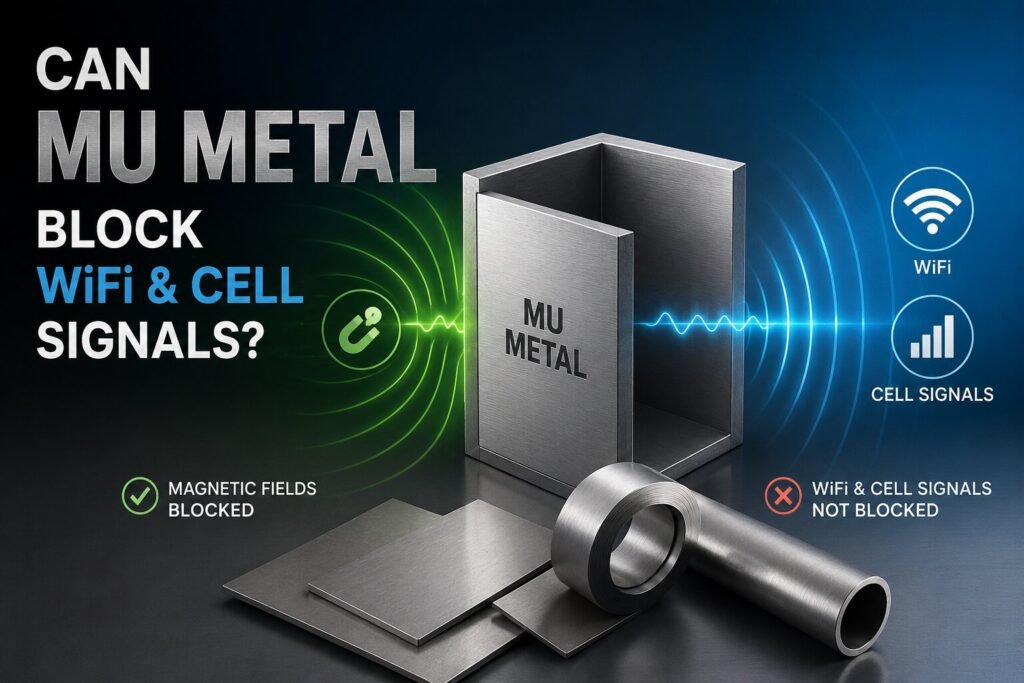
A laboratory technician once lined a test enclosure with Mu Metal expecting it to eliminate WiFi interference. After completing the installation, the wireless devices continued to function almost normally. The shielding worked perfectly for magnetic fields, but it had very little effect on radio-frequency communication. This real-world example highlights one of the biggest misconceptions surrounding Mu Metal WiFi Shielding.
Understanding this difference is essential when selecting shielding materials for industrial, medical, aerospace, and electronics applications. Mu Metal WiFi Shielding is often misunderstood because magnetic shielding and RF shielding operate on entirely different physical principles. Choosing the correct shielding material ensures reliable performance while avoiding unnecessary design costs and expectations.
What Is Mu Metal?
Mu Metal is a high-permeability nickel-iron alloy specifically engineered to redirect and absorb low-frequency magnetic flux.
Instead of blocking electromagnetic waves like a Faraday cage, Mu Metal provides an easier path for magnetic field lines, effectively diverting them away from sensitive equipment.
Typical composition includes:
- Nickel (Ni): 77–80%
- Iron (Fe): Balance
- Molybdenum (Mo): 4–5%
- Copper (Cu): Approximately 5%
- Small additions of manganese and silicon
Its exceptional magnetic permeability makes it one of the world’s most effective magnetic shielding materials.
Does Mu Metal Block WiFi or Cellular Signals?
The simple answer is: No—not by itself.
WiFi, Bluetooth, 4G, and 5G signals are high-frequency electromagnetic waves.
Mu Metal is designed primarily for:
- Low-frequency magnetic fields
- Static magnetic fields (DC)
- Extremely low-frequency AC magnetic fields
- Magnetic interference from transformers, motors, MRI systems, and electrical equipment
Since WiFi operates at frequencies such as:
- 2.4 GHz
- 5 GHz
- 6 GHz
and cellular communication uses frequencies ranging from hundreds of MHz to several GHz, Mu Metal provides little attenuation of these radio-frequency signals.
Why Doesn’t Mu Metal Block Wireless Signals?
The answer lies in the physics.
Mu Metal shields by providing an alternative path for magnetic flux.
WiFi and mobile signals are electromagnetic waves that require conductive RF shielding rather than magnetic shielding.
Materials commonly used for RF shielding include:
- Copper
- Aluminum
- Conductive stainless steel
- Silver-coated fabrics
- Conductive gaskets
- Copper mesh
These materials reflect and absorb radio-frequency energy much more effectively than Mu Metal.
When Is Mu Metal the Right Choice?
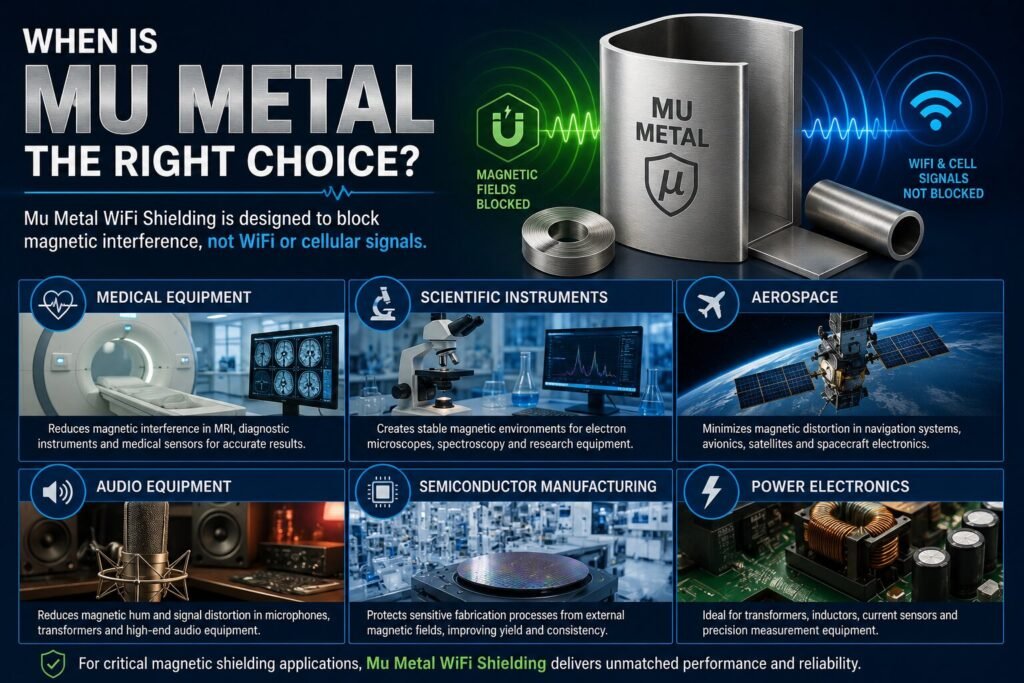
Although it isn’t suitable for blocking WiFi or cellular signals, Mu Metal WiFi Shielding remains indispensable for numerous high-performance applications where protection against magnetic interference is critical. Understanding the true capabilities of Mu Metal WiFi Shielding helps engineers choose the right shielding solution for sensitive equipment.
Medical Equipment
MRI accessories, diagnostic instruments, laboratory analyzers, and medical sensors rely on Mu Metal WiFi Shielding materials to reduce unwanted magnetic interference and improve measurement accuracy.
Scientific Instruments
Electron microscopes, particle detectors, spectroscopy equipment, and research laboratories use Mu Metal WiFi Shielding solutions to create stable magnetic environments for highly precise experiments and measurements.
Aerospace
Navigation systems, avionics, satellites, and spacecraft electronics benefit from Mu Metal WiFi Shielding, which minimizes magnetic distortion and enhances the reliability of mission-critical systems.
Audio Equipment
Professional microphones, transformers, studio amplifiers, and recording equipment use Mu Metal to reduce magnetic hum and signal distortion, ensuring cleaner and higher-quality audio performance.
Semiconductor Manufacturing
Precision fabrication equipment depends on Mu Metal WiFi Shielding to protect highly sensitive manufacturing processes from external magnetic fields, improving production consistency and yield.
Power Electronics
Transformers, inductors, current sensors, and precision measurement equipment benefit from the high magnetic permeability of Mu Metal, making Mu Metal WiFi Shielding an excellent choice for demanding industrial and electrical applications.
Chemical Composition
| Element | Typical Content |
| Nickel | 77–80% |
| Iron | Balance |
| Copper | ~5% |
| Molybdenum | 4–5% |
| Manganese | Small amount |
| Silicon | Small amount |
Properties
Extremely High Magnetic Permeability
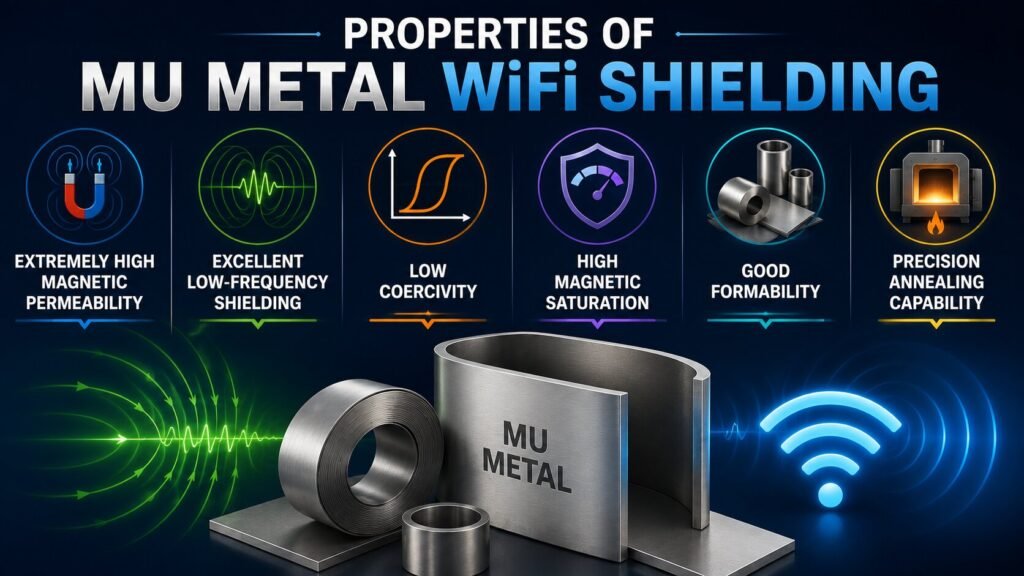
Its exceptionally high magnetic permeability allows Mu Metal WiFi Shielding solutions to efficiently redirect magnetic field lines, protecting sensitive electronic equipment from unwanted magnetic interference.
Excellent Low-Frequency Shielding
Designed specifically for static and low-frequency magnetic fields, Mu Metal WiFi Shielding delivers outstanding protection for precision instruments, laboratory equipment, and medical devices.
Low Coercivity
The alloy requires minimal energy for magnetization and demagnetization, enabling Mu Metal WiFi Shielding materials to maintain stable magnetic performance in demanding applications.
High Magnetic Saturation
With excellent magnetic saturation characteristics, Mu Metal WiFi Shielding performs reliably even in environments exposed to relatively strong magnetic fields.
Good Formability
Available in sheets, foils, strips, tubes, and custom-fabricated components, Mu Metal WiFi Shielding materials can be easily formed into complex shielding solutions without compromising quality.
Precision Annealing Capability
Hydrogen annealing restores the alloy’s maximum magnetic permeability after fabrication, ensuring Mu Metal WiFi Shielding provides consistent, high-performance magnetic shielding for critical industrial applications.
Technical Specifications
| Property | Typical Value |
| UNS Number | N14080 |
| Density | ~8.7 g/cm³ |
| Melting Range | Approximately 1450°C |
| Magnetic Permeability | Up to 100,000+ (after annealing) |
| Electrical Conductivity | Relatively Low |
| Operating Application | Low-frequency magnetic shielding |
Standards
DOMADIA™ supplies Mu Metal manufactured in accordance with applicable international standards, including:
- UNS N14080
- ASTM standards (where applicable)
- DIN specifications
- EN material standards
- Customer-specific engineering requirements
Shapes Available
DOMADIA™ supplies Mu Metal in various forms, including:
- Sheets
- Foils
- Strips
- Plates
- Coils
- Tubes
- Precision fabricated components
- Custom magnetic shields
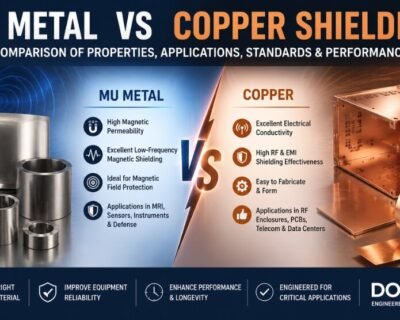
Mu Metal vs RF Shielding Materials
| Requirement | Best Material |
| Static Magnetic Fields | Mu Metal |
| Low Frequency Magnetic Fields | Mu Metal |
| WiFi Shielding | Copper |
| Cellular Signal Shielding | Copper or Aluminum |
| EMI Enclosures | Conductive Metals |
| RF Chambers | Copper Mesh & Conductive Materials |
Can Mu Metal Be Combined with RF Shielding?
Yes.
Many advanced shielding systems combine:
- Inner Mu Metal layer for magnetic shielding
- Copper or aluminum layer for RF shielding
- Conductive gaskets for EMI sealing
This hybrid approach provides comprehensive protection against both magnetic interference and radio-frequency signals.
Why DOMADIA™
DOMADIA™ supplies premium-quality Mu Metal solutions for demanding industrial applications worldwide.
Our advantages include:
- High-permeability Mu Metal
- Precision hydrogen-annealed materials
- Tight dimensional tolerances
- Custom fabrication capabilities
- Consistent magnetic performance
- Fast global delivery
- Technical material selection support
- Reliable quality for critical applications
Whether your project involves medical equipment, aerospace systems, laboratory instruments, semiconductor manufacturing, or scientific research, DOMADIA™ delivers dependable magnetic shielding solutions engineered for long-term performance.
Conclusion
Understanding Mu Metal WiFi Shielding helps engineers select the correct material for every application. While Mu Metal is exceptionally effective at shielding low-frequency and static magnetic fields, it is not designed to block WiFi, Bluetooth, or cellular signals. Those applications require conductive RF shielding materials such as copper or aluminum rather than Mu Metal WiFi Shielding.
Selecting the right shielding technology improves equipment reliability, reduces electromagnetic interference, and prevents costly design errors. By understanding where Mu Metal WiFi Shielding excels and where RF shielding materials are required, engineers can achieve optimal system performance. DOMADIA™ offers premium Mu Metal products and expert guidance to help industries implement Mu Metal WiFi Shielding solutions for dependable magnetic shielding performance.
Choose the Right Magnetic Shielding with DOMADIA™
Protect your sensitive equipment with high-performance Mu Metal solutions engineered for precision magnetic shielding. Whether you need sheets, foils, fabricated shields, or custom components, DOMADIA™ delivers consistent quality, expert technical support, and reliable global supply for the most demanding industrial applications.
Get expert support, premium-quality materials, and dependable supply for all your magnetic shielding requirements.
Talk to: Er.Pankaj Domadia | Kairav Domadia | Aadil Domadia | Pragati Sanap | Pooja N N
#MuMetal #MagneticShielding #EMIShielding #RFShielding #Engineering #Electronics #IndustrialMaterials #WirelessTechnology #DOMADIA
Directly whatsapp us for an Enquiry: https://wa.link/kairav
We’ve supplied to Mumbai, Pune, Indore, Jaipur, and Surat—serving industries across Maharashtra, Madhya Pradesh, Rajasthan, Gujarat, and Goa, with exports to Germany, USA, Japan, South Korea, and Italy.