Blogs
Tungsten Density: Why It Matters for Your Projects? | UNS R07005
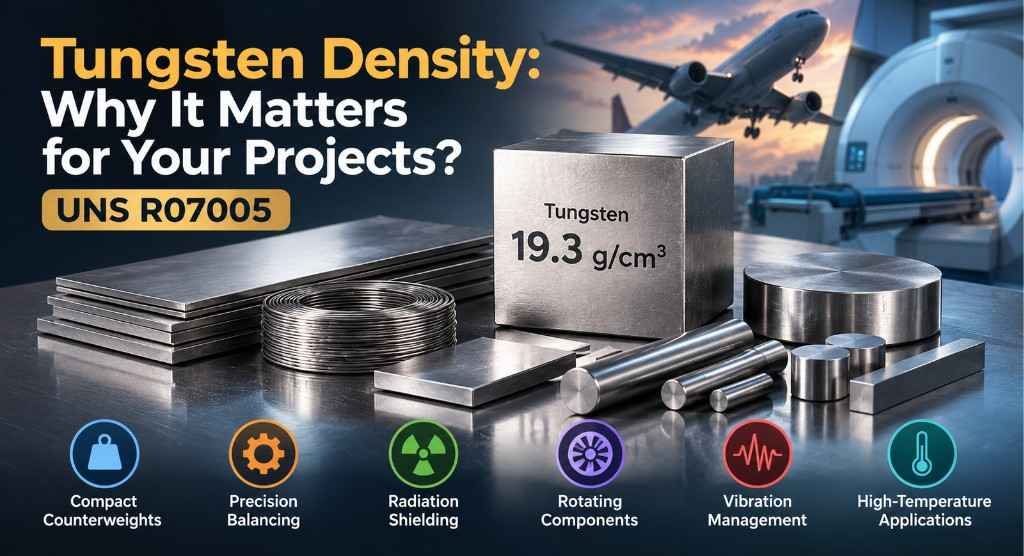
Tungsten Density Guide begins with one remarkable number: 19.3 g/cm³. When engineers need substantial weight within limited space, conventional metals may create design challenges. Tungsten offers an exceptional mass-to-volume ratio, making it valuable for compact assemblies, counterweights, and precision engineering applications.
The Tungsten Density Guide highlights why pure tungsten, with its density of approximately 19.3 g/cm³ and melting point of around 3,414°C, stands out among engineering metals. These properties make tungsten particularly useful where compact dimensions, high mass, and extreme-temperature capability are important.
Understanding the Tungsten Density Guide helps engineers evaluate how density influences component size, balancing, inertia, radiation shielding, vibration management, and overall system performance. Selecting the right tungsten material can improve design efficiency and support demanding industrial applications.
What Does Tungsten Density Actually Mean?
Density describes how much mass is contained within a given volume.
For pure tungsten:
Density: approximately 19.3 g/cm³ or 19,300 kg/m³
That means a relatively small tungsten component can contain a surprisingly large amount of mass.
For perspective, approximate room-temperature densities are:
| Material | Approximate Density |
| Aluminium | 2.70 g/cm³ |
| Titanium | 4.5 g/cm³ |
| Steel | 7.8–8.0 g/cm³ |
| Copper | 8.96 g/cm³ |
| Lead | 11.34 g/cm³ |
| Tungsten | 19.3 g/cm³ |
The exact values can vary according to alloy, grade and condition, but the comparison demonstrates why tungsten becomes particularly interesting when engineers need maximum mass within minimum available space.
Tungsten Density Guide: Why Does High Density Matter?

1. More Mass Can Fit Into Less Space
This is perhaps the simplest—and most important—advantage.
Suppose an engineer requires a counterweight but has very limited installation space.
Using a lower-density material could require a much larger component to achieve the necessary mass. Tungsten can potentially provide the required weight in a substantially smaller volume.
This can be valuable in tightly packaged mechanical, aerospace, instrumentation and industrial assemblies.
2. Compact Counterweights Become Possible
Counterweights are not simply heavy pieces of metal.
Their dimensions, position and mass distribution can affect the performance of the complete system.
ASTM B777 specifically identifies weights and counterbalances for static or dynamic balancing among the intended uses for tungsten-base high-density materials.
High-density tungsten materials can therefore be considered where engineers need significant balancing mass without allowing the counterweight to occupy excessive space.
Potential applications can include:
- Aerospace balancing systems
- Precision machinery
- Robotics
- Rotating equipment
- Instrumentation
- Automotive systems
- Industrial balancing assemblies
3. Density Can Help Radiation Shielding
High-density materials play an important role in radiation attenuation applications. The Tungsten Density Guide explains how tungsten’s exceptional density makes it valuable for specialized radiation shielding systems used in medical, scientific, industrial, and inspection equipment.
ASTM B777 recognizes radiation shielding as an intended application for tungsten-base high-density metals. As highlighted in the Tungsten Density Guide, increasing tungsten content generally improves material density and can enhance radiation attenuation, making tungsten heavy alloys useful for compact shielding components.
However, effective radiation protection depends on radiation type, energy, shielding thickness, component geometry, material composition, and applicable safety standards, rather than density alone.
4. Mass Distribution Can Influence Inertia
In rotating equipment, precise mass distribution is essential for maintaining balance, stability, and efficient mechanical performance. The Tungsten Density Guide explains how tungsten’s exceptional density allows engineers to concentrate substantial mass within compact dimensions, supporting accurate control over rotational inertia.
ASTM B777 identifies high-speed rotating inertia members among the applications of tungsten-base high-density metals. As highlighted in the Tungsten Density Guide, these materials offer valuable advantages where engineers require precise mass positioning, compact component geometry, and controlled rotational performance.
However, successful rotating-system design also depends on component geometry, rotational speed, mechanical strength, balance, and operating conditions, making proper material selection essential.
5. High Density Can Support Vibration-Damping Designs
Unwanted vibration can reduce equipment accuracy, accelerate component wear, and affect overall mechanical performance. The Tungsten Density Guide explains how strategically positioned tungsten mass can help engineers control dynamic behaviour and improve stability in precision machinery and industrial systems.
ASTM B777 recognizes vibration-damping applications for tungsten-base high-density materials. As highlighted in the Tungsten Density Guide, tungsten’s exceptional density allows substantial mass to fit within compact spaces, making it useful for specialized vibration-management designs.
However, effective vibration control depends on component geometry, stiffness, mounting arrangements, operating frequency, and overall system design—not density alone.
6. Tungsten Can Be Valuable Where Space Is Expensive
In many engineering projects, limited physical space can increase overall design costs. The Tungsten Density Guide explains how larger counterweights may require bigger enclosures, additional structural materials, and modifications to surrounding components, increasing weight and manufacturing complexity.
Choosing a cheaper metal does not always guarantee a more economical solution. The Tungsten Density Guide highlights how tungsten’s exceptional density allows engineers to achieve substantial mass within compact dimensions, potentially reducing redesign requirements and improving space efficiency.
The key is not simply comparing tungsten’s material price but understanding how its high density can improve overall design efficiency, functionality, and long-term project value.
7. Density Is Only One Part of Tungsten’s Engineering Value
Tungsten stands out not only for its exceptional density but also for its remarkable thermal properties. The Tungsten Density Guide highlights how this unique combination makes tungsten valuable for demanding engineering applications requiring high mass and extreme-temperature performance.
With a melting point of approximately 3,414°C, the highest among metals, tungsten can withstand temperatures far beyond the capabilities of many conventional materials. The Tungsten Density Guide explains why this combination of high density and exceptional thermal resistance makes tungsten suitable for specialized industrial components and high-temperature engineering applications.
Chemical Composition of Tungsten – UNS R07005
The chemical symbol for tungsten is W, originating from its historical name, wolfram.
Important elemental information includes:
| Property | Value |
| Element | Tungsten |
| Symbol | W |
| Atomic Number | 74 |
| Relative Atomic Mass | 183.84 |
| Density | Approx. 19.3 g/cm³ |
| Melting Point | Approx. 3,414°C |
| Boiling Point | Approx. 5,555°C |
| Appearance | Silvery-white metal |
The Royal Society of Chemistry reports these fundamental physical properties for elemental tungsten.
For certain commercially pure tungsten wire and rod products covered by ASTM F288, Types 1A and 1B carry the designation UNS R07005.
It is important not to assume that every tungsten product automatically has the same UNS designation. The correct grade, composition and specification should always be confirmed according to the required product form and application.
Important Properties of Tungsten

Extremely High Density
At approximately 19.3 g/cm³, tungsten is one of the densest commonly used engineering metals. The Tungsten Density Guide highlights how this exceptional property makes tungsten valuable for compact counterweights, precision balancing, and specialized industrial applications requiring substantial mass within limited space.
Exceptional Melting Point
Tungsten has an extraordinary melting point of approximately 3,414°C, the highest among metals. As explained in the Tungsten Density Guide, this remarkable thermal property makes tungsten suitable for specialized high-temperature applications where conventional engineering metals may lose their effectiveness.
High Mass-to-Volume Ratio
Tungsten allows engineers to achieve substantial component mass without requiring the larger dimensions associated with steel, titanium, or aluminium. The Tungsten Density Guide demonstrates how this advantage supports compact designs, efficient space utilization, and precise weight distribution in demanding engineering projects.
High Stiffness
Tungsten and tungsten-based materials offer high stiffness, making them valuable for applications requiring dimensional stability and resistance to deformation. The Tungsten Density Guide emphasizes that mechanical performance depends on material composition, manufacturing conditions, and whether pure tungsten or a specific tungsten heavy alloy is selected.
Radiation Attenuation Potential
Tungsten’s high density contributes to its effectiveness in appropriately designed radiation shielding systems. According to the Tungsten Density Guide, tungsten-based materials can support specialized medical, scientific, and industrial shielding applications where radiation attenuation, compact dimensions, and material performance are important.
High-Temperature Capability
Tungsten’s exceptional melting point makes it relevant for applications operating at temperatures beyond the practical capabilities of many conventional metals. The Tungsten Density Guide highlights how its combination of high density and thermal resistance makes tungsten valuable for specialized industrial components, electrical equipment, and demanding engineering environments.
Technical Specifications
When specifying tungsten for a project, simply writing “tungsten” on a purchase order may not provide enough information.
Engineers and procurement teams should consider specifying:
| Parameter | What to Specify |
| Material | Pure tungsten or tungsten alloy |
| UNS designation | Where applicable, e.g. UNS R07005 |
| Density | Required minimum/nominal density |
| Purity/composition | According to application |
| Form | Plate, sheet, foil, rod, wire or custom component |
| Thickness/Diameter | Required dimensions |
| Length/Width | Required dimensions |
| Condition | As required by specification |
| Surface finish | Application dependent |
| Dimensional tolerance | Drawing/specification dependent |
| Applicable standard | ASTM or customer specification |
| Quantity | Prototype or production quantity |
For high-density tungsten alloys, density should be treated as an engineering requirement rather than assumed from the word “tungsten.”
Tungsten heavy alloys contain tungsten as the principal constituent but may contain other metallic elements to achieve specific combinations of density, strength, ductility and machinability. Their density therefore does not necessarily equal the approximately 19.3 g/cm³ value of elemental tungsten.
Relevant Tungsten Standards
ASTM B760
ASTM B760 covers wrought unalloyed tungsten plate, sheet and foil.
The standard includes requirements relating to chemical composition, metallurgical condition and dimensional tolerances. ASTM lists B760-07(2023) as the active specification for tungsten plate, sheet and foil.
ASTM B777
ASTM B777 covers tungsten-base high-density metals produced by consolidating metal powder mixtures containing mainly tungsten.
The specification addresses four classes and includes requirements involving composition, density, mechanical properties, microstructure and machinability. ASTM identifies applications including counterweights, rotating inertia members, radiation shielding and vibration damping.
ASTM F288
ASTM F288 covers tungsten wire for electron devices and lamps, along with specified rod products. Commercially pure Types 1A and 1B are designated UNS R07005.
The correct standard should always be selected according to material type, composition, product form and end-use requirement.
Shapes and Forms Available
Depending on grade, specification, dimensions and manufacturing requirements, DOMADIA™ can support enquiries for tungsten materials in forms such as:
- Tungsten Plate
- Tungsten Sheet
- Tungsten Foil
- Tungsten Rod
- Tungsten Bar
- Tungsten Wire
- Tungsten Heavy Alloy Components
- Custom-sized pieces, subject to requirements and availability
ASTM B760 specifically covers tungsten plate, sheet and foil, while ASTM F288 addresses specified tungsten wire and rod products.
Applications of High-Density Tungsten

Aerospace Counterweights
Aircraft and aerospace mechanisms often have strict limitations on available space. The Tungsten Density Guide explains how tungsten-based high-density materials provide substantial balancing mass within compact dimensions, supporting precise weight distribution and efficient aerospace designs.
Precision Balancing
Robotics, instrumentation, and precision machinery require accurately positioned mass for balancing and dynamic control. Understanding the Tungsten Density Guide helps engineers select compact tungsten components that support stability, accuracy, and reliable mechanical performance.
Radiation Shielding
Tungsten-base high-density metals are valuable for specialized radiation shielding in medical, scientific, and industrial equipment. The Tungsten Density Guide highlights how tungsten’s high density contributes to radiation attenuation, while ASTM B777 recognizes radiation shielding as an intended application.
High-Speed Rotating Components
Mass distribution is essential for rotating assemblies. As highlighted in the Tungsten Density Guide, high-density tungsten materials allow engineers to concentrate substantial mass within smaller dimensions, supporting precise inertia control and efficient component design.
Vibration Management
Tungsten-based components can support vibration-management systems where strategically positioned mass helps control mechanical movement. The Tungsten Density Guide demonstrates why compact, high-density materials are useful in precision machinery and specialized industrial equipment.
Electrical and Electronic Applications
Tungsten wire is used in specialized electrical and electronic applications, including lamps and electron devices, because of its exceptional high-temperature properties. ASTM F288 addresses tungsten wire for these applications, supporting material selection according to technical requirements.
High-Temperature Components
Tungsten’s exceptionally high melting point of approximately 3,414°C makes it suitable for specialized high-temperature applications where conventional metals may be unsuitable. The Tungsten Density Guide emphasizes how its combination of high density and thermal capability supports demanding industrial engineering projects.
Why Tungsten Density Can Change the Economics of a Project
Tungsten can be more expensive than common engineering metals.
That fact alone, however, does not determine whether it is expensive for the project.
Consider a design with only a small cavity available for a counterweight.
Steel may initially appear economical. But if the required steel counterweight cannot physically fit inside the available envelope, its lower material price becomes irrelevant.
The engineer might need to:
- Increase component dimensions
- Redesign the enclosure
- Relocate other equipment
- Add structural material
- Modify the assembly
- Accept compromised weight distribution
A compact tungsten-based solution could potentially avoid some of these changes.
Therefore, the correct comparison is not always:
Price of tungsten vs price of steel per kilogram.
It may instead be:
Total cost of achieving the required engineering function.
That is why density matters.
How to Select the Right Tungsten Material
Before specifying tungsten, engineers should answer several questions.
How much mass is required?
Determine the target weight of the component.
How much physical space is available?
Calculate the maximum permitted volume.
Is pure tungsten necessary?
Some applications may benefit more from machinable tungsten heavy alloys than from pure tungsten.
Does the component need machining?
Material form and composition can significantly influence manufacturability.
Will the component operate at high temperature?
Specify both continuous and peak operating conditions.
Is radiation attenuation required?
If so, the shielding system should be designed according to the radiation source, energy and required attenuation.
Which specification applies?
ASTM B760, ASTM B777, ASTM F288 or another customer/industry specification may apply depending on the material and product form.
Why DOMADIA™ for Tungsten Materials?
Selecting tungsten is not simply about requesting the heaviest available metal.
The material must match the engineering requirement, grade, composition, density, form, dimensions, tolerance, condition and applicable specification.
DOMADIA™ supports engineers, procurement professionals, manufacturers, research organisations and industrial customers seeking specialized tungsten and advanced material solutions.
When contacting DOMADIA™, provide as much technical information as possible, including:
Material/grade + UNS designation + required density + form + dimensions + tolerance + quantity + applicable standard + end application.
This helps make material discussions significantly more precise and reduces the risk of selecting a product based on density alone.
Conclusion
The Tungsten Density Guide ultimately demonstrates why one physical property can fundamentally change an engineering design.
At approximately 19.3 g/cm³, tungsten can concentrate exceptional mass into a remarkably compact volume. Combined with its approximately 3,414°C melting point, tungsten provides a distinctive combination of physical properties.
Its density can be particularly valuable for counterweights, compact balancing systems, rotating inertia components, vibration-management systems and radiation shielding, several of which are specifically recognized in ASTM B777.
But density should never be considered alone.
Engineers should evaluate composition, mechanical performance, temperature, machinability, dimensions, geometry, applicable standards and the complete operating environment before selecting the material.
Need tungsten for your next project?
Explore premium tungsten materials and tailored industrial solutions with DOMADIA™ to achieve precision, reliability, and exceptional performance.
Contact DOMADIA™with your required grade, UNS designation, density, dimensions, form, quantity and applicable standard to discuss the appropriate material for your application.
Talk to: Er.Pankaj Domadia | Kairav Domadia | Aadil Domadia | Pragati Sanap | Pooja N N
#Tungsten #TungstenDensity #UNSR07005 #TungstenMetal #TungstenAlloy #HighDensityMetals #EngineeringMaterials #AdvancedMaterials #IndustrialMaterials #DOMADIA
Directly whatsapp us for an Enquiry: https://wa.link/kairav
Our supply network covers Hubballi, Dharwad, Davangere, Chitradurga, and Ballari across Karnataka, Telangana, Andhra Pradesh, Maharashtra, and Goa, with exports to Sweden, Norway, Denmark, Finland, and Iceland.