Blogs
Tungsten vs Copper Weight: 9 Powerful Density Facts Every Engineer Should Know
Tungsten vs Copper Weight: How Heavy Is Tungsten Compared to Copper?
When engineers compare industrial metals, strength and conductivity often receive the most attention. However, Tungsten vs Copper Weight is equally important because weight directly affects structural design, vibration control, radiation shielding, aerospace components, electrical contacts, and high-performance manufacturing.
Although both metals are widely used across industries, tungsten is dramatically heavier than copper. This significant difference influences product performance, durability, machining methods, transportation costs, and overall engineering design, making Tungsten vs Copper Weight a key consideration during material selection.
Understanding why tungsten is so much heavier helps engineers select the right material for demanding applications. By evaluating Tungsten vs Copper Weight alongside mechanical, thermal, and electrical properties, manufacturers can optimize performance, improve efficiency, and extend the service life of critical components.
How Much Heavier Is Tungsten Than Copper?
The answer lies in density.
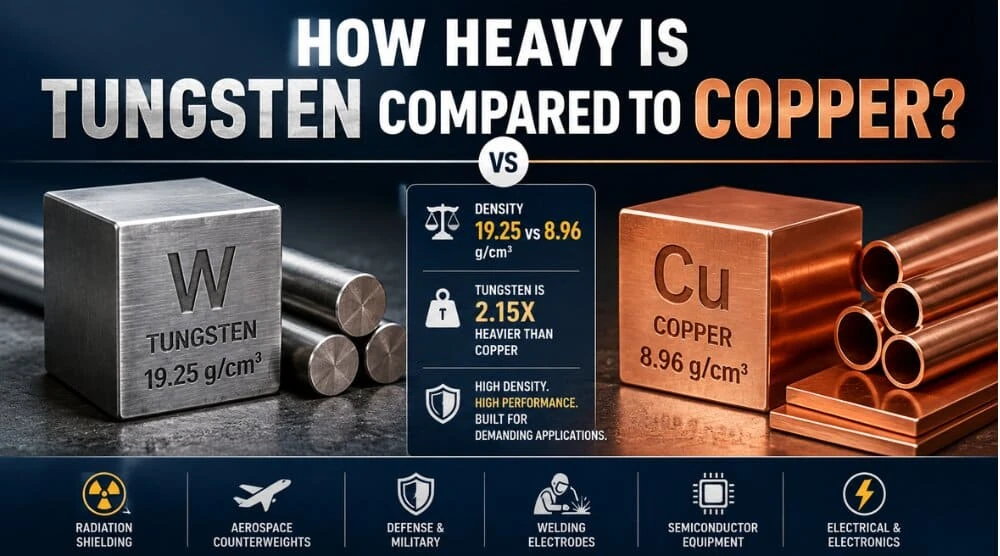
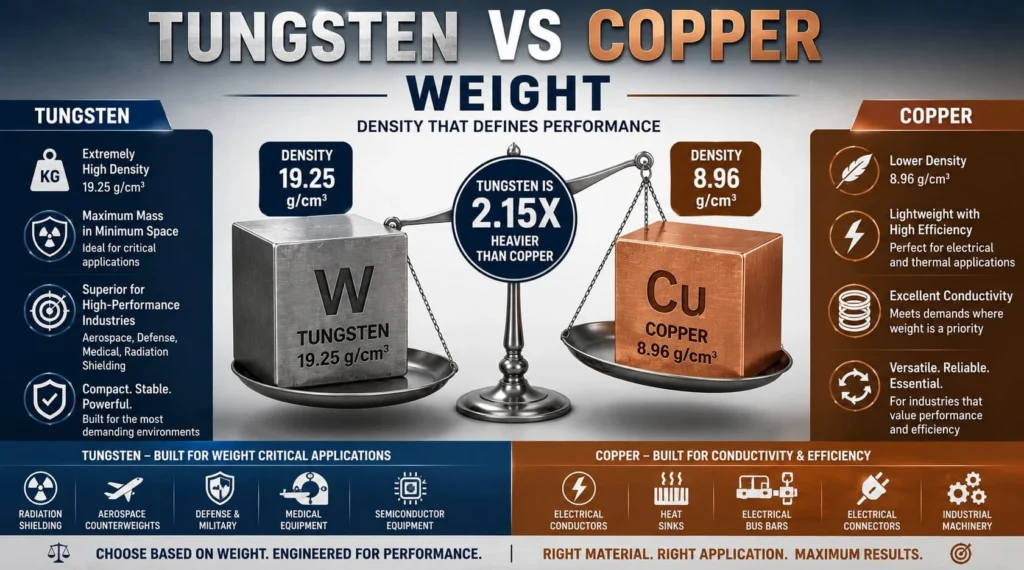
| Material | Density |
| Copper | 8.96 g/cm³ |
| Tungsten | 19.25 g/cm³ |
This means tungsten is approximately 2.15 times heavier than copper for the same volume.
For example:
- A copper cube measuring 10 cm × 10 cm × 10 cm weighs about 8.96 kg.
- The same cube made from tungsten weighs approximately 19.25 kg.
Simply replacing copper with tungsten more than doubles the weight without changing the size.
Why Is Tungsten So Heavy?
Several atomic characteristics contribute to tungsten’s exceptional density.
Large Atomic Mass
Tungsten atoms possess a very high atomic weight (183.84), making every atom significantly heavier than copper atoms.
Dense Crystal Structure
Its body-centered cubic (BCC) crystal arrangement packs atoms closely together, increasing overall density.
Strong Metallic Bonding
The strong atomic bonding contributes to outstanding structural stability under extreme conditions.
Minimal Internal Voids
Compared with many engineering materials, tungsten contains very little unused internal space between atoms.
Chemical Composition
Tungsten (UNS R05200)
| Element | Percentage |
| Tungsten (W) | ≥99.95% |
| Impurities | Trace amounts |
Copper (UNS C11000)
| Element | Percentage |
| Copper (Cu) | ≥99.90% |
| Oxygen | Small controlled amount |
Properties
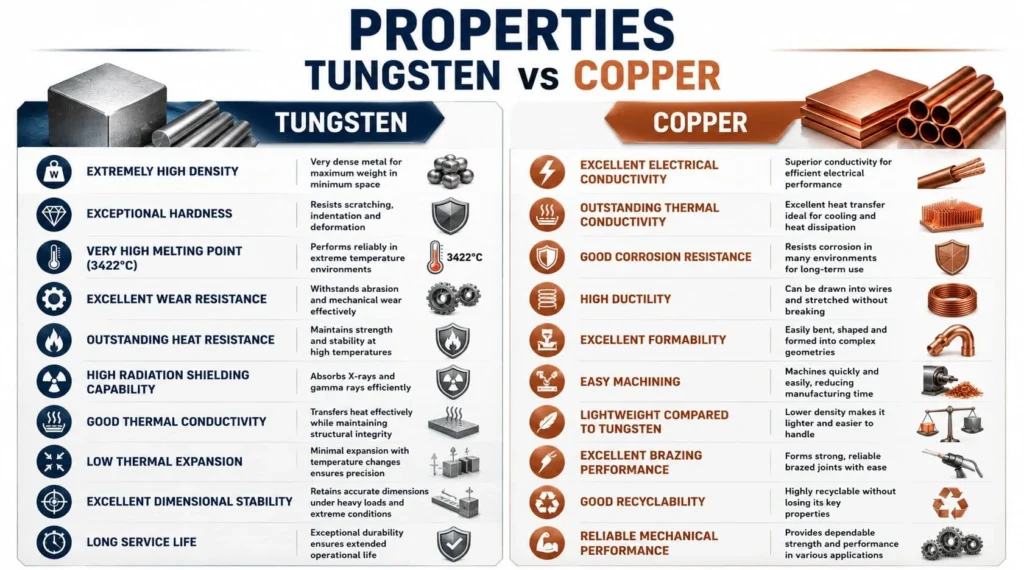
Tungsten
Extremely High Density
The exceptional density highlighted in the Tungsten vs Copper Weight comparison makes tungsten ideal for applications requiring maximum mass in minimum space.
Exceptional Hardness
Tungsten offers outstanding hardness, providing excellent resistance to scratches, deformation, and mechanical wear.
Very High Melting Point (3422°C)
Its extremely high melting point allows tungsten to perform reliably in furnaces, aerospace, and other high-temperature environments.
Excellent Wear Resistance
The superior wear resistance demonstrated by Tungsten vs Copper Weight applications helps extend component life under continuous mechanical stress.
Outstanding Heat Resistance
Tungsten maintains its strength and structural integrity even during prolonged exposure to extreme temperatures.
High Radiation Shielding Capability
The high density emphasized in the Tungsten vs Copper Weight comparison enables tungsten to effectively absorb X-rays and gamma radiation.
Good Thermal Conductivity
Tungsten efficiently transfers heat while maintaining excellent mechanical stability in demanding industrial applications.
Low Thermal Expansion
Its low expansion rate minimizes dimensional changes during temperature fluctuations, ensuring precision performance.
Excellent Dimensional Stability
The unique characteristics behind Tungsten vs Copper Weight allow tungsten components to retain accurate dimensions even under heavy loads and elevated temperatures.
Long Service Life
Exceptional durability, wear resistance, and thermal stability provide tungsten with a long operational lifespan in demanding environments.
Copper
Excellent Electrical Conductivity
Copper delivers outstanding electrical conductivity, making it the preferred choice wherever conductivity is more critical than Tungsten vs Copper Weight.
Outstanding Thermal Conductivity
Its superior thermal conductivity enables rapid heat dissipation in electrical and electronic equipment.
Good Corrosion Resistance
Copper naturally resists corrosion in many industrial environments, ensuring dependable long-term performance.
High Ductility
Its excellent ductility allows copper to be easily drawn into wires and formed into complex shapes without cracking.
Excellent Formability
Copper can be bent, rolled, stamped, and fabricated into a wide range of industrial components with ease.
Easy Machining
Compared with tungsten, copper is significantly easier to machine, reducing manufacturing time and production costs.
Lightweight Compared to Tungsten
The Tungsten vs Copper Weight comparison shows copper is less than half as dense as tungsten, making it suitable where reducing overall component weight is important.
Excellent Brazing Performance
Copper forms strong, reliable brazed joints, making it ideal for heat exchangers, plumbing, and electrical assemblies.
Good Recyclability
Copper can be recycled repeatedly with minimal loss of properties, supporting sustainable manufacturing practices.
Reliable Mechanical Performance
While lighter than tungsten, copper provides dependable mechanical strength for countless electrical and industrial applications where Tungsten vs Copper Weight is not the primary design consideration.
Technical Specifications
Tungsten
- UNS: R05200
- Density: 19.25 g/cm³
- Melting Point: 3422°C
- Boiling Point: 5555°C
- Hardness: High
- Electrical Conductivity: Moderate
- Thermal Conductivity: High
Copper
- UNS: C11000
- Density: 8.96 g/cm³
- Melting Point: 1085°C
- Boiling Point: 2562°C
- Electrical Conductivity: Excellent
- Thermal Conductivity: Excellent
- Machinability: Excellent
Applications
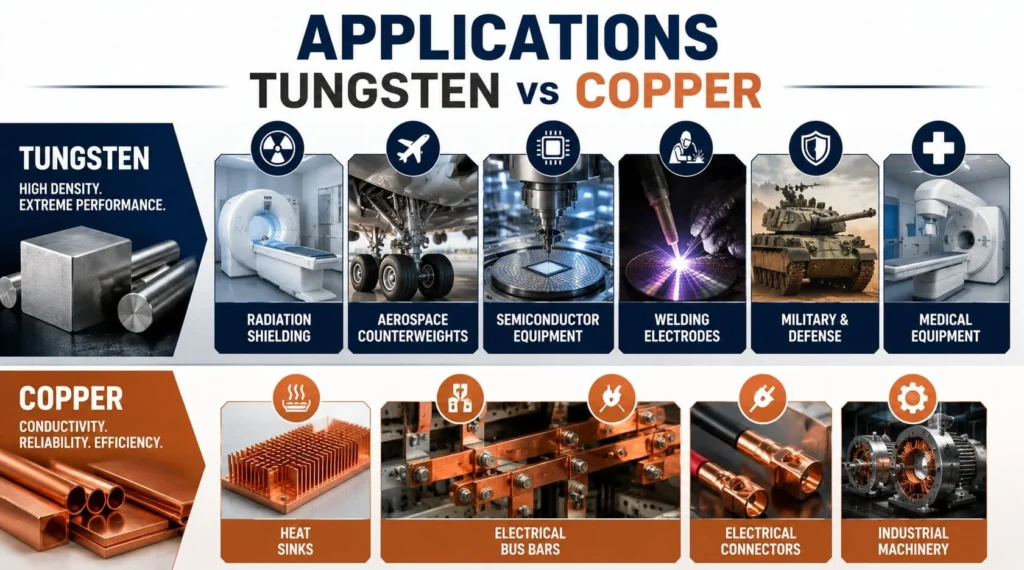
Radiation Shielding
The exceptional density highlighted in the Tungsten vs Copper Weight comparison makes tungsten ideal for medical imaging equipment, X-ray systems, and nuclear shielding, where compact yet highly effective radiation protection is required.
Aerospace Counterweights
Aircraft use tungsten counterweights because the Tungsten vs Copper Weight advantage allows engineers to achieve substantial mass within limited installation space, improving balance and performance.
Semiconductor Equipment
Precision semiconductor manufacturing relies on tungsten for its outstanding dimensional stability, high-temperature resistance, and the superior Tungsten vs Copper Weight characteristics needed in compact, high-performance equipment.
Welding Electrodes
Tungsten remains stable at extremely high temperatures, making it the preferred electrode material for TIG welding and other demanding industrial welding applications.
Military and Defense
Defense systems depend on tungsten for armor-piercing components, kinetic energy applications, and high-density balancing weights where maximum mass and durability are essential.
Medical Equipment
Radiotherapy equipment, CT scanners, and collimators frequently utilize tungsten because its superior density and radiation absorption outperform many other engineering materials.
Heat Sinks
Copper remains the preferred material for electronic heat sinks due to its outstanding thermal conductivity, making it the better choice when efficient heat dissipation is the primary requirement instead of Tungsten vs Copper Weight.
Electrical Bus Bars
Power distribution systems utilize copper because of its exceptional electrical conductivity, ensuring reliable current transmission with minimal energy loss.
Electrical Connectors
Copper provides excellent conductivity, corrosion resistance, and long-term reliability, making it ideal for electrical contacts and connectors across numerous industries.
Industrial Machinery
Many heavy industrial systems combine both metals—using copper for superior electrical conductivity and tungsten for exceptional wear resistance and the unique advantages demonstrated by the Tungsten vs Copper Weight comparison.
International Standards
Tungsten
- ASTM B760
- ASTM B777
- ASTM F288
- ISO 6848
- AMS Specifications
Copper
- ASTM B152
- ASTM B187
- ASTM B170
- EN 13601
- JIS H3100
Shapes Available
DOMADIA™ supplies tungsten and copper in multiple industrial forms:
- Rods
- Bars
- Plates
- Sheets
- Foils
- Tubes
- Pipes
- Wires
- Discs
- Blocks
- Rings
- Machined Components
- Custom CNC Parts
- Electrodes
- Fabricated Assemblies
Tungsten vs Copper: Which Material Should You Choose?
Choose tungsten when your application requires:
- Maximum weight in limited space
- Extreme temperature resistance
- Radiation shielding
- Exceptional wear resistance
- Long-term dimensional stability
Choose copper when your application requires:
- Maximum electrical conductivity
- Superior heat transfer
- Easy fabrication
- Lower component weight
- Cost-effective electrical performance
In many advanced engineering applications, designers combine both materials to leverage the strengths of each.
Why Choose DOMADIA™?
DOMADIA™ supplies premium-quality tungsten and copper materials for industries requiring dependable performance and precision engineering.
Our advantages include:
- Premium Industrial Grades
- International Standard Compliance
- Precision Manufacturing
- Custom Sizes Available
- Fast Worldwide Delivery
- Technical Material Selection Support
- Consistent Material Quality
- Competitive Industrial Pricing
- Reliable Inventory
- Trusted by Diverse Industries Worldwide
Conclusion
Tungsten vs Copper Weight is far more than a simple comparison of mass—it is a critical factor in selecting the right material for demanding engineering applications. Tungsten’s density of 19.25 g/cm³ makes it more than twice as heavy as copper, enabling superior performance in radiation shielding, aerospace balancing, defense systems, and other high-density applications where the Tungsten vs Copper Weight advantage is essential. Copper, on the other hand, remains unmatched for electrical and thermal conductivity, making it indispensable for power distribution, electronics, and efficient heat transfer.
Choosing the right material depends on your application’s technical requirements, operating environment, weight considerations, and long-term performance goals. Understanding Tungsten vs Copper Weight helps engineers make informed decisions that improve reliability, efficiency, and lifecycle value. With extensive expertise in high-performance engineering materials, DOMADIA™ supplies premium tungsten and copper solutions that meet international standards and deliver dependable performance across demanding industries.
Need Premium Tungsten or Copper Materials for Your Project?
Partner with DOMADIA™ for high-quality tungsten and copper products manufactured to international standards, with expert technical support and dependable global supply.
Contact DOMADIA™ today to discuss your application requirements.
Talk to: Er.Pankaj Domadia | Kairav Domadia | Aadil Domadia | Pragati Sanap | Pooja N N
#Tungsten #Copper #TungstenVsCopper #EngineeringMaterials #IndustrialMetals #MetalComparison #RadiationShielding #AerospaceMaterials #ElectricalEngineering #Manufacturing #PrecisionEngineering #DOMADIA
Directly whatsapp us for an Enquiry: https://wa.link/kairav
We’ve supplied to Guwahati, Dibrugarh, Silchar, Tezpur, and Tinsukia across Assam, Meghalaya, Tripura, Mizoram, and Arunachal Pradesh, exporting to Thailand, Malaysia, Singapore, Brunei, and Indonesia.