Blogs
MuMetal vs Silicon Steel – 7 Powerful Differences That Impact Performance | DOMADIA™
MuMetal vs Silicon Steel – The Real Engineering Choice
A transformer in a high-precision lab started failing—not because of design, but because of magnetic interference. The team used silicon steel assuming it would handle the job. It didn’t. The fix? Switching to MuMetal.
This is where MuMetal vs Silicon Steel becomes more than a comparison—it becomes a decision that impacts performance, reliability, and long-term operational cost. In critical industries where magnetic stability matters, the choice between MuMetal vs Silicon Steel can determine whether equipment performs flawlessly or suffers from costly interference and downtime.
What is MuMetal?
MuMetal vs Silicon Steel highlights why MuMetal is a high-permeability nickel-iron soft magnetic alloy specifically engineered for exceptional magnetic shielding performance in critical environments. Its ability to attract and redirect magnetic flux makes it indispensable in applications where even the slightest interference can impact accuracy and reliability.
At DOMADIA™, MuMetal is precision-processed to deliver consistent permeability, ensuring optimal shielding efficiency across demanding industries. From sensitive electronics to advanced medical and aerospace systems, it provides the stability and protection required for uninterrupted performance. In the debate of MuMetal vs Silicon Steel, MuMetal stands out for superior magnetic shielding, ultra-high permeability, and precision performance in mission-critical applications.
What is Silicon Steel?
Silicon Steel, also known as electrical steel, is a specialized iron-silicon alloy engineered for high magnetic efficiency and minimal energy loss. Its unique composition significantly reduces hysteresis and eddy current losses, making it ideal for applications where energy performance is critical.
At DOMADIA™, Silicon Steel is processed to deliver consistent magnetic properties, ensuring reliable performance in transformers, motors, and generators. It plays a vital role in modern power systems by enhancing efficiency, reducing heat generation, and supporting long-term operational stability.
Chemical Composition
MuMetal
- Nickel (Ni): ~77%
- Iron (Fe): Balance
- Copper (Cu): ~5%
- Molybdenum (Mo): ~2%
Silicon Steel
- Iron (Fe): ~96–97%
- Silicon (Si): ~3–4%
Key Properties
| Property | MuMetal | Silicon Steel |
| Magnetic Permeability | Extremely High | Moderate |
| Core Loss | Low (in shielding) | Very Low (in transformers) |
| Saturation Flux Density | Low | High |
| Electrical Resistivity | Moderate | Higher |
| Shielding Capability | Excellent | Limited |
Technical Specifications
MuMetal
- Permeability: Up to 100,000+
- Density: ~8.7 g/cm³
- Annealed for maximum performance
Silicon Steel
- Permeability: 4,000–40,000
- Density: ~7.65 g/cm³
- Available in grain-oriented and non-oriented grades
MuMetal Applications
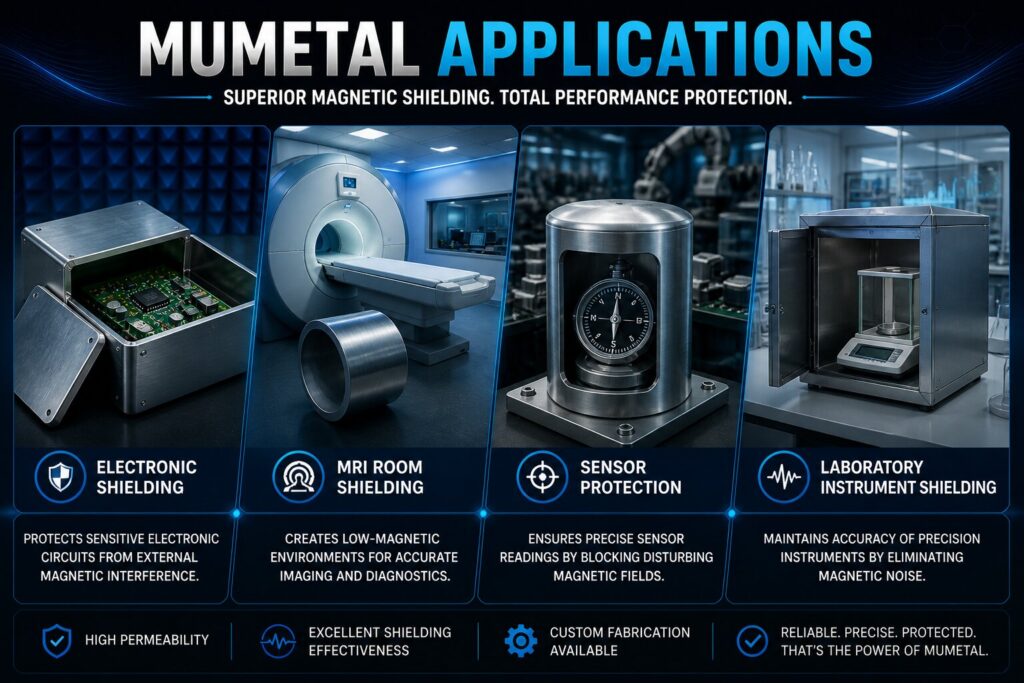
1. Magnetic Shielding Enclosures
MuMetal is widely used in shielding enclosures to block external magnetic fields and prevent interference with sensitive electronic components. It ensures stable performance in laboratories, defense systems, and high-precision environments.
2. Medical Imaging Equipment (MRI, Sensors)
In MRI machines and advanced sensors, MuMetal minimizes magnetic distortion, allowing accurate imaging and signal detection. This improves diagnostic reliability and ensures consistent medical performance.
3. Aerospace Electronics
Aerospace systems require extreme precision, where even minor interference can cause failure. MuMetal protects navigation, communication, and control systems from electromagnetic disturbances.
4. Audio and Precision Instruments
High-end audio systems and measurement instruments rely on MuMetal to eliminate noise caused by magnetic interference. This results in clearer sound quality and highly accurate readings.
Silicon Steel Applications
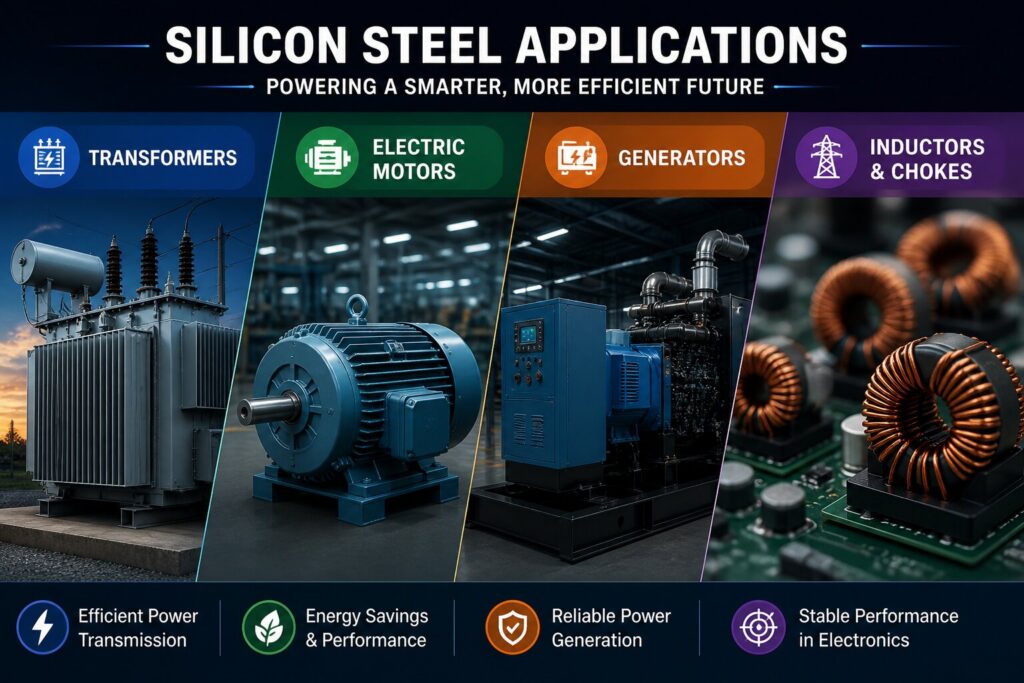
1. Transformers and Inductors
Silicon Steel is essential in transformer cores due to its low energy loss and high magnetic efficiency. It helps improve power transmission efficiency and reduces heat generation during operation.
2. Electric Motors
Used in motor laminations, Silicon Steel enhances magnetic performance while minimizing energy losses. This leads to improved motor efficiency, longer life, and reduced operational costs.
3. Generators
In generators, Silicon Steel ensures efficient conversion of mechanical energy into electrical energy. Its properties reduce core losses, making power generation more stable and cost-effective.
4. Power Distribution Systems
Silicon Steel plays a critical role in power grids by enabling efficient electricity flow with minimal losses. It supports reliable distribution, ensuring consistent power supply across industrial and residential networks.
Standards
MuMetal
- ASTM A753
- MIL-N-14411
Silicon Steel
- ASTM A677
- IEC 60404
Shapes Available
MuMetal
- Sheets
- Foils
- Shields
- Custom fabricated enclosures
Silicon Steel
- Laminations
- Coils
- Sheets
- Strips
Strategic Material Thinking: Function Over Assumption
Old thinking:
“Use one magnetic material for all applications.”
New thinking:
“Choose materials based on purpose—shielding vs energy efficiency.”
In real-world engineering, not all magnetic materials are interchangeable. Assuming one solution fits every application often leads to performance gaps, inefficiencies, and unexpected failures. The shift today is toward application-specific material selection—where MuMetal is chosen for its unmatched shielding capability, and Silicon Steel is selected for its superior electrical efficiency. This is exactly why MuMetal vs Silicon Steel has become a critical discussion for engineers focused on long-term reliability and precision performance
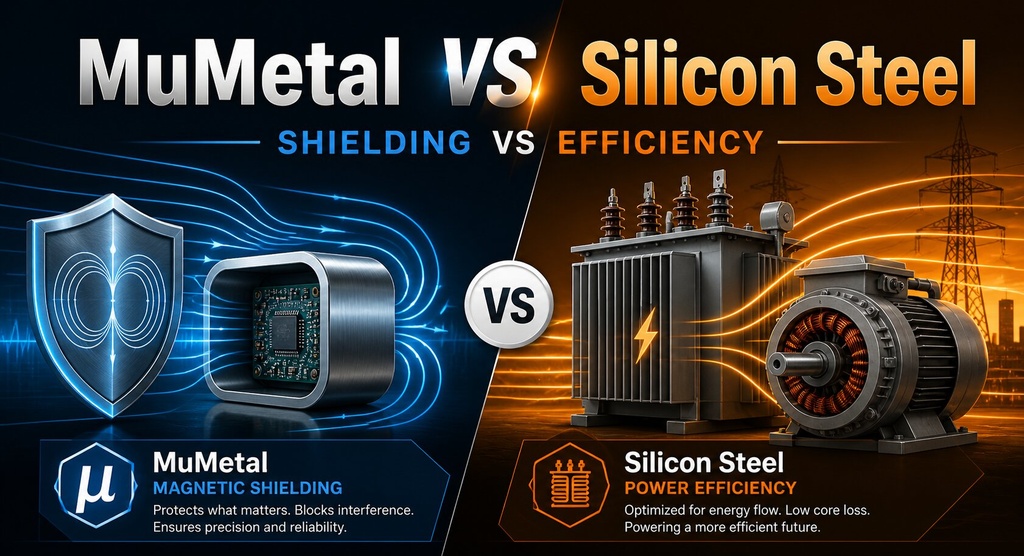
This is the true insight behind MuMetal vs Silicon Steel. One material is designed to absorb and redirect magnetic interference, protecting sensitive systems, while the other is optimized to enhance energy flow and reduce losses in power applications. Understanding this distinction allows engineers to make smarter decisions that improve reliability, efficiency, and long-term system performance.
Why DOMADIA™
Choosing between MuMetal and Silicon Steel is not just about specs—it’s about application precision.
With DOMADIA™, you get:
- High-purity, performance-tested materials
- Custom fabrication support
- Consistent quality across batches
- Engineering guidance for correct material selection
Conclusion
The MuMetal vs Silicon Steel decision goes far beyond a simple material comparison—it directly determines how efficiently and reliably your system performs under real-world conditions. In the discussion of MuMetal vs Silicon Steel, MuMetal stands out where precision matters most, delivering exceptional magnetic shielding in sensitive environments such as medical equipment, aerospace electronics, and high-end instrumentation. On the other hand, Silicon Steel remains the backbone of power and energy systems, offering superior efficiency in transformers, motors, and generators.
Choosing the wrong material can lead to hidden losses, increased electromagnetic interference, frequent system failures, and higher maintenance costs over time. These inefficiencies not only impact performance but also disrupt operations and reduce overall productivity. This is why engineers carefully evaluate MuMetal vs Silicon Steel before finalizing materials for critical applications. In contrast, selecting the right material ensures stable operation, reduced downtime, and long-term cost savings.
Ultimately, understanding the true difference between shielding performance and electrical efficiency is key. When you align the material choice with your application’s core requirement, you unlock durability, precision, and sustainable performance that supports future-ready engineering. The right outcome in MuMetal vs Silicon Steel always depends on whether your priority is magnetic shielding accuracy or electrical energy efficiency.
Choose the Right Magnetic Material for Maximum Performance
Choosing between MuMetal and Silicon Steel is not just technical—it’s strategic. The right material can enhance efficiency, eliminate interference, and extend the life of your system. In the debate of MuMetal vs Silicon Steel, selecting the correct alloy based on your application can significantly improve performance, reliability, and long-term operational stability. Don’t let the wrong choice impact your performance.
DOMADIA™offers engineered MuMetal and Silicon Steel solutions tailored to your exact application requirements.
Get in Touch with DOMADIA™ today to find the perfect solution for your application.
Talk to: Er.Pankaj Domadia | Kairav Domadia | Aadil Domadia | Pragati Sanap | Pooja N N
#MuMetal #SiliconSteel #MagneticShielding #ElectricalSteel #DOMADIA #EngineeringMaterials #IndustrialAlloys
Directly whatsapp us for an Enquiry: https://wa.link/kairav
We’ve delivered to Bengaluru, Mysuru, Mangaluru, Hubballi, and Belagavi—covering Karnataka, Telangana, Tamil Nadu, Kerala, and Andhra Pradesh, with exports to Australia, New Zealand, Singapore, Malaysia, and Indonesia.