Blogs
Copper Foil Thickness Guide: 7 Smart Optimization Strategies for High Performance | DOMADIA™
Copper Foil Thickness Guide for Precision Performance
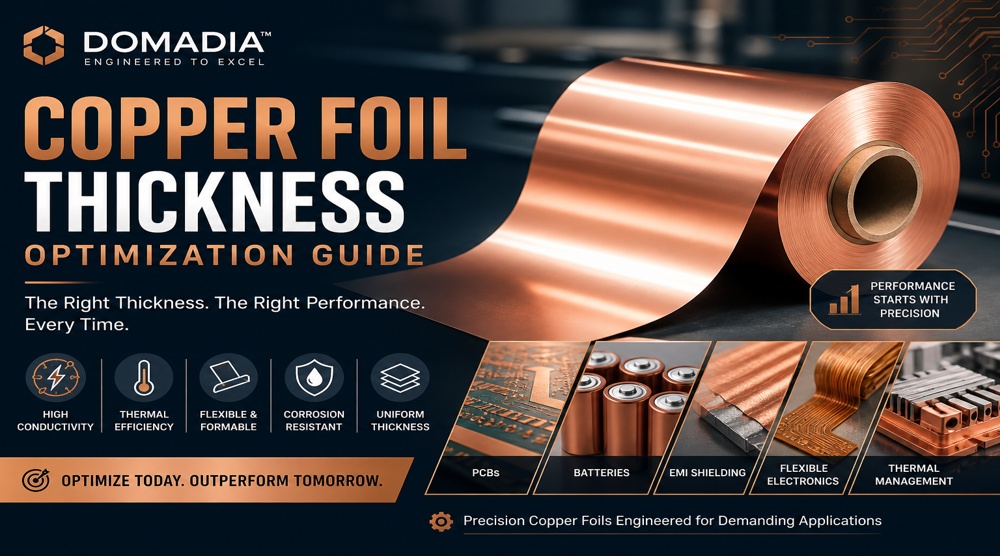
Copper Foil Thickness Guide is the foundation of efficient electrical, thermal, and mechanical performance across industries. Whether used in PCBs, batteries, flexible circuits, or EMI shielding, selecting the right thickness directly impacts conductivity, durability, heat dissipation, and lifecycle cost.
At DOMADIA™, engineers frequently encounter a critical challenge—some industries over-specify copper foil thickness, increasing material and production costs, while others under-specify it, leading to overheating, signal loss, reduced durability, and premature system failure. The key is not choosing the thickest foil, but selecting the correct thickness based on current load, flexibility, thermal requirements, and environmental conditions. This is where a well-planned Copper Foil Thickness Guide helps manufacturers achieve maximum efficiency, reliability, and long-term performance.
What is Copper Foil?
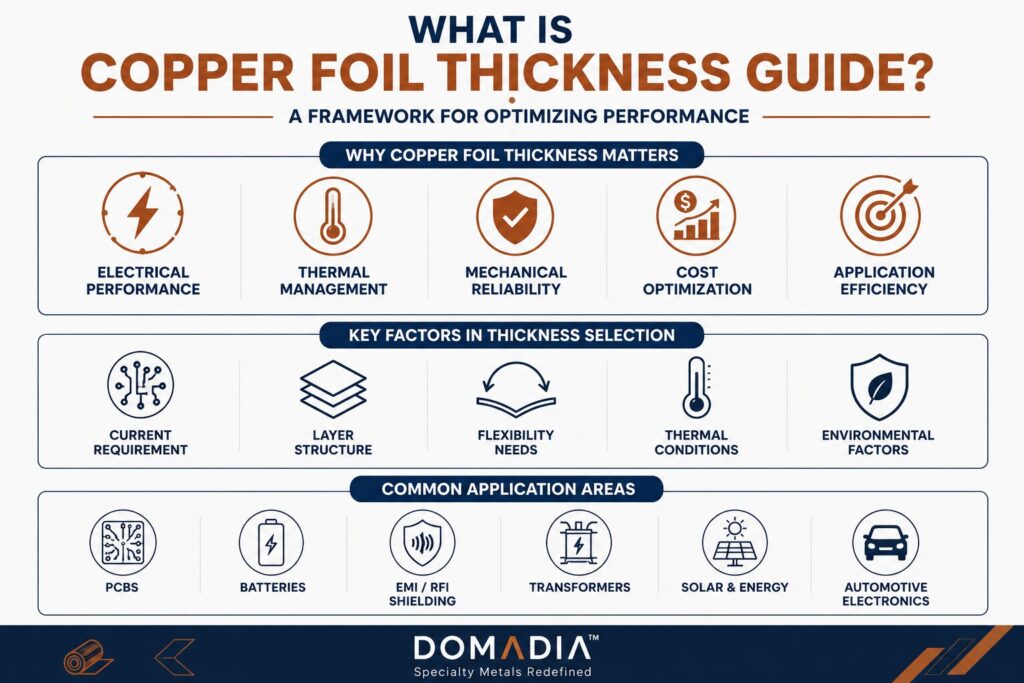
Copper Foil Thickness Guide explains how copper foil is a thin sheet of copper manufactured through rolling or electrodeposition processes. It is widely used in electronics, energy storage, and shielding applications due to its excellent electrical conductivity, thermal stability, and flexibility.
At DOMADIA™, copper foils are engineered to deliver consistent thickness, superior surface quality, and reliable performance under demanding industrial conditions. With the right selection strategy from this Copper Foil Thickness Guide, industries can improve efficiency, reduce energy loss, and achieve long-term reliability in critical applications.
Chemical Composition
High-purity copper foil typically contains:
- Copper (Cu): ≥ 99.90%
- Oxygen (O): Trace levels (for ETP copper)
- Other impurities: Minimal (Ag, Fe, Pb in trace ppm)
This high purity ensures maximum electrical conductivity and minimal signal loss.
Key Properties
Excellent electrical conductivity (~58 MS/m):
As highlighted in the Copper Foil Thickness Guide, the right foil thickness ensures efficient current flow with minimal energy loss, making it ideal for high-performance electrical and electronic applications.
High thermal conductivity:
Allows quick heat dissipation, preventing overheating and improving system reliability.
Superior flexibility and formability:
Easily adapts to complex shapes and designs without cracking, perfect for flexible electronics.
Good corrosion resistance:
Maintains performance and durability even in harsh environmental conditions.
Uniform thickness control:
Provides consistent performance across applications, reducing defects and improving reliability.
High surface smoothness:
Enhances adhesion and conductivity, especially critical in PCB and battery applications.
These properties make copper foil essential in precision-driven industries.
Technical Specifications
- Thickness Range: 5 microns to 105 microns
- Width: Customizable as per application
- Temper: Soft (annealed) to hard rolled
- Surface Treatment: Matte, shiny, or treated for adhesion
- Density: 8.96 g/cm³
- Conductivity: ≥ 98% IACS
Available Shapes
- Rolls: Ideal for continuous, high-volume production with efficient processing and minimal waste.
- Sheets: Pre-cut flat forms for precise applications and easy manual handling.
- Slitted Strips: Narrow, accurately cut foils for electrical and component-specific uses.
- Customized Profiles: Tailor-made shapes designed to meet exact engineering and application requirements.
DOMADIA™ ensures precision cutting and consistent thickness across all forms.
Applications of Copper Foil
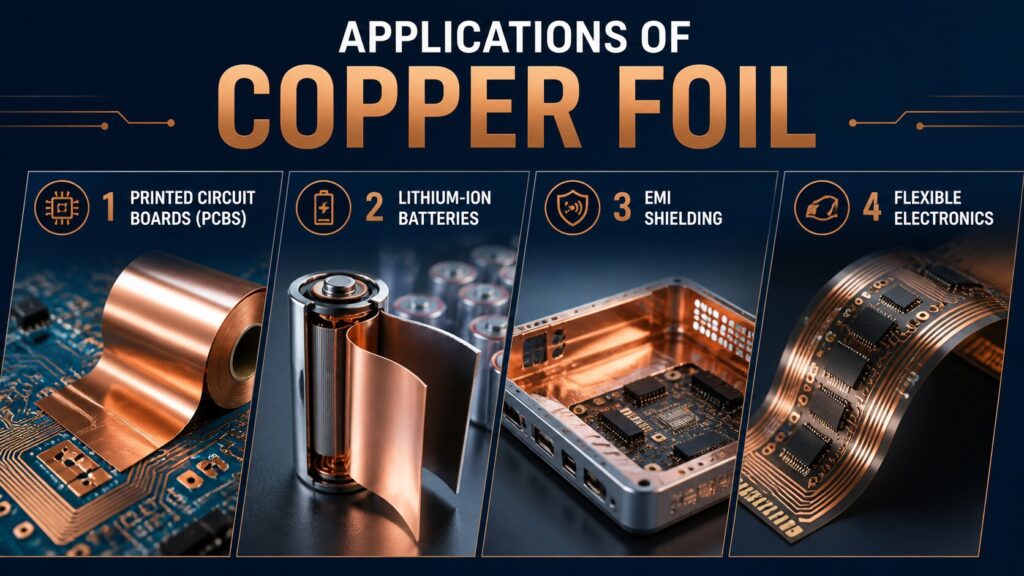
1. Printed Circuit Boards (PCBs)
According to the Copper Foil Thickness Guide, copper foil acts as the conductive layer that enables efficient signal transmission, stable current flow, and reliable circuit functionality in advanced electronic systems.
2. Lithium-ion Batteries
Used as a current collector, ensuring efficient energy transfer and battery performance.
3. EMI Shielding
Provides protection against electromagnetic interference in sensitive electronic devices.
4. Flexible Electronics
Supports bendable circuits used in wearable devices and advanced electronics.
5. Heat Transfer Systems
Enhances thermal management in high-performance applications.
Standards & Compliance
- ASTM B152 / B187 (Copper Foil Standards)
- IPC-4562 (PCB Copper Foil Standard)
- RoHS Compliance
- ISO 9001 Quality Standards
DOMADIA™ ensures all materials meet global industrial and quality benchmarks.
7 Smart Strategies for Thickness Optimization
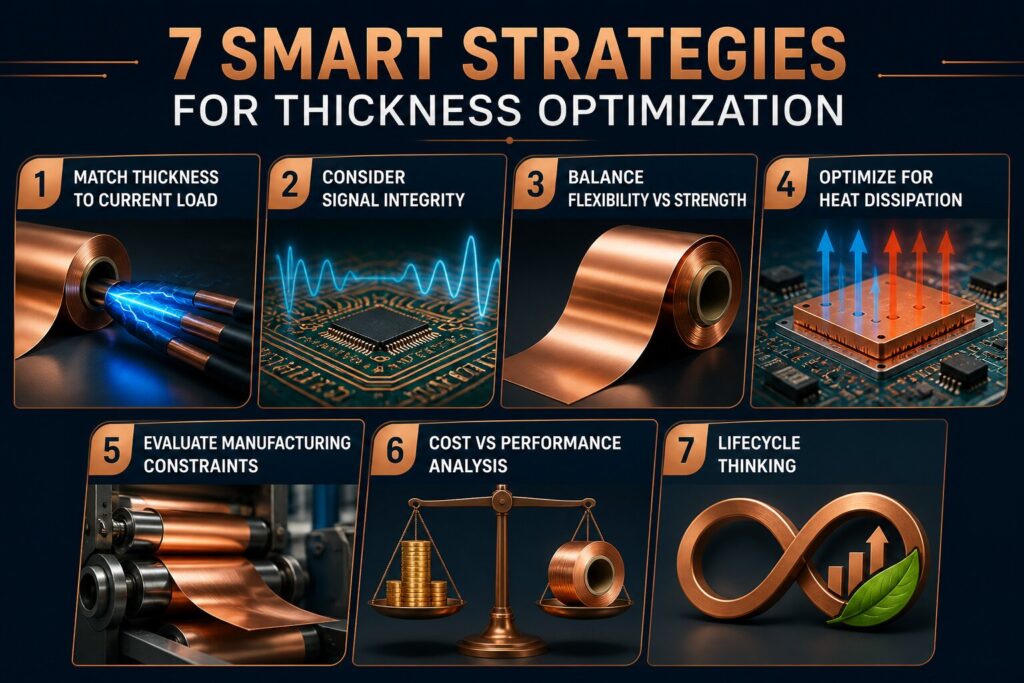
1. Match Thickness to Current Load
Higher current requires thicker foil to reduce resistance and heat generation.
2. Consider Signal Integrity
In high-frequency applications, thinner foils reduce signal distortion.
3. Balance Flexibility vs Strength
Thin foils offer flexibility, while thicker foils provide mechanical durability.
4. Optimize for Heat Dissipation
Thicker foils improve thermal management in power electronics.
5. Evaluate Manufacturing Constraints
Ultra-thin foils require advanced handling and precision processing.
6. Cost vs Performance Analysis
Avoid over-engineering—select thickness based on actual requirements.
7. Lifecycle Thinking
Correct thickness reduces failures, maintenance, and replacement costs.
Mindset Shift: From “More Thickness = Better” to “Right Thickness = Better”
Old thinking: Use thicker copper foil for safety
New thinking: Optimize thickness for performance and efficiency
This shift helps industries reduce material cost, improve performance, and extend product lifecycle. Over-specification increases weight and cost, while under-specification leads to overheating and failure. The Copper Foil Thickness Guide helps strike the perfect balance.
Why DOMADIA™
- Precision-controlled thickness tolerance
- High-purity copper for maximum conductivity
- Custom solutions for diverse industries
- Consistent quality across batches
- Technical support for optimization
With DOMADIA™, you don’t just get copper foil—you get engineered performance tailored to your application.
Conclusion
The Copper Foil Thickness Guide is not just about selecting a dimension—it is about optimizing performance, cost efficiency, and long-term reliability. The right thickness improves conductivity, enhances durability, minimizes energy loss, and ensures consistent efficiency across demanding industrial applications.
By partnering with DOMADIA™, industries gain access to high-performance copper foils designed for precision, consistency, and superior lifecycle value. A well-structured Copper Foil Thickness Guide helps manufacturers prevent costly failures, improve operational stability, and make smarter engineering decisions for future-ready applications.
Optimize Your Copper Foil Performance Today with DOMADIA™
Ready to enhance efficiency, reduce failures, and achieve precision performance? Connect with DOMADIA™ experts to find the perfect copper foil thickness for your application.
Get in Touch Now and Upgrade Your Material Strategy!.
Talk to: Er.Pankaj Domadia | Kairav Domadia | Aadil Domadia | Pragati Sanap | Pooja N N
#CopperFoil #CopperThickness #IndustrialMaterials #ElectronicsManufacturing #DOMADIA #EngineeringExcellence #PCBDesign
Directly whatsapp us for an Enquiry: https://wa.link/kairav
We’ve supplied to Mumbai, Pune, Indore, Jaipur, and Surat—serving industries across Maharashtra, Madhya Pradesh, Rajasthan, Gujarat, and Goa, with exports to Germany, USA, Japan, South Korea, and Italy.