Blogs
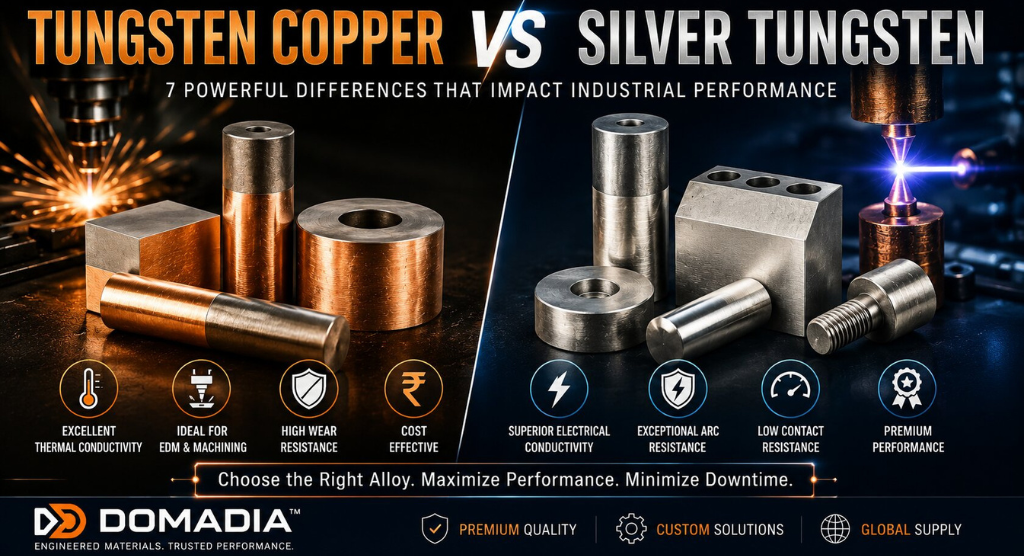
Tungsten Copper vs Silver Tungsten: 7 Powerful Differences That Impact Industrial Performance
Tungsten Copper vs Silver Tungsten: Which Alloy Truly Performs Better?
A manufacturing plant faced repeated shutdowns because electrical contacts in its high-voltage switchgear kept failing. The replacement cycle was becoming expensive, downtime was increasing, and productivity losses were affecting deliveries. The engineering team initially assumed all conductive alloys performed similarly — until they compared Tungsten Copper vs Silver Tungsten in real operating conditions.
That comparison changed everything.
While both materials are designed for high electrical and thermal performance, their applications, durability, conductivity, and cost-efficiency differ significantly. Selecting the wrong alloy can result in overheating, contact erosion, premature wear, and unexpected maintenance expenses.
At DOMADIA™, industries often ask one crucial question:
Should they choose Tungsten Copper or Silver Tungsten for long-term reliability?
The answer depends entirely on the operating environment.
Understanding Tungsten Copper
Tungsten Copper is a pseudo-alloy produced by combining tungsten’s high melting point and wear resistance with copper’s excellent electrical and thermal conductivity.
Unlike traditional alloys, tungsten and copper do not fully dissolve into each other. Instead, the material is manufactured through powder metallurgy and infiltration processes.
Chemical Composition of Tungsten Copper
| Element | Percentage |
| Tungsten (W) | 70–90% |
| Copper (Cu) | 10–30% |
Higher tungsten content increases hardness and arc resistance, while higher copper content improves conductivity.
Understanding Silver Tungsten
Silver Tungsten combines tungsten with silver to create a premium-grade electrical contact material capable of handling severe arcing conditions.
Silver improves conductivity beyond copper levels while tungsten provides mechanical strength and arc erosion resistance.
Chemical Composition of Silver Tungsten
| Element | Percentage |
| Tungsten (W) | 50–80% |
| Silver (Ag) | 20–50% |
Silver Tungsten is primarily used where superior switching performance is required.
Tungsten Copper vs Silver Tungsten: Key Differences
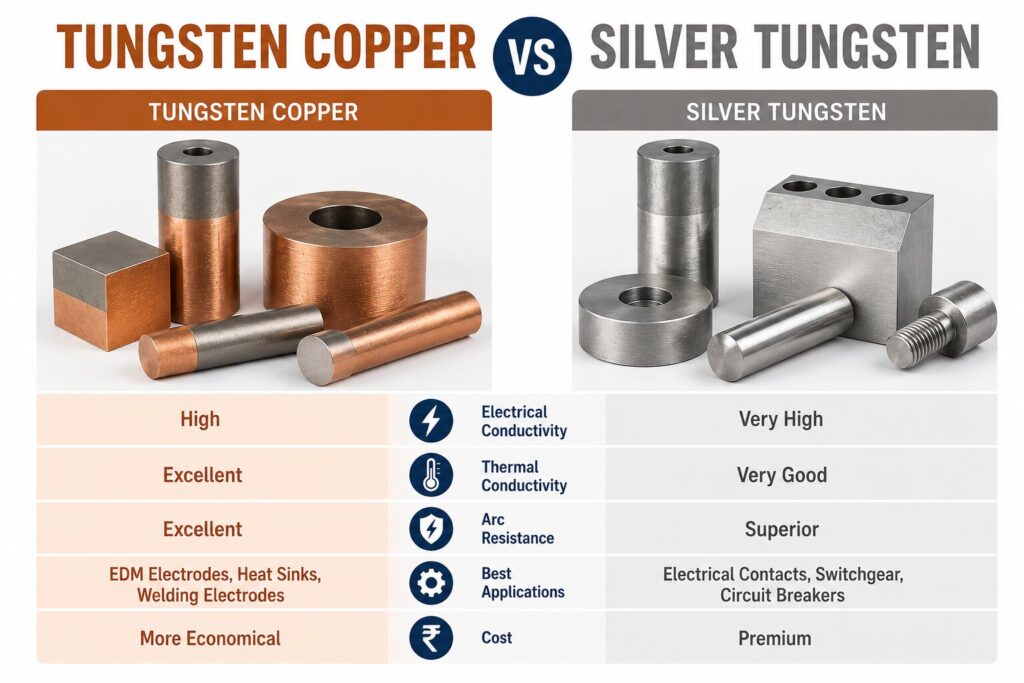
1. Electrical Conductivity
Silver is one of the best electrical conductors in the world.
This gives Silver Tungsten a major advantage in Tungsten Copper vs Silver Tungsten electrical contact applications requiring low contact resistance and stable conductivity.
Conductivity Comparison
| Material | Conductivity |
| Tungsten Copper | Moderate to High |
| Silver Tungsten | Very High |
Silver Tungsten is preferred in circuit breakers, relays, and switchgear where efficient current transfer is critical.
2. Arc Erosion Resistance
Both materials resist arc damage well, but in the Tungsten Copper vs Silver Tungsten comparison, Silver Tungsten performs exceptionally under repetitive switching operations.
Tungsten Copper performs better in thermal environments where heat dissipation matters more than switching frequency.
3. Thermal Conductivity
Tungsten Copper offers superior thermal management.
This makes it ideal for:
- EDM electrodes
- Heat sinks
- Aerospace thermal components
- Resistance welding electrodes
Its ability to rapidly dissipate heat prevents deformation and thermal fatigue.
4. Cost Difference
Silver Tungsten is significantly more expensive because of silver’s market value. However, when comparing Tungsten Copper vs Silver Tungsten, industries working with high-voltage interruption systems often recover that investment through longer service life, superior arc resistance, and reduced maintenance costs.
A cheaper material may appear economical initially, but in the long-term Tungsten Copper vs Silver Tungsten comparison, repeated replacements, downtime, and equipment failures usually cost far more than investing in the right alloy from the start.
Properties Comparison
| Property | Tungsten Copper | Silver Tungsten |
| Electrical Conductivity | High | Extremely High |
| Thermal Conductivity | Excellent | Very Good |
| Arc Resistance | Excellent | Superior |
| Wear Resistance | High | High |
| Hardness | Higher | Moderate |
| Cost | Economical | Premium |
| Contact Resistance | Moderate | Very Low |
Applications of Tungsten Copper
DOMADIA™ supplies Tungsten Copper materials for demanding industrial environments where thermal conductivity, wear resistance, and machinability are critical.
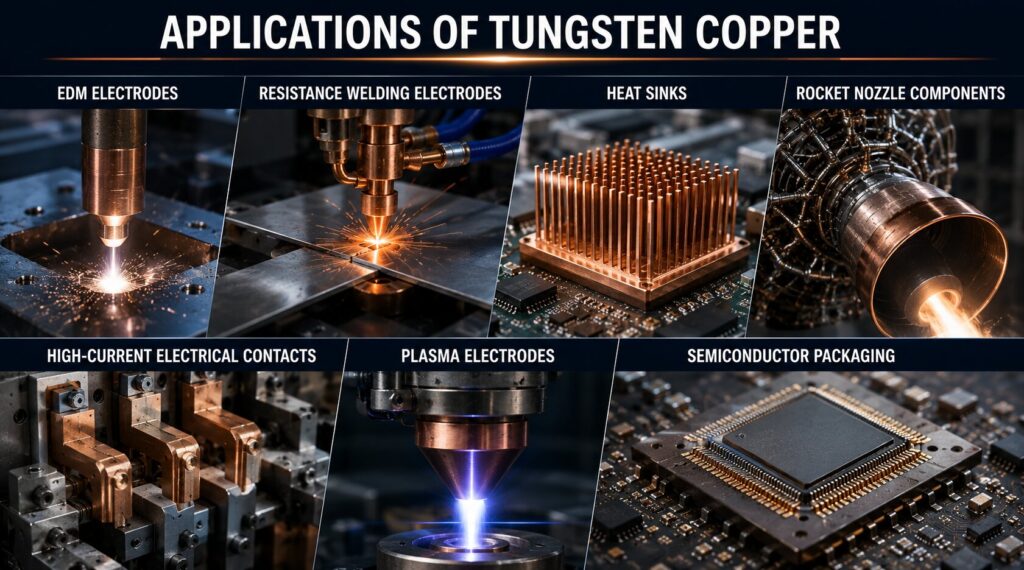
EDM Electrodes
Widely used in Electrical Discharge Machining, Tungsten Copper vs Silver Tungsten applications play a critical role in precision mold manufacturing and complex machining operations. Tungsten Copper offers excellent spark erosion resistance and dimensional stability.
Resistance Welding Electrodes
Used in spot, seam, and projection welding applications where high current carrying capacity and heat dissipation are essential for longer electrode life.
Heat Sinks
Ideal for advanced electronic cooling systems due to superior thermal conductivity and controlled thermal expansion properties.
Rocket Nozzle Components
Applied in aerospace propulsion systems, Tungsten Copper vs Silver Tungsten materials are valued for their ability to withstand extreme thermal loads and high-temperature environments.
High-Current Electrical Contacts
Used in heavy electrical systems where low wear, arc resistance, and high conductivity are required under continuous current loads.
Plasma Electrodes
Preferred in plasma cutting and thermal spray equipment due to excellent thermal shock resistance and durability.
Semiconductor Packaging
Utilized in electronic packaging for effective heat management and reliable thermal conductivity in sensitive semiconductor devices.
Its combination of machinability, conductivity, and thermal stability makes Tungsten Copper one of the most versatile refractory metal composites in modern industries.
Applications of Silver Tungsten
Silver Tungsten is widely used in electrical switching applications where conductivity, arc resistance, and switching reliability are non-negotiable.
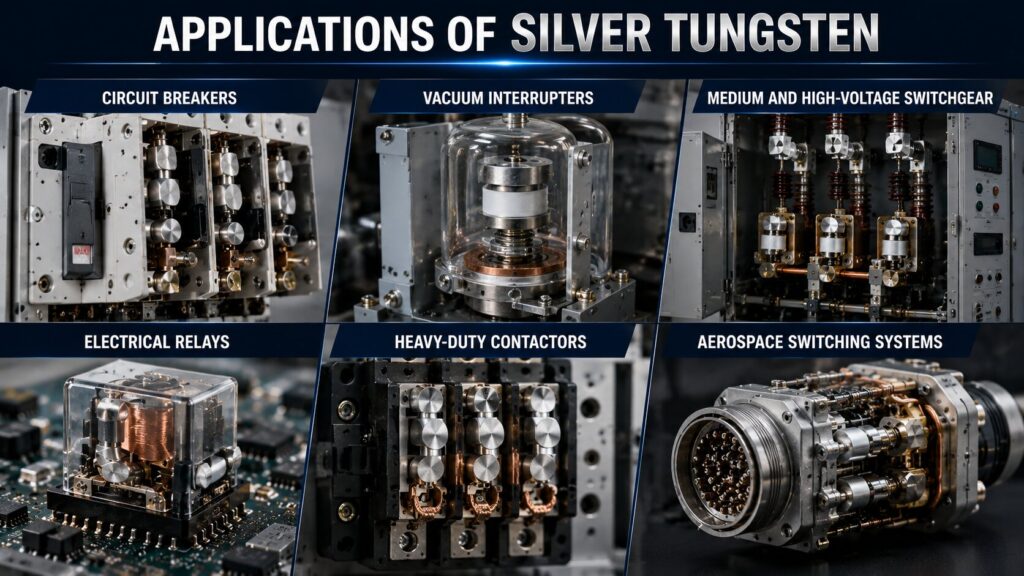
Circuit Breakers
Used in low, medium, and high-voltage breakers, Tungsten Copper vs Silver Tungsten applications require excellent arc erosion resistance and stable electrical performance during repeated switching.
Vacuum Interrupters
Ideal for vacuum switching systems where superior conductivity and contact durability are required under high electrical stress.
Medium and High-Voltage Switchgear
Applied in industrial switchgear systems to ensure reliable current interruption and minimal contact wear during operation.
Electrical Relays
Used in relays requiring low contact resistance, fast switching response, and consistent electrical conductivity.
Heavy-Duty Contactors
Preferred for industrial contactors operating under high-current loads and repetitive switching cycles.
Aerospace Switching Systems
Used in aerospace and defense electrical systems where reliability, conductivity, and resistance to harsh operating environments are critical, Tungsten Copper vs Silver Tungsten becomes an important material selection decision for engineers.
Industries choose Silver Tungsten for applications demanding exceptional switching performance, reduced maintenance, and long operational life.
Technical Specifications
Tungsten Copper Specifications
| Specification | Value |
| Density | 11.8–16.8 g/cm³ |
| Hardness | 75–260 HB |
| Conductivity | 30–55% IACS |
| Thermal Conductivity | 180–250 W/mK |
Silver Tungsten Specifications
| Specification | Value |
| Density | 11.5–15.0 g/cm³ |
| Hardness | 70–220 HB |
| Conductivity | 35–60% IACS |
| Thermal Conductivity | 150–220 W/mK |
Standards Followed
DOMADIA™ materials are supplied according to international industrial standards such as:
- ASTM
- DIN
- ISO
- IEC
- RoHS Compliance
Custom grades are also available depending on conductivity and wear requirements.
Shapes Available
DOMADIA™ supplies both Tungsten Copper and Silver Tungsten in multiple forms:
- Rods
- Plates
- Sheets
- Blocks
- Discs
- Electrodes
- Contact tips
- Custom-machined parts
Precision tolerances are available for critical industrial applications.
Environmental Perspective: Longer Life Means Less Waste
One hidden advantage in the Tungsten Copper vs Silver Tungsten comparison is sustainability.
Frequent replacement of worn-out contacts leads to more scrapping, recycling, transportation, and energy consumption. Silver Tungsten, despite its higher cost, often lasts substantially longer in switching applications.
Longer lifecycle means:
- Reduced industrial waste
- Lower replacement frequency
- Reduced downtime
- Lower environmental impact
At DOMADIA™, material selection is not just about performance — it is also about building more sustainable industrial systems.
Why DOMADIA™?
DOMADIA™ supplies high-performance refractory and conductive alloys trusted by industries requiring reliability under extreme operating conditions.
Why industries choose DOMADIA™:
- Precision-engineered materials
- Consistent electrical performance
- Custom manufacturing capability
- Strict quality inspection
- Fast global supply support
- Technical guidance for material selection
Whether the requirement is EDM machining, aerospace systems, or electrical switching applications, DOMADIA™ delivers Tungsten Copper vs Silver Tungsten materials engineered for long-term industrial performance.
Conclusion
The debate between Tungsten Copper vs Silver Tungsten is not about which alloy is universally better — it is about selecting the right material for the right operating condition.
If thermal conductivity, machinability, and cost-efficiency are priorities, Tungsten Copper becomes an excellent solution.
If the application demands exceptional electrical conductivity, low contact resistance, and superior switching reliability, Silver Tungsten stands out as the premium choice in the Tungsten Copper vs Silver Tungsten comparison.
The right alloy can dramatically reduce downtime, improve efficiency, and extend component life — making material selection a strategic industrial decision rather than just a purchasing decision.
Ready to Upgrade Your Electrical Contact Performance?
Choose the Right Alloy Before Downtime Chooses for You
Whether your industry demands superior thermal conductivity with Tungsten Copper or exceptional switching reliability with Silver Tungsten, selecting the correct material can dramatically improve equipment life, efficiency, and operational stability.
At DOMADIA™, we help industries choose engineered materials that reduce failures, lower maintenance costs, and deliver long-term performance under extreme conditions.
✅ Custom Sizes & Grades
✅ Precision Manufacturing
✅ Global Industrial Supply
✅ Technical Material Support
Get Expert Guidance & Custom Quotes Now
Talk to: Er.Pankaj Domadia | Kairav Domadia | Aadil Domadia | Pragati Sanap | Pooja N N
#TungstenCopper #SilverTungsten #ElectricalContacts #IndustrialAlloys #DOMADIA #CopperTungsten #EngineeringMaterials #EDMElectrodes #ResistanceWelding #MetalIndustry
Directly whatsapp us for an Enquiry: https://wa.link/kairav
We’ve supplied to Mumbai, Pune, Indore, Jaipur, and Surat—serving industries across Maharashtra, Madhya Pradesh, Rajasthan, Gujarat, and Goa, with exports to Germany, USA, Japan, South Korea, and Italy.