Blogs
Does Faraday Fabric Block All Electromagnetic Frequencies? 9 Powerful Facts
Faraday Fabric Frequency Blocking sounds simple: wrap an electronic device, room, enclosure or component in conductive fabric and electromagnetic signals disappear.
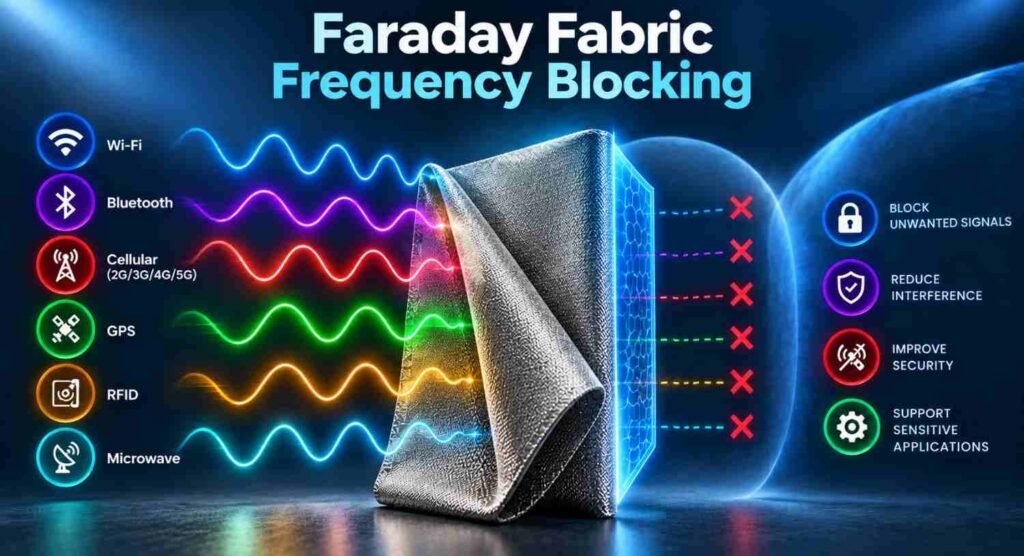
But electromagnetic shielding does not work like an ON/OFF switch. Faraday Fabric Frequency Blocking performance can vary significantly depending on the frequency, material construction, and overall shielding system.
A fabric may perform extremely well against certain radio-frequency signals while delivering very different results at another frequency. Even an excellent shielding material can lose effectiveness because of seams, openings, grounding, installation geometry, or damage.
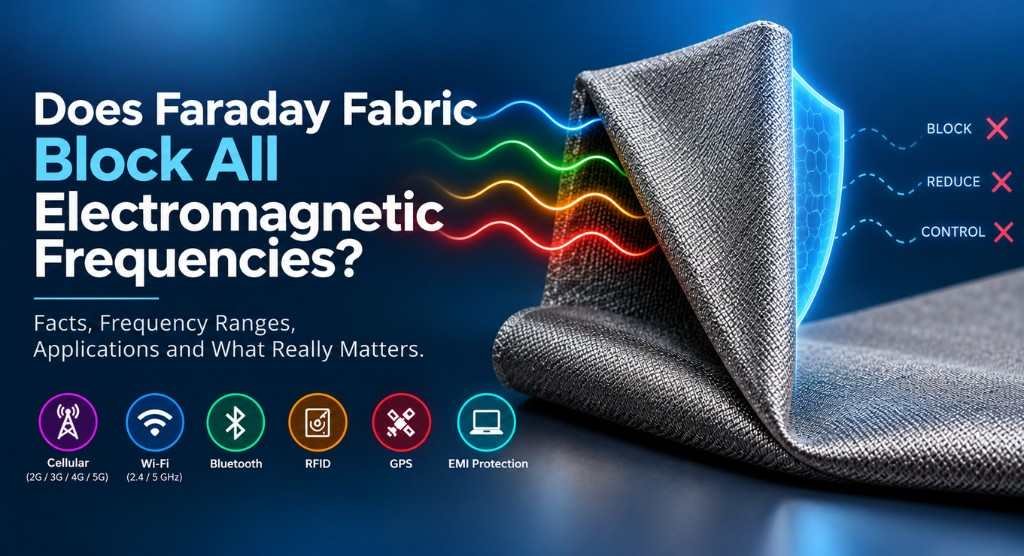
So, does Faraday fabric block all electromagnetic frequencies?
No—not equally, and no responsible engineering specification should treat it as a universal blocker of every electromagnetic frequency.
The better question is:
How much shielding effectiveness does a particular Faraday fabric provide at the frequencies that matter to your application?
Understanding Faraday Fabric Frequency Blocking in this way helps engineers evaluate shielding effectiveness based on actual operating frequencies and installation conditions rather than assuming universal protection.
That distinction can make the difference between a shielding system that works on paper and one that perfo
1. What Is Faraday Fabric?
Faraday fabric is a flexible conductive textile designed to reduce the transmission of electromagnetic energy.
Unlike a conventional fabric whose primary function may be mechanical protection, comfort or filtration, Faraday fabric incorporates electrically conductive materials.
Depending on the construction, this may involve conductive metals or metallic coatings combined with a textile substrate.
Common constructions can include materials based on:
- Nickel
- Copper
- Silver
- Nickel-copper combinations
- Conductive fibres
- Metallized textile substrates
The conductive network enables the material to interact with electromagnetic energy through mechanisms including reflection and absorption.
This is why conductive shielding fabrics can be incorporated into flexible EMI and RF shielding systems where rigid sheet-metal construction may be inconvenient.
2. Chemical Composition and UNS Number
Faraday fabric is not one standardized metallic alloy.
Therefore, there is no single Universal Numbering System (UNS) designation that represents all Faraday fabrics.
This is important when preparing technical specifications.
A conventional engineering alloy may have a tightly controlled chemistry and corresponding UNS designation. A shielding textile, however, may consist of a polymer substrate coated or combined with one or several conductive materials.
Its specification should therefore identify factors such as:
Base textile: polyester, nylon or another specified substrate.
Conductive material: nickel, copper, silver or another conductive coating/fibre system.
Construction: woven, knitted, nonwoven, coated or laminated.
Surface resistance: specified according to the actual product.
Shielding effectiveness: stated in dB against frequency, rather than as a vague claim that the material “blocks EMF.”
For DOMADIA™ applications, the actual material specification should therefore be confirmed instead of assuming that every conductive fabric has identical composition or performance.
3. Does Faraday Fabric Block All Electromagnetic Frequencies?
No.
Electromagnetic radiation covers an enormous spectrum, and a conductive textile cannot automatically provide the same shielding effectiveness across that entire spectrum. Faraday Fabric Frequency Blocking depends on frequency as well as the material’s electrical and physical characteristics.
This means a fabric that performs strongly at one frequency should not automatically be assumed to provide the same attenuation at another.
ASTM D4935, for example, provides a method for measuring electromagnetic shielding effectiveness of planar materials under specified far-field conditions. The current ASTM D4935-18(2026) method covers measurements from 30 MHz to 1.5 GHz with the specified specimen-holder arrangement. ASTM specifically notes that measurements should be made at several frequencies when material parameters vary with frequency.
This is particularly important when evaluating Faraday Fabric Frequency Blocking, because shielding performance measured at one frequency cannot simply be applied across the entire electromagnetic spectrum.
That tells us something important:
Shielding effectiveness must be considered as a function of frequency.
4. Understanding Shielding Effectiveness
Faraday fabric is generally evaluated in terms of shielding effectiveness (SE).
Shielding effectiveness is normally expressed in decibels (dB).
The greater the attenuation, the smaller the amount of electromagnetic energy passing through the shield.
For example, in simplified power terms:
| Shielding Effectiveness | Approximate Power Reduction |
| 10 dB | 90% |
| 20 dB | 99% |
| 30 dB | 99.9% |
| 40 dB | 99.99% |
| 60 dB | 99.9999% |
However, percentage figures alone can be misleading.
A specification such as “60 dB shielding effectiveness” is incomplete unless you also know the frequency, test method, specimen configuration and conditions under which that result was measured.
For engineering applications, ask:
60 dB at what frequency and under what test conditions?
That is a much more useful question.
5. Which Frequencies Can Faraday Fabric Shield?
The answer depends entirely on the particular fabric and its tested frequency range.
Conductive fabrics are commonly considered for shielding signals associated with technologies and equipment operating in RF and microwave ranges.
Depending on tested material performance, applications may involve frequencies associated with:
Mobile and Cellular Communications
Conductive shielding materials may be used in environments where cellular RF signals need to be attenuated.
Wi-Fi
Wi-Fi systems operate at radio and microwave frequencies where suitable conductive enclosures and fabrics can provide substantial attenuation when properly constructed.
Bluetooth
Bluetooth also operates in RF bands and may be attenuated by suitable conductive shielding materials.
RFID
Faraday pouches and enclosures are frequently used for Faraday Fabric Frequency Blocking, helping reduce RF communication with RFID-enabled devices when sufficient shielding effectiveness is achieved at the relevant frequencies.
GPS and Other Wireless Systems
Appropriately engineered conductive enclosures can support effective Faraday Fabric Frequency Blocking by reducing RF signal transmission, provided the shielding system achieves sufficient attenuation at the relevant operating frequencies.
Electronic Equipment EMI
Faraday fabrics can also be integrated into equipment, curtains, covers, and enclosures intended to control electromagnetic interference. Effective Faraday Fabric Frequency Blocking depends on selecting a material that provides suitable shielding performance for the frequencies involved.
The important word in every example is suitable.
Do not select a fabric simply because its product name contains “Faraday.” For reliable Faraday Fabric Frequency Blocking, select the fabric according to its measured shielding performance over your required frequency range.
6. Why Low-Frequency Magnetic Fields Are More Difficult
This is one of the most important distinctions in electromagnetic shielding.
Conductive materials can be highly useful for many electric-field, RF and microwave shielding applications. However, low-frequency magnetic-field shielding can be considerably more challenging.
A thin conductive textile should therefore not automatically be treated as a substitute for a high-permeability magnetic shielding alloy.
Materials such as Mu Metal are specifically associated with magnetic shielding because their high magnetic permeability helps redirect magnetic flux.
Consequently, if an application involves strong low-frequency magnetic fields from transformers, motors, power equipment or similar sources, an engineer may need to consider a different material or a multilayer shielding strategy.
Faraday fabric and magnetic shielding alloy solve different engineering problems.
7. Nine Factors That Determine Faraday Fabric Performance
Two pieces of the same conductive fabric can produce very different real-world results depending on how they are installed.
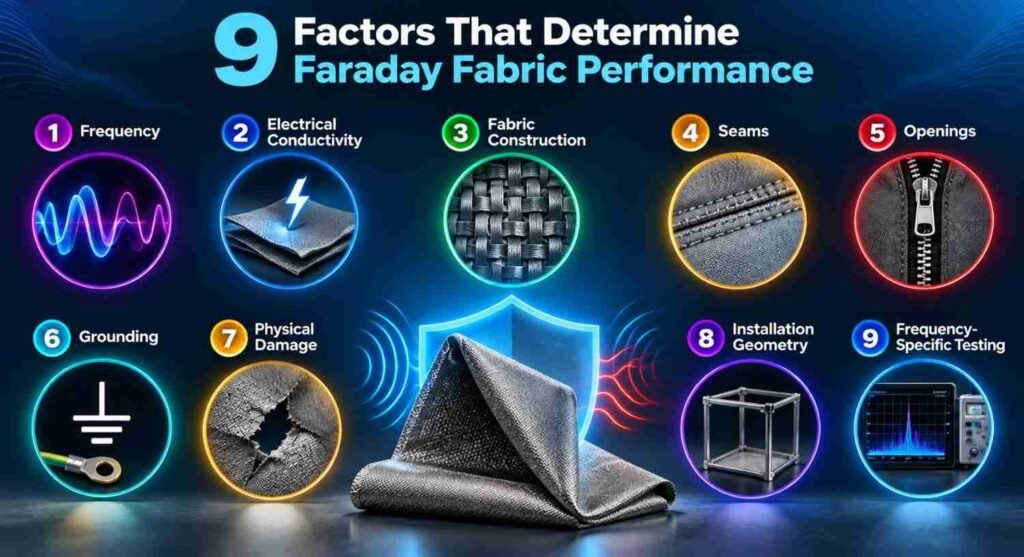
1. Frequency
Shielding effectiveness can change with electromagnetic frequency, making Faraday Fabric Frequency Blocking highly dependent on the specific operating conditions.
Always examine performance across the application’s actual frequency band.
2. Electrical Conductivity
The conductive layer must provide an appropriate electrically conductive path, as reliable Faraday Fabric Frequency Blocking depends on maintaining effective conductivity throughout the shielding material.
Materials and coating quality therefore matter.
3. Fabric Construction
Weave, thickness, coating, substrate and conductive continuity can influence overall performance.
4. Seams
A perfect sheet of shielding material can become a poor enclosure if the seams create leakage paths, reducing Faraday Fabric Frequency Blocking performance.
Overlapping and electrically continuous seams are generally preferable to uncontrolled gaps.
5. Openings
Doors, windows, cable penetrations, ventilation openings, and other apertures can compromise Faraday Fabric Frequency Blocking by reducing the overall shielding effectiveness of the enclosure.
6. Grounding
Grounding requirements for Faraday Fabric Frequency Blocking depend on the shielding system, safety requirements, frequency, and specific application.
Grounding should therefore be carefully designed rather than treated as a universal one-step solution.
7. Physical Damage
Tears, holes, and worn conductive coatings can interrupt electrical continuity and reduce Faraday Fabric Frequency Blocking performance by creating possible leakage points.
8. Installation Geometry
Wrapping a small device and shielding an entire room are fundamentally different engineering tasks. Effective Faraday Fabric Frequency Blocking depends on dimensions, seams, penetrations, and the overall enclosure design.
9. Frequency-Specific Testing
The best way to determine whether Faraday Fabric Frequency Blocking works effectively is to evaluate the shielding solution under conditions relevant to the intended application.
8. Why Tiny Gaps Can Create Big Problems
Here is where Faraday shielding becomes surprisingly unforgiving.
You can purchase an excellent conductive fabric and still create an ineffective enclosure.
Suppose a shielding curtain provides strong attenuation across your required RF band. During installation, however, two panels meet without sufficient conductive overlap.
That seam can become the weak point.
Similarly, a Faraday enclosure may include openings for:
- Power cables
- Data cables
- Ventilation
- Doors
- Windows
- Sensors
- Pipes
- Mechanical controls
Electromagnetic energy does not care that 99% of the enclosure is beautifully covered.
The system’s weak points matter.
This is why professional shielding design focuses not only on the material but on the complete shielding system.
9. Properties of Faraday Fabric
The exact values depend on the particular construction, but conductive shielding fabrics may be selected for a useful combination of properties.
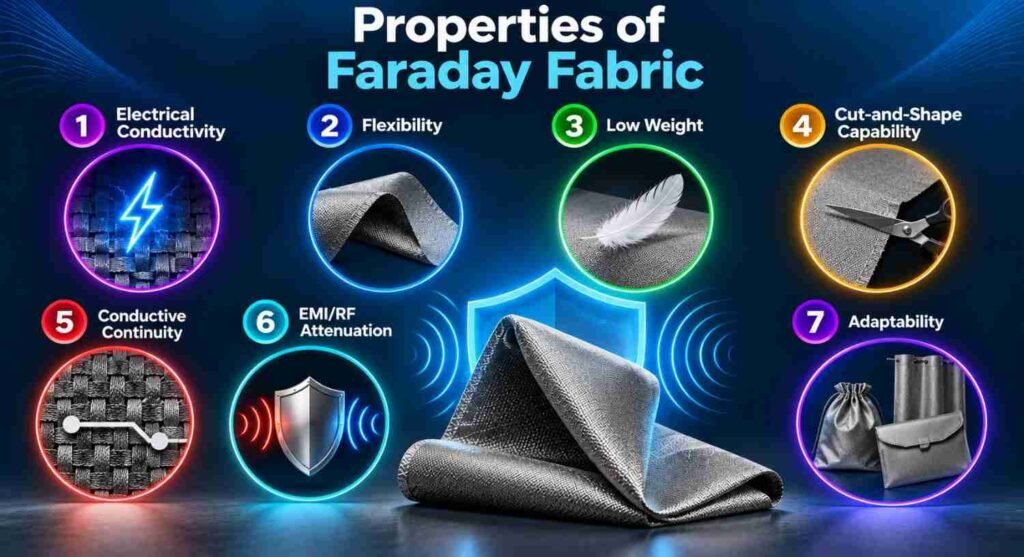
Electrical Conductivity
A conductive surface allows the fabric to interact effectively with electromagnetic fields, supporting reliable Faraday Fabric Frequency Blocking across the intended frequency range.
Flexibility
One of the biggest advantages over rigid metallic shielding is the ability to bend, fold, and conform to complex shapes, making Faraday Fabric Frequency Blocking practical for flexible and irregular shielding configurations.
Low Weight
Thin conductive textiles can provide a lightweight solution for Faraday Fabric Frequency Blocking, offering greater flexibility and lower weight compared with heavy metallic shielding structures.
Cut-and-Shape Capability
Fabric can often be adapted to covers, curtains, pouches, and custom shielding structures, making Faraday Fabric Frequency Blocking suitable for flexible and application-specific shielding designs.
Conductive Continuity
Electrical continuity between different sections is important for maintaining effective Faraday Fabric Frequency Blocking and consistent overall enclosure performance.
EMI/RF Attenuation
Properly specified fabric can provide substantial electromagnetic attenuation, supporting effective Faraday Fabric Frequency Blocking across its tested frequency range.
Adaptability
Faraday fabrics can be useful for temporary, portable, and irregularly shaped shielding installations, making Faraday Fabric Frequency Blocking practical where flexible and adaptable shielding is required.
10. Technical Specifications to Check Before Buying
Never select Faraday fabric based only on a statement such as “blocks radiation.”
Ask for meaningful engineering information.
| Parameter | What to Check |
| Conductive material | Nickel, copper, silver or specified combination |
| Base textile | Polyester, nylon or specified substrate |
| Shielding effectiveness | dB versus frequency |
| Tested frequency range | Minimum and maximum tested frequencies |
| Surface resistance | Product-specific value |
| Thickness | Product-specific value |
| Width | Available roll width |
| Weight | Typically specified per unit area |
| Construction | Woven, knitted, nonwoven or laminated |
| Temperature capability | Application-specific |
| Test method | ASTM, IEEE or other specified method |
| Mechanical durability | Folding, abrasion and wear requirements |
| Environmental resistance | Humidity, oxidation, chemicals and application conditions |
The important point is that technical specifications should come from the exact fabric being supplied, not from generic values for “Faraday fabric.”
11. Standards and Testing Methods
Reliable electromagnetic shielding requires meaningful testing.
ASTM D4935
ASTM D4935 is a recognized test method for measuring the electromagnetic shielding effectiveness of planar materials.
The current D4935-18(2026) method measures net shielding effectiveness resulting from reflection and absorption under specified conditions and covers a measurement range of approximately 30 MHz to 1.5 GHz with the described fixture.
It is especially relevant when evaluating planar shielding materials.
IEEE 299
IEEE 299 addresses measurement of electromagnetic shielding effectiveness for enclosures rather than simply characterizing an isolated piece of fabric.
The previous IEEE 299-2006 standard covered measurements from 9 kHz to 18 GHz, with extension possibilities beyond that range. IEEE currently lists a revision project, P299, whose scope covers 9 kHz to 40 GHz, extendable down to 50 Hz and up to 100 GHz.
This distinction between material testing and enclosure testing is extremely important.
A fabric’s laboratory shielding result is not automatically the same as the shielding effectiveness of a finished room, bag, tent or enclosure.
12. Shapes and Forms Available
DOMADIA™ can support requirements for conductive shielding materials in application-dependent forms and configurations.
These may include:
- Faraday fabric rolls
- Cut sheets
- Custom-sized pieces
- Conductive shielding covers
- Curtain material
- Wrapping material
- Shielding layers
- Custom fabrication material
Availability should always be confirmed according to required dimensions, conductive construction, shielding performance, quantity and end application.
13. Applications of Faraday Fabric
Because of its flexibility, conductive fabric can support a wide variety of EMI and RF control projects.
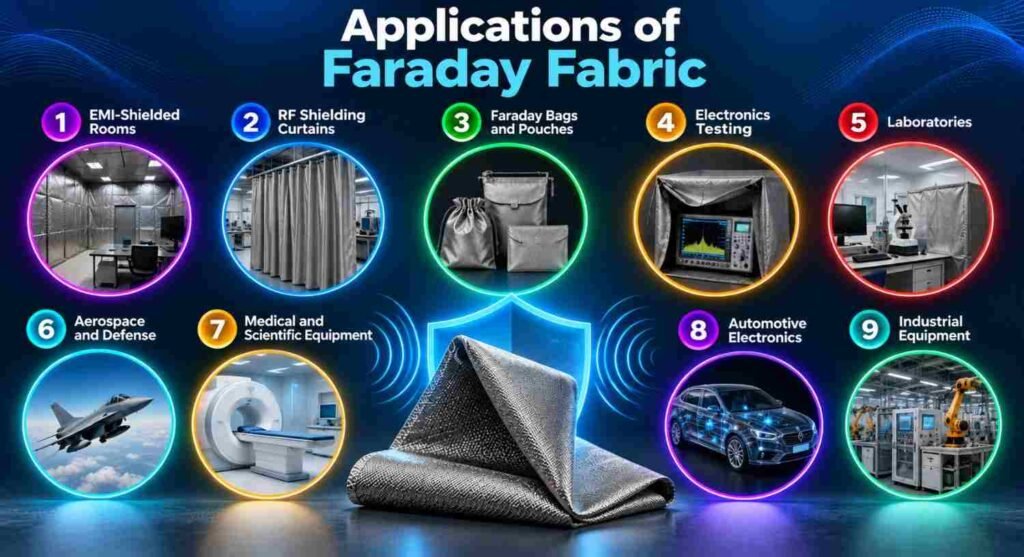
EMI-Shielded Rooms
Conductive textiles may form part of room-scale shielding systems where lightweight and flexible materials are desirable.
RF Shielding Curtains
A fabric-based curtain can support effective Faraday Fabric Frequency Blocking while providing movable and flexible shielding for laboratories, testing areas, and industrial environments.
Faraday Bags and Pouches
Conductive fabric can be fabricated into enclosures for electronic devices where RF isolation is required.
Electronics Testing
Temporary conductive enclosures can help engineers investigate electromagnetic interference and wireless communication behaviour.
Laboratories
Research facilities may use conductive textiles to support effective Faraday Fabric Frequency Blocking as part of experimental RF and EMI shielding arrangements.
Aerospace and Defense
Lightweight, flexible shielding materials can support effective Faraday Fabric Frequency Blocking where mass, complex geometry, and electromagnetic compatibility requirements must be carefully balanced.
Medical and Scientific Equipment
Sensitive instrumentation may require effective Faraday Fabric Frequency Blocking to help manage electromagnetic interference and support reliable equipment performance.
Automotive Electronics
Increasing electronic content in vehicles makes electromagnetic compatibility increasingly important, with Faraday Fabric Frequency Blocking helping manage unwanted electromagnetic interference in suitable automotive shielding applications.
Industrial Equipment
Conductive materials can support effective Faraday Fabric Frequency Blocking by helping manage interference around sensitive electronics, instrumentation, and control systems.
14. Can Faraday Fabric Block 5G, Wi-Fi and Bluetooth?
This question needs a specification-based answer rather than a simple yes or no.
A suitable conductive fabric can substantially attenuate RF signals in bands used by Wi-Fi, Bluetooth, cellular communications and other wireless systems when the material has demonstrated adequate shielding effectiveness at those frequencies and the enclosure is properly constructed.
But do not assume:
“It blocks Wi-Fi, therefore it blocks every 5G frequency.”
Different wireless technologies operate across different bands.
The correct approach is:
Identify frequency → establish required attenuation → review test data → design enclosure → verify finished shielding system.
That five-step process is far more reliable than purchasing fabric based on a generic “EMF blocking” claim.
15. Does More Layers Mean Better Shielding?
Potentially—but not automatically.
Multiple conductive layers can improve attenuation in some shielding designs. However, real performance depends on layer construction, electrical contact, spacing, frequency and enclosure geometry.
If a second layer is added but the system still contains a poorly sealed opening, the opening may remain the dominant leakage path.
More material is therefore not always the first solution.
Better shielding design is often more valuable than simply adding more fabric.
16. Faraday Fabric vs Solid Metal Sheet
Why use fabric when copper or aluminum sheet can create an excellent conductive enclosure?
Because practical engineering involves more than maximum shielding.
Rigid metal sheet may provide excellent electrical continuity and mechanical strength, but it is not always suitable for movable or irregular structures.
Faraday fabric offers:
Flexibility: suitable for curtains, covers and wrapping.
Portability: useful for temporary installations.
Low weight: advantageous when a heavy metal enclosure is impractical.
Ease of fabrication: it can be adapted to unusual shapes.
Foldability: useful for portable shielding products.
Solid metal, meanwhile, may be preferable when structural rigidity, durability and highly controlled enclosure construction are required.
The correct material depends on the application rather than on which material sounds more powerful.
17. The Biggest Myth About Faraday Fabric
The biggest misconception is:
“If the fabric is conductive, it blocks everything.”
Conductivity is only one part of electromagnetic shielding.
Real performance depends on:
Material + Frequency + Construction + Seams + Apertures + Geometry + Installation + Testing
Remove any one of these considerations and the final system may behave differently from expectations.
This is why Faraday Fabric Frequency Blocking should always be evaluated using measured shielding effectiveness rather than marketing terminology alone.
Why DOMADIA™?
Electromagnetic shielding projects rarely begin with the question, “How much fabric do I need?”
They begin with a technical problem.
What frequencies need to be attenuated?
How much shielding effectiveness is required?
Will the material become a curtain, cover, enclosure or equipment shield?
Are there openings or penetrations?
Does the application require flexibility?
What dimensions and quantity are required?
DOMADIA™ supports customers looking for specialized shielding materials by helping them define the material requirement around the actual engineering application.
When enquiring, provide:
- Required frequency range
- Required shielding effectiveness
- Fabric dimensions
- Thickness requirement, if specified
- Conductive material preference
- Required quantity
- Operating environment
- End application
- Applicable testing or compliance requirement
The clearer the technical requirement, the easier it becomes to identify an appropriate shielding material.
Conclusion: Does Faraday Fabric Really Block Everything?
No—and that is not a weakness of Faraday fabric. It is simply how electromagnetic shielding works.
Faraday fabric can be an extremely useful solution for controlling EMI, RF and microwave-frequency signals when the material is correctly selected and incorporated into a properly designed shielding system.
However, it should never be assumed to block every electromagnetic frequency equally.
Low-frequency magnetic fields may require a fundamentally different shielding strategy. Seams and openings can reduce system performance. Material composition, conductivity and construction matter. Most importantly, shielding effectiveness should be evaluated against the actual frequencies encountered in the application.
That is the central lesson behind Faraday Fabric Frequency Blocking:
Don’t ask whether a fabric blocks electromagnetic radiation. Ask how many decibels it attenuates at your required frequencies—and whether the finished enclosure maintains that performance.
For specialized Faraday fabrics, conductive shielding materials and application-specific EMI/RF shielding requirements, contact DOMADIA™ with your frequency range, required attenuation, dimensions, quantity and end-use details.
Need the Right Faraday Fabric for Your Shielding Application?
Not every electromagnetic shielding requirement is the same. DOMADIA™ can help you source Faraday fabric and conductive shielding materials based on your required frequency range, dimensions, shielding performance, quantity, and application.
Need reliable Faraday fabric for your EMI/RF shielding application? Contact Us today to discuss your shielding requirements with DOMADIA™.
Talk to: Er.Pankaj Domadia | Kairav Domadia | Aadil Domadia | Pragati Sanap | Pooja N N
#HighTemperatureCableRange #HighTemperatureCable #HeatResistantCable #IndustrialCables #ElectricalEngineering #Manufacturing #IndustrialAutomation #PowerSystems #DOMADIA
Directly whatsapp us for an Enquiry: https://wa.link/kairav
We’ve supplied to Mumbai, Pune, Indore, Jaipur, and Surat—serving industries across Maharashtra, Madhya Pradesh, Rajasthan, Gujarat, and Goa, with exports to Germany, USA, Japan, South Korea, and Italy.