Blogs
Can You Recycle Tungsten Copper Scrap? 9 Powerful Benefits of Scrap Recovery
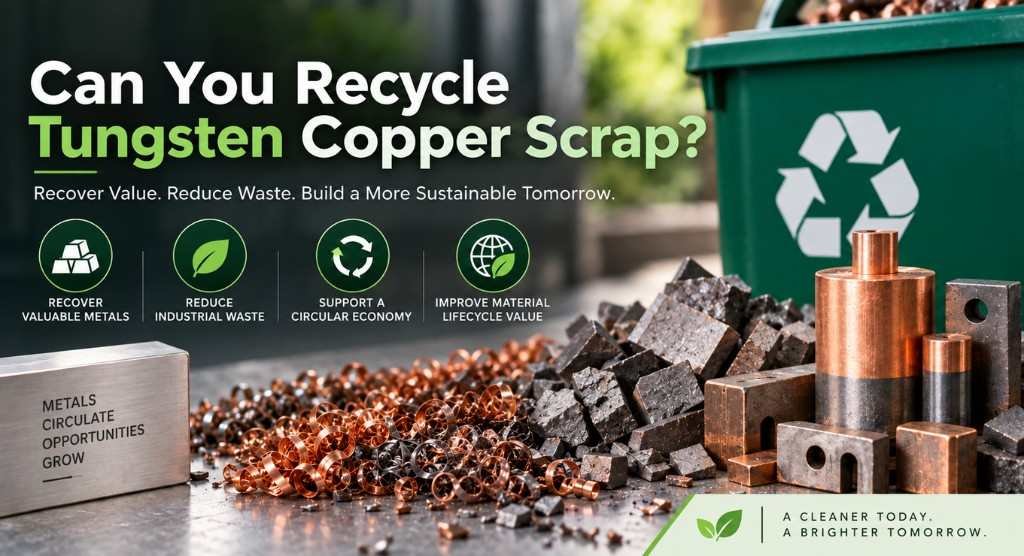
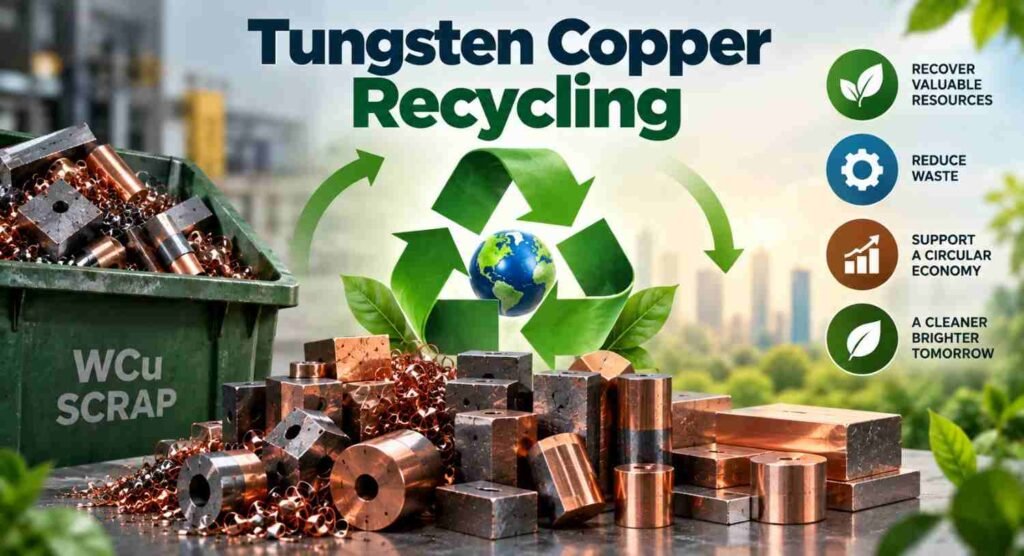
Tungsten Copper Recycling is not only possible—it can be an economically and environmentally valuable way to recover two useful metals from machining waste, worn components, offcuts, rejected parts, and other tungsten-copper scrap.
There is a common moment in a machine shop: a tungsten-copper component has reached the end of its useful life, or a pile of chips and offcuts has accumulated beside the machining center. The part may be finished, but the tungsten and copper inside it have not suddenly lost their value.
That changes the question from “How do we dispose of this scrap?” to “How much value can we recover from it?”
For manufacturers using tungsten-copper materials in electrical, thermal-management, EDM, resistance-welding, aerospace, electronics, and other demanding applications, recycling can form an important part of responsible material management.
At DOMADIA™, we believe specialty materials should be considered across their complete lifecycle—from material selection and processing to scrap segregation and eventual recovery.
What Is Tungsten Copper?
Tungsten copper, often written as WCu, is a composite material combining tungsten and copper.
The two metals have very different characteristics. Tungsten provides properties such as high density, high melting point and resistance to high-temperature degradation, while copper contributes excellent electrical and thermal conductivity.
Importantly, tungsten and copper have very limited mutual solubility under normal processing conditions. Commercial WCu materials are therefore generally produced through powder-metallurgy and infiltration/sintering approaches rather than simply melting the two metals together like a conventional fully soluble alloy.
Common nominal compositions include:
| Grade/Composition | Approx. Tungsten | Approx. Copper |
| W50Cu50 | 50% | 50% |
| W60Cu40 | 60% | 40% |
| W70Cu30 | 70% | 30% |
| W75Cu25 | 75% | 25% |
| W80Cu20 | 80% | 20% |
| W85Cu15 | 85% | 15% |
| W90Cu10 | 90% | 10% |
Exact compositions and specifications should always be confirmed against the supplier’s material documentation.
Tungsten Copper Recycling: Can WCu Scrap Really Be Recycled?
Yes. Tungsten Copper Recycling can recover value from WCu scrap, although the exact recycling route depends heavily on the material’s composition, cleanliness, physical form, contamination level, volume and recycler capabilities.
Unlike ordinary mixed-metal waste, tungsten-copper scrap should ideally be identified and segregated.
Why?
Because throwing a known WCu grade into a mixed-metal scrap stream can reduce its recoverable value and make subsequent processing more complicated.
Potential recycling routes can involve mechanical preparation, thermal or chemical processes, powder recovery, or metallurgical separation and refining. The appropriate method is a specialist decision rather than a one-size-fits-all process.
What Types of Tungsten Copper Scrap Can Potentially Be Recycled?
Tungsten-copper scrap can appear at virtually every stage of manufacturing.
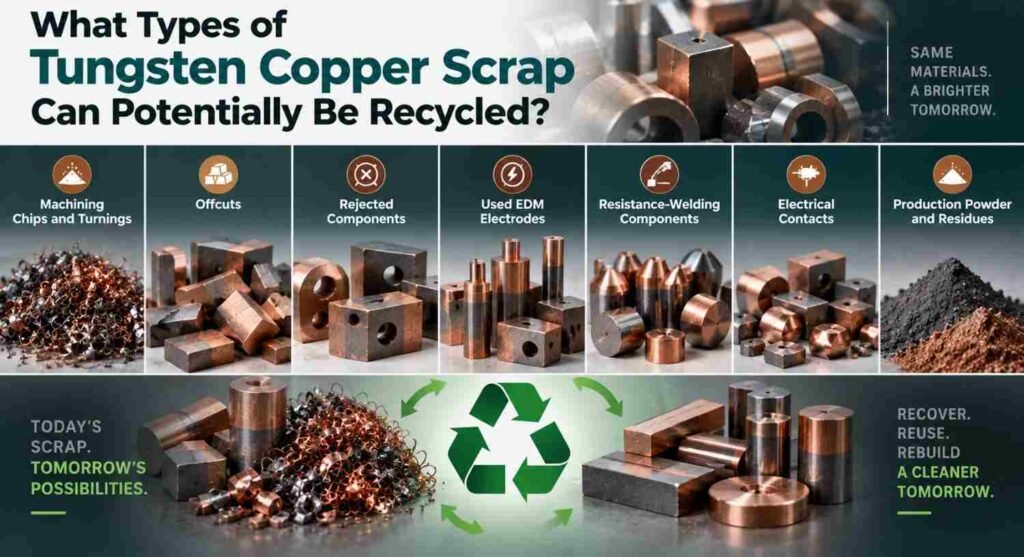
1. Machining Chips and Turnings
Machining tungsten-copper components can generate chips, turnings and fines. When these are collected separately and protected from contamination by other alloys, coolants, oils and foreign materials, Tungsten Copper Recycling can turn them into a potentially useful secondary material stream.
2. Offcuts
Sawing, cutting and fabrication can leave pieces too small for the original job but potentially valuable as scrap, making Tungsten Copper Recycling a practical option for recovering useful material from these WCu remnants.
3. Rejected Components
A dimensional error does not necessarily make the constituent metals worthless. Parts rejected during quality inspection may be candidates for Tungsten Copper Recycling, helping recover potentially valuable tungsten and copper from otherwise unusable WCu components.
4. Used EDM Electrodes
Tungsten-copper materials are commonly associated with electrical-discharge-machining electrode applications, and once an electrode becomes too worn for reliable use, the remaining material may still have recycling value.
5. Resistance-Welding Components
Electrodes and related components exposed to demanding thermal and electrical cycles eventually wear. Instead of treating worn components simply as waste, Tungsten Copper Recycling allows businesses to evaluate whether a specialist recycler can process and recover potentially valuable material from them.
6. Electrical Contacts
Depending on composition and contamination, end-of-life WCu electrical components may also enter specialized recovery streams, making Tungsten Copper Recycling an important consideration for recovering potentially valuable tungsten and copper resources.
7. Production Powder and Residues
Powders require considerably more careful handling than solid scrap. Fine particulate material can create occupational exposure, contamination and housekeeping considerations, making proper handling especially important during Tungsten Copper Recycling. Appropriate industrial procedures should therefore be followed.
9 Powerful Benefits of Recycling Tungsten Copper Scrap
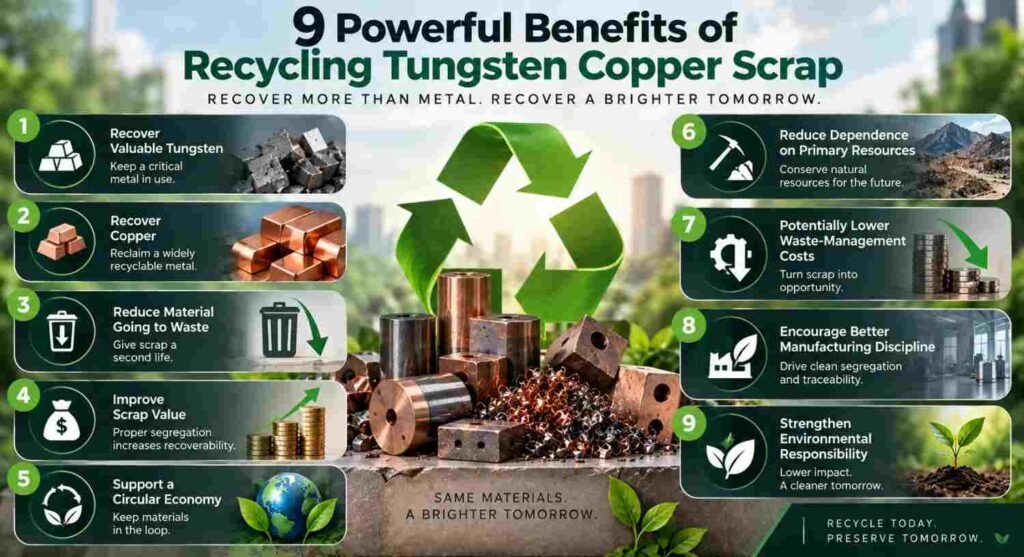
1. Recover Valuable Tungsten
Tungsten is an important industrial raw material with demanding extraction and processing requirements.
A component reaching the end of its service life does not mean its tungsten content has become useless.
Recovering tungsten from suitable scrap can return valuable material to industrial supply chains.
2. Recover Copper
Copper is already one of the world’s most extensively recycled engineering metals.
Recovering copper from WCu scrap can contribute additional value, although the economic viability depends on the scrap composition and recovery process.
3. Reduce Material Going to Waste
Specialty metal scrap should not automatically be treated like ordinary industrial waste. Separating identifiable WCu scrap can support Tungsten Copper Recycling, creating an opportunity for material recovery rather than disposal.
4. Improve Scrap Value
A drum labeled W80Cu20 – Clean Machining Scrap is potentially far more useful to a specialist recycler than an unidentified drum containing WCu, steel, aluminium, brass and other machining debris. For effective Tungsten Copper Recycling, accurate material identification and proper segregation matter.
5. Support Circular Material Use
Recycling extends the useful lifecycle of the constituent materials. Through Tungsten Copper Recycling, recovered material can potentially re-enter manufacturing supply chains after suitable processing and qualification, even after the original component has reached the end of its service life.
6. Reduce Dependence on Primary Resources
Recycling cannot eliminate primary mining, but secondary materials can supplement virgin resource supply.
For strategic and specialized metals, diversification of material sources can also improve supply-chain resilience.
7. Potentially Reduce Waste-Management Costs
Depending on location, quantity and material condition, recycling can sometimes turn a disposal stream into a recoverable-value stream.
The actual economics should be assessed using recycler quotations, transportation expenses, analysis costs and processing charges.
8. Encourage Better Manufacturing Discipline
Once a business starts measuring scrap value, waste segregation usually becomes more important.
Operators have a reason to keep WCu chips away from stainless steel, aluminium, brass and ordinary copper scrap.
That improves traceability.
9. Strengthen Environmental Responsibility
The environmental argument is broader than simply saying, “metal is recyclable.”
Mining, concentration, refining, transportation and material processing all consume resources and energy.
Keeping usable metals circulating for longer can reduce demand for some primary material and prevent potentially recoverable specialty-metal scrap from being unnecessarily discarded.
Environmental Effect: Why Longer Material Lifecycles Matter
There is an important lifecycle principle behind Tungsten Copper Recycling:
The best scrap is often the scrap you did not need to generate prematurely.
Recycling itself requires collection, transportation, sorting and processing. Therefore, recycling is valuable, but extending component life and using material efficiently are also important.
Consider two components.
Component A requires frequent replacement.
Component B performs reliably for considerably longer.
Even when both are recyclable, Component B can potentially require fewer manufacturing, transportation, replacement and recycling cycles over a given operating period.
That is why DOMADIA™ encourages customers to consider performance, durability, machinability, material utilization and eventual recovery together—not merely the initial purchase price.
Properties That Make Tungsten Copper Valuable
The reason WCu scrap deserves attention is closely related to why the material was valuable in the first place.
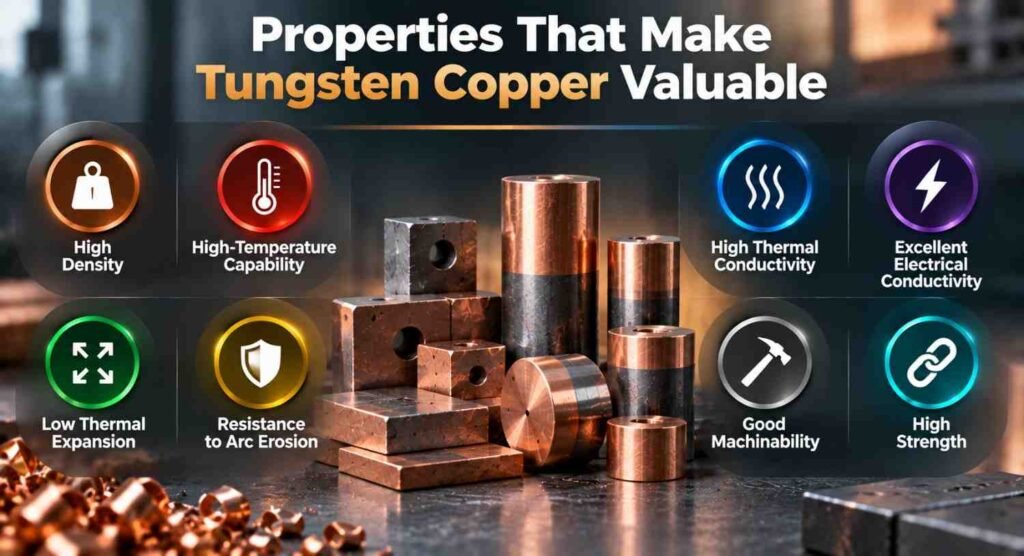
High Density
Increasing tungsten content generally increases the density of the composite, making Tungsten Copper Recycling valuable for recovering potentially useful tungsten and copper from WCu scrap and end-of-life components.
Thermal Conductivity
Copper contributes useful heat-transfer capability, making suitable WCu compositions attractive for thermal-management applications, while Tungsten Copper Recycling can help recover potentially valuable material from manufacturing scrap and end-of-life thermal components.
Electrical Conductivity
Copper also provides electrical conductivity, supporting applications involving electrical current, while Tungsten Copper Recycling can help recover potentially valuable material from used WCu electrical components and manufacturing scrap.
High-Temperature Capability
Tungsten has the highest melting point among pure metals, while the composite structure can provide useful performance in demanding thermal applications.
Controlled Thermal Expansion
Tungsten-rich compositions can provide a lower coefficient of thermal expansion than pure copper, which can be valuable in certain electronic and thermal-management applications, while Tungsten Copper Recycling supports the recovery of potentially valuable material from manufacturing scrap and end-of-life components.
Resistance to Arc Erosion
Certain tungsten-copper compositions are used for electrical-contact and electrode applications where resistance to heat and electrical-arc effects is important.
Technical Specifications of Tungsten Copper
Properties vary significantly with tungsten/copper ratio, processing route, porosity, heat treatment and product form.
Typical engineering characteristics include:
| Characteristic | General Trend |
| Composition | Tungsten + Copper |
| Density | Increases with tungsten content |
| Electrical conductivity | Generally increases with copper content |
| Thermal conductivity | Strongly influenced by copper content and microstructure |
| Thermal expansion | Generally decreases as tungsten content rises |
| Hardness | Generally increases with tungsten content |
| Machinability | Possible, but grade and tooling dependent |
| Manufacturing | Commonly powder metallurgy/infiltration based |
| Recyclability | Potentially recyclable through specialist processors |
These are general engineering trends rather than guaranteed specifications. DOMADIA™ recommends selecting material against the actual application requirements and applicable material documentation.
Standards and Material Designations
One challenge with tungsten-copper composites is that there is no single UNS number covering every WCu composition.
Unlike some conventional alloys that can be referenced through one widely recognized grade designation, tungsten-copper materials are frequently specified through composition, manufacturer grade, drawing requirements, application standards or procurement specifications.
Depending on the product and application, specifications may reference ASTM, AMS, military, industry-specific or customer-defined requirements.
For recycling, the most useful information can include:
- Original WCu composition
- Manufacturer or supplier grade
- Material certificate
- Purchase specification
- Batch or heat/lot identification
- Contamination history
- Product form
- Approximate scrap weight
Do not assign an unknown scrap material a UNS designation without appropriate material verification.
Applications That Generate Tungsten Copper Scrap
WCu scrap can originate from several industrial sectors.
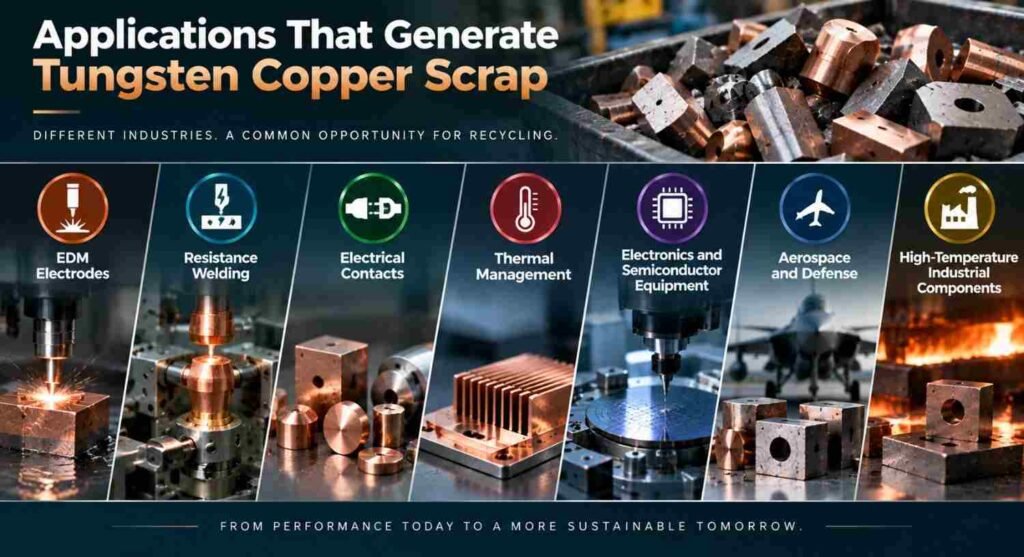
EDM Electrodes
Complex EDM operations may consume electrodes over time and also produce scrap during electrode machining, making Tungsten Copper Recycling an important consideration for recovering potentially valuable WCu material.
Resistance Welding
Electrode components can experience repeated thermal and electrical loading.
Electrical Contacts
Switching and high-current systems can use tungsten-containing contact materials where arc and wear resistance are required.
Thermal Management
Tungsten-copper materials can be used where heat dissipation and thermal-expansion management must work together, while Tungsten Copper Recycling can help recover potentially valuable material from end-of-life components and manufacturing scrap.
Electronics and Semiconductor Equipment
WCu can appear in heat-spreading, packaging and specialized electronic components, making Tungsten Copper Recycling relevant when recovering potentially valuable material from manufacturing scrap and end-of-life parts.
Aerospace and Defense
High density, thermal behavior and dimensional stability can make tungsten-containing materials useful for specialized aerospace and defense applications.
High-Temperature Industrial Components
Specific WCu compositions may be selected where copper alone would not provide the desired combination of thermal, electrical and mechanical characteristics, while Tungsten Copper Recycling can help recover potentially valuable material from manufacturing scrap and end-of-life components.
Shapes Available from DOMADIA™
Depending on grade, composition, dimensions and manufacturing requirements, tungsten-copper materials may be sourced in forms such as:
- Rods
- Bars
- Plates
- Sheets
- Discs
- Blocks
- Electrodes
- Rings
- Machined components
- Custom components
Availability should be confirmed for the required composition, dimensions, tolerance and quantity.
How Should Tungsten Copper Scrap Be Collected?
The recycling process actually begins at the machine—not at the recycling facility.
Step 1: Identify the Grade
Keep W70Cu30, W80Cu20 and other compositions identified wherever practical.
Step 2: Separate Different Materials
Avoid mixing WCu with:
- Steel
- Aluminium
- Brass
- Bronze
- Pure copper
- Carbide
- Nickel alloys
- Other tungsten materials
Step 3: Separate Solid Scrap and Fines
Solid offcuts and machining fines can require different handling and processing.
Step 4: Minimize Contamination
Coolants, cutting oils, abrasive residues and foreign metals may complicate recycling.
Step 5: Keep Documentation
Certificates and purchase records can make scrap identification easier.
Step 6: Weigh the Material
Knowing approximately how much material is available makes discussions with recyclers more productive.
Step 7: Use a Qualified Specialist
WCu should be handled by a recycler or processor capable of evaluating tungsten-bearing composite scrap.
Can You Melt Tungsten Copper Scrap and Reuse It Yourself?
This is generally not a practical workshop recycling method. Effective Tungsten Copper Recycling requires considerably more control than simply reheating used WCu components.
Copper melts at a much lower temperature than tungsten, and tungsten’s extremely high melting point is one reason WCu is typically manufactured through specialized powder-metallurgy techniques.
Simply putting old WCu pieces into a conventional furnace does not reproduce a properly controlled commercial WCu composite. Instead, Tungsten Copper Recycling may require specialized separation, powder preparation, refining, sintering, infiltration and quality-control processes.
For production-critical applications, recycled feedstock must also meet the required chemical, physical and performance specifications.
Is Recycled Tungsten Copper as Good as New Material?
The answer depends on what is meant by “recycled.”
Recovered tungsten and copper can potentially become useful industrial feedstock again after appropriate processing. However, scrap should not simply be assumed to have the same properties as certified new WCu material.
For demanding applications, material should be manufactured, tested and qualified against the applicable specification.
This distinction is particularly important for:
- Aerospace
- Defense
- Semiconductor
- High-current electrical systems
- Precision electronics
- Critical welding applications
Traceability and certification can matter as much as composition.
Why Scrap Segregation Can Affect Profitability
Suppose a machine shop generates 100 kg of WCu scrap.
If it is clearly identified, composition-controlled and reasonably clean, a specialist recycler has better information for assessing it.
If the same material is mixed with steel chips, carbide fragments, aluminium, lubricants and unidentified alloys, processing becomes more difficult.
So one of the simplest actionable fixes is:
Create dedicated, clearly labeled scrap containers for every high-value specialty material used regularly.
For example:
W80Cu20 ONLY
Clean Solids
No Steel / Aluminium / Carbide
That small operational change can improve traceability and make recycling discussions significantly easier.
Why DOMADIA™?
Material selection should not end with a datasheet.
DOMADIA™ supports industries seeking specialty materials for demanding electrical, thermal, manufacturing and engineering applications.
Customers can approach DOMADIA™ for tungsten-copper requirements involving different compositions, shapes and application-specific requirements.
With DOMADIA™, customers can benefit from:
Material Selection Support
Choose a tungsten-to-copper ratio appropriate for the application’s thermal, electrical and mechanical requirements.
Multiple Forms
Source material in practical forms for manufacturing and machining requirements.
Custom Requirements
Discuss dimensions, composition, tolerances and application-specific needs.
Industrial Experience
Work with a supplier focused on specialty metals, engineered materials and demanding industrial applications.
Lifecycle Thinking
Consider material performance, utilization, service life and responsible scrap management as interconnected decisions.
Conclusion: Tungsten Copper Scrap Can Still Hold Value
Tungsten Copper Recycling changes the way manufacturers should look at end-of-life WCu components.
A worn electrode, machining offcut or rejected component is not necessarily worthless waste. It contains tungsten and copper that may potentially be recovered through appropriate specialist recycling processes. With an effective Tungsten Copper Recycling approach, manufacturers can treat suitable end-of-life material as a potentially recoverable resource rather than ordinary industrial waste.
The practical strategy is straightforward: identify the grade, segregate the scrap, minimize contamination, retain documentation and work with a qualified recycling specialist. Proper segregation can make Tungsten Copper Recycling more efficient by helping recyclers understand the material composition and reducing unnecessary mixing with unrelated scrap.
And there is an even bigger lesson.
Sustainability is not simply about recycling more material. It is about selecting appropriate materials, using them efficiently, extending component life wherever practical, reducing unnecessary scrap and then recovering useful resources when the component finally reaches the end of its service life.
Ultimately, Tungsten Copper Recycling should be considered part of a broader lifecycle strategy—one that combines responsible material selection, efficient use, longer service life and end-of-life resource recovery.
That is the lifecycle approach DOMADIA™ believes specialty materials deserve.
Turn Tungsten Copper Requirements Into the Right Material Solution
Looking for Tungsten Copper materials for demanding electrical, thermal, EDM, or industrial applications? DOMADIA™ can help you select the right composition, shape, and specifications for your requirements.
Contact DOMADIA™ today to discuss your Tungsten Copper requirements and get expert material support.
Talk to: Er.Pankaj Domadia | Kairav Domadia | Aadil Domadia | Pragati Sanap | Pooja N N
#MuMetal #UNSN14080 #AcousticShielding #MagneticShielding #EMIShielding #NickelAlloys #EngineeringMaterials #DOMADIA
Directly whatsapp us for an Enquiry: https://wa.link/kairav
We’ve supplied to Mumbai, Pune, Indore, Jaipur, and Surat—serving industries across Maharashtra, Madhya Pradesh, Rajasthan, Gujarat, and Goa, with exports to Germany, USA, Japan, South Korea, and Italy.