Blogs

Is Mu Metal Better Than Lead for Radiation Shielding? 7 Critical Facts About UNS N14080
Mu Metal Radiation Shielding: Is It Really Better Than Lead?
Mu Metal Radiation Shielding can sound like a straightforward alternative to lead—until an engineer asks one crucial question:

What Exactly Are We Trying to Shield?
Mu Metal Radiation Shielding becomes important when the problem involves low-frequency magnetic interference rather than ionizing radiation.
Consider a sensitive instrument operating close to electrical equipment. Its readings fluctuate whenever a nearby transformer is energized. Someone proposes adding lead because lead is famous for “radiation shielding.”
A thick lead barrier is installed.
But the interference remains.
Why?
Because ionizing radiation and low-frequency magnetic fields are different shielding problems. Understanding this distinction is essential when evaluating Mu Metal Radiation Shielding for sensitive instruments and electronic systems.
Lead is widely used to attenuate X-rays and gamma radiation because of its high density and high atomic number. Mu metal, particularly high-permeability UNS N14080, is engineered primarily to redirect low-frequency magnetic flux around sensitive equipment.
Therefore, Mu Metal Radiation Shielding should be considered when magnetic-field interference is the primary concern, while lead serves a fundamentally different purpose in shielding against ionizing radiation.
That difference determines which material should be selected.
1. First, What Do We Mean by “Radiation”?
The word radiation covers several very different physical phenomena.
It can refer to:
- X-rays
- Gamma rays
- Alpha and beta radiation
- Neutron radiation
- Radio-frequency electromagnetic energy
- Electromagnetic fields
- Static and low-frequency magnetic fields
A material that performs exceptionally well against one does not automatically work well against another.
This is the mindset shift engineers need to make:
Do not choose a shielding material because it has a reputation for “shielding.” Choose it according to the type, frequency, intensity and source of the field or radiation.
That is why asking whether mu metal is “better than lead” requires more context.
2. What Is Mu Metal UNS N14080?
Mu metal is a soft magnetic nickel-iron alloy engineered for exceptionally high magnetic permeability.
A commonly specified grade is:
UNS N14080
It is covered by ASTM A753 Alloy 4, a specification for wrought nickel-iron soft magnetic alloys. ASTM describes these materials as alloys intended for applications requiring properties including high magnetic permeability, high electrical resistivity, low coercive field strength and low core loss.
Its exceptional permeability allows magnetic flux to preferentially travel through the material rather than through the protected region.
Therefore, mu metal does not simply “stop” magnetic fields.
It provides a low-reluctance path that redirects magnetic flux around the protected component or space.
That mechanism is fundamentally different from the way lead attenuates X-rays and gamma rays.
3. Chemical Composition of Mu Metal UNS N14080
Typical high-permeability mu-metal chemistry is dominated by nickel and iron.
A representative composition includes:
| Element | Typical / Specified Range |
| Nickel (Ni) | 80–82% |
| Molybdenum (Mo) | 3.5–6%* |
| Manganese (Mn) | ≤0.8% |
| Silicon (Si) | ≤0.5% |
| Cobalt (Co) | ≤0.5% |
| Copper (Cu) | ≤0.30% |
| Chromium (Cr) | ≤0.30% |
| Carbon (C) | ≤0.05% |
| Iron (Fe) | Balance |
*Exact chemistry should always be checked against the applicable material specification and manufacturer certification. Published commercial mu-metal compositions can vary by product and production lot.
The chemistry and carefully controlled heat treatment work together to produce the alloy’s extremely high magnetic permeability.
4. Mu Metal vs Lead: The Fundamental Difference
This is where the comparison becomes interesting.

Mu Metal
Mu metal is designed primarily for magnetic shielding. Mu Metal Radiation Shielding uses the alloy’s high permeability to create a preferred route for magnetic flux, helping reduce the magnetic field reaching sensitive equipment.
Lead
Lead performs an entirely different job.
Its high density and atomic number make it effective at attenuating penetrating ionizing electromagnetic radiation such as X-rays and gamma rays. Lead and lead compounds have therefore been widely used in medical and nuclear radiation-protection systems.
So asking:
“Is mu metal better than lead?”
is similar to asking whether a thermal insulator is better than an electrical insulator.
The answer depends on what must be controlled.
5. Mu Metal vs Lead Shielding Comparison
| Requirement | Mu Metal UNS N14080 | Lead |
| Static magnetic fields | Excellent when correctly engineered | Poor choice |
| Low-frequency magnetic fields | Excellent | Poor choice |
| X-rays | Not its primary shielding function | Excellent/common choice |
| Gamma rays | Not normally selected as primary shielding | Excellent/common choice |
| High magnetic permeability | Extremely high | Very low |
| Main shielding mechanism | Redirects magnetic flux | Attenuates ionizing photons |
| Sensitive instruments | Highly useful | Application dependent |
| Medical X-ray barriers | Generally unsuitable as substitute | Widely used |
| Magnetic sensor protection | Highly suitable | Generally unsuitable |
| Final heat treatment importance | Critical | Not comparable |
The most important takeaway is therefore simple:
Mu metal and lead are not direct substitutes.
They solve fundamentally different shielding problems.
6. Why Lead Works for X-Rays and Gamma Radiation
Lead has an atomic number of 82 and a density of approximately 11.3 g/cm³. These characteristics make it useful for X-ray and gamma-ray attenuation.
When high-energy photons encounter a lead barrier, interactions within the material reduce the radiation transmitted through it.
The required thickness depends on factors including:
- Photon energy
- Radiation type
- Source intensity
- Geometry
- Required attenuation
- Exposure limits
- Applicable regulations
Therefore, radiation-shielding thickness should be determined by a qualified radiation-protection professional rather than selected using a generic thickness recommendation.
Mu metal’s high magnetic permeability does not make it an equivalent replacement for lead in this application.
7. Why Mu Metal Works for Magnetic Fields
Now reverse the situation.
Suppose sensitive measurement electronics are experiencing interference from:
- Transformers
- Electric motors
- Power cables
- Magnets
- Generators
- Low-frequency electromagnetic equipment
Lead is not an effective solution simply because it is dense.
Magnetic shielding depends heavily on magnetic permeability, geometry, saturation behavior, shield thickness and field intensity.
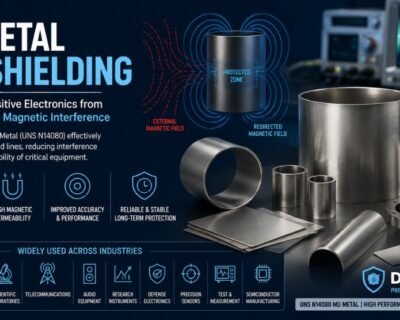
Mu metal excels because it provides an easier path for magnetic flux around the protected region.
Commercial high-permeability mu-metal products can achieve maximum permeability values in the hundreds of thousands after appropriate processing.
That is why mu metal is widely associated with sensitive magnetic instrumentation.
8. Properties of Mu Metal UNS N14080
Representative properties of commercially produced mu metal include:
| Property | Typical Value |
| Density | ~8.7 g/cm³ |
| Melting Temperature | ~1450°C |
| Curie Temperature | ~420°C |
| Electrical Resistivity | ~60 μΩ·cm |
| Thermal Conductivity | ~19 W/m·K |
| Maximum DC Permeability | >400,000* |
| Final-Annealed Tensile Strength | ~530 MPa |
| Final-Annealed Yield Strength | ~160 MPa |
| Final-Annealed Elongation | ~32% |
*Magnetic properties depend strongly on material condition, thickness, processing, heat treatment and shield fabrication. Representative manufacturer data should not automatically be treated as guaranteed design values.
This sensitivity to processing is extremely important.
9. Heat Treatment Can Make or Break Mu Metal Performance
Here is something engineers unfamiliar with Mu Metal Radiation Shielding can easily overlook.
You can purchase the correct alloy.
You can design the correct enclosure.
You can fabricate it accurately.
And still lose significant magnetic shielding performance through improper processing.
Bending, stamping, machining, forming and welding can introduce mechanical stresses that affect the alloy’s magnetic properties.
For maximum permeability, a suitable final annealing process is therefore commonly performed after fabrication. Commercial guidance for high-performance mu-metal shielding specifies final annealing after forming operations to restore or maximize permeability.
This means material selection alone is not enough when designing Mu Metal Radiation Shielding for sensitive equipment.
Fabrication sequence + geometry + heat treatment + installation = shielding performance.
10. Technical Specifications and Standards
For high-permeability mu metal, one of the key standards is:
ASTM A753
ASTM A753 covers wrought nickel-iron soft magnetic alloys, including UNS N14080.
A commonly referenced classification is:
ASTM A753 Alloy 4 – UNS N14080
The older MIL-N-14411 Composition 1 designation may also appear in historical drawings, specifications and industry documentation.
When sourcing material, engineers should clearly specify:
- UNS designation
- Applicable standard
- Material condition
- Thickness
- Dimensions
- Required magnetic properties
- Heat-treatment condition
- Quantity
- Final application
This helps DOMADIA™ identify the appropriate material rather than supplying something based solely on the generic term “mu metal.”
11. Shapes Available
Depending on project requirements and sourcing specifications, high-permeability nickel-iron materials may be supplied or fabricated in forms such as:
- Foil
- Strip
- Sheet
- Plate
- Round bar
- Wire
- Custom fabricated enclosures
- Cylindrical shields
- Cans
- Channels
- Boxes and housings
ASTM A753 covers several wrought forms, while commercial mu-metal suppliers commonly provide sheet, coil, foil and bar products.
The best form depends on the final shielding geometry.
12. Applications of Mu Metal
Because of its magnetic characteristics, mu metal is particularly valuable around equipment vulnerable to static or low-frequency magnetic interference.

Sensitive Electronic Equipment
Precision electronics may require protection from nearby magnetic-field sources, making Mu Metal Radiation Shielding useful for reducing magnetic interference around sensitive components and instruments.
Magnetic Sensors
Highly sensitive sensors can produce measurement errors when exposed to unwanted external fields, making Mu Metal Radiation Shielding valuable for reducing magnetic interference and supporting more reliable measurements.
Transformers
Magnetic shielding may be required to reduce interaction between transformers and nearby sensitive components, making Mu Metal Radiation Shielding valuable for controlling unwanted magnetic-field interference.
Medical and Laboratory Instruments
Precision analytical and diagnostic equipment may contain components vulnerable to low-frequency magnetic interference, making Mu Metal Radiation Shielding useful for protecting sensitive systems and supporting accurate performance.
Aerospace and Defence Electronics
Compact systems can place sensitive electronics close to motors, power systems and other electromagnetic sources, making Mu Metal Radiation Shielding useful for reducing unwanted magnetic-field interference.
Scientific Instruments
Research instruments capable of detecting extremely small signals may require carefully engineered magnetic environments, making Mu Metal Radiation Shielding important for reducing external magnetic interference that could affect sensitive measurements.
Test and Measurement Systems
Calibration and measurement accuracy can be compromised by uncontrolled external magnetic fields, making Mu Metal Radiation Shielding valuable for protecting sensitive equipment and maintaining reliable measurement performance.
13. Applications of Lead Radiation Shielding
Lead remains relevant where ionizing radiation attenuation is the actual requirement.
Common examples include:

Medical X-Ray Facilities
Lead barriers and lead-containing materials have long been used to reduce occupational and surrounding radiation exposure, while Mu Metal Radiation Shielding serves a different purpose by helping protect sensitive equipment from unwanted magnetic fields.
Nuclear Applications
Radiation facilities may incorporate lead as part of engineered shielding systems, while Mu Metal Radiation Shielding may be used separately where sensitive equipment also requires protection from unwanted magnetic fields.
Laboratory Radiation Sources
Equipment using radioactive sources may require carefully calculated shielding, while Mu Metal Radiation Shielding may be incorporated separately when sensitive components also need protection from unwanted magnetic-field interference.
Industrial Radiography
Industrial X-ray and gamma-ray inspection requires radiation-control measures designed around the source and operating conditions, while Mu Metal Radiation Shielding addresses a different requirement by helping protect sensitive equipment from unwanted magnetic-field interference.
Radiation Storage and Transport Systems
Depending on the isotope and regulatory requirements, dense shielding materials may form part of containment or transport systems, while Mu Metal Radiation Shielding serves a different role where protection from unwanted magnetic-field interference is required.
14. What About Neutron Radiation?
This is another reason the word “radiation” should never be treated as a single engineering problem.
Neutron shielding introduces different material requirements. Hydrogen-rich materials, boron-containing materials, concrete and engineered multilayer systems may be considered depending on neutron energy and the application.
Mu Metal Radiation Shielding is not a universal solution for every type of radiation, just as lead is not suitable for every shielding challenge. The material must be selected according to the specific field or radiation involved.
Neither “use mu metal” nor “use lead” should be treated as a universal answer.
Identify the radiation first. Design the shielding second.
15. Can Mu Metal and Lead Be Used Together?
Yes—and this is where the comparison becomes much more useful.
Some sophisticated systems may face multiple shielding challenges simultaneously.
For example, equipment might need protection from:
- Low-frequency magnetic interference, and
- X-ray or gamma radiation.
In such a situation, an engineered multilayer system may incorporate different materials for different functions.
Mu metal could address the magnetic-field problem.
Lead or another suitable high-Z shielding material could address ionizing photon radiation.
Additional conductive materials may be used when high-frequency EMI/RF shielding is also necessary.
The important point is that each layer should have a defined job.
More shielding material does not automatically mean better engineering.
16. So, Is Mu Metal Better Than Lead?
The technically correct answer is:
For low-frequency magnetic shielding: Mu metal is usually the better material.
Lead does not provide the high-permeability magnetic path required for effective low-frequency magnetic-field diversion. Mu Metal Radiation Shielding uses high-permeability nickel-iron alloys specifically engineered to redirect magnetic flux and help protect sensitive equipment from unwanted magnetic interference.
For X-ray and gamma shielding: Lead is generally the more appropriate material.
Lead’s high atomic number and density make it effective for attenuating X-ray and gamma photons.
For complex environments: You may need both—or neither.
The final material system depends on the radiation or field type, energy/frequency, intensity, geometry, allowable space, weight, required attenuation and applicable safety standards.
Why DOMADIA™?
Shielding projects frequently fail at the specification stage because the conversation begins with:
“We need shielding material.”
That description is not enough.
At DOMADIA™, we encourage customers to define the actual engineering requirement before material selection.
For a mu-metal enquiry, useful information includes:
- UNS designation: such as UNS N14080
- Standard: such as ASTM A753 Alloy 4
- Required form
- Thickness
- Width and length
- Material condition
- Quantity
- Magnetic field strength
- Frequency range
- Required attenuation
- Fabrication requirement
- Final application
If your problem involves X-rays, gamma radiation or another ionizing source, radiation type, energy and required attenuation must instead form part of a properly engineered radiation-protection assessment.
DOMADIA™ helps customers source specialized engineering materials according to defined technical requirements—not simply according to a familiar material name.
Conclusion
Mu Metal Radiation Shielding and lead shielding should not be treated as competing solutions to the same problem.
Mu metal UNS N14080 is a high-permeability nickel-iron alloy engineered primarily for shielding static and low-frequency magnetic fields. This makes Mu Metal Radiation Shielding particularly relevant where sensitive instruments, sensors or electronic components need protection from unwanted magnetic interference. Lead, meanwhile, remains a widely established material for attenuating X-rays and gamma radiation.
The winning material therefore depends entirely on the threat.
Magnetic field? Think permeability.
X-ray or gamma radiation? Think photon attenuation.
Multiple interference sources? Engineer the shielding as a system.
For engineers evaluating Mu Metal Radiation Shielding, the key is to identify the type, strength and frequency of the interfering field before selecting the shielding material.
That distinction can prevent unnecessary material costs, ineffective shielding and expensive redesigns.
Need the Right Material for Your Shielding Application?
Magnetic fields and ionizing radiation require different shielding strategies. If your application needs Mu Metal UNS N14080, high-permeability magnetic shielding material, foils, sheets, strips, or custom specifications, DOMADIA™ can help you source the right material for your technical requirements.
Choose the right shielding material from the start. Contact DOMADIA™ for your requirement today.
Talk to: Er.Pankaj Domadia | Kairav Domadia | Aadil Domadia | Pragati Sanap | Pooja N N
#MuMetal #UNSN14080 #RadiationShielding #MagneticShielding #LeadShielding #EMIShielding #ASTMA753 #NickelAlloy #EngineeringMaterials #DOMADIA
Directly whatsapp us for an Enquiry: https://wa.link/kairav
Our materials reach Chennai, Coimbatore, Hosur, Madurai, and Trichy, supporting manufacturing hubs in Tamil Nadu, Kerala, Karnataka, Andhra Pradesh, and Telangana, while shipping to France, Spain, UK, Netherlands, and Belgium.