Blogs
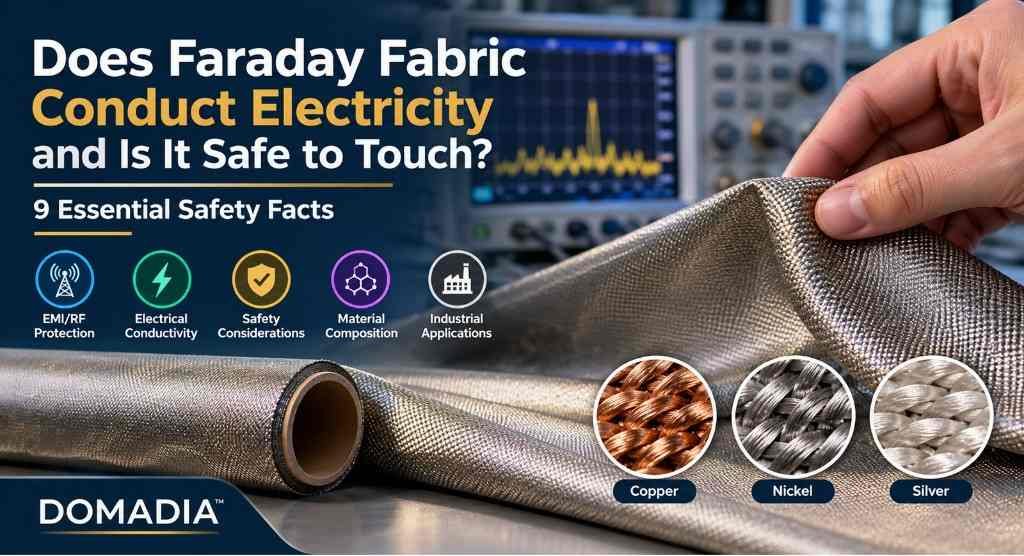
Does Faraday Fabric Conduct Electricity? 9 Essential Safety Facts About Conductive Shielding | UNS C11000
Faraday Fabric Conductivity plays an important role in electromagnetic shielding, electronic protection, and industrial applications. Although Faraday fabric looks like ordinary cloth, its metallic coatings or conductive fibres allow electricity to flow, making its electrical behaviour different from conventional textiles.
Consider an engineer using conductive fabric to protect sensitive equipment from electromagnetic interference. A common question arises: “Can touching this fabric cause an electric shock?” Understanding Faraday Fabric Conductivity helps explain why electrical conductivity alone does not create a shock hazard. Safety depends on electrical voltage, grounding, equipment connections, and environmental conditions.
In this guide, DOMADIA™ explains Faraday Fabric Conductivity, its chemical composition, electrical properties, safety considerations, applications, testing standards, and how to select suitable conductive textiles for reliable electromagnetic shielding.
1. Does Faraday Fabric Conduct Electricity?
Yes. Most Faraday fabrics are intentionally designed to conduct electricity.
Unlike ordinary cotton, polyester, or nylon fabrics, Faraday textiles contain electrically conductive materials such as:
- Copper
- Nickel
- Silver
- Stainless steel
- Silver-coated nylon
- Nickel-copper-coated polyester
These materials create electrically conductive pathways across the fabric.
When electromagnetic fields interact with the conductive textile, the material can reflect and absorb portions of the incident electromagnetic energy.
The effectiveness depends on several factors, including conductivity, shielding geometry, frequency, fabric construction, electrical continuity, and the quality of its metallic coating.
Why does conductivity matter?
Faraday Fabric Conductivity is essential for electromagnetic shielding because conductive textiles support induced electrical currents that help reduce electromagnetic interference around sensitive electronic equipment.
However, Faraday Fabric Conductivity alone does not guarantee effective shielding. Gaps, poor electrical connections, or damaged conductive coatings can significantly reduce protection, even when the fabric itself is highly conductive.
Therefore, understanding Faraday Fabric Conductivity is important for selecting reliable shielding materials while recognizing that electrical conductivity and electrical safety are separate engineering considerations.
2. Is Faraday Fabric Safe to Touch?
In many ordinary situations, clean, intact, unenergized Faraday fabric can be handled safely.
The critical word is unenergized.
A conductive material does not produce an electric shock simply because it conducts electricity.
For an electric shock to occur, an electrical potential difference must drive sufficient current through the body.
Consider three situations.
Situation A: Loose, unconnected shielding fabric
A clean piece of conductive textile lying on an insulated workbench is generally safe to handle, provided it has no hazardous contamination or energized connection.
Situation B: Fabric touching exposed electrical connections
If the material contacts an energized terminal, damaged insulation, or live conductor, it may become energized and create a shock or short-circuit hazard.
Situation C: Fabric near high-voltage equipment
Conductive fabric may create hazardous contact or arcing conditions. Specialized insulation, clearance, bonding, and electrical safety controls may be required.
Therefore, Faraday fabric should never be treated as an electrical insulator or protective barrier against electric shock.
For industrial installations, the appropriate electrical safety assessment is essential before the material is placed near energized equipment.
3. Faraday Fabric Conductivity: How Does It Actually Work?
The shielding mechanism is based on the interaction between electromagnetic fields and electrically conductive materials.
When an electromagnetic wave reaches a conductive fabric, several processes may occur.
Reflection: Conductive surfaces can reflect a portion of the incident electromagnetic energy.
Absorption: Electromagnetic energy may be dissipated within the conductive structure, depending on its electromagnetic properties and thickness.
Transmission: Some energy can pass through the fabric, particularly when the material has openings, insufficient conductivity, or unsuitable construction for the frequency involved.
The overall shielding performance is influenced by the combined effects.
Does higher electrical conductivity always mean better shielding?
Not necessarily.
A highly conductive material can perform poorly when the enclosure has large gaps or insufficient electrical continuity.
Likewise, a material with moderate conductivity may provide useful shielding when properly engineered for the operating frequency and installation geometry.
Important factors include surface resistance, coating uniformity, textile weave, seam construction, and frequency range.
Understanding surface resistance
Conductive fabrics are often characterized using surface resistance or sheet resistance.
Sheet resistance is commonly expressed in ohms per square (Ω/sq).
Lower sheet resistance generally indicates a more conductive surface, although it does not independently establish shielding effectiveness.
For instance, two fabrics may have similar sheet resistance but different shielding performance because their coatings, weave structures, and frequency responses differ.
4. Chemical Composition of Faraday Fabric
Faraday fabric is not a single standardized metal alloy. It is a category of conductive textiles manufactured using different substrates and conductive materials.
The composition depends on the product construction.
| Material | Typical function | Important characteristic |
| Copper | Conductive coating or fibre | High electrical conductivity |
| Nickel | Coating or protective layer | Corrosion and wear characteristics |
| Silver | Conductive coating | Excellent electrical conductivity |
| Polyester | Textile substrate | Dimensional stability and flexibility |
| Nylon | Textile substrate | Flexibility and toughness |
| Stainless steel | Conductive filament or fibre | Mechanical durability |
Copper-based Faraday fabric
Copper is widely used in electrical applications because of its excellent conductivity.
Commercially pure copper such as UNS C11000 is an important reference material for understanding copper-based conductive shielding.
However, a copper-coated fabric should not automatically be described as UNS C11000 unless the coating composition has been verified.
Nickel-copper-coated fabric
Nickel-copper-coated polyester is a common construction for EMI shielding textiles.
Copper contributes conductivity, while nickel can provide additional surface durability and corrosion-related benefits.
Performance depends on the plating system and exposure conditions.
Silver-coated fabric
Silver-coated nylon or other textile substrates are used where high conductivity and flexibility are important.
Silver-containing fabrics can also be relevant for wearable electronics, sensing systems, and specialized conductive textile applications.
Stainless steel conductive textiles
Stainless steel fibres can be woven or blended into fabrics to provide electrical conductivity alongside mechanical durability.
Their conductivity is substantially lower than that of copper or silver, but they can be useful in applications where strength and construction are important.
5. Electrical and Physical Properties of Faraday Fabric
Faraday fabric must be evaluated as both an electrical shielding material and a textile.
The most relevant properties include:
| Property | Engineering significance |
| Electrical conductivity | Supports induced current pathways |
| Surface resistance | Helps characterize conductive coating performance |
| Shielding effectiveness | Measures electromagnetic attenuation under specified test conditions |
| Flexibility | Enables covers, curtains, and irregular enclosures |
| Thickness | Influences construction and handling |
| Tensile strength | Helps assess mechanical durability |
| Abrasion resistance | Affects coating longevity |
| Corrosion resistance | Influences performance in humid or aggressive environments |
| Electrical continuity | Important across seams, overlaps, and joints |
| Thermal stability | Determines suitability for operating temperatures |
Typical technical specifications
Actual values vary considerably by manufacturer and material construction.
| Specification | What buyers should request |
| Substrate | Polyester, nylon, stainless steel blend, or other |
| Conductive material | Copper, nickel, silver, or composite coating |
| Sheet resistance | Measured value in Ω/sq with test method |
| Shielding effectiveness | dB attenuation over specified frequency range |
| Thickness | Nominal value and tolerance |
| Fabric weight | g/m² |
| Width | Standard roll width and tolerance |
| Temperature rating | Validated operating temperature |
| Durability | Flexing, abrasion, cleaning, and environmental performance |
| Test documentation | Relevant laboratory reports and certificates |
Important: Shielding effectiveness values should never be assumed from the material name alone. A 60 dB or 80 dB claim must be supported by testing under stated conditions.
6. Nine Essential Safety Facts About Faraday Fabric
Understanding the safety of conductive textiles helps engineers avoid unnecessary risks.

Fact 1: Conductive fabric is not necessarily energized
A fabric can conduct electricity without carrying a dangerous voltage. Faraday Fabric Conductivity allows electrical current to flow when an appropriate voltage is applied, but conductivity alone does not create an electric shock hazard.
Therefore, an isolated, unenergized textile is generally safe to handle under normal conditions, provided Faraday Fabric Conductivity does not create unintended contact with live electrical sources.
Fact 2: Faraday fabric is not electrical insulation
This is one of the most important safety distinctions when understanding Faraday Fabric Conductivity.
Ordinary electrical insulation is designed to prevent electric current from flowing through a material under specified conditions. In contrast, Faraday Fabric Conductivity allows electrical currents to flow through interconnected conductive pathways, helping the fabric interact with electromagnetic fields and provide shielding against electromagnetic interference.
Therefore, Faraday fabric should never replace approved electrical insulating materials, protective gloves, or electrical safety barriers, as its conductive nature can create serious electrical hazards when used improperly.
Fact 3: Contact with live equipment can be dangerous
A conductive textile can unintentionally connect two electrical terminals or bridge a live conductor to an accessible surface. Due to Faraday Fabric Conductivity, such contact may create serious risks of electric shock, equipment damage, overheating, or fire.
Therefore, understanding Faraday Fabric Conductivity and maintaining proper electrical insulation and safe installation practices are essential for preventing electrical hazards.
Fact 4: Grounding requires proper engineering
Grounding may be appropriate for certain conductive shielding installations, particularly where electrical continuity and electromagnetic interference management are important.
However, Faraday Fabric Conductivity does not mean that grounding automatically makes every conductive fabric safe for electrical applications.
Proper grounding arrangements must be selected according to the electrical system, installation environment, potential electrical hazards, and applicable safety standards to ensure reliable shielding performance and safe operation.
Fact 5: Static electricity is different from mains electricity
Conductive fabrics may be incorporated into electrostatic discharge (ESD) management systems, where controlled dissipation of static electricity is essential for protecting sensitive electronic components and equipment.
However, Faraday Fabric Conductivity and effective EMI shielding performance do not automatically guarantee suitability for ESD protection, as both applications have different electrical performance requirements.
Therefore, the material must be carefully evaluated against relevant ESD standards, including surface resistance, charge dissipation characteristics, and application-specific safety requirements.
Fact 6: Damaged coatings can affect performance
Repeated folding, abrasion, cleaning, and mechanical stress may gradually damage conductive coatings and weaken the interconnected conductive pathways within the fabric.
These changes can negatively affect Faraday Fabric Conductivity by increasing electrical resistance, disrupting current flow, and reducing electromagnetic shielding effectiveness over time.
Therefore, regular inspection, proper handling, and appropriate maintenance are essential for preserving the fabric’s electrical performance, durability, and long-term shielding reliability.
Fact 7: Moisture and contamination matter
Moisture, conductive dust, metal particles, and chemical residues can change the electrical behaviour of an installation.
These conditions should be evaluated where the fabric is used around sensitive electrical equipment.
Fact 8: Skin contact requires material-specific evaluation
Electrical safety does not automatically guarantee suitability for prolonged skin contact. While Faraday Fabric Conductivity supports electromagnetic shielding, nickel-containing coatings may cause allergic reactions in sensitive individuals.
Additionally, damaged coatings can release particles or expose rough fibres, creating potential skin irritation. Therefore, wearable applications must consider Faraday Fabric Conductivity alongside skin compatibility, material durability, and appropriate safety testing.
Use a more precise shielding phraseClarify the wearable safety recommendation
Fact 9: Shielding fabric does not guarantee complete electromagnetic protection
Faraday fabric can reduce electromagnetic interference across specified frequency ranges. However, Faraday Fabric Conductivity does not guarantee protection against all electromagnetic fields, particularly low-frequency magnetic fields.
Therefore, engineers must evaluate Faraday Fabric Conductivity, shielding effectiveness, and operating frequency to select materials that meet their specific electromagnetic shielding requirements.
7. Standards Applicable to Faraday Fabric
The relevant standards depend on whether the textile is used for EMI shielding, ESD control, or another electrical application.
| Standard | Application |
| ASTM D4935-18(2026) | Electromagnetic shielding effectiveness of planar materials |
| IEEE Std 299 | Shielding effectiveness of electromagnetic shielding enclosures |
| IEC 61340-5-1:2024 | ESD control requirements for protecting electronic devices |
| ASTM D257 | DC resistance or conductance of insulating materials, where applicable |
| ISO 10993 series | Biological evaluation where relevant to medical-device contact |
ASTM D4935-18(2026)
This standard is particularly relevant for measuring electromagnetic shielding effectiveness in planar materials.
The specified test method covers approximately 30 MHz to 1.5 GHz, under defined far-field measurement conditions. It does not establish electrical shock safety or performance at every frequency.
IEC 61340-5-1:2024
This standard addresses the protection of electronic devices against electrostatic phenomena.
It is relevant when conductive materials form part of an ESD-controlled environment, but compliance requires evaluation of the complete ESD control program rather than simply using conductive fabric.
Engineers should request test reports corresponding to the actual material construction and application.
8. Industrial Applications of Faraday Fabric

EMI and RF shielding
Conductive fabrics are used in shielding curtains, flexible enclosures, covers, and testing environments to reduce unwanted electromagnetic interference.
Sensitive electronic equipment
Shielding textiles help reduce electromagnetic interference around sensitive sensors, communication devices, and control systems. Effective Faraday Fabric Conductivity supports reliable electromagnetic shielding and improved equipment performance.
ESD-controlled environments
Appropriately qualified conductive textiles may be incorporated into static-control applications where electrical resistance and grounding are carefully managed.
Wearable electronics and smart textiles
Specialized conductive fabrics can support flexible sensors, signal pathways, and electronic textiles. Faraday Fabric Conductivity plays an important role in these applications, provided electrical and skin-contact safety requirements are met.
Additionally, Faraday Fabric Conductivity supports potential applications in aerospace electronics, automotive EMC testing, telecommunications, laboratory shielding, and portable RF protection systems.
9. Available Shapes and Forms of Faraday Fabric
Conductive textiles are available in several configurations depending on the manufacturer and material system.
| Form | Typical application |
| Fabric rolls | Large shielding surfaces and custom fabrication |
| Cut sheets | Equipment covers and localized shielding |
| Conductive tapes | Seams and electrical continuity |
| Flexible curtains | Laboratory and industrial shielding partitions |
| Conductive mesh | Ventilation-compatible shielding structures |
| Custom fabricated covers | Specialized equipment enclosures |
| Conductive pouches | Portable shielding applications |
The appropriate construction depends on the shielding frequency, mechanical conditions, dimensions, and electrical safety requirements.
How to Choose the Right Faraday Fabric
Before purchasing conductive shielding fabric, engineers should consider the complete application rather than focusing exclusively on conductivity.
Why Choose DOMADIA™ for Faraday Fabric?
Selecting the correct conductive textile requires understanding both its electromagnetic shielding performance and the conditions under which it will operate.
At DOMADIA™, we recognize that industrial customers need more than a general statement that a fabric blocks electromagnetic interference.
They need materials suited to their specific engineering requirements.
Material selection support
DOMADIA™ helps customers evaluate Faraday Fabric Conductivity requirements by offering guidance on copper-based, nickel-based, silver-coated, and other specialized conductive shielding textiles, subject to product availability and application needs.
Application-oriented specifications
Different industries require different shielding solutions.
A laboratory shielding curtain, an electronic enclosure, and a flexible equipment cover may require different materials, seam designs, and performance characteristics.
Focus on technical requirements
Customers can share their required frequency range, shielding effectiveness, material composition, dimensions, and operating conditions with DOMADIA™ to evaluate Faraday Fabric Conductivity and identify suitable shielding solutions.
Industrial sourcing requirements
DOMADIA™ supports engineering and procurement inquiries involving Faraday Fabric Conductivity and specialized shielding materials for electronics, telecommunications, industrial equipment, research, and other demanding applications.
Frequently Asked Questions
Can Faraday fabric give you an electric shock?
Yes, if it becomes energized and a hazardous current path exists. An isolated, unenergized piece is generally safe to handle, but it must never be treated as electrical insulation.
Does Faraday fabric need to be grounded?
Not always. Grounding depends on the shielding design and electrical safety requirements. Some RF shielding applications operate without a direct ground connection, while others require engineered bonding or grounding.
Can I use Faraday fabric near electrical wires?
Only when the installation has been assessed for electrical safety. The fabric must not contact exposed live conductors or compromise required insulation and clearance.
Is copper Faraday fabric better than silver Faraday fabric?
Neither is universally better. Performance depends on coating thickness, continuity, resistance, durability, corrosion behaviour, and operating frequency.
Can Faraday fabric block Wi-Fi and mobile signals?
Properly designed conductive fabric enclosures can attenuate Wi-Fi and mobile communication signals within tested frequency ranges. Actual results depend on the material and enclosure construction.
Is Faraday fabric safe to wear?
Some specialized conductive textiles are designed for wearable applications. However, not every industrial shielding fabric is suitable for direct or prolonged skin contact.
Conclusion: Is Faraday Fabric Conductive and Safe?

Faraday Fabric Conductivity is the fundamental property that makes conductive textiles effective for electromagnetic shielding.
Copper, nickel, silver, and stainless steel create electrical pathways that help reduce electromagnetic interference when incorporated into suitable fabric constructions.
However, Faraday Fabric Conductivity should never be confused with electrical insulation or guaranteed user safety.
Unenergized Faraday fabric is generally safe to handle under normal conditions, but contact with live electrical equipment can create serious electrical hazards.
For successful industrial applications, engineers must evaluate electrical safety, material composition, shielding effectiveness, frequency range, surface resistance, durability, and applicable testing standards.
Ultimately, understanding Faraday Fabric Conductivity helps engineers select materials that deliver reliable shielding performance, long-term durability, and suitability for their specific installation environments.
At DOMADIA™, we help customers explore specialized conductive shielding materials tailored to their technical requirements and industrial applications.
Need Reliable Faraday Fabric for Your Application? Contact DOMADIA™
Looking for reliable conductive shielding fabric for EMI/RF protection, electronic enclosures, laboratory applications, or specialized industrial equipment? Explore high-performance shielding solutions with DOMADIA™.
Contact DOMADIA™ with your required fabric composition, shielding frequency, attenuation level, dimensions, quantity, and operating conditions.
Talk to: Er.Pankaj Domadia | Kairav Domadia | Aadil Domadia | Pragati Sanap | Pooja N N
#FaradayFabric #ConductiveFabric #EMIShielding #RFShielding #ElectricalSafety #ElectromagneticShielding #UNSC11000 #IndustrialMaterials #DOMADIA
Directly whatsapp us for an Enquiry: https://wa.link/kairav
Our materials reach Chennai, Coimbatore, Hosur, Madurai, and Trichy, supporting manufacturing hubs in Tamil Nadu, Kerala, Karnataka, Andhra Pradesh, and Telangana, while shipping to France, Spain, UK, Netherlands, and Belgium.