Blogs
Faraday Fabric vs Metal Mesh: 9 Powerful Differences in EMI Shielding Performance (UNS C11000)
Faraday Fabric vs Metal Mesh is an important comparison for industries requiring reliable electromagnetic interference (EMI) protection. Both materials provide effective shielding, but their performance depends on conductivity, durability, and application requirements.
When comparing Faraday Fabric vs Metal Mesh, Faraday fabric offers lightweight flexibility and easy installation, while metal mesh provides mechanical strength and durability for industrial applications.
The effectiveness of Faraday Fabric vs Metal Mesh depends on operating frequency, material quality, and installation conditions. Choosing the right material ensures reliable EMI protection and long-term performance.
In this guide, DOMADIA™ explores 9 powerful differences in Faraday Fabric vs Metal Mesh, covering shielding effectiveness, properties, applications, technical specifications, standards, and cost.
What Is Faraday Fabric?
Faraday fabric is a conductive textile designed to attenuate electromagnetic fields by using electrically conductive fibers, coatings, or metallic layers.
Unlike ordinary clothing or upholstery fabrics, Faraday fabrics contain conductive materials that interact with electromagnetic waves.
Common constructions include:
- Silver-plated nylon or polyester
- Copper-coated synthetic fibers
- Nickel-copper-coated polyester
- Stainless steel fiber textiles
- Hybrid conductive woven fabrics
When properly integrated into a shielding system, these textiles can reflect and absorb electromagnetic energy, helping reduce unwanted signal transmission.
How does Faraday fabric work?
Electromagnetic shielding relies on several physical mechanisms.
Reflection: Conductive surfaces generate currents in response to incident electromagnetic fields, producing fields that oppose transmission.
Absorption: Electromagnetic energy is attenuated as it propagates through conductive or magnetic materials.
Multiple interactions: Layered materials and internal interfaces can introduce additional reflections, although their net effect depends on the construction and frequency.
Faraday fabric is particularly useful when shielding must remain flexible, lightweight, foldable, or compatible with complex shapes.
Common applications include EMI shielding curtains, electronic equipment covers, shielded pouches, conductive gaskets, laboratory enclosures, and specialized protective textiles.
However, performance depends on more than the fabric itself. Seam conductivity, closures, grounding arrangements, and installation geometry can significantly influence overall effectiveness.
What Is Metal Mesh?
Metal mesh is a network of intersecting metallic wires, woven strands, expanded metal, or perforated conductive material.
It creates a conductive structure that can attenuate electromagnetic fields while allowing some combination of airflow, visibility, or drainage.
Common metal mesh materials include:
- Copper mesh, including commercially pure copper grades such as UNS C11000
- Stainless steel mesh, including UNS S30400 and UNS S31600
- Aluminum mesh
- Nickel mesh
- Brass mesh
- Tin-plated or nickel-plated copper mesh
Unlike many conductive fabrics, metal mesh typically relies on continuous metallic wires rather than thin conductive coatings on nonmetallic fibers.
How does metal mesh provide shielding?
When electromagnetic waves encounter a conductive mesh, currents are induced in its metallic structure.
The shielding response depends on conductivity, wire geometry, aperture dimensions, frequency, polarization, and electrical connections between adjacent mesh sections.
A sufficiently fine, electrically continuous mesh can provide effective shielding at selected frequencies.
However, larger openings can permit greater field penetration, particularly when aperture dimensions become significant relative to wavelength.
Important: Metal mesh does not automatically provide better shielding than conductive fabric. Its effectiveness must be evaluated against the actual operating frequency and enclosure design.
Faraday Fabric vs Metal Mesh: Quick Technical Comparison

| Parameter | Faraday fabric | Metal mesh |
| Primary construction | Conductive textile or coated fibers | Woven or formed metallic network |
| Flexibility | Usually excellent | Varies with wire diameter and weave |
| Weight | Often lightweight | Depends on alloy and geometry |
| Electrical conductivity | Depends on coating and fiber structure | Depends on metal and contact continuity |
| Shielding effectiveness | Can be high with suitable construction | Can be high with suitable aperture design |
| Mechanical durability | Sensitive to abrasion and coating damage | Often more robust against abrasion |
| Air permeability | Depends on weave and coatings | Generally good for open mesh |
| Installation | Convenient for soft or irregular surfaces | Suitable for frames, panels, vents, and screens |
| Corrosion resistance | Depends on conductive finish | Depends on alloy and surface treatment |
| Typical service life | Depends on wear, laundering, and environment | Depends on corrosion, fatigue, and installation |
| Best suited for | Flexible covers, pouches, curtains | Ventilation panels, rigid screens, enclosures |
The most useful comparison is based on measured shielding effectiveness, installation requirements, environmental exposure, and total ownership cost, rather than material category alone.
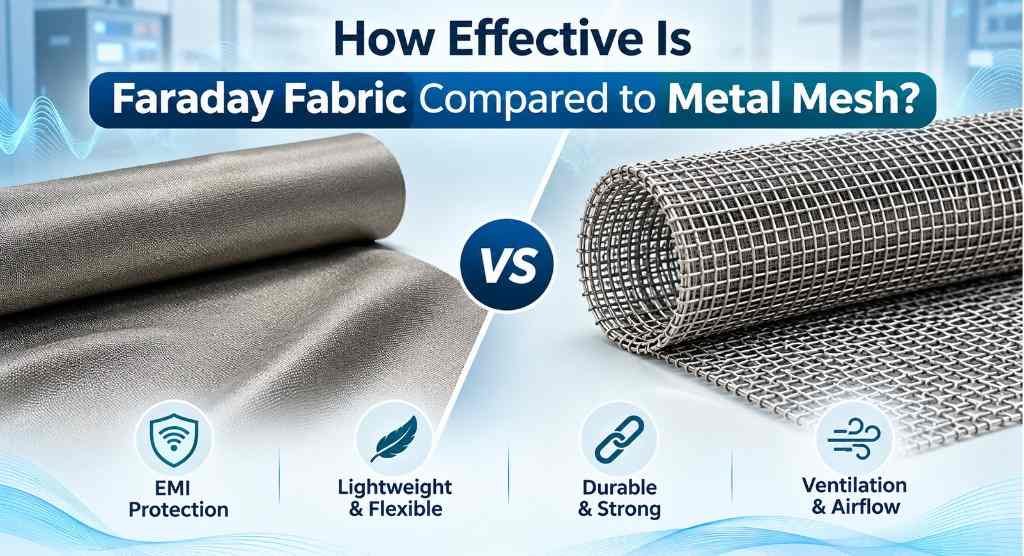
How Effective Is Faraday Fabric Compared to Metal Mesh? 9 Powerful Differences
Both Faraday fabric and metal mesh provide effective electromagnetic shielding. However, their performance depends on conductivity, frequency, material quality, and installation.

1. Shielding Effectiveness
Faraday fabric and metal mesh can both reduce electromagnetic interference (EMI). In a Faraday Fabric vs Metal Mesh comparison, shielding effectiveness depends on material construction, operating frequency, and shielding design.
2. Electrical Conductivity
In a Faraday Fabric vs Metal Mesh comparison, metal mesh, especially UNS C11000 copper mesh, offers excellent electrical conductivity, while Faraday fabric uses conductive coatings or metallic fibers to provide effective EMI protection.
3. Electromagnetic Leakage
In a Faraday Fabric vs Metal Mesh comparison, metal mesh contains small openings that may allow electromagnetic energy to pass through, while Faraday fabric’s conductive coatings and weave density influence its shielding effectiveness.
4. Flexibility and Installation
In a Faraday Fabric vs Metal Mesh comparison, Faraday fabric offers lightweight flexibility and easy folding, making it ideal for curtains, covers, and portable shielding, while metal mesh is better suited for framed panels and permanent installations.
5. Durability and Lifespan
In a Faraday Fabric vs Metal Mesh comparison, metal mesh generally offers better mechanical durability in industrial environments, while Faraday fabric may experience coating wear or damage from repeated folding, washing, or abrasion.
6. Weight and Portability
Faraday fabric is generally lighter and easier to transport. Metal mesh can be heavier depending on the metal, wire thickness, and mesh design.
7. Corrosion Resistance
Corrosion resistance depends on the material used. Stainless steel mesh offers good resistance in many environments, while coated Faraday fabrics require suitable protection against moisture and chemical exposure.
8. Ventilation and Airflow
In a Faraday Fabric vs Metal Mesh comparison, metal mesh is commonly preferred for electronic enclosures requiring ventilation, while Faraday fabric can also provide airflow depending on its weave and construction.
9. Cost and Long-Term Value
Faraday fabric can be economical for lightweight and temporary shielding applications. Metal mesh may offer better long-term value in permanent installations because of its mechanical durability.
Final Comparison
Faraday fabric is ideal for flexible, lightweight, and portable EMI shielding, while metal mesh is often better for durable, permanent, and ventilation-based applications.
At DOMADIA™, we help industries select suitable shielding materials based on performance requirements, durability, and long-term application needs.
Chemical Composition of Faraday Fabric and Metal Mesh
Chemical composition determines conductivity, corrosion resistance, mechanical behavior, and compatibility with the operating environment.
Faraday fabric composition
| Fabric type | Typical composition | Main advantage |
| Silver-plated nylon | Polyamide substrate with silver coating | Flexibility and conductivity |
| Copper-nickel polyester | Polyester with copper/nickel conductive layers | Conductivity and practical handling |
| Stainless steel fiber fabric | Stainless steel fibers blended or woven with textiles | Heat and mechanical resistance |
| Silver-plated polyester | Polyester with silver conductive coating | Lightweight shielding |
| Hybrid conductive textile | Multiple conductive fibers or coatings | Tailored performance |
The actual metal percentage varies by manufacturer, coating thickness, and textile construction.
Metal mesh composition and UNS grades
| Material | UNS designation | Typical composition |
| Electrolytic tough pitch copper | C11000 | Minimum 99.90% Cu, including Ag |
| Stainless steel 304 | S30400 | 18–20% Cr, 8–10.5% Ni, balance Fe and minor elements |
| Stainless steel 316 | S31600 | 16–18% Cr, 10–14% Ni, 2–3% Mo, balance Fe and minor elements |
| Commercially pure aluminum 1100 | A91100 | Minimum 99.00% Al |
| Cartridge brass 260 | C26000 | Approximately 70% Cu and 30% Zn |
Compositions are representative grade specifications; individual material certifications and applicable standards should be checked before procurement.
For demanding EMI shielding applications, DOMADIA™ can assist with selecting suitable conductive materials based on the required alloy, dimensions, and application specifications.
Technical Specifications Engineers Should Compare
Before purchasing either material, request a technical datasheet that includes the following parameters.
| Technical parameter | Faraday fabric | Metal mesh |
| Material thickness | mm | Wire diameter and overall thickness, mm |
| Electrical resistance | Ω/square | Wire conductivity and mesh continuity |
| Shielding effectiveness | dB across frequency | dB across frequency |
| Frequency range | MHz/GHz | MHz/GHz |
| Aperture dimensions | Textile pore or yarn spacing | Clear opening, mm |
| Mechanical properties | Tensile and tear strength | Wire strength and mesh integrity |
| Flexibility | Bend and fold performance | Bend radius and deformation behavior |
| Corrosion resistance | Coating durability | Alloy-specific resistance |
| Thermal performance | Textile and coating temperature limits | Alloy and assembly temperature limits |
| Available dimensions | Roll width, length, cut panels | Mesh count, roll width, cut panels |
Example specification for a copper mesh
For a UNS C11000 copper mesh, a purchase specification might include:
- Material: UNS C11000 copper
- Construction: Woven wire mesh
- Mesh count: As required
- Wire diameter: As required
- Aperture: Defined in millimeters
- Surface finish: Bare or specified plating
- Shielding performance: Verified over the required frequency band
- Supply form: Roll, sheet, or fabricated panel
A nominal alloy grade alone does not establish shielding performance.
The final mesh geometry, assembly design, and test conditions must also be specified.
Standards for EMI Shielding Fabrics and Metal Mesh
Industrial shielding applications require reliable measurement procedures.
ASTM D4935 — Planar material shielding effectiveness
ASTM D4935-18(2026) provides a test method for evaluating the electromagnetic shielding effectiveness of planar materials under specified far-field conditions.
Its stated measurement range is approximately 30 MHz to 1.5 GHz, subject to the method’s limitations.
This standard is useful for comparing material specimens, but it does not automatically establish the performance of a complete enclosure.
IEEE 299 — Shielding enclosure testing
IEEE 299 provides a recognized framework for measuring the shielding effectiveness of electromagnetic shielding enclosures.
The IEEE 299-2006 edition addressed large enclosures, including those incorporating metal screening and shielding fabrics. IEEE currently lists that edition as inactive-reserved, with a revision project underway.
IEEE 299.1 — Smaller enclosures
IEEE 299.1-2013 addresses shielding effectiveness measurement methods for smaller enclosures and boxes.
This is relevant to electronic housings, test enclosures, and compact shielded assemblies. A revision project is also underway.
Additional material standards
Depending on the alloy and product form, engineers may also refer to relevant ASTM, EN, ISO, or customer-specific material specifications.
For example, copper wire and stainless steel wire products may be governed by different manufacturing and material standards.
Important distinction: A material standard verifies composition or mechanical requirements, while an EMI shielding test establishes electromagnetic performance. Both may be necessary for a complete technical specification.
Industrial Applications of Faraday Fabric and Metal Mesh

Electronics and telecommunications
In Faraday Fabric vs Metal Mesh applications, conductive fabrics protect portable devices and electronic assemblies, while metal mesh supports ventilation panels and equipment enclosures.
Research laboratories
The Faraday Fabric vs Metal Mesh comparison helps laboratories select suitable shielding curtains, temporary partitions, and screened enclosures to reduce electromagnetic interference during sensitive measurements.
Aerospace and defense
In Faraday Fabric vs Metal Mesh applications, lightweight conductive textiles and metallic screens help manage EMI in aerospace equipment, electronic systems, and defense assemblies.
Industrial automation
For Faraday Fabric vs Metal Mesh applications, metal mesh provides ventilation screening, while flexible conductive fabrics protect irregular equipment interfaces and temporary testing setups.
Medical and scientific instrumentation
The Faraday Fabric vs Metal Mesh comparison helps engineers choose suitable shielding materials to reduce electromagnetic interference in sensitive medical and scientific equipment.
Available Shapes and Supply Forms
Both materials can be supplied in several forms, depending on manufacturer capabilities and project requirements.
Faraday fabric
- Continuous rolls
- Cut sheets
- Flexible panels
- Sewn covers
- Curtains
- Conductive pouches
- Custom textile assemblies
Metal mesh
- Woven mesh rolls
- Cut-to-size sheets
- Framed panels
- Expanded metal
- Formed screens
- Cylindrical mesh components
- Custom fabricated shielding parts
For specialized requirements, DOMADIA™ can help customers identify appropriate material grades, dimensions, and supply configurations, subject to availability.
Which Shielding Material Should You Choose?
Choosing between Faraday fabric and metal mesh depends on your application, shielding requirements, and operating environment. Both materials offer effective EMI protection, but each has different advantages.
Choose Faraday Fabric When:
- You need lightweight and flexible shielding.
- Your application requires portable covers, bags, or curtains.
- The material must bend or fold easily.
- You need shielding for irregularly shaped electronic equipment.
- Easy installation and handling are important.
Choose Metal Mesh When:
- You need strong and durable shielding for industrial equipment.
- Your application requires permanent shielding installations.
- Airflow and ventilation are important.
- The material must withstand mechanical stress.
- You need rigid screens, panels, or equipment enclosures.
Which One Is Better?
Faraday fabric is generally better for flexible and portable applications, while metal mesh is often more suitable for permanent and mechanically demanding installations.
However, shielding effectiveness depends on operating frequency, electrical conductivity, material construction, and installation quality.
At DOMADIA™, we help industries evaluate suitable EMI shielding materials based on their technical requirements, application conditions, and long-term performance needs.
Environmental Impact: Why Material Longevity Matters
Environmental responsibility is becoming increasingly important in industrial material selection. In a Faraday Fabric vs Metal Mesh comparison, both materials have different environmental impacts depending on their composition, durability, and recyclability.
When evaluating Faraday Fabric vs Metal Mesh, metal mesh may offer recycling advantages because copper, aluminum, and stainless steel have established recycling systems. Conductive fabrics can be more difficult to recycle due to metallic coatings bonded to synthetic fibers.
The environmental impact of Faraday Fabric vs Metal Mesh also depends on manufacturing processes, transportation, material recovery, and replacement frequency. Durable shielding materials can help reduce waste and unnecessary resource consumption.
In the Faraday Fabric vs Metal Mesh selection process, choosing long-lasting materials can minimize frequent replacements, reduce recycling requirements, and support sustainable industrial operations.
At DOMADIA™, we emphasize responsible material selection and long-term durability. Our approach to Faraday Fabric vs Metal Mesh focuses on reliable shielding performance, efficient resource utilization, and reduced environmental impact throughout the material’s service life.
Why DOMADIA™ for Faraday Fabric and Metal Mesh?
Selecting an EMI shielding material requires more than identifying a conductive surface.
The material must be compatible with the required electrical, mechanical, dimensional, and environmental specifications.
DOMADIA™ focuses on helping industrial customers evaluate specialized materials for demanding engineering applications.
Material selection support
For Faraday Fabric vs Metal Mesh requirements, DOMADIA™ helps customers evaluate conductive textiles, copper-based materials, and specialized EMI shielding solutions based on their applications.
Understanding industrial applications
The Faraday Fabric vs Metal Mesh comparison helps industries select suitable materials for shielding curtains, ventilation panels, aerospace components, and electronic enclosures.
Technical specification focus
When evaluating Faraday Fabric vs Metal Mesh, DOMADIA™ emphasizes material grades, dimensions, electrical conductivity, surface conditions, and relevant industry standards.
Long-term engineering value
In Faraday Fabric vs Metal Mesh selection, DOMADIA™ focuses on durability, reliable shielding performance, lifecycle costs, and long-term value rather than initial material price alone.
Specialized sourcing requirements Customers can discuss requirements involving conductive fabrics, precision metallic materials, mesh constructions, and other advanced materials, subject to technical feasibility and availability.
Conclusion: Faraday Fabric vs Metal Mesh — Which Is More Effective?
Faraday Fabric vs Metal Mesh is not a comparison with one universal winner.
Both materials can provide valuable electromagnetic shielding, but their strengths differ.
Faraday fabric is particularly attractive for flexible, lightweight, portable, and irregularly shaped shielding applications.
Metal mesh is often preferred for permanent installations, ventilation panels, rigid structures, and environments requiring greater mechanical robustness.
The most important performance factors remain:
- Shielding effectiveness at the required frequency
- Electrical conductivity and continuity
- Aperture dimensions
- Mechanical durability
- Environmental compatibility
- Installation quality
- Total lifecycle cost
For engineers, the best shielding material is not necessarily the thickest, heaviest, or most expensive.
It is the material that consistently meets the specified electromagnetic and mechanical requirements throughout its intended service life.
DOMADIA™ supports an application-focused approach to specialized material selection, helping customers explore suitable conductive materials for their industrial requirements.
When evaluating Faraday Fabric vs Metal Mesh, prioritize verified technical performance, installation reliability, and long-term engineering value.
Get Reliable EMI Shielding Solutions with DOMADIA™
DOMADIA™ helps industries explore high-quality EMI shielding materials designed for reliable performance, durability, and long-term value.
Contact DOMADIA™ today to discuss your shielding requirements and find the right material for your project.
Talk to: Er.Pankaj Domadia | Kairav Domadia | Aadil Domadia | Pragati Sanap | Pooja N N
#FaradayFabric #MetalMesh #EMIShielding #ElectromagneticShielding #CopperMesh #UNSC11000 #ConductiveFabric #RFShielding #FaradayCage #EMIProtection #IndustrialMaterials #AdvancedMaterials
Directly whatsapp us for an Enquiry: https://wa.link/kairav
We’ve supplied to Mumbai, Pune, Indore, Jaipur, and Surat—serving industries across Maharashtra, Madhya Pradesh, Rajasthan, Gujarat, and Goa, with exports to Germany, USA, Japan, South Korea, and Italy.