Blogs
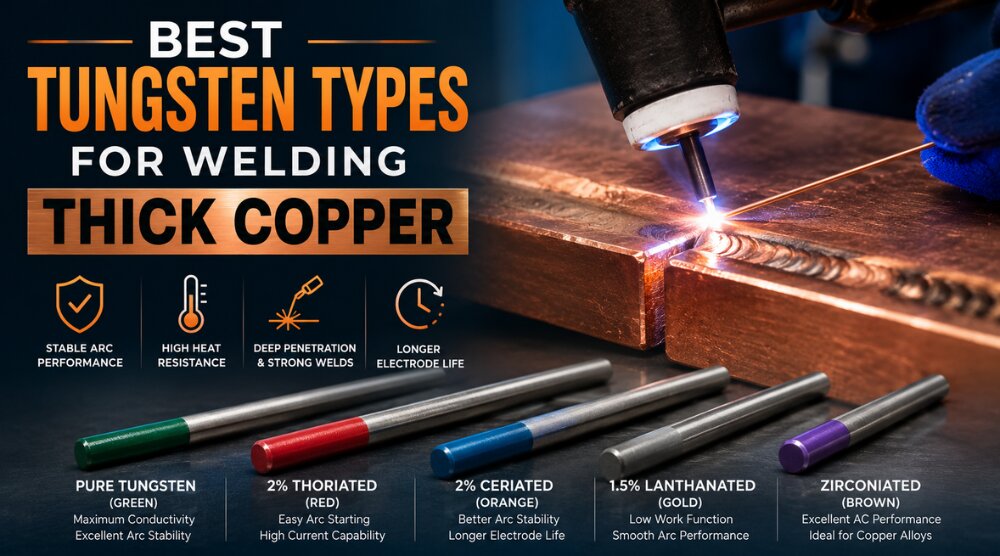
Best Tungsten Types for Welding Thick Copper: 7 Powerful Choices for Superior Performance
Best Tungsten Types for Welding Thick Copper
Welding thick copper is far more challenging than welding ordinary steels. Copper’s exceptionally high thermal conductivity rapidly pulls heat away from the weld pool, making it difficult to maintain proper fusion. Selecting the correct tungsten electrode often determines whether a weld achieves excellent penetration or suffers from poor arc stability and excessive defects.
Choosing the Best Tungsten Types improves arc initiation, maintains a stable welding arc, extends electrode life, and delivers cleaner welds with fewer interruptions. The Best Tungsten Types also help reduce electrode contamination and ensure consistent performance when welding high-conductivity copper materials. Whether you work in electrical manufacturing, heavy fabrication, aerospace, or resistance welding, understanding the strengths of the Best Tungsten Types helps maximize welding performance.
Why Copper Is Difficult to Weld
Copper transfers heat nearly five times faster than carbon steel.
This means welders require:
- Higher welding current
- Excellent arc stability
- Consistent electrode performance
- Superior heat resistance
- Longer electrode life
A poor tungsten selection often causes:
- Arc wandering
- Electrode contamination
- Excessive grinding
- Reduced penetration
- Frequent downtime
Selecting the proper tungsten minimizes these problems significantly.
7 Best Tungsten Types for Welding Thick Copper
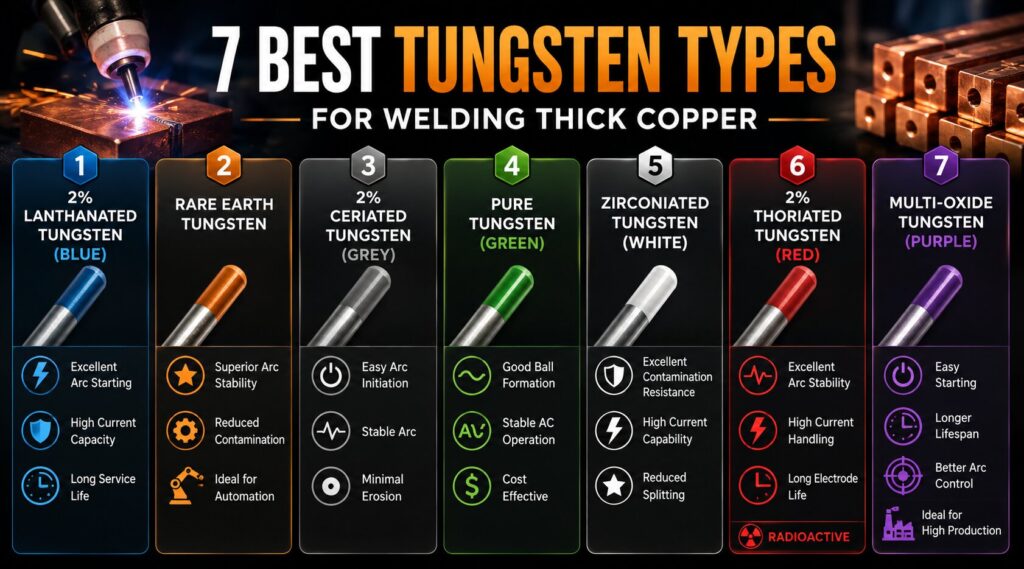
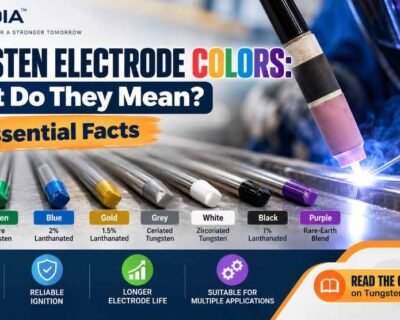
1. 2% Lanthanated Tungsten (Blue)
Many professional welders consider 2% Lanthanated Tungsten the first choice for thick copper welding.
Advantages
- Excellent arc starting
- Stable arc characteristics
- High current carrying capacity
- Low electrode wear
- Long service life
Applications
- Heavy copper fabrication
- Busbars
- Electrical conductors
- Industrial equipment
2. Rare Earth Tungsten
Rare earth tungsten combines several oxide additives that improve overall electrode performance.
Advantages
- Superior arc stability
- Reduced contamination
- Excellent lifespan
- Suitable for automated welding
Applications
- Robotic TIG welding
- Aerospace fabrication
- Precision manufacturing
- High-volume production
3. 2% Ceriated Tungsten (Grey)
Ceriated tungsten performs exceptionally well at low to medium current levels but can also handle many copper welding applications.
Advantages
- Easy arc initiation
- Stable arc
- Minimal electrode erosion
- Smooth welding performance
Applications
- Medium-thickness copper
- Electronics
- Precision assemblies
4. Pure Tungsten (Green)
Pure tungsten remains useful for specific AC welding applications, although it is less common for thick copper.
Advantages
- Good ball formation
- Stable AC operation
- Cost-effective
Limitations
- Lower current capacity
- Faster wear under demanding conditions
5. Zirconiated Tungsten (White)
Zirconiated tungsten performs extremely well under AC welding conditions.
Advantages
- Excellent contamination resistance
- Stable arc
- High current capability
- Reduced electrode splitting
Applications
- Heavy copper AC welding
- High-current fabrication
6. 2% Thoriated Tungsten (Red)
Thoriated tungsten has been an industry standard for decades.
Advantages
- Excellent arc stability
- High current handling
- Long electrode life
Note
Due to its radioactive thorium content, many industries now prefer lanthanated or rare earth alternatives.
7. Multi-Oxide Tungsten
Modern multi-oxide tungsten electrodes combine several rare earth oxides for improved overall performance.
Advantages
- Easy starting
- Longer lifespan
- Better arc control
- Reduced grinding frequency
Applications
- Automated welding
- High-production environments
- Heavy industrial fabrication
Chemical Composition
Different tungsten electrodes contain specific oxide additions to improve welding characteristics.
| Tungsten Type | Typical Composition |
| Pure Tungsten | 99.5% W minimum |
| Lanthanated | W + 1–2% La₂O₃ |
| Ceriated | W + 2% CeO₂ |
| Zirconiated | W + 0.8% ZrO₂ |
| Thoriated | W + 2% ThO₂ |
| Rare Earth | W + Mixed Rare Earth Oxides |
Powerful Properties That Make Tungsten Ideal for Thick Copper Welding
The right tungsten electrode offers numerous performance benefits.
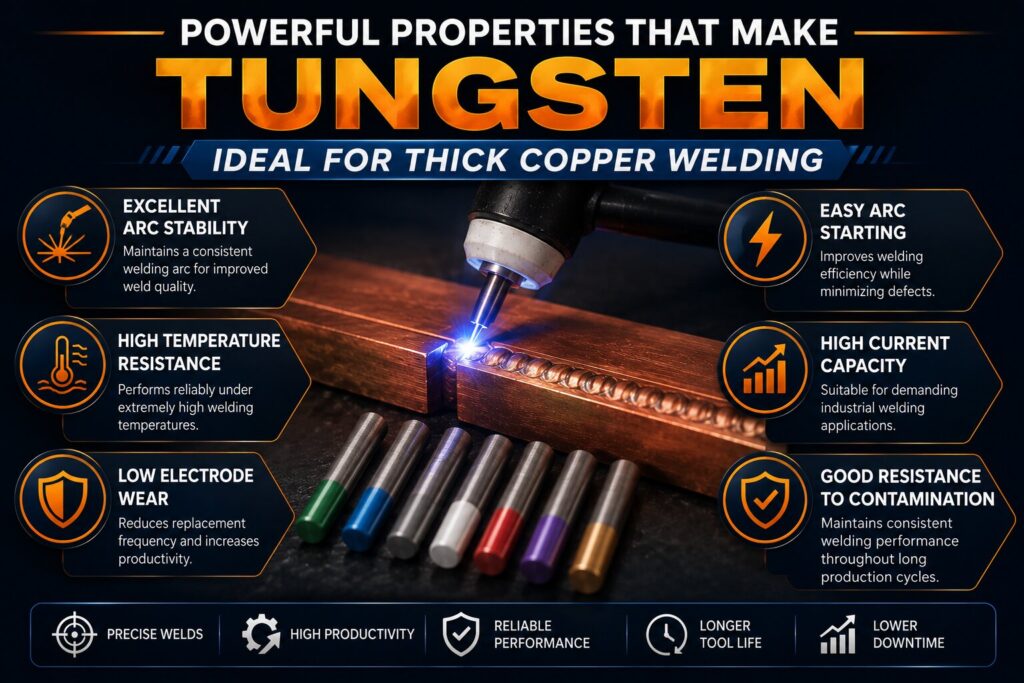
Excellent Arc Stability
Maintains a consistent welding arc for improved weld quality.
High Temperature Resistance
Performs reliably under extremely high welding temperatures.
Low Electrode Wear
Reduces replacement frequency and increases productivity.
Easy Arc Starting
Improves welding efficiency while minimizing defects.
High Current Capacity
Suitable for demanding industrial welding applications.
Good Resistance to Contamination
Maintains consistent welding performance throughout long production cycles.
Technical Specifications
Typical specifications include:
- Diameter: 1.0 mm to 6.4 mm
- Length: 150 mm, 175 mm, 178 mm
- Surface Finish: Ground or polished
- Manufacturing Standard: AWS A5.12
- Welding Process: TIG (GTAW)
- Current Type: AC, DC, or both depending on grade
Standards
Quality tungsten electrodes generally comply with:
- AWS A5.12
- ISO 6848
- EN ISO 6848
These standards ensure reliable chemical composition, dimensional accuracy, and welding performance.
Applications of the Best Tungsten Types for Welding Thick Copper
The Best Tungsten Types are widely used across demanding industries.
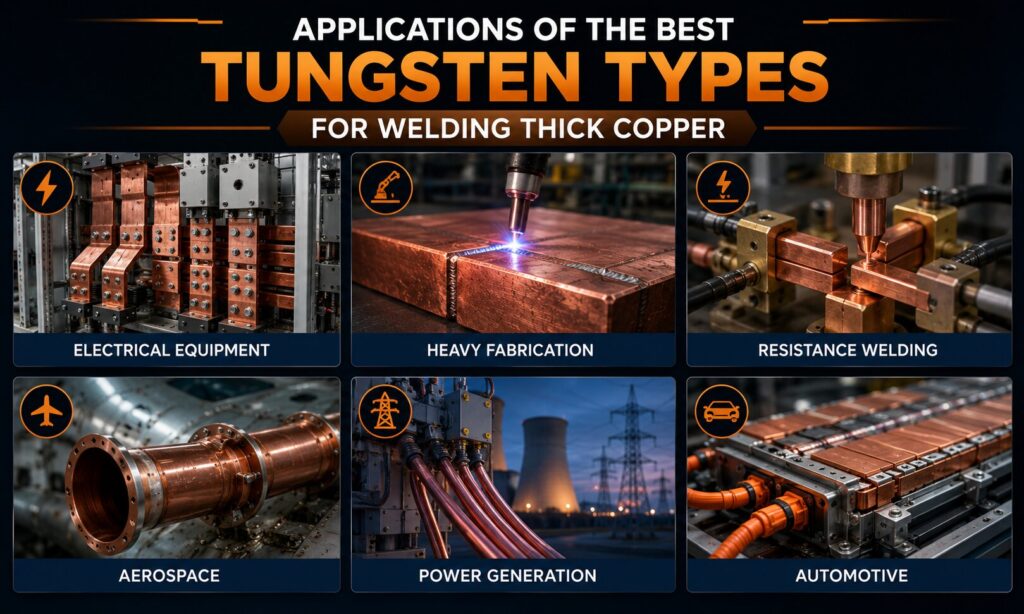
Electrical Equipment
Copper busbars, switchgear, and high-current conductors.
Heavy Fabrication
Large copper plates and industrial assemblies.
Resistance Welding
Electrodes and current-carrying components.
Aerospace
Precision copper components requiring defect-free welds.
Power Generation
Copper conductors and electrical systems.
Automotive
Electric vehicle battery connections and copper busbars using the Best Tungsten Types for stable, high-quality welds.
Industrial Manufacturing
Copper piping, heat exchangers, and custom fabrication.
Shapes Available
DOMADIA™ supplies tungsten materials in multiple configurations, including:
- Rods
- Electrodes
- Ground Electrodes
- Straight Lengths
- Custom Diameters
- Precision Cut Pieces
Custom specifications are available to match customer requirements.
Why DOMADIA™
Selecting the right supplier is just as important as selecting the right tungsten electrode.
DOMADIA™ provides:
- Premium-quality tungsten materials
- Consistent chemical composition
- Precision manufacturing
- Custom sizes and specifications
- Reliable industrial supply
- Technical support for material selection
- Worldwide delivery for diverse industries
Our commitment to quality ensures dependable performance for critical welding applications.
Conclusion
Selecting the Best Tungsten Types significantly improves welding performance when working with thick copper. The correct electrode delivers better arc stability, deeper penetration, longer service life, and greater productivity while reducing downtime and electrode replacement costs.
Whether your application involves heavy electrical equipment, aerospace components, or industrial fabrication, choosing the Best Tungsten Types ensures consistent weld quality and dependable results. DOMADIA™ offers premium tungsten solutions designed to meet demanding industrial requirements with consistent quality, reliable performance, and expert support to help customers select the Best Tungsten Types for their specific welding applications.
Choose the Right Tungsten for Reliable Copper Welding
DOMADIA™ supplies premium tungsten materials in a wide range of grades, sizes, and custom specifications to meet your exact industrial requirements.
Get in Touch with Us today for expert guidance and premium tungsten solutions tailored to your application.
Talk to: Er.Pankaj Domadia | Kairav Domadia | Aadil Domadia | Pragati Sanap | Pooja N N
#TIGWelding #CopperWelding #TungstenElectrode #IndustrialWelding #Manufacturing #Engineering #DOMADIA #MetalProcessing #Fabrication #WeldingTechnology
Directly whatsapp us for an Enquiry: https://wa.link/kairav
We’ve supplied to Mumbai, Pune, Indore, Jaipur, and Surat—serving industries across Maharashtra, Madhya Pradesh, Rajasthan, Gujarat, and Goa, with exports to Germany, USA, Japan, South Korea, and Italy.