Blogs
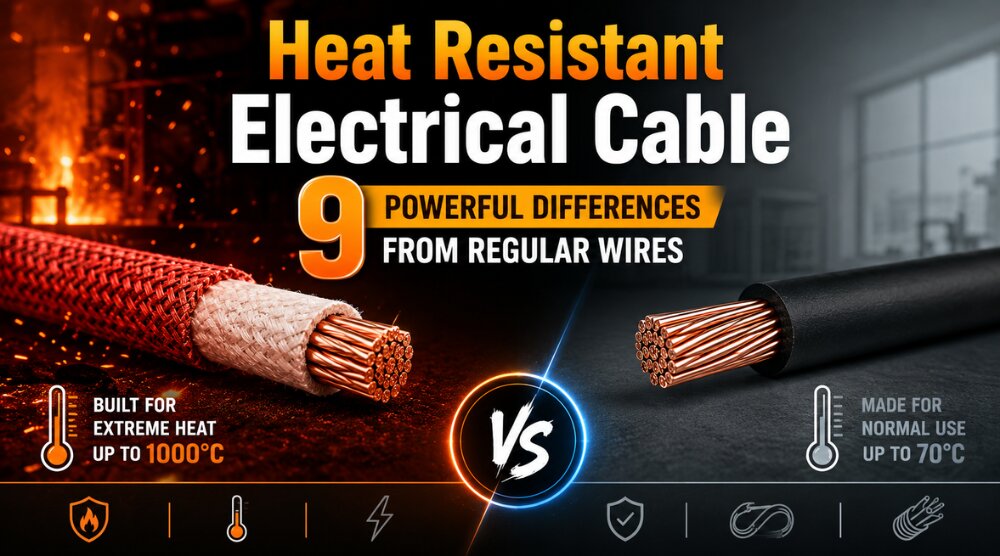
High Temperature Wire: 9 Powerful Ways It Beats Regular Wires
Electrical wiring is often hidden behind machines, panels, or protective conduits, making it easy to overlook its importance. Yet, the reliability of an entire industrial operation often depends on selecting the right type of wire. While ordinary electrical wires work well in homes and offices, they quickly reach their limits in environments exposed to extreme heat.
High Temperature Wire is specifically engineered to withstand temperatures that would rapidly damage conventional wiring. Unlike standard cables, High Temperature Wire maintains reliable electrical performance, insulation integrity, and long-term durability even under continuous exposure to elevated temperatures. Whether installed inside industrial furnaces, aerospace systems, glass manufacturing plants, or power generation facilities, these specialized wires continue delivering dependable performance in severe thermal conditions.
Understanding how High Temperature Wire differs from regular wires can help engineers, maintenance professionals, and procurement teams make better decisions that improve safety, reduce downtime, and increase equipment reliability. Choosing the right High Temperature Wire not only extends the lifespan of electrical systems but also supports safer and more efficient operation in demanding industrial environments.
What Is High Temperature Wire?
A High Temperature Wire is designed to operate safely at temperatures far beyond the capabilities of standard PVC-insulated electrical wires.
Instead of conventional insulation, these wires incorporate advanced materials capable of maintaining their electrical and mechanical properties even after prolonged exposure to intense heat.
Common insulation materials include:
- Silicone Rubber
- PTFE (Teflon®)
- Fiberglass Braiding
- Ceramic Fiber
- Mica Tape
- Fluoropolymer Insulation
These specialized materials ensure the wire continues operating safely where ordinary wiring would soften, crack, or fail completely.
Why Regular Wires Cannot Handle Extreme Heat
Standard electrical wires are primarily designed for residential, commercial, and light industrial installations where operating temperatures remain relatively moderate.
Once exposed to excessive heat, conventional insulation begins to deteriorate.
This deterioration may result in:
- Softened insulation
- Brittle outer jackets
- Electrical leakage
- Short circuits
- Reduced dielectric strength
- Premature cable failure
- Increased fire hazards
Replacing failed wiring frequently becomes expensive, especially when production lines must be shut down.
9 Powerful Differences Between High Temperature Wire and Regular Wires
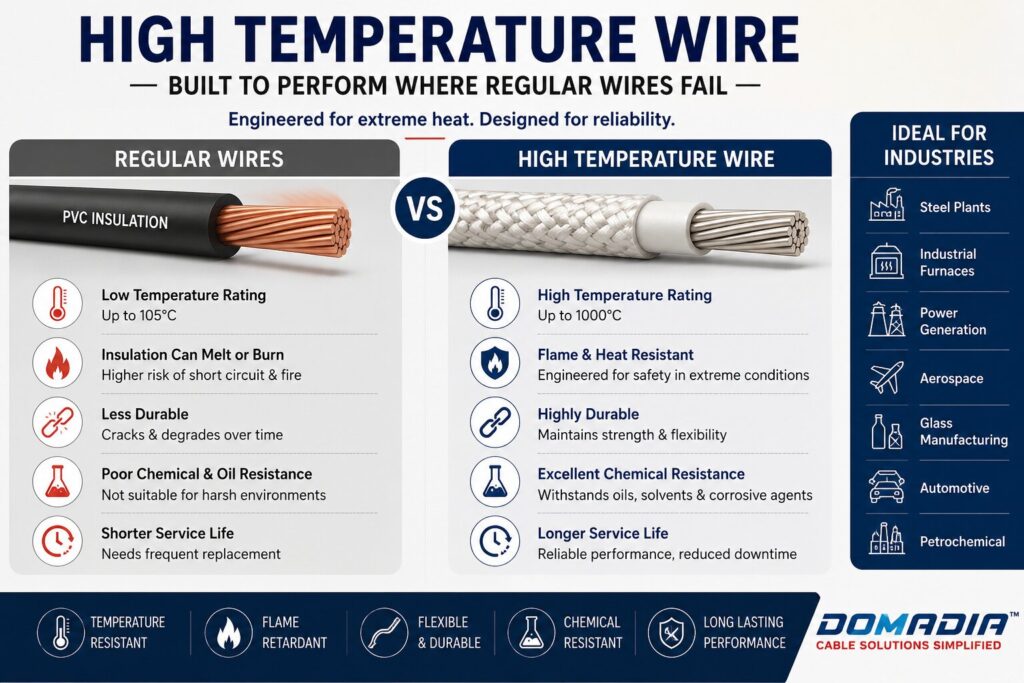
1. Much Higher Operating Temperature
The biggest advantage of High Temperature Wire is its ability to perform continuously under elevated temperatures.
Typical operating ranges include:
Regular Wire
- 70°C
- 90°C
- Up to 105°C
High Temperature Wire
- 180°C
- 250°C
- 400°C
- 600°C
- Up to 1000°C for specialized constructions
This enormous temperature difference makes these wires suitable for the most demanding industrial environments.
2. Insulation Materials
Regular wires generally use:
- PVC
- XLPE
- PE
High-temperature cables use advanced insulation systems including:
- Silicone rubber
- PTFE
- Fiberglass
- Ceramic fiber
- Mica insulation
These materials maintain their integrity under continuous thermal exposure.
3. Flame Resistance
A Heat Resistant Electrical Cable is designed to continue performing safely when exposed to heat and flames.
Many constructions provide:
- Flame retardancy
- Low smoke emission
- Fire survival capability
- Circuit integrity during emergencies
Standard wires generally provide limited fire resistance.
4. Mechanical Stability
Heat accelerates insulation aging.
Regular wires often become:
- Brittle
- Cracked
- Fragile
High-temperature cables maintain:
- Flexibility
- Mechanical strength
- Stable insulation
- Longer operational life
Even after repeated heating and cooling cycles.
5. Chemical Resistance
Industrial environments often expose wiring to:
- Oils
- Solvents
- Chemicals
- Moisture
- Corrosive vapors
Special insulation materials offer excellent resistance against these harsh conditions, extending cable service life.
6. Electrical Performance
Elevated temperatures can negatively affect electrical insulation.
High-performance insulation maintains:
- Stable dielectric strength
- Low leakage current
- Reliable voltage performance
- Improved electrical safety
This is critical for precision industrial equipment.
7. Service Life
Continuous heat rapidly ages conventional insulation.
A Heat Resistant Electrical Cable is specifically engineered for prolonged exposure, significantly reducing:
- Maintenance
- Unexpected failures
- Replacement frequency
- Production interruptions
The result is lower lifetime operating costs.
8. Industrial Reliability
High-temperature cables are commonly specified where failure simply is not acceptable.
Examples include:
- Steel plants
- Aerospace testing
- Glass manufacturing
- Petrochemical processing
- Power generation
- Industrial furnaces
Ordinary wiring cannot reliably survive these operating conditions.
9. Safety Margin
Electrical safety becomes increasingly important as operating temperatures rise.
High-temperature cables help reduce the risk of:
- Insulation breakdown
- Electrical faults
- Fire hazards
- Unexpected shutdowns
- Equipment damage
For many industries, this additional safety margin justifies the investment.
Chemical Composition
Although the exact composition depends on the cable design, high-temperature cables typically include:
Conductors
- Copper
- Nickel-plated Copper
- Silver-plated Copper
- Nickel Conductors
Insulation
- Silicone Rubber
- PTFE
- Fiberglass
- Ceramic Fiber
- Mica Tape
- Fluoropolymers
Outer Protection
- Braided Fiberglass
- Stainless Steel Braid
- Silicone Coating
- High-temperature Jackets
Properties of Heat Resistant Electrical Cable
High-performance cables deliver several important advantages.
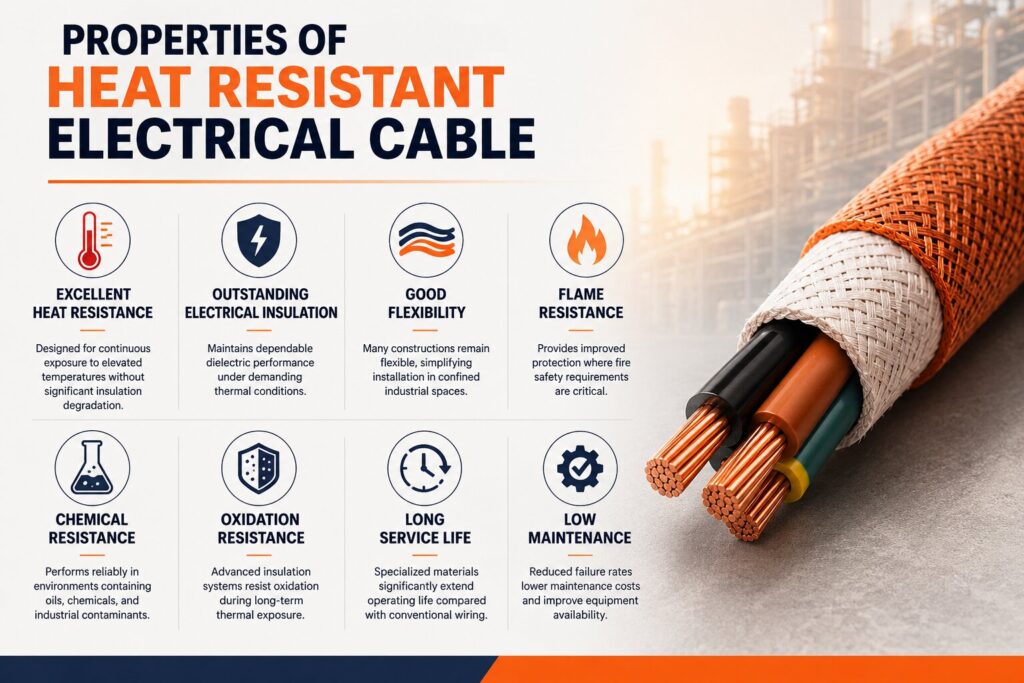
Excellent Heat Resistance
Designed for continuous exposure to elevated temperatures without significant insulation degradation.
Outstanding Electrical Insulation
High Temperature Wire maintains dependable dielectric performance under demanding thermal conditions, ensuring safe and reliable electrical insulation even in extreme operating environments.
Good Flexibility
Many constructions remain flexible, simplifying installation in confined industrial spaces.
Flame Resistance
Provides improved protection where fire safety requirements are critical.
Chemical Resistance
High Temperature Wire performs reliably in environments containing oils, chemicals, and industrial contaminants, ensuring long-lasting performance even in harsh industrial conditions.
Oxidation Resistance
Advanced insulation systems resist oxidation during long-term thermal exposure.
Long Service Life
Specialized materials significantly extend operating life compared with conventional wiring.
Low Maintenance
Reduced failure rates lower maintenance costs and improve equipment availability.
Technical Specifications
Typical specifications may include:
| Parameter | Typical Range |
| Operating Temperature | 180°C to 1000°C |
| Voltage Rating | 300V–1000V |
| Conductor Material | Copper, Nickel-Plated Copper |
| Insulation | Silicone, PTFE, Fiberglass |
| Flame Resistance | Yes |
| Flexibility | Excellent |
| Chemical Resistance | High |
| Moisture Resistance | Excellent |
| Fire Survival Options | Available |
Specifications vary according to cable construction and application.
Applications
High-temperature cables are essential across numerous industries.
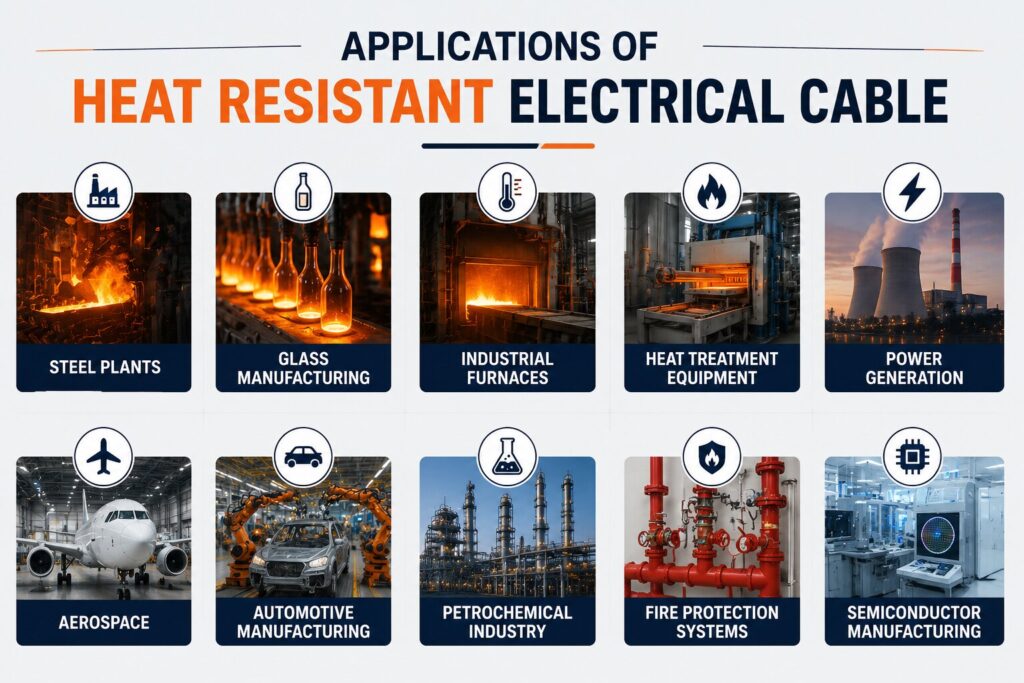
Steel Plants
Reliable electrical connections around furnaces, reheating systems, and rolling mills.
Glass Manufacturing
Suitable for equipment operating near molten glass and radiant heat.
Industrial Furnaces
Powering heaters, sensors, and controls exposed to continuous high temperatures.
Heat Treatment Equipment
High Temperature Wire remains reliable during repeated heating and cooling cycles, maintaining consistent performance and reducing the risk of insulation failure in demanding applications.
Power Generation
Used around boilers, turbines, and auxiliary equipment.
Aerospace
Supports thermal chambers, engine testing facilities, and specialized electrical systems.
Automotive Manufacturing
Ideal for robotic welding lines and paint curing ovens.
Petrochemical Industry
Performs reliably in chemically aggressive and high-temperature environments.
Fire Protection Systems
Maintains circuit integrity during emergency situations.
Semiconductor Manufacturing
Provides dependable electrical performance in precision thermal processing equipment.
Shapes Available
DOMADIA™ offers various configurations based on industrial requirements.
- Single Core Cable
- Multi-Core Cable
- Shielded Cable
- Braided Cable
- Flexible Cable
- High-Temperature Sensor Cable
- Thermocouple Extension Cable
- Custom Assemblies
Custom sizes and constructions are also available for specialized applications.
Why DOMADIA™
Selecting the right supplier is just as important as selecting the right cable.
DOMADIA™ delivers:
- High-quality industrial cable solutions
- Consistent manufacturing standards
- Custom-engineered cable constructions
- Reliable technical assistance
- Fast delivery
- Competitive pricing
- Extensive industrial experience
- Support for demanding applications across multiple industries
Whether your application involves furnaces, aerospace testing, power generation, or advanced manufacturing, DOMADIA™ provides dependable solutions engineered for long-term performance.
Conclusion
A Heat Resistant Electrical Cable is far more than an upgraded version of an ordinary wire. Its specialized insulation materials, superior thermal stability, enhanced safety, and longer service life enable reliable operation in environments where standard cables would quickly fail.
For industries operating under extreme temperatures, choosing the correct cable is an investment in safety, productivity, and equipment reliability. By selecting high-performance solutions from DOMADIA™, businesses can reduce downtime, extend maintenance intervals, and ensure dependable electrical performance even in the most demanding industrial conditions.
Ready for Reliable High Temperature Wire Solutions?
Choose DOMADIA™ for high-performance wiring engineered to withstand extreme temperatures and demanding industrial environments.
Get in Touch with Us today to find the right High Temperature Wire solution for your application with expert guidance from DOMADIA™.
Talk to: Er.Pankaj Domadia | Kairav Domadia | Aadil Domadia | Pragati Sanap | Pooja N N
#HighTemperatureWire #IndustrialCable #HeatResistantWire #ElectricalEngineering #IndustrialAutomation #Manufacturing #PowerGeneration #DOMADIA
Directly whatsapp us for an Enquiry: https://wa.link/kairav
We’ve delivered to Bengaluru, Mysuru, Mangaluru, Hubballi, and Belagavi—covering Karnataka, Telangana, Tamil Nadu, Kerala, and Andhra Pradesh, with exports to Australia, New Zealand, Singapore, Malaysia, and Indonesia.