Blogs
EDM Electrode Materials Comparison: 7 Powerful Differences That Impact Machining Performance
EDM Electrode Materials Comparison: Why Material Selection Matters
A precision mold manufacturer once struggled with inconsistent surface finishes and frequent electrode replacements during production.
The machining parameters seemed correct. The EDM machine was functioning perfectly.
The actual problem?
The wrong electrode material had been selected for the application.
In Electrical Discharge Machining (EDM), electrode material directly affects machining speed, accuracy, surface finish, wear rate, and overall production costs. Choosing the right material can significantly improve productivity while reducing downtime.
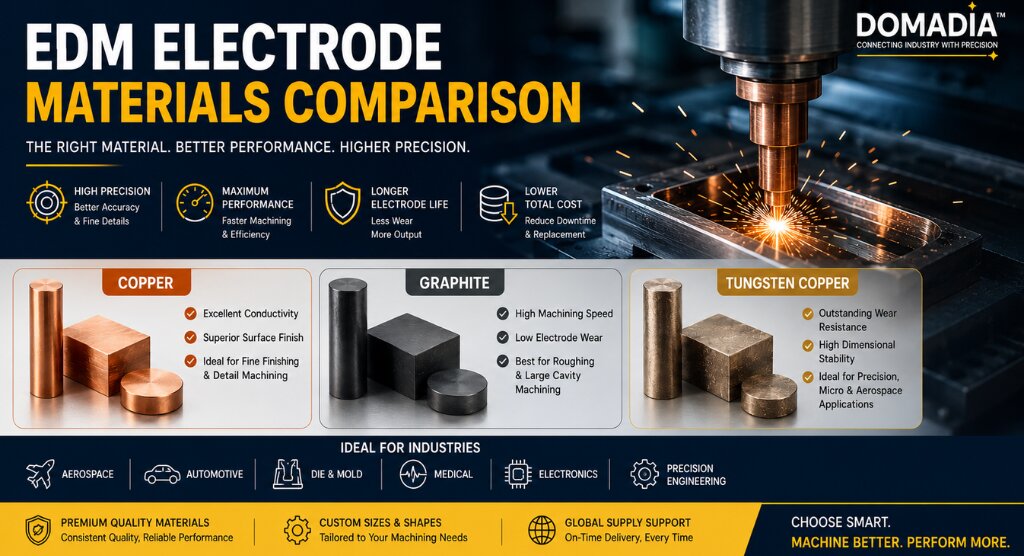
This EDM Electrode Materials Comparison explores the most commonly used EDM electrode materials and helps manufacturers determine which option delivers the best performance for specific machining requirements.
Whether producing complex molds, precision aerospace components, or high-accuracy industrial parts, an effective EDM Electrode Materials Comparison can help identify the ideal electrode solution for maximizing machining performance, extending electrode life, and reducing overall manufacturing costs.
What Are EDM Electrode Materials?
EDM electrodes are conductive materials used to generate controlled electrical sparks that erode conductive workpieces.
The most common EDM electrode materials include:
- Copper
- Graphite
- Tungsten Copper
- Silver Tungsten
- Brass
- Copper Tungsten
Each material offers distinct advantages depending on machining conditions, accuracy requirements, and workpiece characteristics.
7 Powerful EDM Electrode Material Comparisons
1. Electrical Conductivity
Electrical conductivity affects spark efficiency and machining stability.
Copper
- Excellent conductivity
- Stable spark generation
- Suitable for fine finishing
Graphite
- Lower conductivity than copper
- Performs well in rough machining
Tungsten Copper
- High conductivity with enhanced thermal resistance
- Suitable for demanding precision applications
Best Choice: Copper and Tungsten Copper
2. Electrode Wear Resistance
Electrode wear directly impacts dimensional accuracy and production costs.
Copper
- Moderate wear resistance
Graphite
- Better wear resistance in roughing operations
Tungsten Copper
- Exceptional resistance to erosion
- Maintains shape for extended machining cycles
Best Choice: Tungsten Copper
3. Surface Finish Quality
Surface finish is critical in molds, dies, and precision tooling.
Copper
- Produces excellent surface finish
- Ideal for mirror-finish applications
Graphite
- Good finish but may leave slightly rougher surfaces
Tungsten Copper
- Superior dimensional consistency
- Excellent fine-detail reproduction
Best Choice: Copper and Tungsten Copper
4. Machining Speed
Production efficiency often depends on material removal rates.
Graphite
- High material removal capability
- Preferred for rough machining
Copper
- Moderate machining speed
Tungsten Copper
- Slightly slower but highly accurate
Best Choice: Graphite
5. Thermal Stability
EDM generates extremely high localized temperatures.
Copper
- Good heat dissipation
Graphite
- Excellent thermal shock resistance
Tungsten Copper
- Outstanding thermal conductivity and thermal stability
Best Choice: Tungsten Copper
6. Fine Detail Machining
Modern industries increasingly require micro-features and intricate geometries.
Copper
- Excellent for small cavities and sharp corners
Graphite
- Less suitable for extremely fine details
Tungsten Copper
- Exceptional dimensional control
- Maintains electrode geometry under prolonged machining
Best Choice: Tungsten Copper
7. Overall Cost vs Lifecycle Value
Many manufacturers focus only on initial electrode cost.
However, total operating cost includes:
- Electrode replacement frequency
- Downtime
- Machining consistency
- Scrap generation
- Rework expenses
Copper
- Lower initial cost
- Moderate lifespan
Graphite
- Cost-effective for roughing operations
Tungsten Copper
- Higher initial investment
- Significantly longer service life
- Reduced replacement frequency
Although tungsten copper costs more than standard electrode materials, its longer operational life often delivers lower total production costs.
Comparison Table
| Property | Copper | Graphite | Tungsten Copper |
| Conductivity | Excellent | Good | Excellent |
| Wear Resistance | Moderate | Good | Excellent |
| Surface Finish | Excellent | Good | Excellent |
| Machining Speed | Moderate | High | Moderate |
| Thermal Stability | Good | Excellent | Excellent |
| Fine Detail Capability | Excellent | Moderate | Excellent |
| Service Life | Good | Good | Excellent |
Chemical Composition
Copper Electrode
| Element | Percentage |
| Copper (Cu) | 99.9% Min |
Graphite Electrode
| Element | Percentage |
| Carbon (C) | 99%+ |
Tungsten Copper Electrode
| Element | Percentage |
| Tungsten (W) | 70–90% |
| Copper (Cu) | 10–30% |
Properties of Copper Electrodes
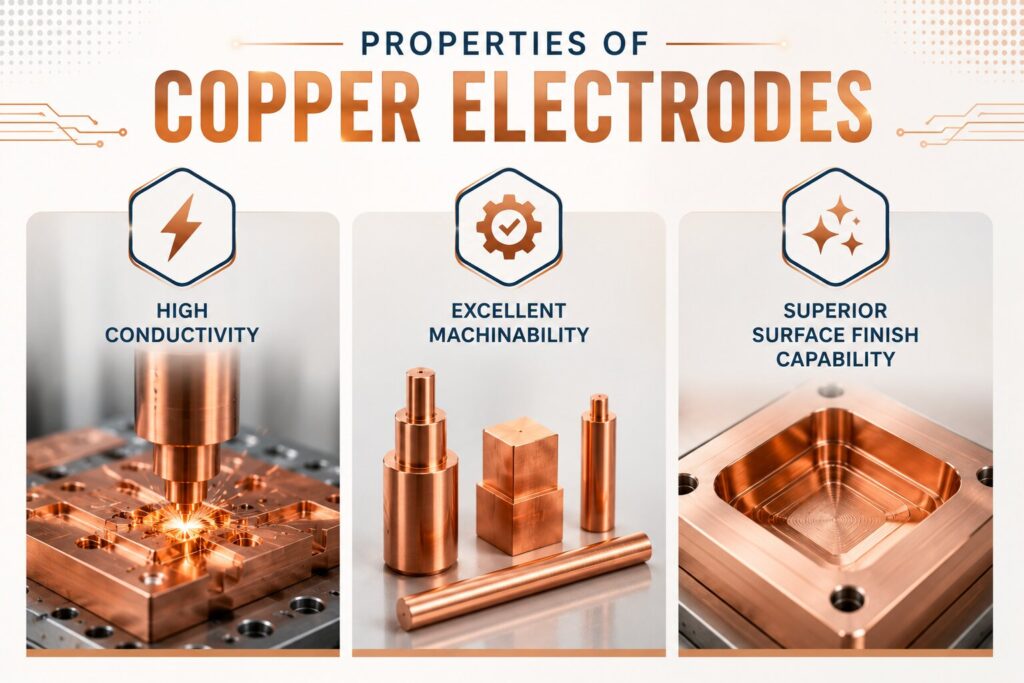
High Conductivity
Copper electrodes offer excellent electrical conductivity, enabling efficient spark generation and stable EDM performance. This helps improve machining accuracy while reducing energy losses during operation. In any EDM Electrode Materials Comparison, copper is widely recognized for delivering reliable performance, superior conductivity, and consistent machining results across a variety of EDM applications.
Excellent Machinability
Copper can be easily machined into complex electrode shapes and intricate geometries. In an EDM Electrode Materials Comparison, copper is valued for its excellent machinability, allowing manufacturers to produce precision electrodes efficiently while maintaining high dimensional accuracy.
Superior Surface Finish Capability
Copper electrodes are known for producing smooth and high-quality surface finishes. In an EDM Electrode Materials Comparison, copper stands out for applications requiring fine details, mirror-like surfaces, and tight dimensional tolerances, making it a preferred choice for precision machining.
Properties of Graphite Electrodes
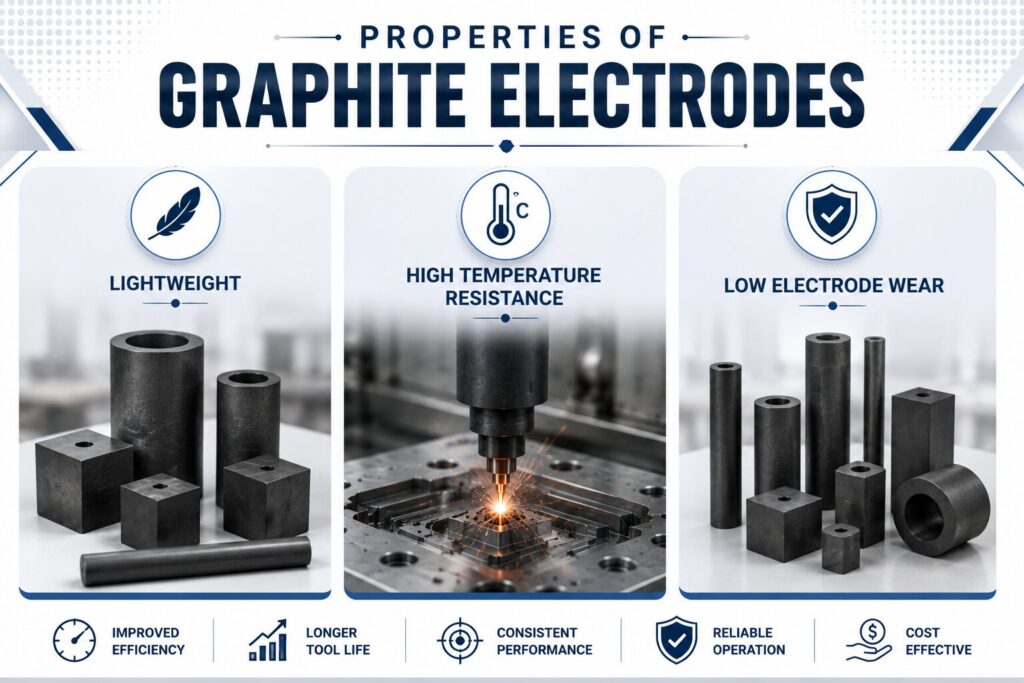
Lightweight
Graphite has a significantly lower density than metallic electrode materials, making it easier to handle and machine. Its lightweight nature also reduces stress on EDM machine components during operation.
High Temperature Resistance
Graphite maintains its structural integrity even under extreme EDM temperatures. This thermal stability helps ensure consistent machining performance during high-energy discharge operations.
Low Electrode Wear
Graphite electrodes exhibit excellent resistance to erosion during EDM processes. Lower wear rates result in longer electrode life, improved dimensional consistency, and reduced replacement costs.
Properties of Tungsten Copper Electrodes
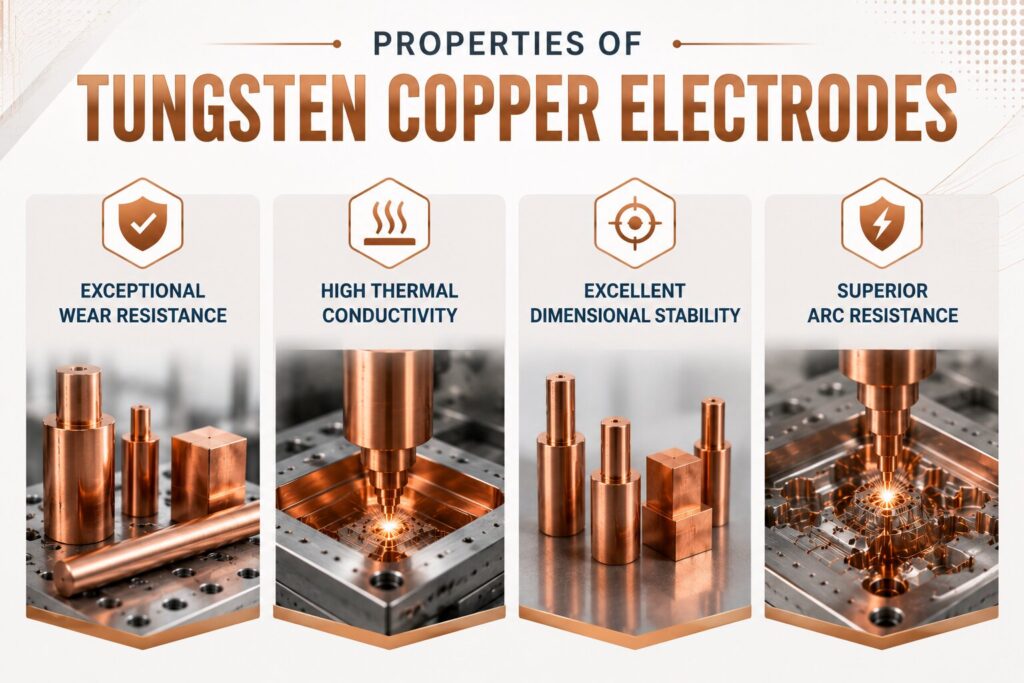
Exceptional Wear Resistance
Tungsten copper electrodes withstand intense electrical discharges with minimal material loss. In an EDM Electrode Materials Comparison, tungsten copper is highly regarded for its exceptional wear resistance, helping maintain electrode geometry and extending service life in demanding EDM operations.
High Thermal Conductivity
The combination of tungsten and copper provides excellent heat dissipation characteristics. In an EDM Electrode Materials Comparison, tungsten copper is valued for its superior thermal conductivity, which reduces localized overheating and enhances machining stability during high-performance EDM operations.
Excellent Dimensional Stability
Tungsten copper maintains precise dimensions even during prolonged machining cycles. This stability is essential for manufacturing highly accurate components with intricate features.
Superior Arc Resistance
Tungsten copper offers outstanding resistance to electrical arc damage and erosion. This property enhances electrode durability and ensures consistent performance in demanding EDM applications. In an EDM Electrode Materials Comparison, tungsten copper is often preferred for its superior arc resistance, helping maintain machining consistency and reduce electrode wear under high-intensity operating conditions.
Technical Specifications
| Property | Copper | Graphite | Tungsten Copper |
| Density (g/cm³) | 8.9 | 1.8–2.0 | 14–17 |
| Conductivity (% IACS) | 100 | 15–25 | 30–55 |
| Hardness | Medium | Low | High |
| Melting Point | 1085°C | Sublimes >3600°C | >3000°C Composite |
Applications of Copper Electrodes
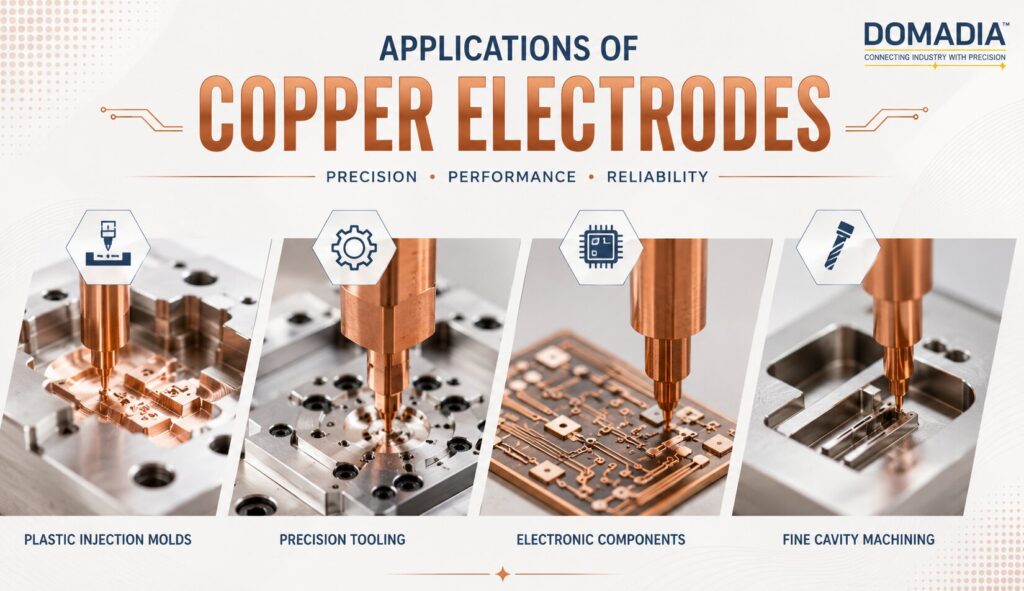
Plastic Injection Molds
Copper electrodes are widely used for machining complex cavities and fine details in plastic injection molds. Their excellent conductivity helps achieve superior surface finishes and precise dimensional accuracy.
Precision Tooling
Precision tooling applications require tight tolerances and consistent machining performance. Copper electrodes provide stable spark generation, making them ideal for producing highly accurate tooling components. In an EDM Electrode Materials Comparison, copper remains a preferred choice for precision tooling due to its ability to deliver reliable machining accuracy and superior surface quality.
Electronic Components
The electronics industry relies on copper electrodes for manufacturing intricate conductive parts and micro-features. Their high conductivity supports precise EDM machining with minimal surface defects. In an EDM Electrode Materials Comparison, copper is widely used for electronics applications where dimensional accuracy, fine detail reproduction, and consistent machining performance are critical.
Fine Cavity Machining
Copper electrodes excel in creating deep, narrow, and intricate cavities where high accuracy is essential. They help achieve smooth finishes and maintain detailed geometries throughout the machining process. In an EDM Electrode Materials Comparison, copper is highly valued for cavity machining applications that demand precision, excellent surface quality, and consistent dimensional control.
Applications of Graphite Electrodes
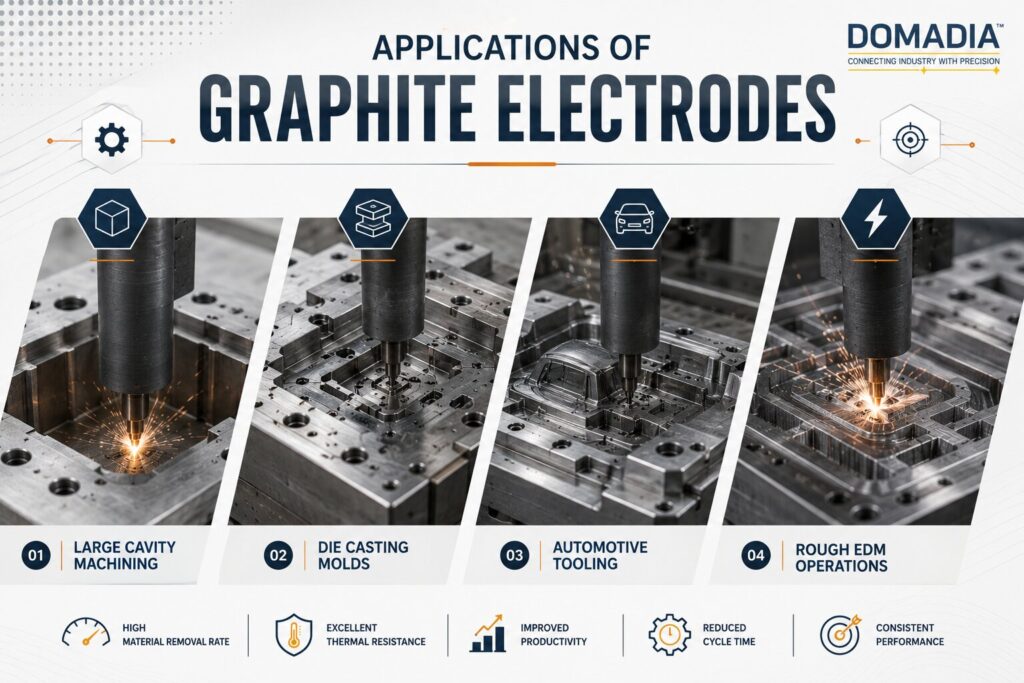
Large Cavity Machining
Graphite electrodes are preferred for large cavity EDM operations due to their lightweight structure and high material removal rates. They improve productivity while reducing electrode wear during extended machining cycles. In an EDM Electrode Materials Comparison, graphite is highly valued for large cavity machining because it enables faster processing, improved efficiency, and reliable performance in demanding EDM applications.
Die Casting Molds
Die casting molds often require efficient rough machining of large sections. Graphite electrodes offer excellent thermal resistance and machining speed, making them ideal for these demanding applications. In an EDM Electrode Materials Comparison, graphite is frequently chosen for die casting mold production because it enables faster material removal while maintaining reliable machining performance.
Automotive Tooling
Automotive manufacturers use graphite electrodes for producing dies, molds, and tooling components. Their ability to machine large features quickly helps reduce production time and manufacturing costs. In an EDM Electrode Materials Comparison, graphite is widely preferred in automotive manufacturing for its high machining efficiency, excellent thermal stability, and cost-effective performance in large-scale production environments.
Rough EDM Operations
Graphite electrodes are particularly effective in roughing applications where material removal speed is the primary objective. They maintain performance under high-energy discharge conditions and deliver consistent machining results.
Applications of Tungsten Copper Electrodes
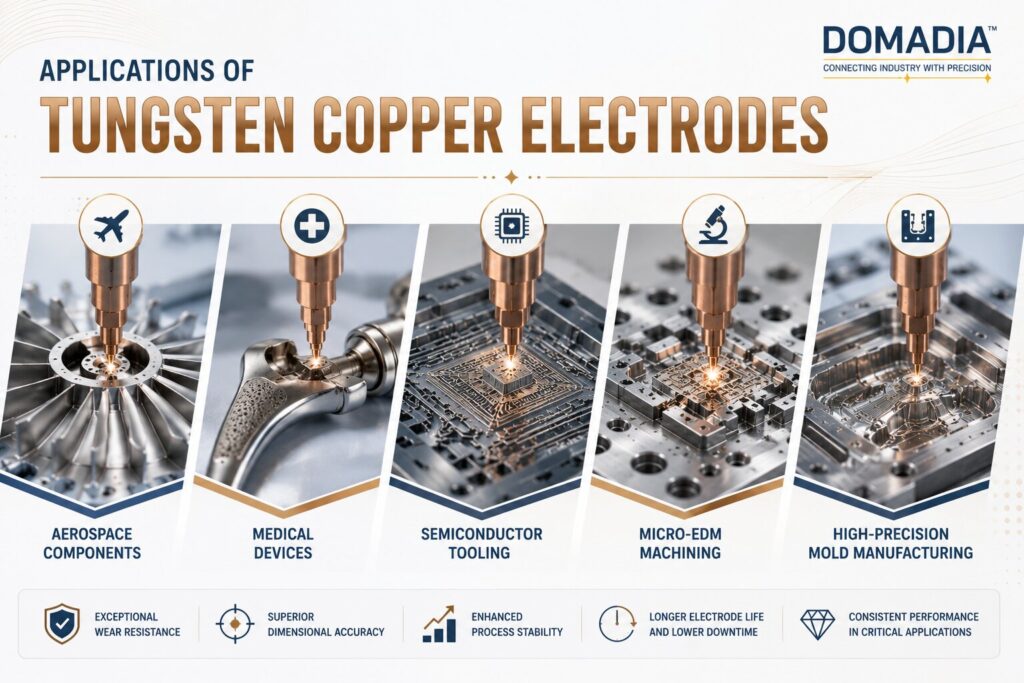
Aerospace Components
Aerospace parts require exceptional dimensional accuracy and material consistency. Tungsten copper electrodes provide superior wear resistance and precision, making them suitable for critical aerospace manufacturing.
Medical Devices
Medical device manufacturing demands extremely fine features and high surface quality. In an EDM Electrode Materials Comparison, tungsten copper electrodes are preferred for precision EDM processes used in surgical instruments and implantable components.
Semiconductor Tooling
Semiconductor production involves machining microscopic and highly detailed features. Tungsten copper electrodes deliver the stability and accuracy required for advanced semiconductor tooling applications. In an EDM Electrode Materials Comparison, tungsten copper is often selected for semiconductor manufacturing because of its exceptional dimensional stability, wear resistance, and ability to maintain precision when machining intricate micro-scale features.
Micro-EDM Machining
Micro-EDM machining requires electrodes capable of maintaining geometry under extremely fine machining conditions. Tungsten copper offers outstanding dimensional stability and low wear rates for miniature components.
High-Precision Mold Manufacturing
High-performance molds used in electronics, medical, and aerospace industries require exceptional accuracy. Tungsten copper electrodes help achieve intricate details, longer electrode life, and superior surface finishes. In an EDM Electrode Materials Comparison, tungsten copper is highly valued for precision mold manufacturing due to its outstanding dimensional stability, wear resistance, and ability to deliver consistent machining results in critical applications.
Standards
Common standards applicable to EDM electrode materials include:
- ASTM B187
- ASTM B702
- ASTM B631
- ISO 9001 Manufacturing Standards
- DIN Material Specifications
- JIS Industrial Standards
Shapes Available
DOMADIA™ supplies EDM electrode materials in:
- Rods
- Bars
- Plates
- Blocks
- Round Electrodes
- Custom Profiles
- Precision Machined Components
- Special EDM Electrode Assemblies
Why DOMADIA™
DOMADIA™ supplies high-performance EDM materials designed for precision manufacturing industries.
Technical Expertise
Material recommendations based on machining requirements.
Quality Assurance
Strict control of material composition and dimensional accuracy.
Custom Manufacturing
Special sizes and custom-machined electrode solutions available.
Industry Support
Serving aerospace, automotive, electronics, tooling, defense, and precision engineering sectors.
Long-Term Value
High-quality materials help reduce downtime, scrap generation, and electrode replacement costs.
Conclusion
Selecting the right electrode material is one of the most important decisions in EDM machining. This EDM Electrode Materials Comparison demonstrates that while copper remains excellent for finishing operations and graphite excels in rough machining, tungsten copper often provides the best balance of wear resistance, dimensional stability, and long-term value.
As machining tolerances become tighter and production demands increase, investing in the correct electrode material can dramatically improve productivity, reduce operational costs, and enhance component quality. By applying the insights shared in this EDM Electrode Materials Comparison, manufacturers can make more informed material selection decisions that support higher machining efficiency and consistent production results. DOMADIA™ continues supporting manufacturers with advanced EDM material solutions engineered for precision performance.
Ready to Improve Your EDM Machining Performance?
DOMADIA™ supplies precision EDM electrode materials engineered for demanding industrial applications.
Contact DOMADIA™ today to find the ideal EDM electrode material for your manufacturing requirements and maximize machining efficiency.
Talk to: Er.Pankaj Domadia | Kairav Domadia | Aadil Domadia | Pragati Sanap | Pooja N N
#EDMElectrodeMaterialsComparison #EDMMachining #CopperElectrode #GraphiteElectrode #TungstenCopper #PrecisionEngineering #Manufacturing #ToolMaking #DOMADIA
Directly whatsapp us for an Enquiry: https://wa.link/kairav
Our supply network spans Delhi, Noida, Gurugram, Faridabad, and Ghaziabad across Delhi NCR, Haryana, UP, Rajasthan, and Punjab, reaching clients in UAE, Saudi Arabia, Qatar, Oman, and Kuwait.