Blogs
EMI Shielding Testing Guide: 7 Powerful dB Facts Explained (UNS N14080)
EMI Shielding Testing Guide: Why dB Ratings Matter More Than Most Engineers Think
A medical device manufacturer once faced repeated failures during electromagnetic compatibility (EMC) certification. The enclosure material appeared adequate on paper, yet the equipment continued experiencing interference from nearby wireless systems. The problem was not the material itself—it was a misunderstanding of shielding effectiveness ratings. This real-world challenge highlights why an EMI Shielding Testing Guide is essential for selecting and validating the right shielding solution.
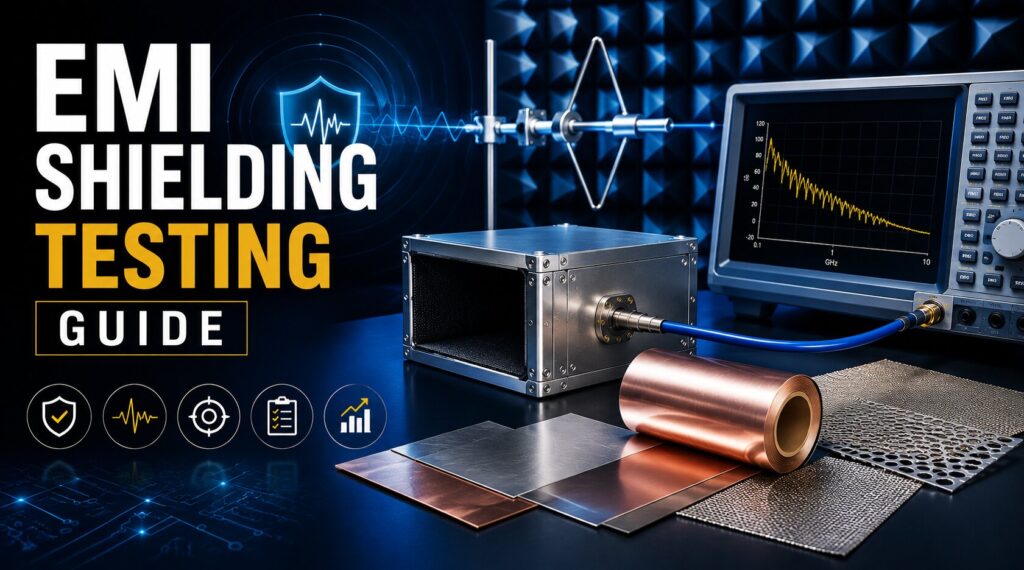
Many engineers see a shielding value such as 40 dB, 60 dB, or 100 dB and assume higher is always better. While that is partially true, understanding what those numbers actually represent is essential for selecting the right shielding material and avoiding costly design mistakes.
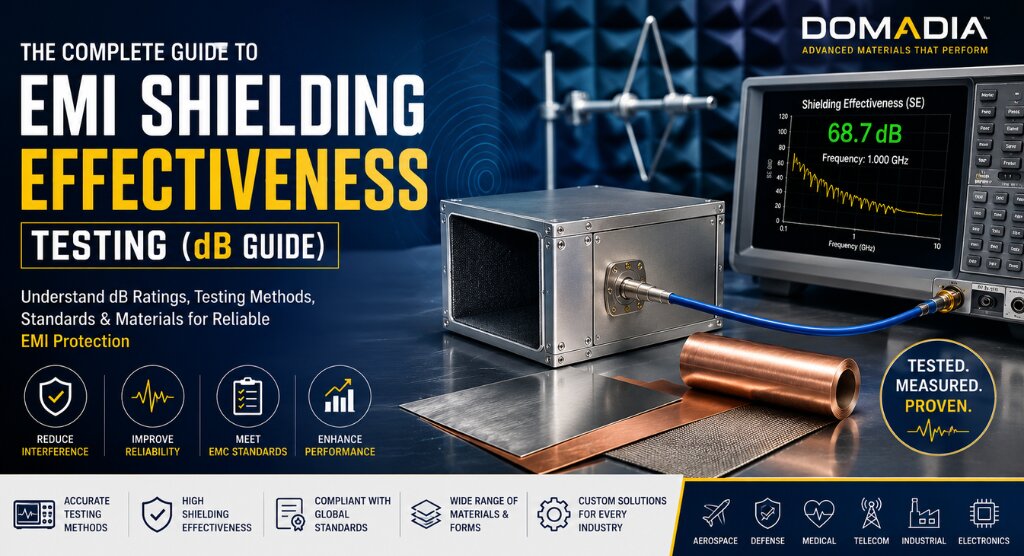
This EMI Shielding Testing Guide explains how shielding effectiveness is measured, what dB values mean, applicable standards, material selection considerations, and why proper testing is critical for modern electronics.
What Is EMI Shielding Effectiveness?
EMI (Electromagnetic Interference) Shielding Effectiveness (SE) measures how well a material or enclosure reduces electromagnetic energy passing through it.
The performance is expressed in decibels (dB) and represents the difference between the electromagnetic energy before and after shielding. An EMI Shielding Testing Guide helps engineers understand these measurements and evaluate real-world shielding performance.
Higher dB values indicate stronger attenuation and better protection against electromagnetic interference.
Understanding Shielding Effectiveness in dB
Shielding effectiveness is generally calculated using:
SE (dB) = 20 log (E₁/E₂)
Where:
- E₁ = Incident field strength
- E₂ = Transmitted field strength
Common Shielding Performance Levels
| Shielding Effectiveness | Signal Reduction |
| 20 dB | 90% Reduction |
| 40 dB | 99% Reduction |
| 60 dB | 99.9% Reduction |
| 80 dB | 99.99% Reduction |
| 100 dB | 99.999% Reduction |
Even a small increase in dB rating can represent a significant improvement in EMI protection.
Chemical Composition of UNS N14080
UNS N14080, commonly known as Mu-Metal, is widely used in magnetic shielding applications where low-frequency electromagnetic fields must be controlled.
Typical Chemical Composition
| Element | Percentage (%) |
| Nickel (Ni) | 77 – 80 |
| Iron (Fe) | Balance |
| Molybdenum (Mo) | 4 – 5 |
| Copper (Cu) | 4 – 5 |
| Other Elements | Trace |
This composition provides extremely high magnetic permeability and excellent magnetic field attenuation.
How EMI Shielding Works
Shielding effectiveness is achieved through three primary mechanisms:
Reflection
Conductive materials reflect incoming electromagnetic waves away from sensitive electronics.
Absorption
Magnetic materials absorb electromagnetic energy and dissipate it internally.
Multiple Reflections
Internal reflections within shielding layers further reduce transmitted energy.
The combined contribution of these mechanisms determines the overall shielding effectiveness.
Standards Used for EMI Shielding Effectiveness Testing
Reliable testing requires internationally recognized standards.
IEEE 299
One of the most widely accepted standards for measuring shielding effectiveness of enclosures and shielded rooms.
MIL-STD-285
Historically used military standard for shielding effectiveness evaluation.
IEEE STD 299.1
Updated methodology for smaller enclosures and electronic systems.
ASTM D4935
Commonly used for measuring shielding effectiveness of planar materials.
IEC 61000 Series
International EMC standards used for commercial and industrial equipment.
Proper compliance testing ensures consistent and repeatable results.
Properties of High-Performance EMI Shielding Materials
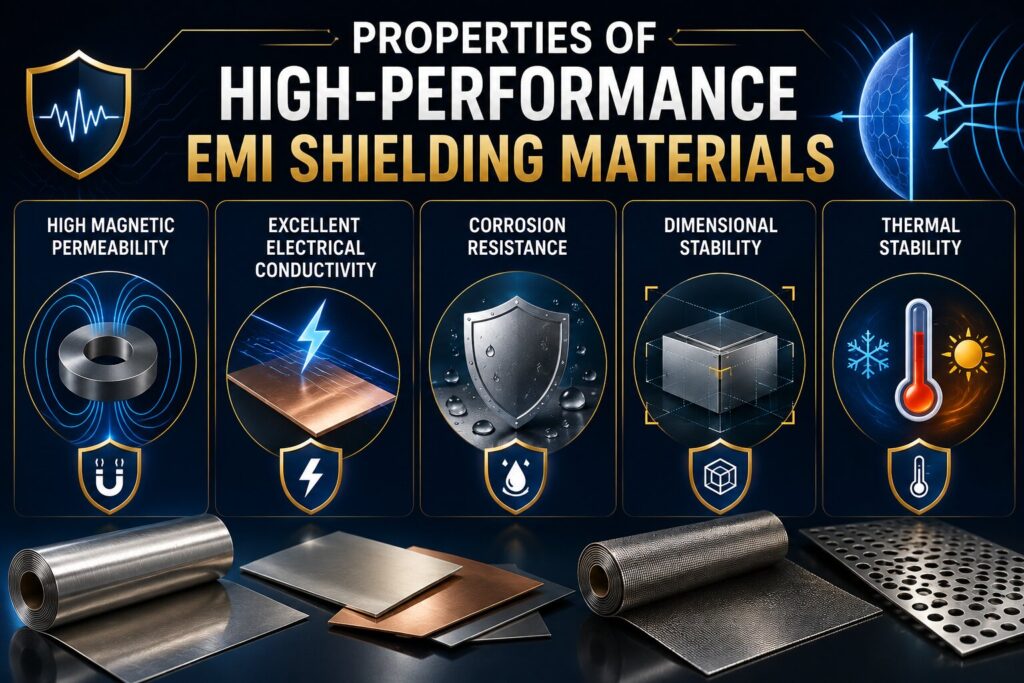
High Magnetic Permeability
High magnetic permeability allows shielding materials to efficiently redirect and absorb magnetic fields, reducing interference in sensitive electronic systems. In an EMI Shielding Testing Guide, this property is critical for evaluating low-frequency magnetic shielding performance.
Excellent Electrical Conductivity
Excellent electrical conductivity helps reflect electromagnetic waves away from protected equipment, improving overall shielding effectiveness. An EMI Shielding Testing Guide often highlights conductivity as a key factor in RF and high-frequency shielding applications.
Corrosion Resistance
Corrosion-resistant shielding materials maintain their protective performance even in harsh industrial and outdoor environments. This characteristic is important in any EMI Shielding Testing Guide because long-term reliability directly impacts shielding effectiveness.
Dimensional Stability
Dimensional stability ensures shielding components retain their shape and fit throughout their operational life. An EMI Shielding Testing Guide recognizes this property as essential for maintaining consistent EMI protection and minimizing leakage paths.
Thermal Stability
Thermal stability enables shielding materials to perform reliably across varying temperatures without degradation. In an EMI Shielding Testing Guide, this property is vital for applications exposed to continuous thermal cycling or elevated operating temperatures.
Technical Specifications of UNS N14080 Shielding Material
| Property | Typical Value |
| UNS Number | N14080 |
| Density | ~8.7 g/cm³ |
| Relative Permeability | Up to 100,000+ |
| Saturation Flux Density | Approx. 0.8 Tesla |
| Electrical Resistivity | ~55 µΩ-cm |
| Magnetic Shielding Capability | Excellent |
| Formability | Excellent |
| Annealing Requirement | Recommended |
Proper annealing significantly enhances magnetic shielding performance.
Applications of EMI Shielding Effectiveness Testing
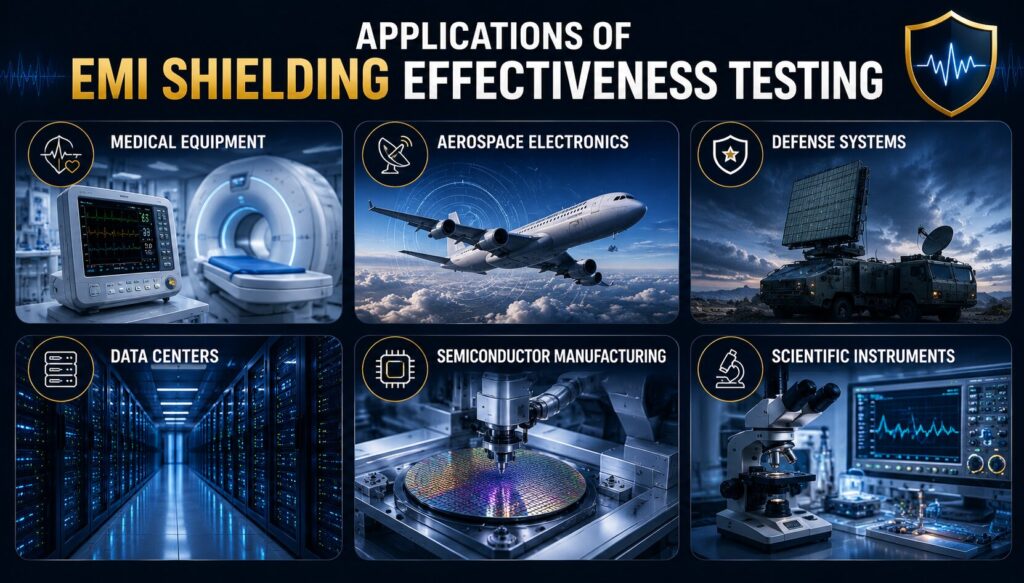
Medical Equipment
Medical devices rely on accurate signal transmission, and an EMI Shielding Testing Guide helps ensure protection from electromagnetic interference that could affect performance.
Aerospace Electronics
An EMI Shielding Testing Guide supports the development of reliable navigation, communication, and control systems used in demanding aerospace environments.
Defense Systems
Defense electronics require robust protection, and an EMI Shielding Testing Guide helps validate shielding performance in mission-critical applications.
Data Centers
Data centers use an EMI Shielding Testing Guide to reduce electromagnetic interference that can impact servers, storage devices, and networking equipment.
Semiconductor Manufacturing
An EMI Shielding Testing Guide helps protect highly sensitive semiconductor manufacturing equipment from unwanted electromagnetic disturbances.
Scientific Instruments
Laboratories use an EMI Shielding Testing Guide to improve measurement accuracy by minimizing electromagnetic interference in precision instruments.
Shapes Available for EMI Shielding Materials
DOMADIA™ supplies shielding materials in various forms to meet application requirements.
Foils
Ideal for lightweight shielding assemblies and flexible applications.
Sheets
Used for panels, cabinets, and equipment enclosures.
Strips
Suitable for custom fabrication and shielding assemblies.
Plates
Provide structural support with high shielding capability.
Fabricated Components
Custom-engineered shielding solutions for specialized projects.
Precision-Cut Parts
Designed for exact fitment in critical electronic systems.
7 Powerful Factors That Influence Shielding Effectiveness Results
1. Material Selection
Different materials perform differently across frequency ranges.
2. Material Thickness
Increased thickness often improves absorption performance.
3. Frequency Range
Shielding effectiveness varies significantly with frequency.
4. Joint Design
Poor seams and gaps can dramatically reduce shielding performance.
5. Grounding Quality
Improper grounding may compromise shielding effectiveness.
6. Surface Condition
Corrosion and contamination can affect conductivity.
7. Manufacturing Accuracy
Precision fabrication minimizes leakage paths.
Why DOMADIA™
Technical Material Expertise
DOMADIA™ assists customers in selecting the most suitable shielding materials based on frequency range, environmental conditions, and performance requirements.
Quality-Focused Supply
Every material is sourced and supplied with strict quality standards.
Custom Manufacturing Support
Tailored dimensions and fabricated components are available for demanding applications.
Industry Experience
Supporting aerospace, defense, electronics, medical, and industrial sectors.
Reliable Global Supply Network
Consistent material availability helps reduce project delays and operational disruptions.
Conclusion
The EMI Shielding Testing Guide demonstrates that shielding effectiveness is far more than a simple dB number. Material selection, frequency range, enclosure design, testing methodology, and manufacturing quality all influence real-world shielding performance.
As electronic systems become more compact and increasingly sensitive, accurate shielding effectiveness testing becomes essential for reliability, compliance, and long-term performance. DOMADIA™ continues supporting industries with advanced shielding materials and engineering expertise designed to meet evolving electromagnetic compatibility challenges.
Looking for high-performance EMI shielding materials?
ExploreDOMADIA™’s range of precision foils, sheets, strips, and fabricated shielding components engineered for critical industrial applications.
Get in touch with us today and let DOMADIA help you find the right EMI shielding solution for maximum protection, compliance, and long-term performance.
Talk to: Er.Pankaj Domadia | Kairav Domadia | Aadil Domadia | Pragati Sanap | Pooja N N
EMIShielding #ShieldingEffectiveness #EMCTesting #MagneticShielding #UNSN14080 #RFShielding #DOMADIA #IndustrialMaterials #ElectronicsManufacturing #EMIProtection
Directly whatsapp us for an Enquiry: https://wa.link/kairav
We’ve supplied to Mumbai, Pune, Indore, Jaipur, and Surat—serving industries across Maharashtra, Madhya Pradesh, Rajasthan, Gujarat, and Goa, with exports to Germany, USA, Japan, South Korea, and Italy.