Blogs
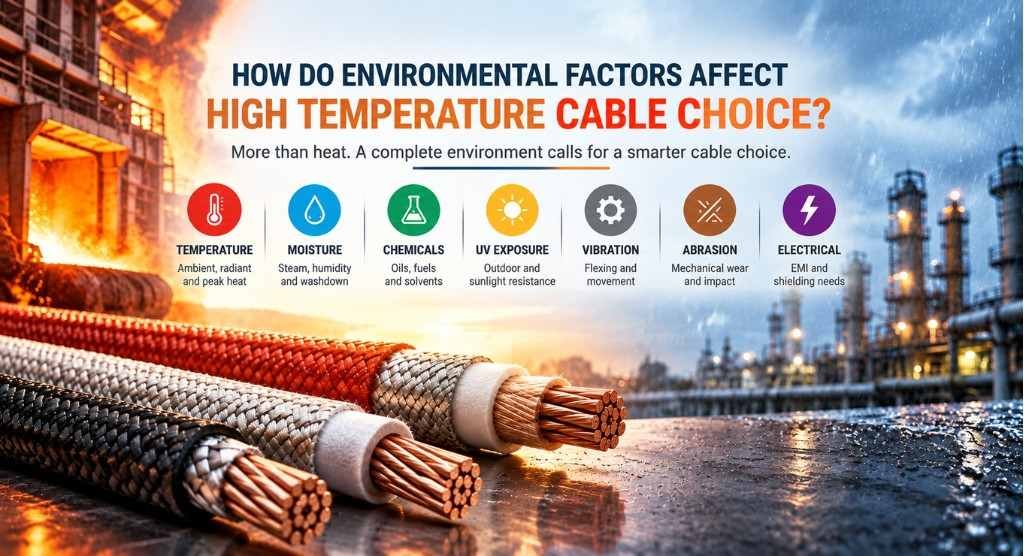
How Do Environmental Factors Affect High Temperature Cable Choice? 9 Critical Factors for UNS C11000 Conductors
High Temperature Cable Choice is not simply a question of asking, “How hot will it get?”
A cable operating beside an industrial furnace may face intense radiant heat. Another cable with the same conductor temperature may sit outdoors under sunlight, rain, and humidity. A third may run through machinery where oil, vibration, and repeated movement are bigger threats than temperature itself. These differences show why High Temperature Cable Choice must consider the complete operating environment.
All three installations can be described as “high-temperature applications”—yet specifying the same cable for all three could be a costly mistake.
The environment surrounding a cable influences its insulation, conductor, jacket, shielding, mechanical construction, and expected service performance. Temperature is only the beginning.
At DOMADIA™, high-temperature cable enquiries are therefore better approached by looking at the complete operating environment rather than selecting a cable from its maximum temperature rating alone. A well-planned High Temperature Cable Choice considers thermal, electrical, chemical, and mechanical conditions together before the final cable construction is selected.
Why High Temperature Cable Choice Depends on the Environment
A cable is a system rather than a single material.
Its construction can include:

- Conductor
- Primary insulation
- Fiberglass or mineral-based layers
- Protective braid
- Outer jacket
- Electrical shielding
- Mechanical reinforcement
Each layer performs a different function.
The conductor carries current, while insulation provides electrical separation. A jacket or braid may protect against abrasion, chemicals, moisture or mechanical damage.
Consequently, a cable capable of surviving a high temperature in a clean, dry laboratory environment may not necessarily offer the same service performance inside an oily steel plant or exposed outdoor installation.
UL’s wire and cable guidance specifically distinguishes characteristics such as dry and wet temperature ratings, outdoor use, sunlight resistance and oil resistance, demonstrating why environmental suitability must be considered separately from temperature capability.
1. Ambient and Operating Temperature
Temperature remains the first question—but it needs to be defined correctly.
There is an important difference between:
Ambient temperature – the temperature surrounding the cable.
Conductor temperature – the temperature reached by the conductor during electrical loading.
Surface exposure temperature – heat reaching the cable from furnaces, heaters, exhaust systems or hot machinery.
Short-term peak temperature – temporary exposure during abnormal or process conditions.
Continuous operating temperature – the temperature the cable experiences for prolonged periods.
For example, a cable may normally operate around 200°C but occasionally encounter much higher short-duration thermal exposure.
Selecting a cable only because its published maximum temperature exceeds the expected ambient temperature may therefore be inadequate.
Engineers should establish:
- Normal ambient temperature
- Maximum continuous temperature
- Maximum conductor temperature
- Duration of peak-temperature exposure
- Proximity to radiant heat
- Thermal cycling frequency
- Required service life
This information helps determine whether materials such as silicone, fluoropolymers, fiberglass, mica or other specialized insulation systems should be evaluated.
2. Moisture, Steam and Humidity
Heat and water can be a difficult combination.
A cable installed in a dry oven has a very different environmental challenge from one operating around steam lines, washdown equipment or humid process machinery.
Moisture can potentially affect insulation performance, metallic components, connectors and terminations if the cable system has not been designed for the environment.
UL guidance accordingly distinguishes cable temperature ratings for dry and wet locations and identifies specific markings associated with evaluated wet-location products.
Applications involving:
- Steam
- Condensation
- Outdoor rainfall
- High humidity
- Water spray
- Washdown procedures
should therefore include moisture exposure in the cable specification.
A high dry-temperature rating by itself does not prove that a cable is suitable for the same temperature in a wet environment.
3. Oils, Fuels and Industrial Chemicals
Here is where a cable that looks perfectly healthy on installation day can become a maintenance problem later.
Industrial environments frequently contain:
- Lubricating oils
- Hydraulic fluids
- Cutting fluids
- Cleaning agents
- Fuels
- Solvents
- Acids
- Alkalis
- Process chemicals
The cable’s outer materials need appropriate compatibility with the substances they are expected to encounter.
UL’s application guidance, for example, separately identifies oil resistance and notes that an oil-resistance evaluation does not automatically establish resistance to gasoline or every other chemical.
That distinction matters.
“Chemical resistant” should never be treated as a universal property.
An insulation or jacket material that performs well against one fluid may behave differently when exposed to another chemical, concentration, temperature or duration.
For demanding applications, DOMADIA™ recommends defining the actual chemical exposure during the cable-selection process rather than simply requesting an “oil-resistant high-temperature cable.”
4. UV Radiation and Outdoor Weather
Outdoor high-temperature cables face an additional enemy: sunlight.
Ultraviolet radiation can gradually affect certain polymeric cable materials. Outdoor installations may simultaneously experience:
- UV exposure
- Rain
- Humidity
- Dust
- Temperature fluctuations
- Wind
- Pollution
- Mechanical movement
This means a cable’s thermal rating alone cannot establish outdoor suitability.
UL guidance identifies sunlight resistance separately and explains that qualifying cable products can carry markings such as “SUNLIGHT RESISTANT,” “SUN. RES.” or “SR,” depending on the cable type.
For outdoor installations, engineers should therefore confirm whether the selected cable construction has been evaluated for the actual outdoor conditions involved.
5. Abrasion and Mechanical Damage
Sometimes heat is not what kills the cable.
Movement is.
A cable can be thermally suitable but still experience premature failure if it continuously rubs against:
- Metal edges
- Cable trays
- Machine frames
- Moving assemblies
- Rough surfaces
- Other cables
Industrial machinery can also expose cables to crushing, pulling and impact.
This makes mechanical protection particularly important in environments such as:
- Steel plants
- Foundries
- Furnaces
- Glass manufacturing
- Industrial ovens
- Heavy machinery
- Process plants
Protective fiberglass braiding, metallic braiding, suitable outer jackets or other reinforcement may be considered depending on the application.
The correct construction should balance thermal capability with the required mechanical protection.
6. Flexing, Vibration and Movement
A cable attached to stationary furnace instrumentation and a cable attached to moving equipment should not automatically use the same construction.
Repeated flexing places mechanical stress on:
- Conductors
- Insulation
- Shields
- Jackets
- Termination points
Vibration can create another challenge around motors, generators, pumps, turbines, industrial machinery and transportation systems.
Fine-stranded conductors may provide greater flexibility than solid or less-flexible constructions, but conductor design must still match electrical, thermal and mechanical requirements.
Where continuous movement occurs, specify:
- Bend radius
- Flexing frequency
- Travel distance
- Cable speed
- Torsion, if present
- Vibration level
- Installation method
A cable rated for high temperature is not automatically a continuous-flex cable.
7. Fire, Flame, Smoke and Halogen Requirements
In some environments, cable behaviour during a fire can be as important as normal operating temperature.
This is particularly relevant in:
- Public infrastructure
- Transportation
- Power installations
- Control systems
- Industrial facilities
- Enclosed equipment
- High-occupancy environments
Different specifications may require particular flame-propagation, smoke or halogen-related performance.
The IEC 60332 series covers tests on electric and optical-fibre cables under fire conditions, while IEC 60754-1 provides a method for determining halogen acid gas evolved during combustion of cable materials containing halogenated compounds.
These standards should not be treated as interchangeable.
A project’s applicable specification, regulatory requirements and cable construction must be checked individually.
8. Electrical Interference and EMI
High-temperature environments often contain more than heat.
Industrial facilities can include:
- Variable-frequency drives
- Motors
- Transformers
- Welding equipment
- Switching equipment
- High-current conductors
- Power electronics
Sensitive instrumentation cables operating nearby may require electrical shielding to reduce electromagnetic interference.
Shielding requirements depend on factors such as:
- Signal type
- Frequency
- Cable routing
- Nearby interference sources
- Grounding strategy
- Required signal integrity
For temperature sensors, instrumentation and control circuits, the electrical environment can therefore significantly influence cable construction.
Shielding should be engineered as part of the system rather than added simply because an installation “has EMI.”
9. Dust, Debris and Harsh Industrial Atmospheres
Dust may sound harmless compared with 500°C machinery, but industrial dust can introduce serious design considerations. For this reason, High Temperature Cable Choice should account for airborne particles and contamination as well as thermal exposure.
Applications may involve:
- Metal particles
- Carbon dust
- Cement dust
- Glass particles
- Foundry debris
- Chemical powders
- Combustible dust
Deposits can affect heat dissipation, mechanical surfaces, and equipment cleanliness. These environmental conditions should therefore be considered when determining the appropriate cable construction.
In hazardous or combustible atmospheres, High Temperature Cable Choice becomes part of a much larger system-safety decision involving approved equipment, glands, enclosures, and installation practices.
A high-temperature rating alone should never be interpreted as approval for hazardous locations.
High Temperature Cable Choice: Insulation Materials Matter
Different insulation systems offer different combinations of temperature resistance, flexibility, chemical resistance and mechanical performance.
Silicone
Silicone-insulated cables can provide good flexibility and useful elevated-temperature capability.
They may be considered for:
- Heating equipment
- Industrial appliances
- Motors
- Lighting
- Ovens
- General high-temperature wiring
The exact temperature, voltage and environmental rating must be confirmed from the specified cable construction.
PTFE and Other Fluoropolymers
PTFE-based constructions can provide a combination of elevated-temperature performance and resistance to many chemicals.
They are frequently considered for demanding electrical, instrumentation and industrial applications.
Chemical compatibility should still be checked against the actual substance and operating conditions.
Fiberglass
Fiberglass is widely associated with high-temperature wire and cable constructions, making it an important material to consider in High Temperature Cable Choice. It can be used as insulation, braid, or reinforcement, often alongside additional thermal-resistant materials.
Mica-Based Systems
Mica can be incorporated into specialized cable systems where exceptional thermal and fire-related performance is required, making it an important consideration in High Temperature Cable Choice. The complete cable construction—not mica alone—determines the finished product’s electrical and environmental performance.
Chemical Composition and Cable Construction
Unlike a metal alloy, a high-temperature cable does not have one universal “chemical composition.”
Instead, its composition depends on its layers.
A typical specialized construction could include:
| Component | Possible Material | Primary Function |
| Conductor | Copper / nickel-plated copper / nickel-based conductor | Electrical conduction |
| Conductor grade | Copper such as UNS C11000 where specified | High electrical conductivity |
| Primary insulation | Silicone / PTFE / other fluoropolymer / mica system | Electrical and thermal insulation |
| Reinforcement | Fiberglass | Thermal/mechanical protection |
| Shield | Metallic braid or foil system | EMI control |
| Outer protection | Fiberglass braid / fluoropolymer / specialized jacket | Environmental protection |
The exact combination depends on operating temperature, voltage, current, flexibility, atmosphere and certification requirements.
Properties to Consider
Important properties when evaluating a high-temperature cable include several thermal, electrical, mechanical, and environmental factors. A reliable High Temperature Cable Choice should consider how these properties work together under actual operating conditions.

Temperature Resistance
Ability of the complete cable construction to operate within its specified thermal range. Temperature resistance is one of the most important factors influencing High Temperature Cable Choice, particularly around furnaces, ovens, heating equipment, and other high-heat environments.
Dielectric Strength
Ability of the insulation system to withstand electrical stress. When making a High Temperature Cable Choice, dielectric performance should be evaluated alongside the required voltage and operating temperature.
Flexibility
Important where routing, vibration, or repeated movement occurs. Flexible construction can become a key consideration when the cable must bend or move during operation.
Chemical Resistance
Critical around oils, fuels, cleaning chemicals, and industrial process fluids. Chemical exposure should therefore be identified before finalizing the High Temperature Cable Choice for harsh industrial environments.
Moisture Resistance
Relevant for outdoor, steam, condensation, and washdown environments. The cable construction should be suitable for the expected level and type of moisture exposure.
Abrasion Resistance
Useful where cables contact machinery, equipment, cable-routing surfaces, or other rough surfaces that could cause mechanical wear.
UV Resistance
Important for outdoor exposure, where High Temperature Cable Choice must account for prolonged sunlight, UV radiation, and changing weather conditions.
Flame Performance
May be required by applicable equipment, building, installation, or industry standards, so High Temperature Cable Choice should consider the exact flame-performance requirements specified for the application.
Mechanical Strength
Important where pulling, vibration, crushing, or physical abuse is expected, making mechanical durability a critical factor in High Temperature Cable Choice alongside thermal and environmental conditions.
Technical Specifications to Define Before Ordering
Instead of beginning an enquiry with:
“I need a high-temperature cable.”
a better specification would define the actual operating conditions.
Consider providing DOMADIA™ with:
| Specification | Information Required |
| Continuous operating temperature | °C |
| Maximum short-term temperature | °C |
| Voltage rating | V |
| Current requirement | A |
| Conductor size | AWG / mm² |
| Number of conductors | Required cores |
| Conductor material | Copper / plated copper / other |
| Insulation | Silicone / PTFE / fiberglass / mica / specified system |
| Environment | Indoor / outdoor |
| Moisture exposure | Dry / humid / wet / steam |
| Chemical exposure | Oil / fuel / solvent / acid / alkali / other |
| Mechanical conditions | Fixed / flexing / vibration / abrasion |
| UV exposure | Yes / No |
| Shielding | Required / not required |
| Flame requirement | Applicable standard/specification |
| Length | Metres |
| Certification | UL / IEC / project-specific requirement |
This approach makes cable selection considerably more precise.
Standards Relevant to High-Temperature Cable Selection
Applicable standards vary by cable construction, country, installation and industry.
Examples that may become relevant include:
UL 758
UL 758 covers Appliance Wiring Material constructions. Individual AWM styles can have specific temperature, voltage, flame and environmental ratings. The exact recognized style and application must therefore be verified rather than assuming all UL 758 cables provide identical performance.
IEC 60332 Series
The IEC 60332 series addresses testing of electric and optical-fibre cables under fire conditions.
IEC 60754
IEC 60754 includes methods relating to gases evolved during combustion of cable materials, including measurement of halogen-related content.
The applicable standard should always be established from the project’s technical, regulatory and safety requirements.
Applications of High Temperature Cables
High-temperature cable systems can be required across numerous demanding industries. The right High Temperature Cable Choice depends on the combination of heat, mechanical stress, chemicals, moisture, vibration, and electrical requirements found in each application.

Industrial Furnaces
Power, instrumentation, and control wiring may operate near intense heat and radiant thermal energy. In these environments, High Temperature Cable Choice should account for continuous temperature as well as radiant and peak heat exposure.
Industrial Ovens
Heating equipment requires cables selected for the temperature around heating zones, controls, and sensors. A suitable High Temperature Cable Choice can also depend on cable routing, insulation requirements, voltage, and proximity to heating elements.
Steel and Metal Processing
Heat, abrasion, oils, scale, and mechanical activity can occur simultaneously. This combination makes High Temperature Cable Choice particularly important in demanding metal-processing environments.
Glass Manufacturing
Furnaces and hot-process equipment create demanding thermal environments for electrical wiring. Cable construction may need to address both elevated temperatures and the surrounding industrial conditions.
Automotive Systems
Engine compartments, exhaust-adjacent equipment, turbocharger systems, and certain EV power-electronics environments can expose cables to combinations of heat, vibration, fluids, and restricted installation space. For automotive applications, High Temperature Cable Choice should therefore consider more than temperature resistance alone.
Aerospace
Weight, temperature, vibration, chemicals, electrical performance, and applicable aerospace specifications can all influence High Temperature Cable Choice, which should be evaluated against the specific system and operating environment.
Power Generation
Generators, turbines, and associated equipment can expose wiring to heat, oils, and vibration. A carefully evaluated High Temperature Cable Choice can help match the cable construction to these combined environmental and mechanical demands.
Sensors and Instrumentation
Thermocouples, process sensors, and control systems may require temperature resistance alongside flexibility, shielding, and signal integrity, making electrical interference and installation conditions important factors in High Temperature Cable Choice.
Kilns
Ceramic and industrial kilns can create severe radiant and ambient heat around electrical systems. In these environments, High Temperature Cable Choice should consider the expected temperature range, cable location, insulation system, and overall operating conditions.
Shapes and Forms Available
Depending on the required specification and manufacturing availability, DOMADIA™ can support enquiries for several high-temperature cable and wire configurations.
Single-Core Wire
Useful for equipment wiring and internal electrical connections.
Multi-Core Cable
Multiple insulated conductors can be combined into one cable construction for control, instrumentation or power applications.
Shielded Cable
Suitable where electromagnetic interference control is part of the electrical design.
Braided Cable
Protective braiding can provide additional mechanical or thermal protection depending on the construction.
Flexible High-Temperature Cable
Fine-stranded constructions may be considered where flexibility is required.
Custom Cable Assemblies
Application-specific constructions, conductor sizes, insulation systems, lengths and configurations may be considered subject to manufacturing capability and quantity.
A Practical Cable Selection Scenario
Consider two factories.
Factory A requires cable beside an industrial oven at elevated temperature. The environment is clean, dry, and stationary. In this situation, High Temperature Cable Choice may primarily depend on thermal and electrical requirements.
Factory B requires cable at approximately the same operating temperature—but the cable is exposed to oil mist, vibration, periodic washdown, and continuous machine movement. Here, High Temperature Cable Choice must account for mechanical movement, chemical exposure, moisture, and vibration alongside temperature.
The temperature specification appears almost identical.
The environmental specification is completely different.
Choosing solely from the temperature rating could therefore result in a cable that survives the heat but struggles with the actual working environment. A reliable High Temperature Cable Choice should consider everything the cable will experience throughout its service life.
That is the mindset shift:
Don’t ask only, “How hot can this cable survive?”
Ask:
“What will this cable experience every day?”
That question produces a much more useful engineering specification.
Why DOMADIA™?
Specialized cable selection becomes easier when the enquiry begins with the application rather than a generic product name.
DOMADIA™ supports enquiries for high-temperature cables and specialized electrical materials for demanding industrial applications.
Customers can specify requirements including:
- Operating temperature
- Conductor material and size
- Voltage
- Number of cores
- Insulation system
- Cable diameter
- Flexibility
- Shielding
- Chemical exposure
- Moisture exposure
- Mechanical conditions
- Required standards
- Length and quantity
Rather than assuming one cable construction works everywhere, DOMADIA™ can help evaluate sourcing options around the project’s technical requirements.
For critical applications, final cable selection should always be validated against the applicable engineering specification, manufacturer documentation, installation requirements and relevant standards.
Conclusion
High Temperature Cable Choice is ultimately an environmental engineering decision—not merely a temperature-rating decision.
Heat matters, but so do moisture, chemicals, oil, UV radiation, abrasion, flexing, vibration, EMI, dust, fire requirements, and installation conditions. A well-planned High Temperature Cable Choice considers how these factors interact throughout the cable’s operating environment.
A 250°C cable is not automatically superior to a 200°C cable if its construction is unsuitable for the chemicals, mechanical stresses, or moisture encountered in the application. This is why an effective High Temperature Cable Choice must look beyond the maximum temperature rating and consider the complete operating environment.
The most reliable specification therefore starts with the complete environment. Define where the cable will operate, what it will touch, how it will move, what temperatures it will experience, and what standards it must satisfy. Only then should conductor, insulation, shielding, and protective construction be finalized.
For engineers and procurement teams, the right High Temperature Cable Choice should balance thermal performance with electrical, mechanical, chemical, and environmental requirements. Evaluating these factors together can help prevent premature cable failure and unsuitable material selection.
For specialized high-temperature cable requirements, DOMADIA™ can support enquiries based on temperature, electrical specifications, environmental exposure, and required cable construction. Making the right High Temperature Cable Choice begins with understanding the complete application rather than focusing on temperature alone.
A carefully evaluated High Temperature Cable Choice helps ensure that the selected cable construction is better matched to the real conditions it will face throughout its service life.
Choose the Right High-Temperature Cable for Your Environment
Heat is only one part of cable selection. DOMADIA™ understands that moisture, chemicals, oils, UV exposure, vibration, abrasion, flexibility, and electrical requirements can all influence the right cable construction for demanding applications.
Need help sourcing a high-temperature cable for a demanding industrial application? Contact DOMADIA™ with your operating temperature, voltage, conductor size, insulation preference, environmental conditions, required standards, and quantity.
Talk to: Er.Pankaj Domadia | Kairav Domadia | Aadil Domadia | Pragati Sanap | Pooja N N
#HighTemperatureCable #HighTemperatureWire #HeatResistantCable #IndustrialCable #UNSC11000 #PTFECable #IndustrialWiring #CableSelection #ElectricalEngineering #DOMADIA
Directly whatsapp us for an Enquiry: https://wa.link/kairav
Our materials have reached Kolhapur, Sangli, Satara, Ratnagiri, and Sindhudurg across Maharashtra, Goa, Karnataka, and MP, exporting to Japan, South Korea, Taiwan, Hong Kong, and China.