Blogs
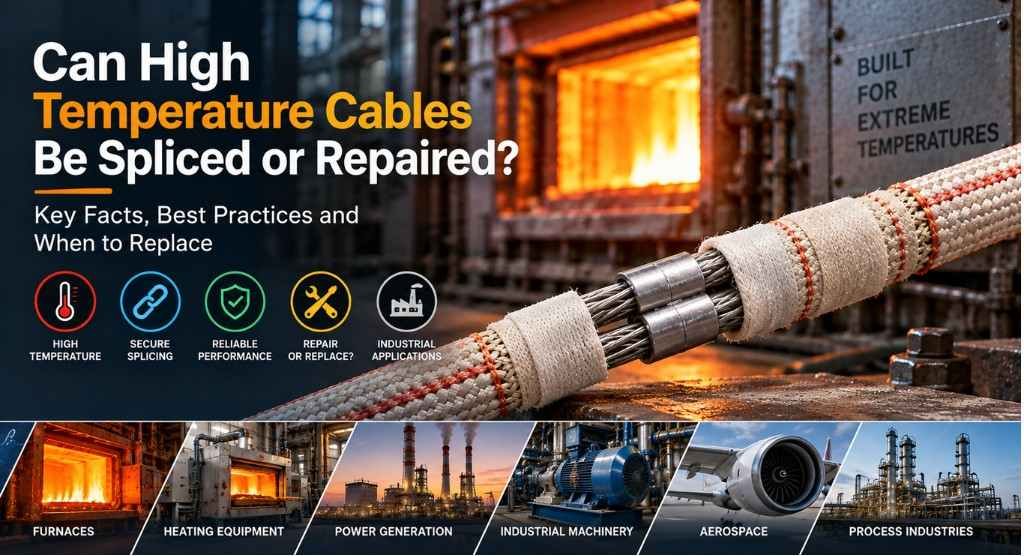
Can High Temperature Cables Be Spliced or Repaired? 9 Critical Facts Engineers Should Know
High Temperature Cable Repair: Can a Damaged Cable Really Be Saved?
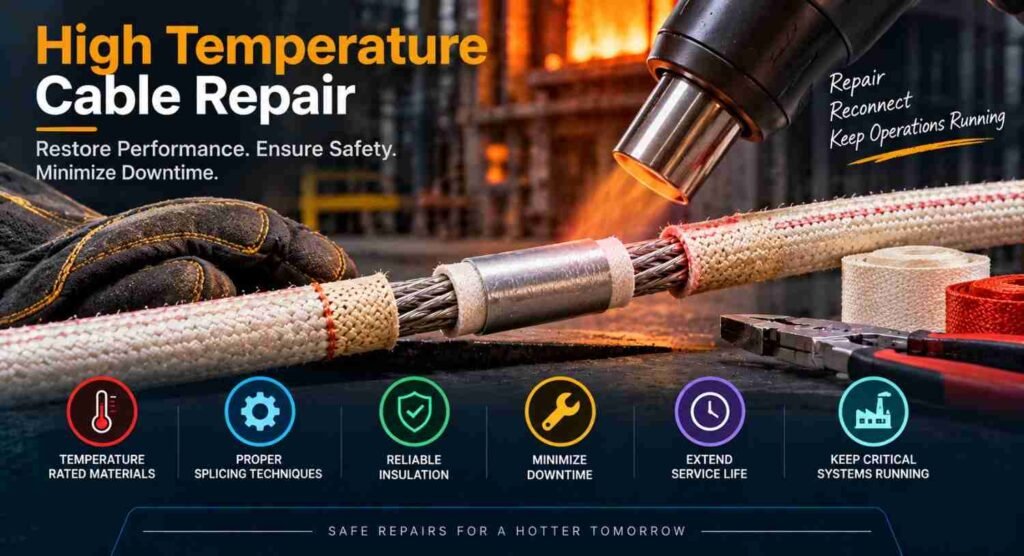
High Temperature Cable Repair sounds simple until a damaged cable is operating beside a furnace, industrial oven, heater, hot motor, or process line. A splice may restore electrical continuity, but the real question is whether the repaired section can withstand the same temperature, voltage, current, chemicals, vibration, and mechanical stress as the original cable.
Ordinary electrical tape, connectors, adhesives, or heat-shrink materials may not be suitable for extreme temperatures. Therefore, High Temperature Cable Repair requires compatible materials and repair methods designed for the actual operating environment. At DOMADIA™, we believe High Temperature Cable Repair should be treated as an engineering decision—not simply a maintenance shortcut.
1. Yes, High Temperature Cables Can Sometimes Be Spliced
There is no universal rule stating that every high-temperature cable must be replaced as soon as it is damaged.
Properly engineered splices are possible in appropriate applications.
In fact, commercial high-temperature electrical insulation products specifically recognize splice and connection applications. For example, 3M’s technical data for Glass Cloth Electrical Tape 69 provides an engineering specification for insulating splices on certain 600 V, 130°C-rated wire. The same tape has a UL 200°C temperature rating.
However, this does not mean every cable rated for 200°C can automatically be repaired using that particular tape.
The complete repair must be evaluated as a system.
Think of a splice as a chain containing several links:
Conductor → Connection → Insulation → Mechanical Protection → Environment
If one component is rated below the actual operating requirement, the repaired section may become the limiting component.
2. Why High-Temperature Cable Splicing Is Different
Repairing ordinary wiring and repairing cable operating near extreme heat are very different jobs.
High-temperature cable constructions may use materials such as:
- Silicone rubber
- PTFE
- FEP
- PFA
- Fiberglass
- Mica-based insulation
- Ceramic-fiber systems
- Mineral insulation
- Nickel-plated conductors
- Nickel conductors
- Special high-temperature braids
These materials are selected because conventional insulation may soften, embrittle, oxidize, melt, or lose electrical performance at elevated temperatures.
Therefore, putting an ordinary repair material onto a specialized cable can defeat the purpose of specifying a high-temperature cable in the first place.
The splice must survive more than heat.
Engineers should consider:
Temperature – continuous and peak exposure.
Voltage – insulation must remain appropriate for system voltage.
Current – poor joints can introduce electrical resistance and localized heating.
Mechanical stress – vibration, movement and flexing can attack the joint.
Chemical exposure – oils, solvents, moisture, acids and process chemicals may affect repair materials.
Abrasion – a repaired outer surface may need mechanical protection.
Thermal cycling – repeated heating and cooling can stress the connection.
That is why the correct question is not simply, “Can this cable be joined?”
It is:
“Can we create a joint that remains suitable for the complete operating environment?”
3. Temperature Rating Is the First Major Check
Consider a hypothetical cable rated for continuous operation at 250°C.
Now suppose it is repaired with an insulating component suitable only for 105°C.
The cable itself may still be capable of handling 250°C, but the repaired area cannot automatically be treated as having the original cable’s thermal capability.
The lowest-rated critical component can become the practical limitation.
For perspective, 3M specifies its Glass Cloth Electrical Tape 69 at a UL temperature rating of 200°C, while another glass-cloth product, Tape 90, is specified for a temperature range up to 155°C.
This illustrates an important point:
Even products that look broadly similar can have significantly different temperature capabilities.
Never select a repair material based purely on appearance.
Check its actual technical data.
4. The Conductor Connection Matters Just as Much as the Insulation
There are really two repairs happening during a cable splice.
First, you restore the electrical conductor path.
Second, you restore the insulation and environmental protection.
Both must succeed.
Depending on the cable construction and approved procedure, conductor joining methods may involve specialized:
- Crimp connections
- Mechanical connectors
- Terminal systems
- Brazed or welded connections
- Manufacturer-specified joining systems
The correct technique depends on conductor material, conductor size, cable design, temperature, current, movement and application requirements.
Why is connection resistance important?
A poor connection can have greater resistance than the original continuous conductor.
When current passes through that resistance, additional heat can be generated.
That creates a dangerous irony:
The cable may survive the furnace—but the badly made splice may create its own miniature furnace.
For high-current equipment, this becomes especially important.
5. Insulation Must Be Rebuilt Correctly
Once conductor continuity is restored, the insulation system needs to be reconstructed.
This is where ordinary maintenance habits can cause problems.
A technician should not assume that conventional electrical tape is automatically suitable simply because it provides electrical insulation at room temperature.
High-temperature insulation products can use materials specifically engineered for elevated temperatures.
For example, 3M Glass Cloth Electrical Tape 69 combines glass-cloth backing with a high-temperature thermosetting silicone adhesive and is UL recognized at 200°C. 3M identifies uses including motor applications, lead connections and high-temperature electrical insulation.
Depending on the application and cable design, repair insulation might involve:
- High-temperature glass cloth tape
- Silicone-based insulation
- PTFE-based insulating products
- Fiberglass sleeves
- Ceramic sleeves
- Mica-based insulation
- High-temperature heat-shrink products specifically rated for the conditions
The important words here are “specifically rated.”
Generic materials should not be assumed suitable.
6. When Should a High Temperature Cable NOT Be Repaired?
Sometimes replacement is the better engineering decision.
Replace rather than repair when:
The conductor is extensively damaged
If strands are burned, severely oxidized, melted or mechanically compromised, a local insulation patch will not solve the real problem.
Damage extends along a significant length
Multiple damaged areas can indicate broader thermal degradation.
The insulation has become brittle
A cable that cracks in one location because of thermal aging may be approaching failure elsewhere.
The cable has experienced severe overheating
The visible damage may be only one symptom.
The repair material cannot match the operating environment
A 200°C solution is not automatically appropriate for a cable operating beyond that temperature.
The cable is safety-critical
Aerospace, defense, medical, hazardous-area, transportation and other regulated systems may have strict requirements governing whether field repairs are permitted.
The manufacturer’s instructions prohibit splicing
Manufacturer requirements should take priority over a generic repair approach.
Certification could be compromised
A field splice may affect compliance with the original cable or equipment approval.
Sometimes a ₹500 repair that creates ₹5 lakh of downtime later is not really a saving.
7. What About Extremely High Temperatures?
This is where the situation becomes more specialized.
At moderate industrial temperatures, various polymeric insulation technologies may be practical.
As temperatures climb toward several hundred degrees Celsius, material choices narrow considerably.
At extremely high temperatures—particularly applications approaching 1000°C—engineers may need specialized constructions involving materials such as:
- Ceramic fiber
- Fiberglass
- Mica
- Mineral insulation
- Nickel-based conductors
- Specialized refractory insulation systems
Conventional polymer-based repair approaches may be unsuitable in these environments.
A cable engineered for a furnace, kiln, heat-treatment plant, glass-processing system, steel operation, or high-temperature sensor installation should therefore be repaired only using materials and procedures appropriate to that exact thermal class.
8. High Temperature Cable Repair: A Practical Decision Process
Before authorizing a repair, engineers and maintenance teams can work through a structured checklist.
| Question | Why It Matters |
| What caused the damage? | Prevents repeat failure |
| What is the continuous temperature? | Determines thermal requirement |
| What is the maximum peak temperature? | Checks short-duration exposure |
| What is the conductor material? | Determines connection compatibility |
| What is the conductor size? | Affects connector selection |
| What insulation is used? | Helps restore compatible insulation |
| What is the system voltage? | Determines dielectric requirements |
| What current does the cable carry? | Poor joints can create heat |
| Is the cable flexing? | Joint needs mechanical durability |
| Are chemicals present? | Repair materials must resist exposure |
| Is moisture present? | Environmental sealing may be necessary |
| Is certification required? | Field repair may affect compliance |
| Does the manufacturer permit repair? | May determine whether splicing is acceptable |
Only after answering these questions should the repair method be selected.
Chemical Composition and Material Construction
Unlike metallic alloys, high-temperature cables do not have one universal “chemical composition.”
They are engineered assemblies.
A typical construction may contain:
Conductor
Depending on the temperature range and electrical requirement:
- Copper
- Tinned copper
- Silver-plated copper
- Nickel-plated copper
- Nickel
- Other specialized conductor materials
Primary Insulation
Possible materials include:
- Silicone
- PTFE
- FEP
- PFA
- Mica
- Fiberglass
- Ceramic materials
Protective Layer
Some cables incorporate:
- Fiberglass braid
- Metal braid
- Stainless-steel protection
- Specialized textile coverings
- Mineral or ceramic layers
Each layer performs a particular function.
Therefore, a repair should consider the entire cable construction, rather than only the visible outer insulation.
Important Properties of High Temperature Cables
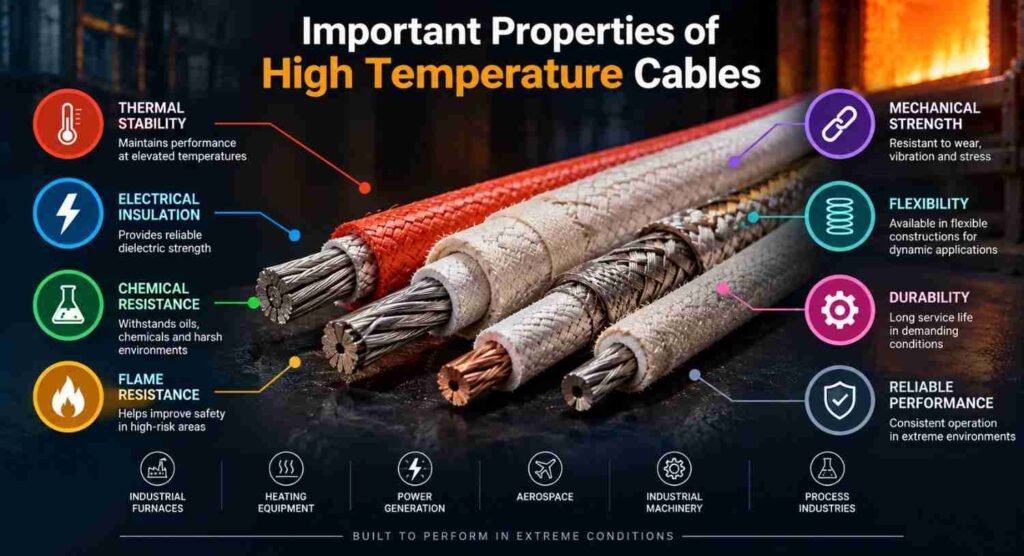
Thermal Stability
The insulation system should maintain useful electrical and mechanical performance throughout its specified temperature range. For reliable High Temperature Cable Repair, the replacement insulation should also be suitable for the cable’s actual operating conditions. A properly planned High Temperature Cable Repair helps prevent the repaired section from becoming a weak point under prolonged heat exposure.
Electrical Insulation
The dielectric material separates energized conductors and helps prevent leakage, short circuits, and electrical breakdown. During High Temperature Cable Repair, the dielectric material should remain suitable for the required operating temperature and electrical conditions. Proper High Temperature Cable Repair helps maintain insulation integrity and dependable electrical separation under demanding heat exposure.
Conductor Stability
Conductors and terminations must tolerate the required current and temperature. During High Temperature Cable Repair, replacement conductors and termination components should be suitable for the operating conditions. Proper High Temperature Cable Repair helps maintain reliable electrical performance under demanding thermal loads.
Chemical Resistance
Certain high-temperature cable materials are selected for environments containing oils, chemicals, moisture or aggressive industrial substances.
Flame Resistance
Depending on construction and certification, cables may offer specified flame-performance characteristics.
Flexibility
Silicone and certain specialized constructions can offer useful flexibility, although performance depends heavily on cable design.
Abrasion Resistance
Braids, jackets and protective coverings may be used where mechanical wear is expected.
Technical Specifications to Check Before Splicing
There is no single specification covering every high-temperature cable.
Before carrying out High Temperature Cable Repair, verify at least:
| Technical Parameter | What to Verify |
| Temperature rating | Continuous and intermittent |
| Voltage rating | Operating voltage |
| Conductor | Material and plating |
| Conductor size | AWG or mm² |
| Insulation | Silicone, PTFE, mica, fiberglass, etc. |
| Current requirement | Application-specific load |
| Flexibility | Fixed or moving installation |
| Chemical resistance | Oils, solvents, acids, moisture |
| Flame performance | Applicable standard |
| Splice insulation | Rated for required conditions |
| Connector | Conductor and temperature compatibility |
| Compliance | Required industrial standard |
Never assume that because the original cable meets a particular standard, a field-repaired version automatically retains exactly the same certification.
Standards and Compliance
High-temperature cables may be manufactured or selected against requirements associated with organizations and systems such as:
- UL
- CSA
- IEC
- ASTM
- SAE
- MIL specifications
- OEM-specific specifications
- Industry-specific electrical codes
The applicable requirement depends on the cable and its application.
For example, 3M states that its Glass Cloth Electrical Tape 69 is UL Recognized, carries a UL 200°C temperature rating, and is QPL-listed to a specification related to MIL-I-19166.
But compliance of one insulation product does not automatically certify an entire repaired cable assembly.
For critical installations, the repair procedure itself may need to be approved, documented, inspected or tested.
Shapes and Configurations Available
High-temperature electrical cables and related products can be supplied in numerous constructions, including:
- Single-core wire
- Multi-core cable
- Round cable
- Flat cable
- Flexible leads
- Braided cable
- Shielded cable
- Armoured cable
- Thermocouple cable
- Sensor leads
- Heating cable
- Fiberglass-insulated wire
- PTFE-insulated wire
- Silicone-insulated cable
- Mica-insulated cable
- Ceramic-fiber insulated cable
- Custom cable assemblies
DOMADIA™ can support customers in identifying suitable high-temperature cable constructions according to application requirements.
Applications Where High Temperature Cables Are Commonly Used
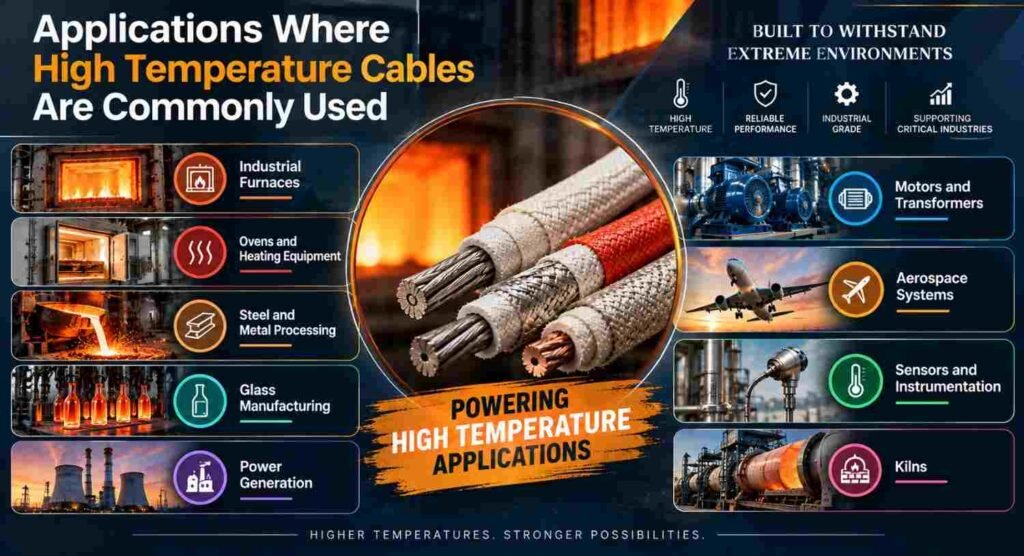
Industrial Furnaces
Electrical connections near furnace chambers require careful management of radiant and ambient heat. In these demanding areas, High Temperature Cable Repair should use components suitable for the expected thermal exposure. Proper High Temperature Cable Repair helps maintain connection integrity and reliable electrical performance.
Ovens and Heating Equipment
Industrial ovens, dryers, and heating systems may require heat-resistant wiring for dependable operation. In these environments, High Temperature Cable Repair should use materials capable of handling the required thermal conditions. Proper High Temperature Cable Repair can help maintain wiring integrity and reliable performance around high-heat equipment.
Steel and Metal Processing
Hot zones around heat-treatment, casting, and processing equipment can expose cables to demanding temperatures. In these environments, High Temperature Cable Repair should use components suitable for the expected heat exposure. Proper High Temperature Cable Repair helps maintain cable integrity and reliable operation in challenging thermal conditions.
Glass Manufacturing
Glass-processing equipment combines extreme heat with challenging industrial conditions. In these environments, High Temperature Cable Repair should use materials suitable for the required temperature and operating conditions. Proper High Temperature Cable Repair helps maintain cable integrity and dependable performance near high-heat processes.
Power Generation
Generators, turbines, and auxiliary equipment can create elevated-temperature wiring environments. In these applications, High Temperature Cable Repair should use materials suitable for the expected electrical and thermal demands. Proper High Temperature Cable Repair helps maintain cable reliability and performance under challenging operating conditions.
Motors and Transformers
Heat-resistant insulation can be useful around windings, leads, and associated connections exposed to elevated temperatures. In these areas, High Temperature Cable Repair should use insulation materials compatible with the expected thermal and electrical conditions. Proper High Temperature Cable Repair helps maintain insulation integrity and reliable performance.
Aerospace Systems
Low weight, reliability, vibration resistance, and thermal performance can all influence cable selection. In demanding applications, High Temperature Cable Repair should consider these same operating requirements. Proper High Temperature Cable Repair helps maintain dependable cable performance under heat, vibration, and mechanical stress.
Sensors and Instrumentation
Thermocouples and other sensors frequently operate close to the process being measured, exposing their cables to elevated temperatures. In these applications, High Temperature Cable Repair should use materials compatible with the sensor and operating environment. Proper High Temperature Cable Repair helps maintain reliable signal transmission under demanding thermal conditions.
Kilns
Ceramic and industrial kilns may require specialized cable constructions for very high-temperature areas. In these demanding environments, High Temperature Cable Repair should use materials suitable for the expected heat exposure. Proper High Temperature Cable Repair helps maintain cable integrity and reliable operation under extreme thermal conditions.
9. Repair the Cause, Not Just the Cable
This may be the most important lesson.
Suppose a cable failed because it touched a hot metal surface.
You repair it perfectly.
Then you put it back against the same surface.
You have not completed a repair.
You have started a countdown.
Whenever cable damage occurs, investigate the root cause.
Look for:
- Excessive ambient temperature
- Radiant heat
- Overcurrent
- Loose electrical connections
- Incorrect cable selection
- Mechanical abrasion
- Excessive bending
- Vibration
- Chemical attack
- Moisture ingress
- Poor routing
- Insufficient shielding from heat
Sometimes the best cable repair is actually a system-design correction.
Move the cable.
Add appropriate mechanical or thermal protection.
Improve routing.
Correct the electrical load.
Or select a cable construction better suited to the application.
Why DOMADIA™?
High-temperature cable selection becomes challenging because temperature alone does not tell the whole story.
A customer may say:
“We need a 500°C cable.”
But DOMADIA™ looks beyond that single number.
The real selection process can involve:
Temperature + Voltage + Current + Conductor + Insulation + Flexibility + Chemicals + Environment + Mechanical Protection
DOMADIA™ supports industrial customers with specialized high-temperature wires and cable solutions for demanding applications.
Whether the requirement involves industrial heating equipment, furnaces, sensors, electrical machinery, process plants, or specialized high-temperature installations, choosing the correct construction from the beginning can reduce premature failures and unnecessary repair cycles.
Conclusion
So, can high temperature cables be spliced or repaired?
Yes—sometimes.
But High Temperature Cable Repair should never mean simply joining two conductors and wrapping the area with whatever insulation happens to be available.
A properly engineered repair needs to consider the conductor connection, temperature rating, voltage, current, insulation system, mechanical loading, environmental exposure and applicable certification requirements.
For localized damage under suitable conditions, an approved high-temperature splice can potentially provide a practical solution.
For severe thermal degradation, extensive conductor damage, safety-critical applications, or situations where the repaired assembly cannot satisfy the required operating conditions, complete cable replacement is usually the more appropriate choice.
With high-temperature wiring, the question is not merely whether the repair works today.
The question is whether it will continue working after hundreds or thousands of hours of heat, thermal cycling and real industrial service.
For specialized high-temperature cable requirements, DOMADIA™ can help identify cable constructions suited to the actual operating environment.
Need Reliable High-Temperature Cables for Extreme Conditions?
Whether you need a new cable, a replacement, or guidance on the right construction for your operating temperature, DOMADIA™can help you select the right solution.
Contact us today with your temperature, voltage, conductor size, and application details to find a suitable high-temperature cable solution.
Talk to: Er.Pankaj Domadia | Kairav Domadia | Aadil Domadia | Pragati Sanap | Pooja N N
#RareEarthMetals #RareEarthElements #PermanentMagnets #IndustrialMaterials #AdvancedManufacturing #Electronics #EVTechnology #RenewableEnergy #DOMADIA
Directly whatsapp us for an Enquiry: https://wa.link/kairav
Our materials have reached Nagpur, Aurangabad, Nashik, Kolhapur, and Solapur—strengthening Maharashtra, Goa, Karnataka, MP, and Gujarat industries, with exports to South Africa, Kenya, Egypt, Morocco, and Nigeria.