Blogs
Rare Earth Elements EVs: 7 Powerful Reasons They Matter
Introduction: The Hidden Materials Powering the EV Revolution
A few years ago, electric vehicles were viewed as a niche technology. Today, they are rapidly becoming the backbone of global transportation. Governments are investing heavily in EV infrastructure, automakers are launching new electric models every month, and consumers are increasingly choosing sustainable mobility solutions.
Yet behind every high-performance electric vehicle lies a group of materials that rarely receive attention outside technical circles. Rare Earth Elements EVs depend on these critical materials to deliver superior efficiency, high power density, compact motor design, and long-term operational reliability.
From permanent magnets inside traction motors to advanced electronic systems, rare earth elements have become indispensable to modern electric mobility. Understanding the importance of Rare Earth Elements EVs helps explain why these materials are now considered among the most strategically valuable resources in the global automotive and clean energy industries.
What Are Rare Earth Elements?
Rare earth elements (REEs) are a group of 17 metallic elements found within the Earth’s crust. Despite their name, many are relatively abundant, but economically viable extraction and refining remain challenging.
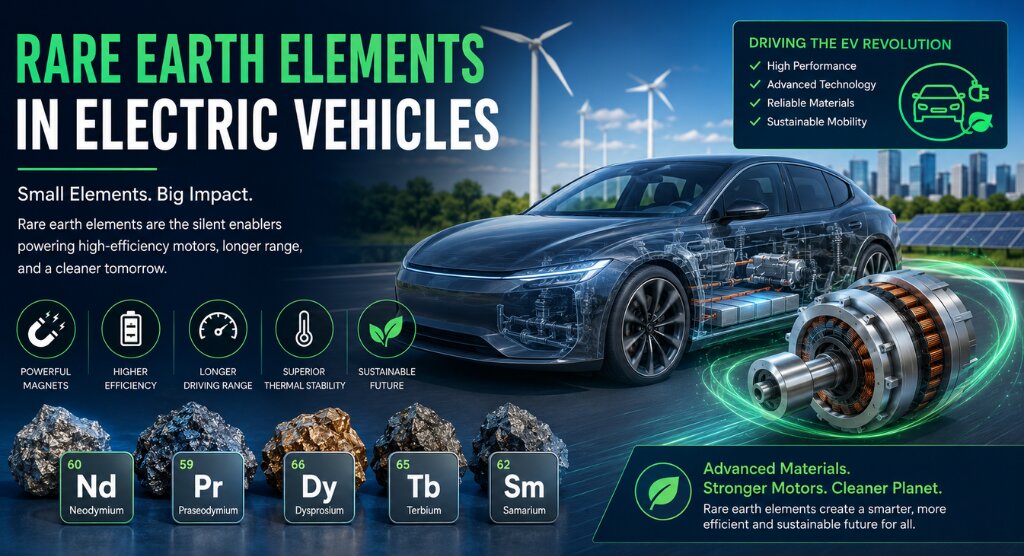
The most important rare earth elements used in electric vehicles include:
- Neodymium (Nd)
- Praseodymium (Pr)
- Dysprosium (Dy)
- Terbium (Tb)
- Samarium (Sm)
- Lanthanum (La)
- Cerium (Ce)
These elements possess unique magnetic, electrical, and thermal properties that make Rare Earth Elements EVs applications highly effective in modern electric vehicle systems. Their exceptional performance enables manufacturers to develop smaller, lighter, and more efficient components without compromising reliability.
As the demand for electric mobility continues to grow, Rare Earth Elements EVs technologies are becoming increasingly important for achieving higher energy efficiency, improved vehicle performance, and long-term sustainability across the automotive industry.electrical, and thermal characteristics that make them ideal for advanced EV applications.
Chemical Composition of Key EV Rare Earth Magnets
Permanent magnets used in EV motors typically contain:
| Element | Typical Function |
| Neodymium (Nd) | Primary magnetic strength |
| Iron (Fe) | Structural magnetic matrix |
| Boron (B) | Enhances magnetic properties |
| Dysprosium (Dy) | Improves high-temperature performance |
| Terbium (Tb) | Increases thermal stability |
| Praseodymium (Pr) | Enhances magnetic efficiency |
A common magnet composition is:
Nd₂Fe₁₄B (Neodymium-Iron-Boron Magnet)
This alloy delivers some of the highest magnetic energy densities available commercially.
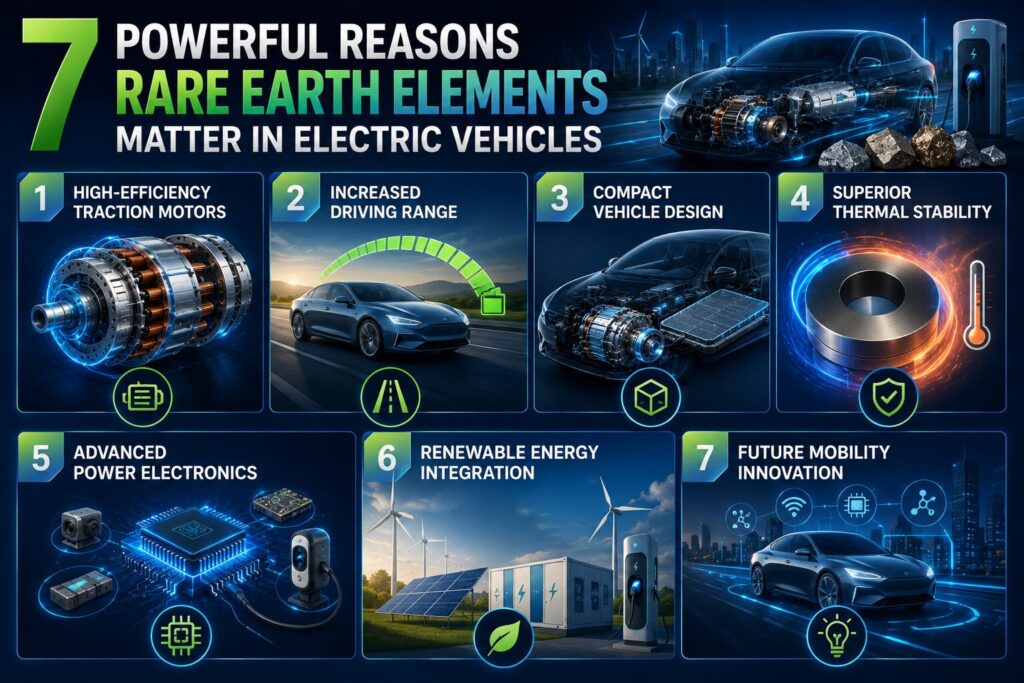
7 Powerful Reasons Rare Earth Elements Matter in Electric Vehicles
1. High-Efficiency Traction Motors
Electric vehicles depend on compact motors capable of delivering high torque while maintaining maximum efficiency. Rare Earth Elements EVs technologies make this possible by enabling smaller motor sizes, greater power density, and reduced energy losses. These advanced magnetic materials help manufacturers build lighter and more efficient propulsion systems, directly contributing to improved vehicle performance and extended driving range.
2. Increased Driving Range
Every percentage improvement in motor efficiency translates directly into additional driving range, making electric vehicles more practical and cost-effective for everyday use. Advanced magnet technologies used in Rare Earth Elements EVs help manufacturers reduce battery load, improve power conversion efficiency, and maximize overall energy utilization. By enabling motors to deliver more power with less energy loss, these materials support longer driving distances, faster performance, and enhanced reliability, making electric vehicles increasingly suitable for both daily commuting and long-distance transportation.
3. Compact Vehicle Design
Modern EV manufacturers continuously focus on maximizing available space without compromising performance. Rare Earth Elements EVs applications enable engineers to develop smaller motors, lighter drive systems, and more compact powertrains, helping optimize vehicle architecture. This efficient design approach creates additional room for larger battery packs, improved passenger comfort, and enhanced overall vehicle functionality.
4. Superior Thermal Stability
Electric motors operate under extreme thermal conditions, especially in high-performance and commercial vehicles. Rare Earth Elements EVs applications benefit from elements such as dysprosium and terbium, which help magnets maintain stability, reduce demagnetization, and ensure reliable performance even at elevated operating temperatures.
5. Advanced Power Electronics
Modern electric vehicles rely on far more than just motors and batteries. Rare Earth Elements EVs technologies also support critical electronic components such as sensors, battery management systems, control units, charging systems, and advanced driver assistance systems (ADAS). These applications help improve vehicle intelligence, optimize energy management, enhance safety features, and ensure reliable performance throughout the vehicle’s operating life.
6. Renewable Energy Integration
Electric vehicles are becoming an essential part of broader renewable energy ecosystems, creating stronger links between transportation and clean power generation. Rare Earth Elements EVs technologies support critical infrastructure such as wind turbines, smart grids, fast-charging networks, and energy storage systems. By enabling efficient energy generation, distribution, and utilization, these advanced materials help strengthen the connection between sustainable transportation and the global transition toward cleaner energy solutions.
7. Future Mobility Innovation
As electric vehicles continue evolving, advanced materials are becoming increasingly important for future innovation. Rare Earth Elements EVs technologies play a vital role in supporting developments such as higher-performance magnets, improved motor efficiency, reduced material consumption, and more effective recycling solutions. These advancements will help manufacturers build more sustainable, efficient, and intelligent electric vehicles, further accelerating the growth of electric mobility worldwide.
Properties of Rare Earth Elements Used in EVs
Exceptional Magnetic Strength
Rare earth magnets generate extremely powerful magnetic fields relative to their size.
High Energy Density
Enables compact motor construction without sacrificing performance.
Thermal Resistance
Maintains stable magnetic properties under demanding operating conditions.
Corrosion Resistance
Special coatings and alloying improve durability in automotive environments.
Long Service Life
Supports reliable operation throughout the vehicle lifecycle.
Technical Specifications of NdFeB EV Magnets
| Property | Typical Value |
| Magnet Type | NdFeB |
| Density | 7.4 – 7.6 g/cm³ |
| Operating Temperature | Up to 200°C |
| Magnetic Energy Product | 35 – 55 MGOe |
| Coating Options | Nickel, Epoxy, Zinc |
| Magnetic Strength | Extremely High |
| Corrosion Resistance | Moderate to High |
Standards Relevant to Rare Earth Materials
Several standards govern rare earth materials and EV magnet manufacturing:
- ASTM Standards
- ISO 9001 Quality Management
- IEC Standards for Electrical Components
- SAE Automotive Material Standards
- RoHS Compliance Requirements
- REACH Environmental Compliance
These standards help ensure performance consistency and reliability.
Applications of Rare Earth Elements in Electric Vehicles
Electric Vehicle Traction Motors
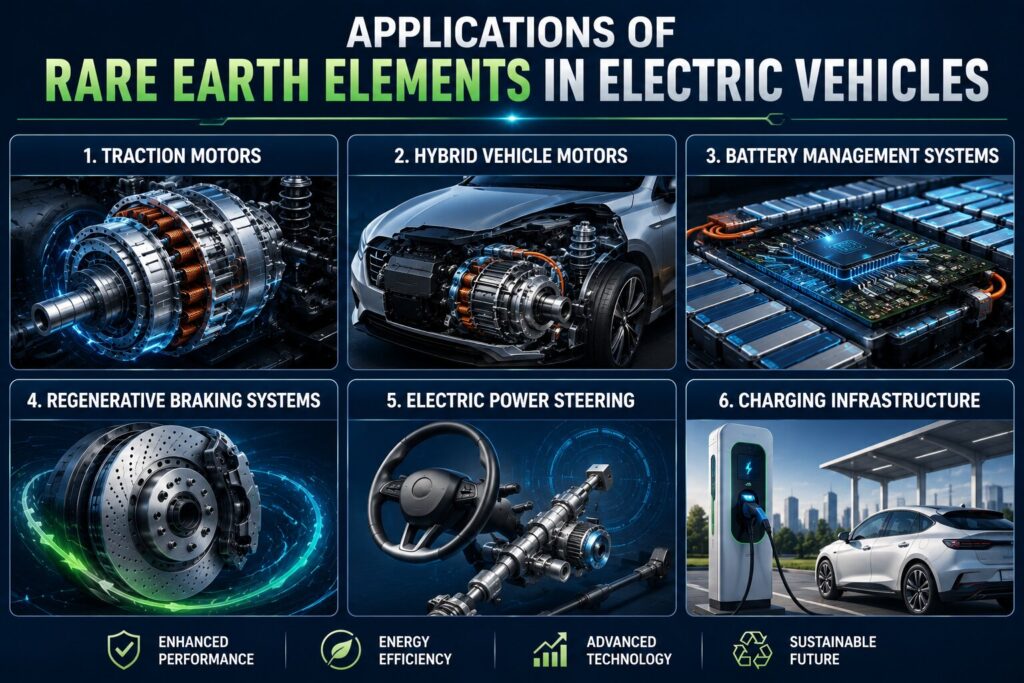
Rare Earth Elements EVs are widely used in traction motors, where powerful permanent magnets enable efficient torque generation, compact motor design, and improved energy efficiency for modern electric vehicles.
Hybrid Vehicle Powertrains
In hybrid vehicle systems, Rare Earth Elements EVs technologies support high-efficiency motors that work alongside internal combustion engines, improving fuel economy, performance, and overall energy management.
Battery Management Systems
Rare Earth Elements EVs technologies support advanced battery management systems by enabling accurate energy monitoring, efficient power control, and improved overall battery performance and safety.
Regenerative Braking Systems
Rare Earth Elements EVs technologies help improve regenerative braking performance by enabling efficient energy recovery, allowing vehicles to capture and reuse energy that would otherwise be lost during braking.
Electric Power Steering (EPS) Systems
Rare Earth Elements EVs technologies are used in electric power steering systems to provide accurate, responsive, and energy-efficient steering assistance, enhancing vehicle control, comfort, and safety.
Charging Infrastructure
Rare Earth Elements EVs technologies are used in charging equipment and power conversion systems to improve energy transfer efficiency, support faster charging, and enhance overall electrical performance.
Sensors and Control Electronics
Enable intelligent vehicle operation.
Shapes Available
Rare earth magnets and components are available in multiple configurations:
- Rings
- Blocks
- Discs
- Cylinders
- Arcs
- Segments
- Custom Precision Shapes
Shape selection depends on motor design, magnetic field requirements, and installation constraints.
Market Growth and Industry Outlook
The electric vehicle market continues expanding rapidly worldwide.
Several industry forecasts indicate strong long-term demand for critical minerals and rare earth materials as EV adoption accelerates.
Key growth drivers include:
- Government electrification programs
- Expanding charging infrastructure
- Rising consumer adoption
- Renewable energy integration
- Advanced battery technologies
This makes rare earth elements one of the most strategically important material groups for the next decade.
Environmental Considerations
One important discussion surrounding EV materials involves sustainability.
While rare earth extraction presents environmental challenges, ongoing improvements are helping address these concerns:
- Better mining practices
- Advanced refining technologies
- Magnet recycling programs
- Circular economy initiatives
- Reduced material consumption through innovation
Long-lasting rare earth magnets also reduce replacement frequency, helping lower overall resource consumption throughout an EV’s lifecycle.
Why DOMADIA™
DOMADIA™ supports industries requiring advanced engineering materials for high-performance applications.
Technical Expertise
Deep understanding of specialty metals and critical material applications.
Quality-Focused Supply
Materials sourced and supplied with strict quality standards.
Industry Support
Rare Earth Elements EVs solutions support a wide range of industries, including aerospace, electronics, automotive, renewable energy, and advanced manufacturing, where high-performance materials are essential for efficiency, reliability, and technological innovation.
Custom Requirements
Support for project-specific material specifications and dimensions.
Reliable Global Network
Strong supply capabilities for demanding industrial applications worldwide.
Conclusion
Rare Earth Elements EVs are quietly powering the transformation of global transportation. Their exceptional magnetic properties, thermal stability, efficiency advantages, and role in advanced motor technology make them essential for modern electric vehicles.
As EV adoption accelerates and sustainable mobility becomes increasingly important, the demand for high-performance rare earth materials will continue growing. Companies that understand these critical materials today will be better prepared for the next generation of automotive innovation.
DOMADIA™ remains committed to supporting industries with advanced material solutions that enable progress, performance, and long-term reliability in emerging technologies.
Power the Future of Electric Mobility with Advanced Rare Earth Materials
From high-performance rare earth materials to advanced engineering solutions, DOMADIA™ helps industries stay ahead in the evolving electric mobility landscape.
Looking for expert material solutions? Get in Touch With Us for technical support and guidance.
Talk to: Er.Pankaj Domadia | Kairav Domadia | Aadil Domadia | Pragati Sanap | Pooja N N
#RareEarthElements #ElectricVehicles #EVTechnology #NeodymiumMagnets #CleanEnergy #SustainableMobility #EVInnovation #SpecialMetals #DOMADIA
Directly whatsapp us for an Enquiry: https://wa.link/kairav
We’ve supplied to Rewari, Bawal, Neemrana, Tijara, and Behror—serving Haryana, Rajasthan, Delhi, UP, and Punjab, exporting to Czech Republic, Austria, Hungary, Switzerland, and Liechtenstein.