Blogs

Magnetic Shielding Mistakes: 7 Costly Errors That Reduce EMI Protection in UNS N14080
Magnetic Shielding Mistakes That Quietly Destroy Performance
A factory installed premium magnetic shielding around sensitive medical equipment.
The material specification looked perfect.
The installation team followed drawings carefully.
Everything seemed right… until signal distortion started appearing within weeks.
The problem was not the alloy.
It was the Magnetic Shielding Mistakes surrounding the implementation process.
Across electronics, aerospace, defense, EV systems, laboratories, transformers, and precision instruments, shielding failures often come from avoidable engineering errors rather than poor materials.
That’s where understanding Magnetic Shielding Mistakes becomes critical.
DOMADIA™ works closely with industries handling high-permeability alloys like UNS N14080 Mu Metal, helping engineers avoid expensive downtime, inaccurate readings, EMI leakage, and repeated redesign costs caused by common Magnetic Shielding Mistakes.
What is Magnetic Shielding?
Magnetic shielding is the process of redirecting magnetic field lines using high-permeability materials so sensitive devices remain protected from electromagnetic interference (EMI). Proper design helps industries avoid common Magnetic Shielding Mistakes that can reduce shielding efficiency.
Unlike electrical shielding, magnetic shielding requires materials capable of absorbing and redirecting low-frequency magnetic flux.
One of the most trusted materials for this application is UNS N14080 Mu Metal, widely used to minimize Magnetic Shielding Mistakes in critical industrial and electronic systems.
Chemical Composition of UNS N14080 Mu Metal
| Element | Composition (%) |
| Nickel (Ni) | 75–80 |
| Iron (Fe) | Balance |
| Molybdenum (Mo) | 4–5 |
| Copper (Cu) | 1–2 |
| Manganese (Mn) | Small traces |
This composition gives the alloy extremely high magnetic permeability and low coercivity.
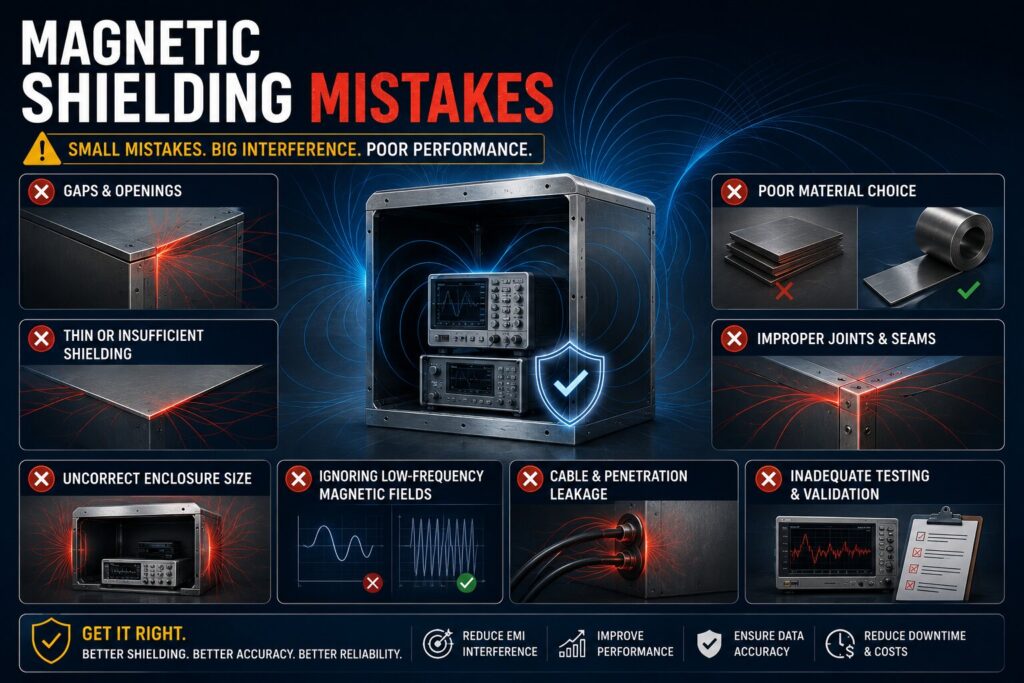
7 Common Magnetic Shielding Mistakes
1. Choosing the Wrong Material
Many engineers use stainless steel or aluminum expecting magnetic shielding performance.
That creates immediate shielding inefficiency.
Correct Solution
Use high-permeability alloys like:
- UNS N14080 Mu Metal
- Permalloy
- Nickel-Iron alloys
DOMADIA™ supplies precision magnetic shielding materials specifically designed for low-frequency EMI environments.
2. Ignoring Annealing Requirements
Mu Metal loses permeability after machining, welding, bending, or mechanical stress.
Without hydrogen annealing, shielding efficiency can collapse dramatically.
Reality Check
A perfectly designed shield may perform poorly simply because post-fabrication annealing was skipped.
3. Poor Joint & Seam Design
Even microscopic gaps can leak magnetic flux.
Common problems include:
- Open seams
- Improper overlaps
- Loose fasteners
- Inconsistent welds
Best Practice
Use overlapping joints and continuous shielding paths.
4. Shield Too Thin for Flux Density
Many applications underestimate magnetic field intensity.
Thin shielding saturates quickly.
Result
- Leakage
- Instrument instability
- Sensor drift
- EMI failure
DOMADIA™ helps industries select proper shielding thickness based on operating environments.
5. Mechanical Damage During Installation
High-permeability alloys are sensitive to:
- Hammering
- Rough handling
- Excessive bending
- Vibration stress
This changes grain structure and weakens performance.
6. Ignoring Shield Geometry
Flat panels alone often fail because magnetic fields travel around corners and edges.
Better Design
Use:
- Cylindrical enclosures
- Multi-layer shielding
- Rounded corners
- Complete coverage systems
7. Using One Shield for Every Frequency
A major misconception in EMI protection is assuming one material blocks all frequencies.
Truth
Different frequencies require:
- Different materials
- Layer combinations
- Hybrid shielding systems
Mu Metal performs exceptionally well in low-frequency magnetic shielding but may require conductive layers for higher-frequency EMI.
Properties of UNS N14080 Mu Metal
| Property | Value |
| Density | 8.7 g/cm³ |
| Magnetic Permeability | Extremely High |
| Coercive Force | Very Low |
| Electrical Resistivity | Moderate |
| Saturation Flux Density | Excellent |
| Corrosion Resistance | Moderate |
Technical Specifications
| Specification | Details |
| UNS Number | N14080 |
| ASTM Standard | ASTM A753 |
| Material Type | Nickel-Iron Soft Magnetic Alloy |
| Magnetic Performance | High Permeability |
| Condition | Annealed |
| Available Temper | Soft Magnetic |
Applications of Magnetic Shielding

Medical Equipment
MRI Systems
Magnetic shielding helps maintain imaging accuracy by reducing external electromagnetic interference around MRI machines and preventing critical Magnetic Shielding Mistakes in medical environments.
Diagnostic Instruments
Sensitive diagnostic equipment requires stable magnetic environments for precise readings and reliable patient monitoring, reducing the risk of Magnetic Shielding Mistakes in healthcare applications.
EEG Devices
Shielding minimizes electromagnetic noise that can interfere with brainwave signal detection and analysis.
Defense & Aerospace
Radar Systems
Magnetic shielding improves radar performance by protecting sensitive electronic components from EMI disturbances.
Navigation Equipment
Aircraft and defense navigation systems rely on shielding to ensure signal stability and operational accuracy.
Satellite Electronics
Shielding protects satellite circuits and communication systems from magnetic interference in extreme environments.
Electronics
Transformers
Magnetic shielding reduces flux leakage and improves transformer efficiency in high-performance electrical systems, helping prevent common Magnetic Shielding Mistakes in critical power applications.
Sensors
Precision sensors require controlled magnetic environments to maintain accurate detection and measurement.
Audio Systems
Shielding prevents humming, distortion, and unwanted noise in professional audio equipment.
Semiconductor Equipment
Semiconductor manufacturing systems use shielding to protect delicate processes from electromagnetic disruptions.
Research Laboratories
Magnetic Field Isolation Chambers
These chambers create low-interference environments for advanced scientific testing and magnetic field studies.
Particle Measurement Instruments
Shielding ensures accurate particle analysis by reducing magnetic disturbances during experiments.
EV & Power Systems
Battery Systems
Magnetic shielding protects EV battery electronics from electromagnetic interference and improves system reliability.
Power Electronics
Shielding enhances performance and operational safety in converters, inverters, and power control systems.
Charging Infrastructure
EV charging stations use shielding to maintain stable electrical performance and reduce EMI-related issues.
Shapes Available from DOMADIA™
DOMADIA™ supplies magnetic shielding materials in:
- Foils
- Sheets
- Plates
- Strips
- Coils
- Rings
- Tubes
- Custom fabricated parts
- Precision shielding enclosures
Standards Followed
DOMADIA™ materials comply with:
- ASTM A753
- UNS N14080
- MIL standards (where applicable)
- Precision industrial specifications
- Custom OEM requirements
Why DOMADIA™
Industries working with magnetic shielding cannot afford uncertainty caused by Magnetic Shielding Mistakes.
DOMADIA™ supports engineers with reliable solutions designed to minimize costly Magnetic Shielding Mistakes and improve long-term shielding performance.
Precision Material Selection
Helping customers choose the right shielding alloy based on frequency and application.
Custom Manufacturing
Tailored dimensions and fabricated shielding parts.
Technical Support
Guidance on annealing, handling, installation, and shielding optimization.
Reliable Global Supply
Fast supply support for industrial and research applications.
Consistent Quality
Controlled processing for stable magnetic properties.
The Hidden Cost of Shielding Failure
Most companies calculate only material cost.
Very few calculate:
- Equipment downtime
- EMI troubleshooting hours
- Reinstallation expenses
- Product recall risks
- Calibration failures
The cheapest shielding solution often becomes the most expensive mistake.
That’s why proper engineering matters more than simply purchasing a metal sheet.
Conclusion
Magnetic Shielding Mistakes are rarely obvious during installation.
They often appear later as signal instability, interference, inaccurate measurements, and unexpected operational failures.
Many industries underestimate how small Magnetic Shielding Mistakes can impact long-term EMI protection and equipment reliability.
Using the correct material, proper annealing, accurate thickness, optimized geometry, and expert fabrication makes the real difference.
UNS N14080 Mu Metal remains one of the most effective solutions for low-frequency magnetic shielding when engineered correctly.
DOMADIA™ helps industries move beyond trial-and-error shielding and toward reliable long-term EMI protection.
Discover the 7 Most Common Magnetic Shielding Mistakes Affecting Industrial Performance
Discover howDOMADIA™ delivers reliable UNS N14080 magnetic shielding solutions for superior long-term EMI protection.
Get in Touch With Us Today for Reliable UNS N14080 Magnetic Shielding Solutions and Advanced EMI Protection.
Talk to: Er.Pankaj Domadia | Kairav Domadia | Aadil Domadia | Pragati Sanap | Pooja N N
#MagneticShielding #EMIShielding #MuMetal #UNSN14080 #DOMADIA #Engineering #Electronics #IndustrialSolutions #ShieldingMaterials #EMIProtection
Directly whatsapp us for an Enquiry: https://wa.link/kairav
We’ve delivered to Bengaluru, Mysuru, Mangaluru, Hubballi, and Belagavi—covering Karnataka, Telangana, Tamil Nadu, Kerala, and Andhra Pradesh, with exports to Australia, New Zealand, Singapore, Malaysia, and Indonesia.