Blogs
Regular Copper vs Beryllium Copper: 9 Powerful Differences Every Engineer Should Know
Regular Copper vs Beryllium Copper
Regular Copper vs Beryllium Copper is one of the most important material comparisons for engineers and manufacturers selecting copper alloys for industrial applications. Copper has been one of the world’s most valuable engineering materials for centuries. Its excellent electrical conductivity, thermal conductivity, and corrosion resistance make it indispensable across electrical, plumbing, electronics, and industrial applications.
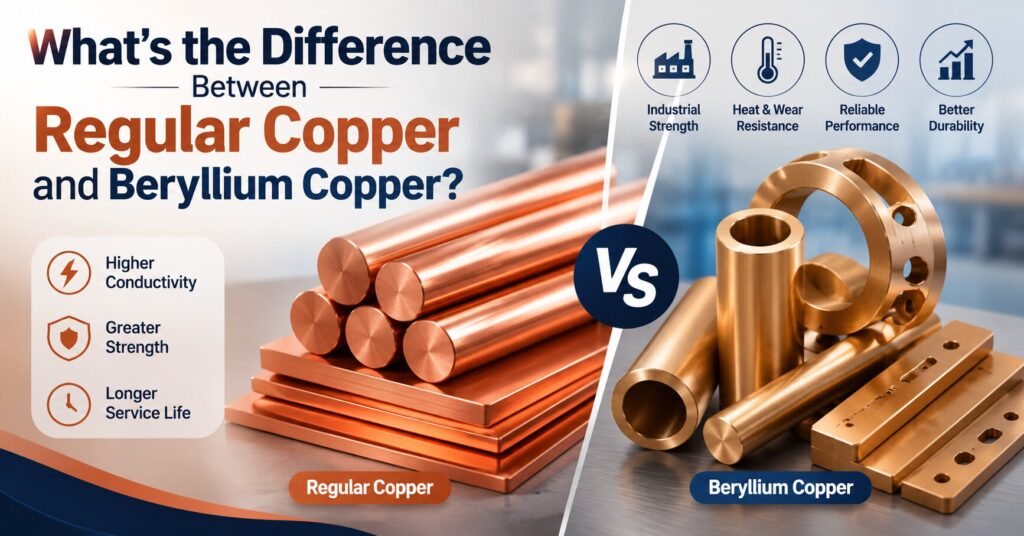
However, not every application can rely on pure copper alone. Industries requiring significantly higher strength, wear resistance, fatigue life, and non-sparking performance often choose Beryllium Copper instead. Understanding the differences in Regular Copper vs Beryllium Copper allows businesses to select materials that deliver the right balance of conductivity, durability, and long-term reliability.
Ultimately, Regular Copper vs Beryllium Copper is not simply a comparison of material cost—it is a comparison of performance, lifecycle value, maintenance savings, and overall operational efficiency.
What Is Regular Copper?
Regular copper generally refers to commercially pure copper grades such as C10100 (OFHC Copper), C11000 (Electrolytic Tough Pitch Copper), and similar grades containing more than 99.9% copper.
It offers exceptional electrical and thermal conductivity but has relatively low mechanical strength.
What Is Beryllium Copper?
Beryllium Copper is a high-performance copper alloy containing a small percentage of beryllium along with copper and carefully controlled alloying elements.
After heat treatment, it develops extremely high strength while retaining good electrical conductivity, excellent fatigue resistance, and outstanding wear resistance.
UNS C17200 is the most widely used high-strength Beryllium Copper grade.
Chemical Composition
Regular Copper
| Element | Typical Content |
| Copper (Cu) | 99.9% minimum |
| Oxygen (varies by grade) | Small amount |
| Other Elements | Trace quantities |
Beryllium Copper (UNS C17200)
| Element | Typical Content |
| Copper | Balance |
| Beryllium | 1.80–2.00% |
| Cobalt + Nickel | Minimum 0.20% |
| Other Elements | Small controlled amounts |
9 Powerful Differences Between Regular Copper and Beryllium Copper
1. Mechanical Strength
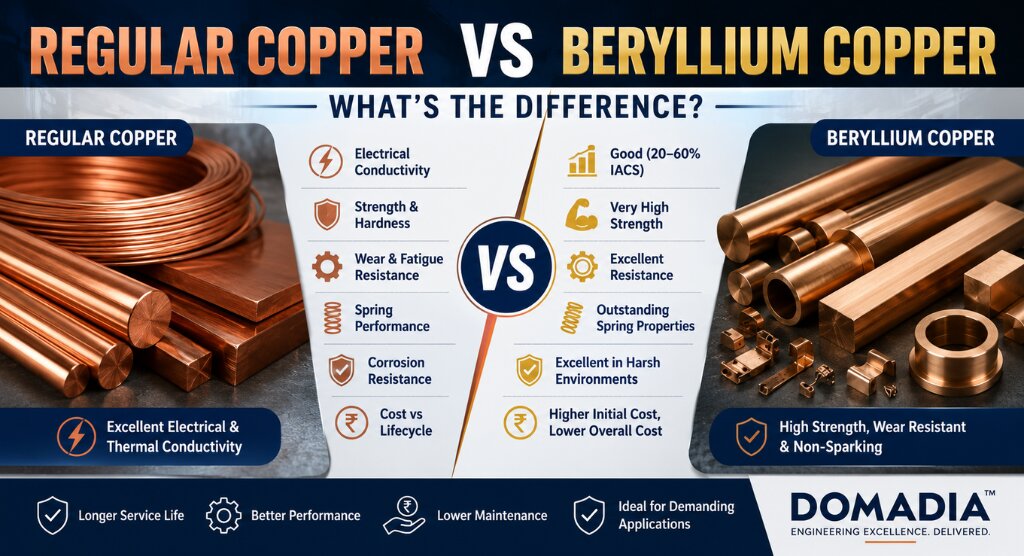
When comparing Regular Copper vs Beryllium Copper, regular copper is relatively soft and easy to deform, whereas beryllium copper becomes several times stronger after age hardening, making it ideal for demanding mechanical applications requiring exceptional strength and durability.
2. Electrical Conductivity
Regular copper offers nearly 100% IACS conductivity.
Beryllium Copper provides approximately 20–60% IACS depending on grade and heat treatment, which remains sufficient for many electrical applications.
3. Wear Resistance
Pure copper wears relatively quickly under repeated friction.
Beryllium Copper offers exceptional wear resistance, extending component life.
4. Fatigue Resistance
Components subjected to repeated loading benefit greatly from Beryllium Copper because of its outstanding fatigue strength.
5. Spring Performance
Regular copper has poor spring characteristics.
Beryllium Copper maintains elastic properties over millions of operating cycles.
6. Non-Sparking Properties
In the comparison of Regular Copper vs Beryllium Copper, one of the biggest advantages of beryllium copper is its non-sparking nature, making it the preferred choice for hazardous environments such as oil & gas, mining, and explosive industrial applications where safety is critical.
7. Corrosion Resistance
Both materials resist corrosion well, although Beryllium Copper generally performs better in many industrial environments requiring long service life.
8. Machinability
Regular copper is relatively easy to form but can create gummy chips during machining.
Beryllium Copper machines efficiently after proper heat treatment while maintaining dimensional accuracy.
9. Cost vs Lifecycle
When comparing Regular Copper vs Beryllium Copper, regular copper has a lower initial purchase cost. However, beryllium copper often provides a much lower total cost of ownership because its superior strength, wear resistance, and longer service life reduce replacement frequency, maintenance expenses, and costly downtime.
Properties of Regular Copper
Extremely High Electrical Conductivity
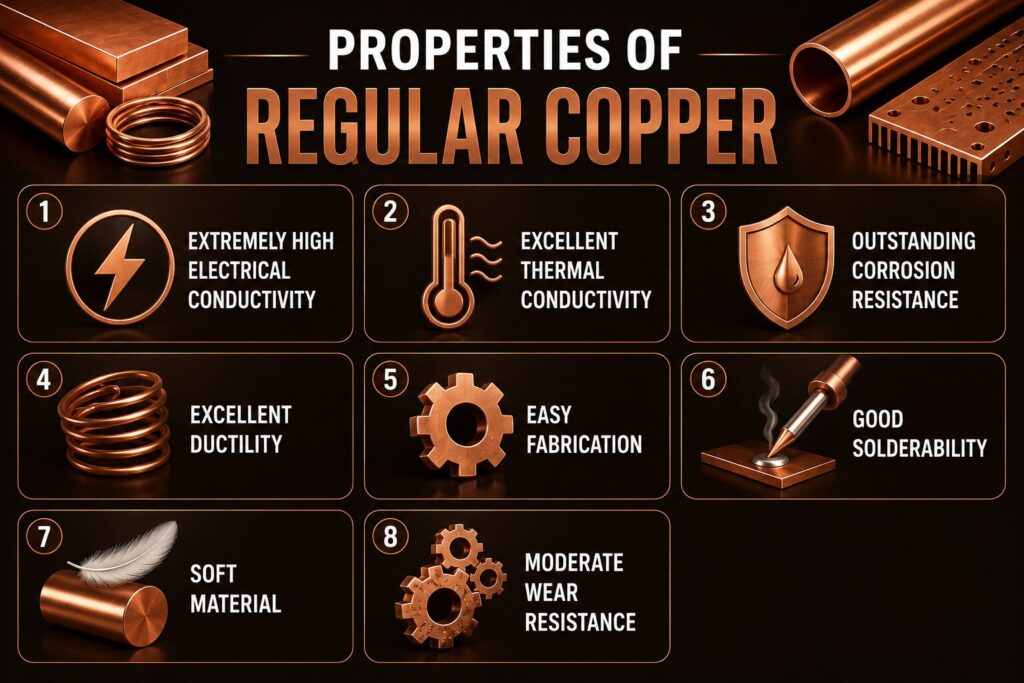
Regular Copper delivers outstanding electrical conductivity, making it ideal for power transmission, electrical wiring, and busbars. In the Regular Copper vs Beryllium Copper comparison, pure copper remains the preferred choice when maximum conductivity is the primary requirement.
Excellent Thermal Conductivity
Its exceptional ability to transfer heat makes Regular Copper suitable for heat exchangers, cooling systems, and thermal management applications where efficient heat dissipation is essential.
Outstanding Corrosion Resistance
Regular Copper naturally forms a protective oxide layer that helps resist corrosion in many indoor and outdoor environments, ensuring dependable long-term performance.
Excellent Ductility
The material can be bent, drawn, and formed into complex shapes without cracking, making fabrication simple for a wide variety of industrial products.
Easy Fabrication
Regular Copper is easy to cut, machine, weld, and form, allowing manufacturers to produce components efficiently with reduced processing time.
Good Solderability
Its excellent soldering characteristics create reliable electrical joints, making it widely used in electronics, electrical assemblies, and PCB manufacturing.
Soft Material
Regular Copper is relatively soft compared to alloyed copper grades. In Regular Copper vs Beryllium Copper, this softness makes it less suitable for applications involving high mechanical loads or repeated wear.
Moderate Wear Resistance
Although suitable for many general-purpose applications, Regular Copper experiences wear more quickly than hardened copper alloys under continuous friction or repeated contact.
Properties of Beryllium Copper
Very High Strength
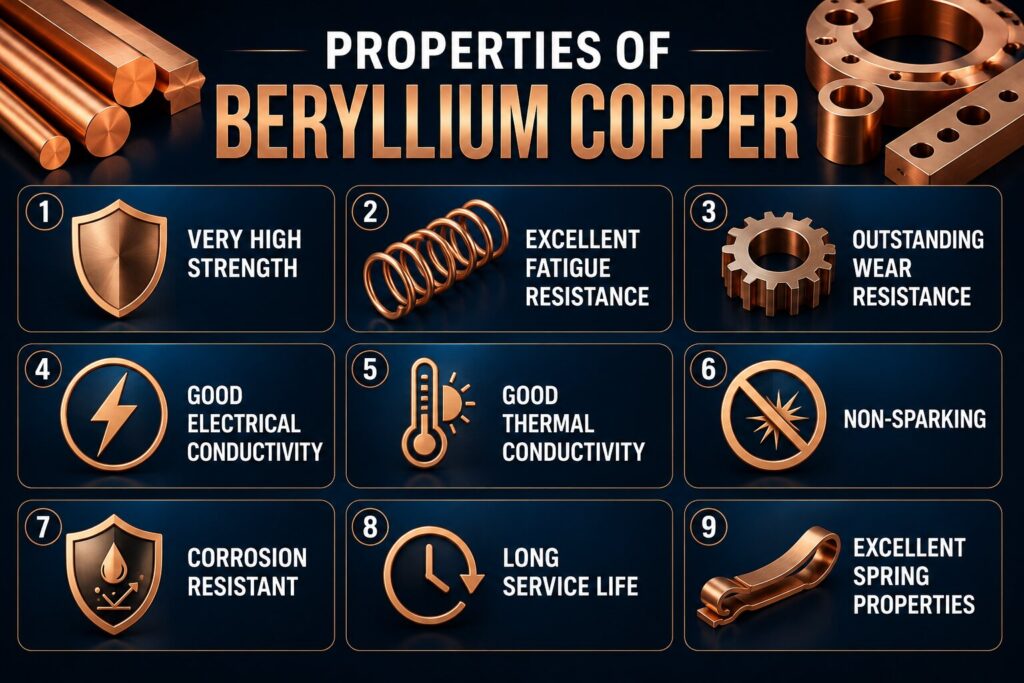
After age hardening, Beryllium Copper achieves exceptional mechanical strength while maintaining useful electrical conductivity. This is one of the biggest advantages highlighted in Regular Copper vs Beryllium Copper.
Excellent Fatigue Resistance
Beryllium Copper withstands millions of repeated loading cycles without failure, making it ideal for springs, electrical contacts, and precision mechanical components.
Outstanding Wear Resistance
Its superior hardness significantly reduces wear caused by friction, extending component life and lowering maintenance costs in demanding industrial environments.
Good Electrical Conductivity
Although lower than pure copper, Beryllium Copper still provides good electrical conductivity for many electrical and electronic applications. In Regular Copper vs Beryllium Copper, it offers an excellent balance between conductivity and strength.
Good Thermal Conductivity
The alloy efficiently transfers heat while maintaining excellent mechanical performance, making it suitable for moulds, welding electrodes, and thermal management components.
Non-Sparking
One of the most valuable features of Beryllium Copper is its non-sparking nature, allowing safe use in explosive or flammable environments where conventional tools may create ignition risks.
Corrosion Resistant
Beryllium Copper offers excellent resistance to corrosion, oxidation, and harsh industrial environments, ensuring long-term reliability with minimal maintenance.
Long Service Life
Its combination of strength, fatigue resistance, and wear resistance enables a much longer operational life. In Regular Copper vs Beryllium Copper, this longer lifecycle often results in lower overall ownership costs despite the higher initial investment.
Excellent Spring Properties
Beryllium Copper maintains excellent elasticity and spring performance over extended operating cycles, making it the preferred material for precision springs, connectors, and electrical contacts. This is another major reason why Regular Copper vs Beryllium Copper frequently favors Beryllium Copper for high-performance engineering applications.
Technical Specifications
| Property | Regular Copper | Beryllium Copper |
| UNS Number | C11000 / C10100 | C17200 |
| Density | ~8.96 g/cm³ | ~8.25 g/cm³ |
| Electrical Conductivity | Up to 100% IACS | 20–60% IACS |
| Tensile Strength | 200–250 MPa | Up to 1400 MPa |
| Hardness | Low | Very High |
| Wear Resistance | Moderate | Excellent |
| Fatigue Strength | Moderate | Excellent |
| Spring Performance | Poor | Outstanding |
Applications of Regular Copper

Electrical Wiring
Regular Copper is the industry standard for electrical wiring because of its exceptional electrical conductivity and reliability. In the Regular Copper vs Beryllium Copper comparison, Regular Copper remains the preferred choice for residential, commercial, and industrial power distribution.
Busbars
Copper busbars efficiently carry high electrical currents with minimal energy loss, making them essential in switchgear, transformers, substations, and electrical panels.
Heat Exchangers
Its outstanding thermal conductivity allows Regular Copper to transfer heat rapidly, making it ideal for heat exchangers, condensers, cooling systems, and HVAC equipment.
Roofing
Regular Copper is widely used for architectural roofing, gutters, and cladding due to its excellent corrosion resistance, attractive appearance, and exceptionally long service life.
Plumbing
Copper pipes provide reliable water distribution because they resist corrosion, withstand pressure, and maintain water quality for residential and industrial plumbing systems.
PCB Manufacturing
Printed circuit boards use Regular Copper foils to create highly conductive electrical pathways that ensure efficient signal transmission and dependable electronic performance.
Electrical Connectors
Regular Copper is commonly used for electrical connectors, terminals, and cable lugs where superior conductivity and low electrical resistance are critical. In Regular Copper vs Beryllium Copper, this makes Regular Copper the ideal option for maximum current-carrying capability.
Applications of Beryllium Copper
Aerospace Components
Beryllium Copper is used in aerospace connectors, landing gear components, bushings, bearings, and precision mechanisms because of its exceptional strength, fatigue resistance, and lightweight performance.
Electrical Contacts
Its excellent combination of electrical conductivity, wear resistance, and spring performance makes Beryllium Copper ideal for switches, relays, connectors, and high-reliability electrical contacts. This is one of the major advantages highlighted in Regular Copper vs Beryllium Copper.
Precision Springs
Beryllium Copper maintains its elasticity over millions of operating cycles, making it the preferred material for precision springs used in aerospace, electronics, medical devices, and automotive systems.
Oil & Gas Tools
Non-sparking drilling tools, safety equipment, and maintenance tools used in hazardous oil and gas environments are frequently manufactured from Beryllium Copper to improve workplace safety.
Non-Sparking Hand Tools
Hammers, wrenches, screwdrivers, chisels, and other safety tools are produced from Beryllium Copper to eliminate spark generation in explosive atmospheres where conventional steel tools may pose risks.
Plastic Injection Moulds
The alloy’s excellent thermal conductivity and outstanding wear resistance improve cooling efficiency, reduce cycle times, and extend mould life in plastic injection moulding operations.
Resistance Welding Electrodes
Beryllium Copper is widely used for resistance welding electrodes because it combines high strength with good electrical and thermal conductivity, ensuring consistent weld quality and extended electrode life.
Automotive Connectors
Modern vehicles rely on Beryllium Copper connectors, terminals, sensors, and electrical systems that require excellent fatigue resistance, durability, and long-term electrical reliability. In Regular Copper vs Beryllium Copper, the alloy offers superior performance in demanding automotive applications.
Medical Equipment
Beryllium Copper is used in precision surgical instruments, diagnostic equipment, medical connectors, and imaging systems where strength, dimensional stability, corrosion resistance, and long service life are essential. This further demonstrates why Regular Copper vs Beryllium Copper often favors Beryllium Copper for high-performance engineering applications.
Standards
Common standards include:
- ASTM B152
- ASTM B187
- ASTM B194
- ASTM B196
- ASTM B197
- ASTM B441
- UNS C11000
- UNS C10100
- UNS C17200
Shapes Available
DOMADIA™ supplies Beryllium Copper and copper materials in various forms including:
- Rods
- Round Bars
- Flats
- Plates
- Sheets
- Strips
- Foils
- Wires
- Tubes
- Blocks
- Rings
- Custom CNC Components
- Precision Machined Parts
Environmental Impact
Choosing materials with a longer operational life also contributes to sustainability. Although Beryllium Copper has a higher initial cost, its exceptional durability means components require replacement far less frequently than many conventional materials. Reduced replacement cycles lead to less scrap generation, lower recycling frequency, decreased maintenance activity, and reduced downtime—helping industries improve both operational efficiency and environmental performance.
Why DOMADIA™
DOMADIA™ supplies premium-quality Beryllium Copper products that meet demanding industrial applications worldwide.
Our advantages include:
- Certified industrial-grade materials
- Strict quality inspection
- Precision machining capabilities
- Custom sizes available
- Technical material support
- Competitive global pricing
- Fast delivery
- Reliable international supply network
Conclusion
When evaluating Regular Copper vs Beryllium Copper, the right choice depends entirely on your application’s performance requirements. Regular Copper remains the preferred material for maximum electrical and thermal conductivity, while Beryllium Copper excels where high strength, fatigue resistance, wear resistance, spring performance, and long service life are critical. Understanding Regular Copper vs Beryllium Copper enables engineers and buyers to select materials that deliver the best balance of performance and long-term reliability.
Although Beryllium Copper has a higher upfront cost, its exceptional durability, reduced maintenance, fewer replacements, and improved reliability often result in a substantially lower total cost of ownership. In many demanding industrial environments, Regular Copper vs Beryllium Copper is ultimately a comparison between initial purchase price and long-term value. DOMADIA™ supplies premium-quality Beryllium Copper solutions engineered to provide consistent performance, dependable quality, and reliable global supply for critical industrial applications.
Upgrade to Beryllium Copper That Delivers Strength Beyond Ordinary Copper
DOMADIA™ supplies premium UNS C17200 Beryllium Copper in rods, bars, plates, sheets, strips, foils, wires, and custom machined components—engineered to meet the toughest industrial requirements with consistent quality and expert technical support.
Whether your application demands superior electrical conductivity or exceptional strength and durability, Get in Touch with DOMADIA™ for expert guidance and premium Beryllium Copper solutions engineered to deliver maximum performance, reliability, and long-term value.
Talk to: Er.Pankaj Domadia | Kairav Domadia | Aadil Domadia | Pragati Sanap | Pooja N N
#BerylliumCopper #CopperAlloys #UNSC17200 #EngineeringMaterials #IndustrialMetals #CopperComparison #DOMADIA #Manufacturing #ElectricalEngineering #MetalSolutions
Directly whatsapp us for an Enquiry: https://wa.link/kairav
We’ve supplied to Mumbai, Pune, Indore, Jaipur, and Surat—serving industries across Maharashtra, Madhya Pradesh, Rajasthan, Gujarat, and Goa, with exports to Germany, USA, Japan, South Korea, and Italy.