Blogs
Silicone vs PTFE vs Ceramic Cable Insulation: 7 Powerful Differences for High-Temperature Applications
Silicone vs PTFE vs Ceramic Cable Insulation: Which One Should You Choose?
A furnace unexpectedly shuts down during peak production. Investigation reveals that the cable insulation degraded under extreme temperatures, causing signal loss and equipment failure. The downtime costs thousands of dollars, while production schedules suffer significant delays.
Selecting the correct cable insulation material is not simply a technical decision—it directly impacts safety, reliability, maintenance costs, and operational efficiency. Understanding the differences in Silicone vs PTFE vs Ceramic Cable Insulation can help prevent costly failures and improve long-term operational performance.
This guide explores Silicone vs PTFE vs Ceramic Cable Insulation to help engineers and procurement professionals select the right solution for demanding environments. By comparing Silicone vs PTFE vs Ceramic Cable Insulation based on temperature resistance, flexibility, durability, and application suitability, businesses can make more informed cable selection decisions.
Understanding High-Temperature Cable Insulation
Cable insulation protects conductors from electrical leakage, mechanical damage, environmental exposure, and thermal degradation.
In industries such as:
- Steel manufacturing
- Glass production
- Foundries
- Aerospace
- Power generation
- Semiconductor manufacturing
Standard insulation materials often fail due to excessive heat exposure. This is where Silicone, PTFE, and Ceramic insulation technologies become essential.
What is Silicone Cable Insulation?
Silicone rubber insulation is widely used in industrial environments requiring flexibility and heat resistance.
Chemical Composition
Typical silicone insulation consists of:
- Polysiloxane polymers
- Silicon
- Oxygen
- Organic side groups
- Heat-resistant additives
Key Properties
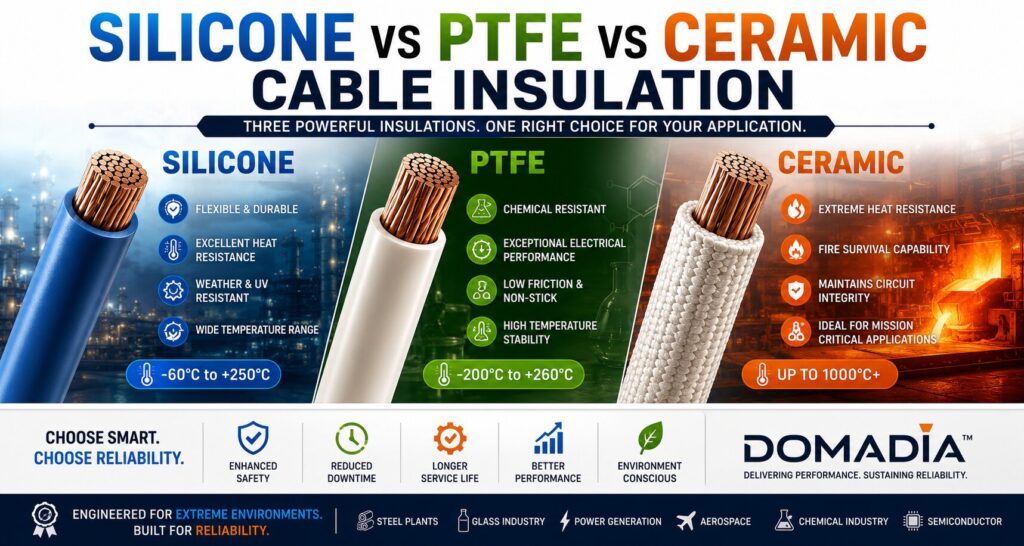
- Excellent flexibility
- Good dielectric strength
- Moisture resistant
- UV resistant
- Ozone resistant
- Good weather resistance
Temperature Range
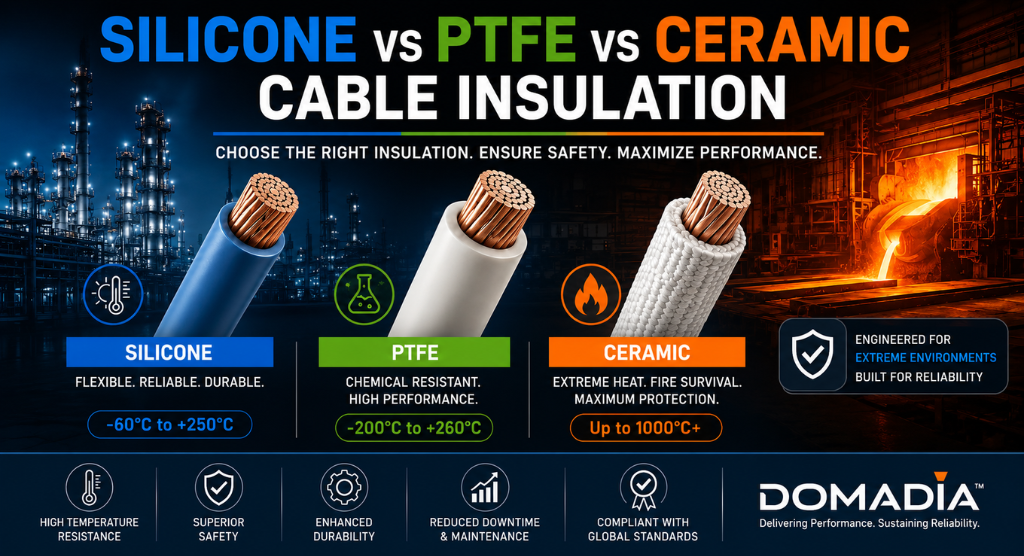
- Continuous operation: -60°C to +180°C
- Special grades: Up to +250°C
Applications
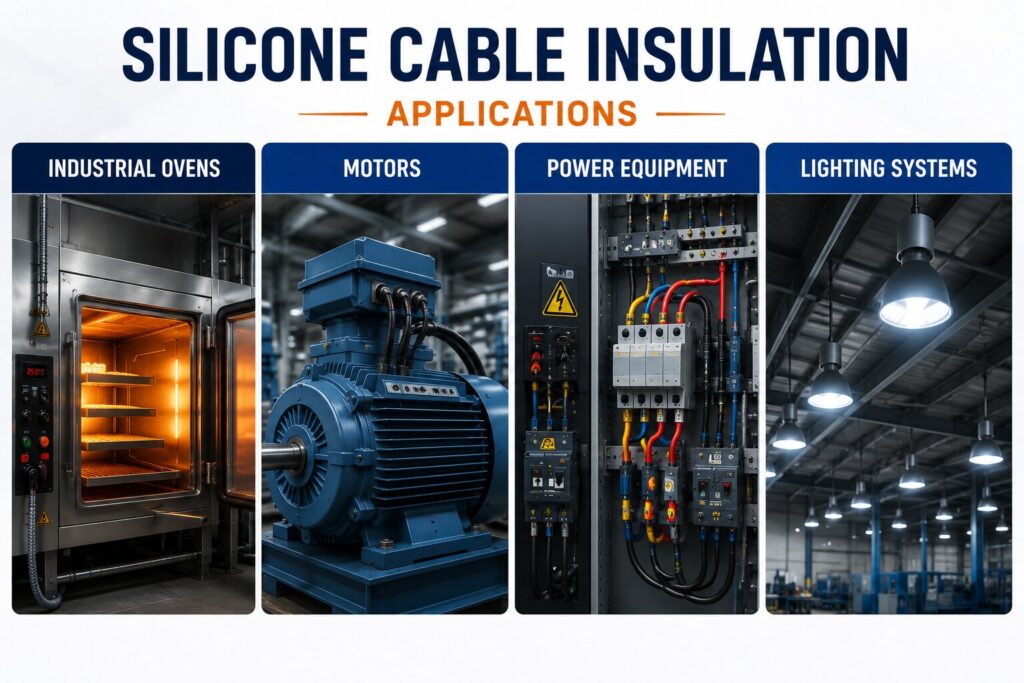
- Industrial ovens
- Lighting systems
- Motors
- Power equipment
- Food processing machinery
- General industrial wiring
Advantages
- Highly flexible
- Easy installation
- Excellent aging resistance
- Good vibration resistance
Limitations
- Lower abrasion resistance than PTFE
- Not suitable for ultra-high temperatures
What is PTFE Cable Insulation?
PTFE (Polytetrafluoroethylene) is one of the most advanced fluoropolymer insulation materials available.
Chemical Composition
PTFE consists primarily of:
- Carbon atoms
- Fluorine atoms
Chemical Formula:
(C₂F₄)n
Key Properties
- Exceptional chemical resistance
- Extremely low friction
- Excellent dielectric performance
- Non-stick characteristics
- High thermal stability
Temperature Range
- Continuous operation: -200°C to +260°C
Applications

- Aerospace systems
- Military electronics
- Semiconductor equipment
- Chemical processing plants
- Medical devices
- High-performance instrumentation
Advantages
- Superior chemical resistance
- Excellent electrical properties
- High-temperature stability
- Low smoke generation
Limitations
- Higher cost
- Less flexible than silicone
- More difficult to process
What is Ceramic Cable Insulation?
Ceramic insulation systems are designed for the most extreme thermal environments.
Unlike conventional insulation materials, ceramic-based insulation can maintain circuit integrity even during fire conditions.
Chemical Composition
Typical ceramic insulation systems may contain:
- Ceramic fiber materials
- Silica compounds
- Alumina compounds
- Mineral-based fire-resistant layers
Key Properties
- Extremely high-temperature resistance
- Fire survival capability
- Excellent thermal stability
- Non-combustible construction
Temperature Range
- Continuous exposure: Up to 1000°C and beyond
- Fire survival applications: Even higher short-duration temperatures
Applications
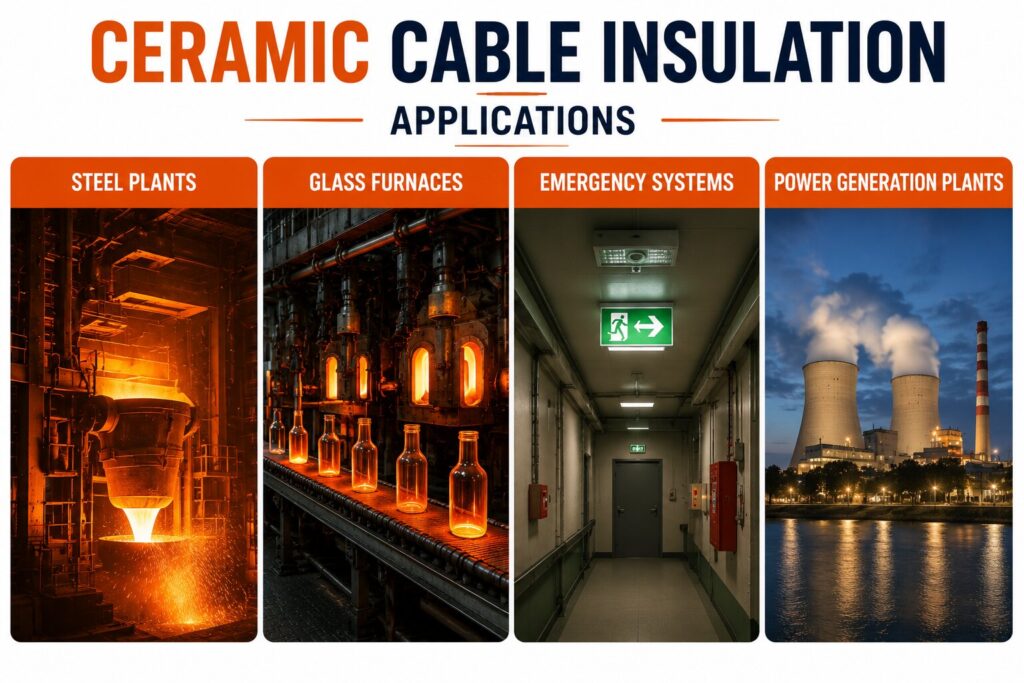
- Steel plants
- Glass furnaces
- Emergency systems
- Fire survival circuits
- Petrochemical facilities
- Power generation plants
Advantages
- Exceptional heat resistance
- Fire-resistant operation
- Maintains circuit integrity during emergencies
Limitations
- Less flexible
- Higher installation complexity
- Specialized application use
Technical Comparison: Silicone vs PTFE vs Ceramic Cable Insulation
| Property | Silicone | PTFE | Ceramic |
| Continuous Temperature | 180°C–250°C | 260°C | 1000°C+ |
| Flexibility | Excellent | Moderate | Low |
| Chemical Resistance | Good | Excellent | Excellent |
| Fire Resistance | Good | Very Good | Outstanding |
| Mechanical Flexibility | Excellent | Moderate | Limited |
| Electrical Performance | Very Good | Excellent | Good |
| Installation Ease | Easy | Moderate | Specialized |
| Cost | Moderate | Higher | Highest |
Industry Standards
High-temperature insulated cables are often manufactured according to:
Silicone Insulated Cables
- IEC 60228
- IEC 60332
- UL Standards
- RoHS Compliance
PTFE Insulated Cables
- MIL Specifications
- ASTM Standards
- UL Standards
- IEC Standards
Ceramic Insulated Cables
- IEC 60331
- BS 6387
- EN 50200
- Fire Survival Standards
Technical Specifications Overview
| Parameter | Silicone | PTFE | Ceramic |
| Voltage Rating | Up to 1.1 kV | Up to 1.1 kV | Application Specific |
| Moisture Resistance | Excellent | Excellent | Good |
| UV Resistance | Excellent | Excellent | Excellent |
| Flame Retardancy | Good | Excellent | Outstanding |
| Smoke Generation | Moderate | Low | Very Low |
| Abrasion Resistance | Good | Excellent | Moderate |
Available Cable Configurations
Depending on application requirements, these insulation systems are available in:
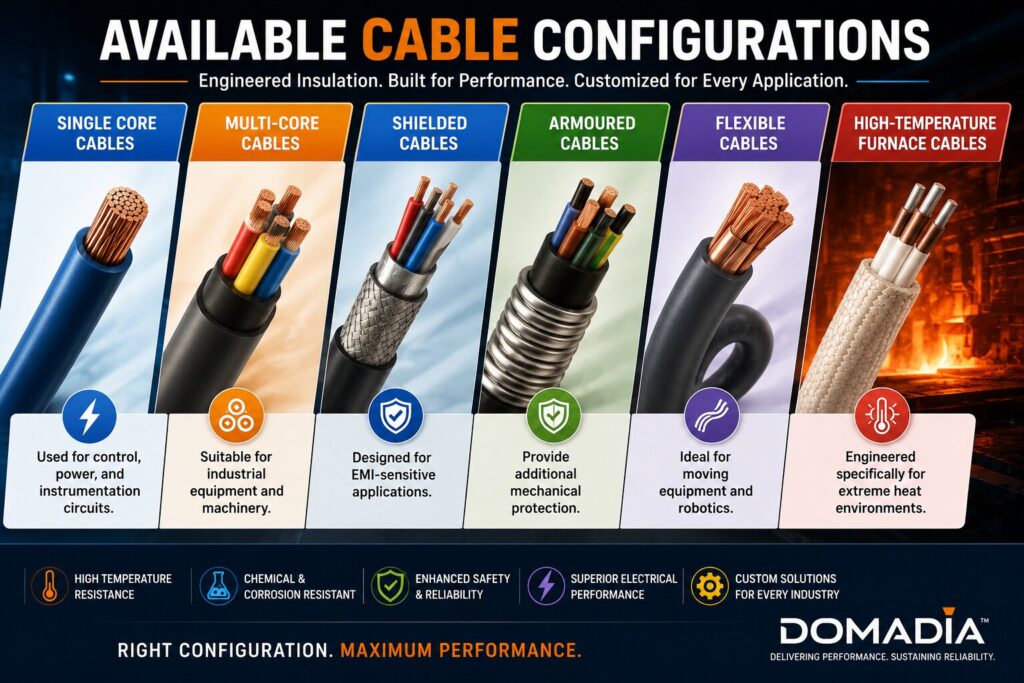
Single Core Cables
Used for control, power, and instrumentation circuits.
Multi-Core Cables
Suitable for industrial equipment and machinery.
Shielded Cables
Designed for EMI-sensitive applications.
Armoured Cables
Provide additional mechanical protection.
Flexible Cables
Ideal for moving equipment and robotics.
High-Temperature Furnace Cables
Engineered specifically for extreme heat environments.
How to Choose the Right Insulation Material
Choose Silicone When:
- Flexibility is important
- Temperatures remain below 250°C
- Cost-effectiveness is required
- Outdoor exposure exists
Choose PTFE When:
- Chemical resistance is critical
- Electrical performance is essential
- Temperatures reach 260°C
- Aerospace or semiconductor applications are involved
Choose Ceramic When:
- Temperatures exceed conventional cable limits
- Fire survival capability is required
- Furnace environments are present
- Mission-critical circuits must remain operational during emergencies
Why DOMADIA™?
DOMADIA™ supplies advanced high-temperature cable solutions engineered for demanding industrial environments, helping industries select the most suitable Silicone vs PTFE vs Ceramic Cable Insulation for critical applications.
What Sets DOMADIA™ Apart?
✔ Extensive high-temperature cable expertise
✔ Industrial-grade material selection
✔ Custom cable configurations
✔ Compliance with international standards
✔ Reliable technical support
✔ Fast supply for critical applications
✔ Solutions for furnace, aerospace, power, steel, and manufacturing industries
Whether your application requires flexible silicone insulation, chemically resistant PTFE construction, or extreme-temperature ceramic cable technology, DOMADIA™ provides dependable solutions tailored to your operating conditions. Our team helps customers evaluate Silicone vs PTFE vs Ceramic Cable Insulation requirements based on temperature exposure, environmental conditions, and performance expectations.
With years of experience supporting demanding industries, DOMADIA™ delivers reliable guidance and product solutions for Silicone vs PTFE vs Ceramic Cable Insulation applications where safety, durability, and long-term performance are essential.
From industrial furnaces to aerospace systems and critical power infrastructure, DOMADIA™ helps organizations optimize their Silicone vs PTFE vs Ceramic Cable Insulation selection for maximum operational reliability and reduced lifecycle costs.
Conclusion
Selecting the right Silicone vs PTFE vs Ceramic Cable Insulation solution can significantly improve equipment reliability, reduce downtime, and enhance operational safety.
Silicone offers outstanding flexibility and weather resistance. PTFE delivers superior chemical and electrical performance. Ceramic insulation provides unmatched protection in extreme heat and fire-survival applications.
Understanding operating temperatures, environmental conditions, regulatory requirements, and long-term performance expectations allows engineers to make informed Silicone vs PTFE vs Ceramic Cable Insulation selection decisions that maximize system reliability and lifecycle value. Investing in the proper Silicone vs PTFE vs Ceramic Cable Insulation system also helps reduce maintenance costs, extend cable service life, and improve overall operational efficiency in demanding industrial environments.
Ultimately, choosing the most suitable Silicone vs PTFE vs Ceramic Cable Insulation for your application ensures long-term performance, enhanced safety, and dependable operation even under the most challenging conditions.
Find the Perfect High-Temperature Cable Solution with DOMADIA™
Whether you require flexible silicone cables, chemically resistant PTFE cables, or extreme-temperature ceramic insulated cables, DOMADIA™ can help you select the ideal solution for your operating environment.
Looking for reliable high-temperature cable solutions?Contact DOMADIA™ today for expert assistance in selecting the ideal Silicone, PTFE, or Ceramic insulated cable for your application.
Talk to: Er.Pankaj Domadia | Kairav Domadia | Aadil Domadia | Pragati Sanap | Pooja N N
#UltraThinFoil #DOMADIA #PrecisionEngineering #MetalFoils #CopperFoil #NickelFoil #IndustrialManufacturing #AdvancedMaterials #FoilManufacturing #EngineeringSolutions
Directly whatsapp us for an Enquiry: https://wa.link/kairav
From Hyderabad, Secunderabad, Warangal, Karimnagar, and Nizamabad, we serve Telangana, Andhra Pradesh, Karnataka, Maharashtra, and Chhattisgarh, with global reach to Turkey, Greece, Poland, Hungary, and Czech Republic.