Blogs
Silicone vs Teflon Cables: 9 Powerful Differences | UNS C11000
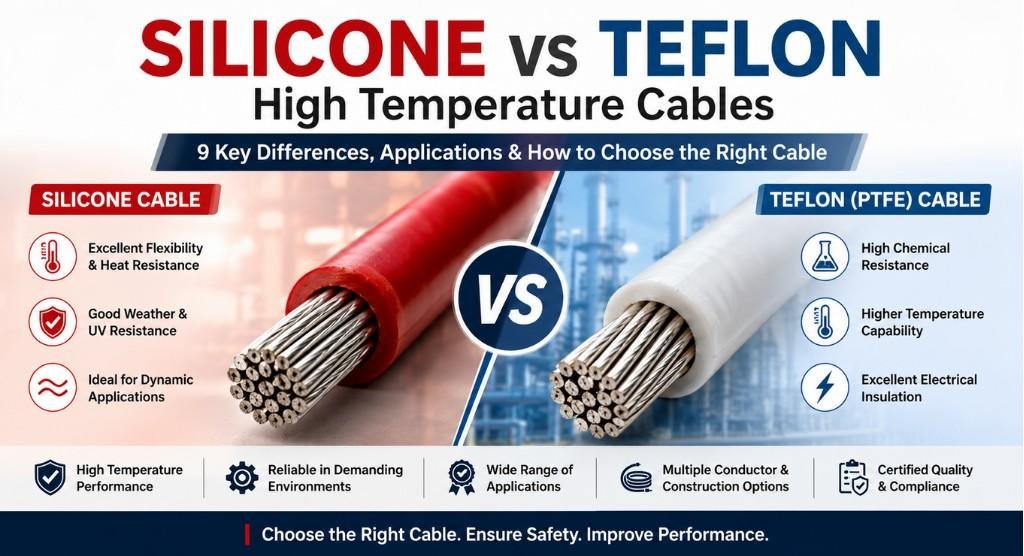
Silicone vs Teflon Cables may look like a straightforward insulation choice, but selecting the wrong one can turn into a costly engineering problem.
A maintenance engineer replaces wiring near a hot machine. The conductor size is correct. The voltage rating looks right. The cable is sold as “high temperature.” Yet months later, the insulation starts showing signs of wear.
What went wrong?
The missing question was not simply, “How hot does the cable get?” It was also: Does the cable need to flex? Will it encounter oils or chemicals? Is space limited? Will it face abrasion?
That is where the difference between silicone-insulated and PTFE-insulated—commonly called Teflon—high-temperature cables becomes important.
Both can perform in demanding environments, but they solve different engineering problems. DOMADIA™ helps industrial buyers evaluate high-temperature cable requirements based on operating temperature, conductor, insulation, voltage, flexibility, chemical exposure and application conditions.
What Are Silicone High Temperature Cables?
Silicone high-temperature cables use silicone rubber as the primary electrical insulation around a metallic conductor. When comparing Silicone vs Teflon Cables, silicone insulation is particularly valued for its flexibility and ability to perform reliably in high-temperature environments.
Silicone rubber is especially useful where wiring must remain flexible while exposed to elevated temperatures. This makes it suitable for equipment where ordinary thermoplastic insulation may become unsuitable because of sustained heat.
Depending on the exact certified cable construction, silicone-insulated wires can be found with ratings around 200°C. For example, UL’s historical AWM Style 3518 describes extruded silicone-rubber insulation in a 200°C, 300 V construction with an FEP covering. Ratings must always be checked against the exact manufacturer’s datasheet and certification rather than assumed from insulation chemistry alone.
Understanding Silicone vs Teflon Cables can help engineers select appropriate insulation based on temperature requirements, flexibility, chemical exposure, installation conditions, and the specific application.
Typical applications include heating equipment, appliances, industrial machinery, lighting systems, and other equipment requiring flexible, heat-resistant wiring.
What Are PTFE or Teflon High Temperature Cables?
PTFE, or polytetrafluoroethylene, is a fluoropolymer valued for high-temperature capability, electrical insulation, chemical resistance and low friction.
PTFE-insulated cables are frequently selected where engineers need a combination of:
- High continuous operating temperature
- Excellent chemical resistance
- Thin insulation possibilities
- Good dielectric performance
- Low moisture absorption
- Resistance to many aggressive operating environments
Some UL AWM PTFE constructions carry ratings of 250°C. UL Style 5344, for example, specifies a PTFE-based construction rated at 250°C and 600 V. This demonstrates why PTFE is commonly considered for particularly demanding high-temperature electrical applications.
Again, 250°C should not be treated as the universal rating for every PTFE cable. Actual limits depend on the complete cable design and certification.
Silicone vs Teflon Cables: Quick Comparison
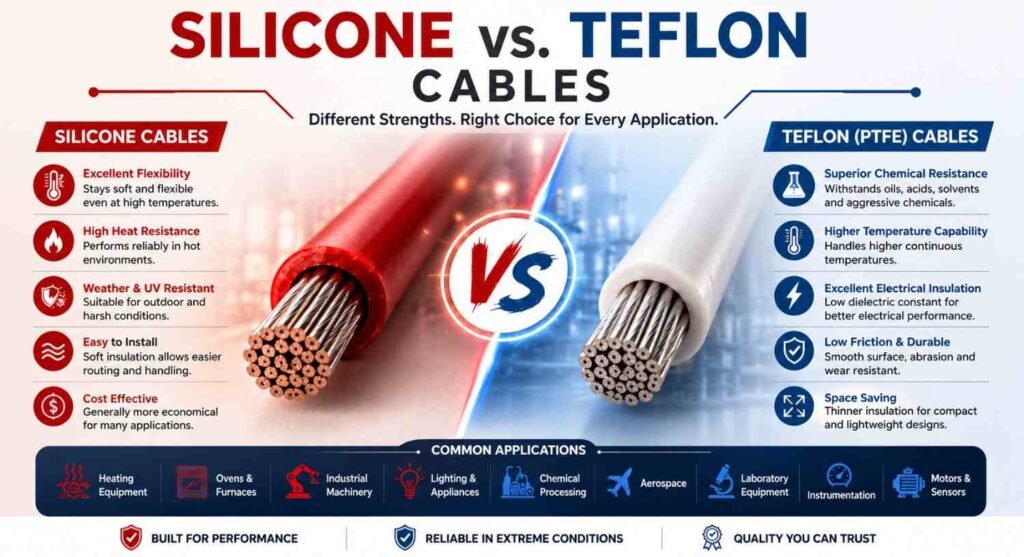
| Property | Silicone Cable | PTFE/Teflon Cable |
| High-temperature capability | Excellent | Excellent to exceptionally high |
| Typical certified constructions | Often available around 180–200°C | Some constructions reach 250°C |
| Flexibility | Excellent | Good, construction-dependent |
| Chemical resistance | Good | Excellent |
| Oil resistance | Construction-dependent | Generally excellent |
| Moisture resistance | Good | Excellent |
| Electrical insulation | Excellent | Excellent |
| Low-friction surface | Moderate | Excellent |
| Space-saving insulation | Moderate | Often advantageous |
| Cost | Generally economical | Typically higher |
| Best suited for | Flexible hot environments | Heat + chemicals + compact/high-performance systems |
These are general engineering comparisons. The certified cable datasheet always takes priority.
9 Key Differences Between Silicone and Teflon High Temperature Cables
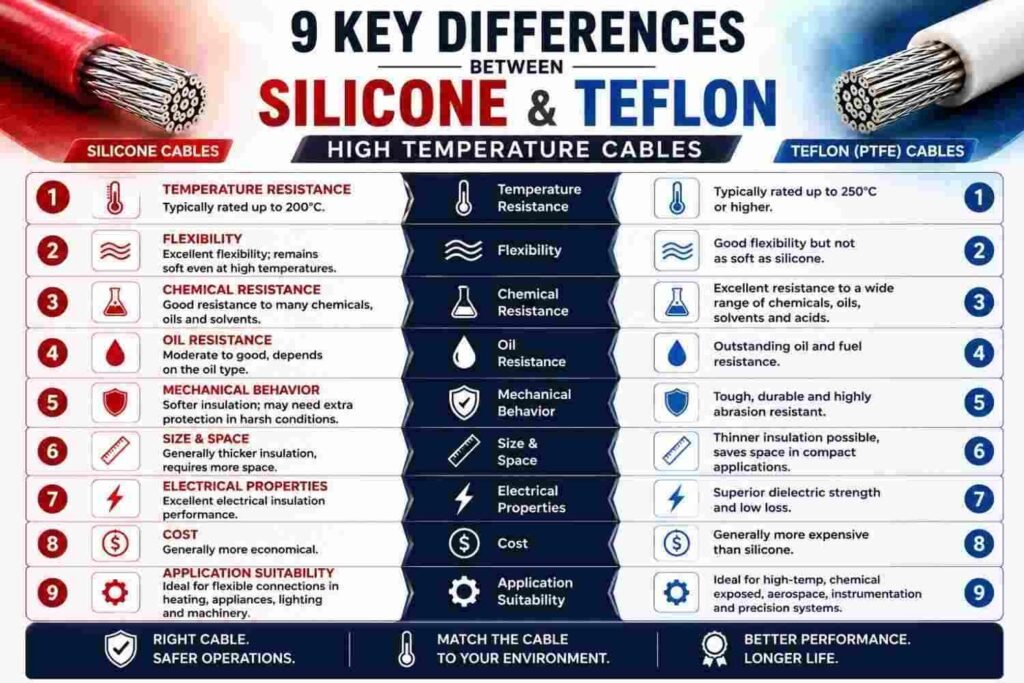
1. Temperature Resistance
Temperature is usually the first specification engineers check when comparing Silicone vs Teflon Cables for high-temperature electrical applications.
Silicone insulation is well established for elevated-temperature wiring, with numerous constructions designed around approximately 180°C to 200°C service.
PTFE can go further in appropriate constructions. UL’s Style 5344 provides an example of a PTFE-containing wire construction rated at 250°C.
This does not mean that PTFE automatically wins every application.
When evaluating Silicone vs Teflon Cables, the highest temperature rating should not be the only deciding factor. If your equipment operates comfortably within the certified silicone cable’s limits, paying for additional temperature capability may provide little practical advantage.
Mindset shift: Don’t buy the insulation with the highest temperature number. Buy the cable whose certified temperature rating safely matches the actual operating environment.
2. Flexibility
Here, silicone often has a major practical advantage.
Silicone rubber can remain soft and flexible across a broad temperature range. That makes silicone-insulated cable attractive for applications where wires need to bend during installation or where some movement occurs during operation.
Examples can include:
- Heating equipment
- Lighting systems
- Industrial ovens
- Laboratory equipment
- Appliances
- Internal machine wiring
PTFE cables can also be flexible, particularly when manufactured with finely stranded conductors, but PTFE does not have the same soft, rubber-like feel as silicone.
For repeated movement, however, never choose solely by insulation material. Stranding, conductor class, bend radius and complete cable construction matter.
3. Chemical Resistance
This is one of PTFE’s strongest advantages when comparing Silicone vs Teflon Cables for demanding industrial environments.
PTFE is widely valued in engineering for its resistance to many chemicals and aggressive environments. Therefore, when high temperatures occur together with chemical exposure, PTFE can become particularly attractive.
Silicone offers useful environmental resistance but should not automatically be considered equivalent to PTFE when aggressive chemicals, solvents, fuels, or process fluids are involved. This difference can be an important consideration when selecting Silicone vs Teflon Cables for applications exposed to both heat and challenging substances.
Chemical compatibility should always be verified against the specific substance, concentration, exposure duration, and operating temperature.
4. Mechanical Behaviour
High-temperature resistance means very little if the insulation is mechanically damaged.
Soft silicone insulation provides flexibility, but certain silicone constructions may require additional protection when abrasion, sharp edges or mechanical abuse are expected.
That protection can include:
- Fiberglass braiding
- Protective jackets
- Conduit
- Sleeving
- Additional cable coverings
PTFE provides a tougher, low-friction surface in many cable designs, making it attractive where compactness and resistance to environmental exposure matter.
Neither should be treated as mechanically indestructible.
5. Cable Size and Space
Space inside modern equipment is expensive, making size an important consideration when comparing Silicone vs Teflon Cables for compact electrical systems.
Control cabinets, sensors, instrumentation, aerospace systems, and compact industrial assemblies can have extremely limited routing space.
PTFE’s electrical properties can allow manufacturers to develop relatively thin-wall insulation systems for suitable applications.
This can help engineers achieve:
smaller outside diameter + high-temperature capability + strong electrical insulation.
Silicone insulation may be physically thicker depending on the cable design, although that construction can provide the flexibility engineers need. When evaluating Silicone vs Teflon Cables, engineers should therefore balance available installation space with flexibility, temperature rating, and electrical performance.
When space is extremely restricted, PTFE deserves serious consideration.
6. Electrical Properties
Both materials are excellent electrical insulators when properly engineered into a cable.
PTFE is particularly valued where engineers require dependable dielectric properties in demanding high-frequency, high-temperature or precision electrical environments.
Silicone is also a strong electrical insulation material and is widely used in high-temperature electrical equipment.
The final electrical performance, however, depends on more than insulation chemistry.
Engineers should evaluate:
- Rated voltage
- Insulation thickness
- Conductor size
- Dielectric strength
- Shielding requirements
- Creepage and clearance
- Installation environment
- Applicable certification
7. Conductor Construction
The insulation receives most of the attention, but the conductor deserves equal consideration.
High-temperature cables may use conductors such as:
- Bare copper
- Tinned copper
- Silver-plated copper
- Nickel-plated copper
- Nickel or nickel-alloy conductors for specialized designs
Copper conductors may correspond to grades such as UNS C11000, depending on the specific product and procurement specification.
For standardized cable conductors, IEC 60228:2023 covers nominal conductor cross-sectional areas and includes requirements concerning wire sizes and conductor resistance for various cable conductor classes.
The conductor finish becomes increasingly important as operating temperature and environmental severity increase.
8. Cost
PTFE cable generally commands a higher price than basic silicone high-temperature cable constructions. This initial cost difference is an important factor when comparing Silicone vs Teflon Cables, but purchase price alone does not determine long-term value.
Cable procurement should not be reduced to price per metre.
Suppose a lower-cost cable repeatedly fails because the installation contains aggressive chemicals, excessive temperatures, or unsuitable mechanical conditions. When selecting Silicone vs Teflon Cables, engineers should consider how these operating conditions may affect service life and maintenance requirements.
The real expense becomes:
Cable cost + labour + machine shutdown + lost production + replacement + troubleshooting.
Conversely, installing expensive PTFE cable where a properly rated silicone construction comfortably satisfies every requirement can unnecessarily increase project cost. A practical Silicone vs Teflon Cables comparison should therefore consider both technical performance and total operating costs.
The correct question is:
Which cable provides the required service life at the lowest total operating cost?
Ultimately, choosing between Silicone vs Teflon Cables should be based on temperature, chemical exposure, mechanical demands, expected service life, and overall project economics—not simply the initial cable price.
That is a far more useful purchasing criterion.
9. Application Suitability
The easiest way to choose between the two materials is to start with the operating environment.
Silicone High Temperature Cables May Be Better For:
Industrial Heating Equipment
Silicone vs Teflon Cables are commonly considered for flexible connections around heaters and temperature-controlled machinery.
Ovens and Furnaces
Silicone vs Teflon Cables are suitable options for wiring located in appropriately rated hot zones, depending on the required temperature and operating conditions.
Lighting Equipment
Heat-resistant internal connections near high-temperature light sources.
Home and Commercial Appliances
Internal wiring in ovens, heaters and other hot appliances where the specific cable is approved.
Industrial Machinery
Applications requiring flexible routing around heat-producing components can benefit from Silicone vs Teflon Cables, depending on temperature, flexibility, and installation requirements.
PTFE/Teflon High Temperature Cables May Be Better For:
Chemical Processing Equipment
Where heat and chemical exposure occur simultaneously, Silicone vs Teflon Cables should be carefully evaluated to ensure reliable performance under demanding operating conditions.
Aerospace Systems
When comparing Silicone vs Teflon Cables, weight, space, temperature performance, and reliability can all influence the final material selection.
Laboratory Equipment
For specialized instruments operating around heat or aggressive substances, Silicone vs Teflon Cables should be evaluated according to temperature, chemical resistance, flexibility, and electrical requirements.
Sensors and Instrumentation
Where compact wiring and electrical performance are important.
Industrial Process Equipment
For harsh environments involving heat, oils, chemicals, or demanding electrical requirements, Silicone vs Teflon Cables should be carefully evaluated to ensure reliable performance.
Chemical Composition: Silicone vs PTFE
Although both materials perform as electrical insulation, their chemistry is fundamentally different.
Silicone Rubber
When comparing Silicone vs Teflon Cables, it is useful to understand the material structure behind silicone insulation. Silicone elastomers are based on a siloxane polymer backbone containing silicon and oxygen, combined with organic groups and formulation-specific additives.
This structure contributes to silicone’s thermal stability, durability, and characteristic flexibility, making these properties important considerations when selecting Silicone vs Teflon Cables for demanding electrical applications.
PTFE
When comparing Silicone vs Teflon Cables, PTFE stands out because of its distinctive fluoropolymer chemistry. PTFE is composed primarily of carbon and fluorine, based on repeating tetrafluoroethylene-derived units.
The strong carbon-fluorine bonding contributes significantly to PTFE’s chemical inertness, thermal performance, and electrical characteristics. These properties are important considerations when evaluating Silicone vs Teflon Cables for high-temperature and chemically demanding environments.
The conductor itself is separate from the insulation chemistry and may use copper or specially plated copper depending on the required temperature, electrical performance, and application.
Technical Specifications to Compare Before Ordering
Do not send a supplier an enquiry saying only:
“Need high-temperature Teflon cable.”
That leaves too many variables undefined.
A useful procurement specification should include:
| Specification | Information Required |
| Insulation | Silicone / PTFE / other |
| Conductor material | Copper / plated copper / special alloy |
| Conductor size | AWG or mm² |
| Number of cores | Single / multicore |
| Voltage rating | Application dependent |
| Continuous temperature | °C |
| Maximum short-term temperature | °C, if applicable |
| Flexibility | Fixed / flexible / continuous movement |
| Shielding | Required / not required |
| Jacket | Material and requirement |
| Chemical exposure | Oil, solvent, acid, etc. |
| Mechanical protection | Required / not required |
| Certification | UL / IEC / application-specific |
| Quantity | Metres / coils / project quantity |
This information makes cable selection faster and substantially reduces the risk of specifying the wrong construction.
Standards for Silicone and Teflon High Temperature Cables
There is no single standard that makes every silicone or PTFE cable interchangeable.
Standards depend on the cable’s intended application, construction, voltage and market.
UL 758
UL 758 – Appliance Wiring Material (AWM) is commonly encountered for internal wiring constructions.
UL’s historical database illustrates how dramatically specifications can vary even within broadly similar insulation families. For example, a silicone-rubber-based Style 3518 construction is rated 200°C/300 V, while PTFE-based Style 5344 is rated 250°C/600 V.
That is exactly why engineers should never assume that “silicone cable” or “PTFE cable” alone defines the temperature or voltage rating.
IEC 60228
IEC 60228:2023 addresses conductors of insulated cables, including nominal cross-sectional areas, wire requirements and conductor resistance values.
Other IEC, UL, EN or application-specific standards may apply depending on the final equipment.
Always specify the required certification at the enquiry stage.
Shapes and Configurations Available
High-temperature cable products can be manufactured or supplied in numerous configurations depending on the application:
- Single-core wire
- Multicore cable
- Flexible stranded wire
- Shielded cable
- Braided cable
- Fiberglass-covered cable
- Twisted pair
- Sensor and instrumentation cable
- Custom cable assemblies
- High-temperature lead wire
- Flat or specialized constructions
DOMADIA™ can support enquiries where buyers need specialized high-temperature cable constructions based on operating conditions and technical specifications.
Silicone vs Teflon Cables: Which Should You Choose?
A simple decision framework can make the choice easier.
Choose silicone when: flexibility is a major requirement, the operating temperature falls safely within the cable’s certified range, chemical exposure is manageable, and a soft, easy-to-route cable is advantageous.
Choose PTFE when: higher temperature capability is required, chemical resistance is critical, installation space is limited, or the operating environment demands a more specialized insulation system.
And if your operating temperature exceeds the capabilities of both?
Don’t simply increase the cable’s temperature rating indefinitely. Extremely high-temperature environments can require specialized constructions using mica, fiberglass, ceramic-related insulation systems or nickel conductors. UL records, for example, include specialized mica/glass constructions with ratings far beyond ordinary silicone or PTFE wiring.
Why DOMADIA™ for High Temperature Cables?
A high-temperature cable should not be selected from temperature alone.
DOMADIA™ focuses on helping industrial customers source materials according to actual technical requirements, including:
Temperature Requirements
Cable selection should consider Silicone vs Teflon Cables based on continuous and application-specific operating temperature requirements.
Insulation Options
Support for silicone, PTFE and other specialized high-temperature constructions depending on requirements.
Conductor Options
Different conductor materials, sizes, plating options and configurations can be considered according to the application.
Industrial Applications
Material requirements can be evaluated for heating equipment, furnaces, machinery, instrumentation, electrical equipment and specialized industrial systems.
Technical Procurement Support
Buyers can provide temperature, voltage, conductor size, insulation, quantity and environmental conditions so the appropriate cable construction can be identified.
The goal is not to sell the cable with the biggest temperature number.
It is to supply the right cable for the operating environment.
Conclusion
The Silicone vs Teflon Cables decision ultimately comes down to the conditions surrounding the conductor.
Silicone is an excellent option when flexibility, heat resistance and practical installation are priorities. PTFE becomes especially valuable when higher temperature capability, chemical resistance, compact construction and demanding environmental performance matter.
Neither material is universally superior.
A silicone cable correctly selected for a 180°C application can be a better engineering choice than an unnecessarily expensive PTFE construction. Likewise, using silicone solely to save money can become costly if aggressive chemicals or higher temperatures cause premature cable failure.
Before purchasing, define the temperature, voltage, conductor size, flexibility, chemical exposure, mechanical conditions and required standards.
That turns cable selection from guesswork into engineering.
For specialized silicone, PTFE and high-temperature cable requirements, contact DOMADIA™ with your operating conditions and technical specifications to discuss an appropriate material solution.
Need the Right High-Temperature Cable for Your Application?
DOMADIA™ supplies specialized Silicone and PTFE (Teflon) High Temperature Cables for demanding industrial environments. Share your temperature, voltage, conductor size, insulation, and application requirements with us to identify a suitable cable solution.
👉 Contact DOMADIA™ Today for Your High-Temperature Cable Requirements.
Talk to: Er.Pankaj Domadia | Kairav Domadia | Aadil Domadia | Pragati Sanap | Pooja N N
#HighTemperatureCables #SiliconeCable #TeflonCable #PTFECable #HeatResistantWire #IndustrialCables #ElectricalEngineering #UNSC11000 #DOMADIA
Directly whatsapp us for an Enquiry: https://wa.link/kairav
Our materials reached Bareilly, Pilibhit, Shahjahanpur, Hardoi, and Lakhimpur—supporting UP, Uttarakhand, Bihar, MP, and Jharkhand, with exports to Belgium, Netherlands, Luxembourg, Germany, and France.