Blogs
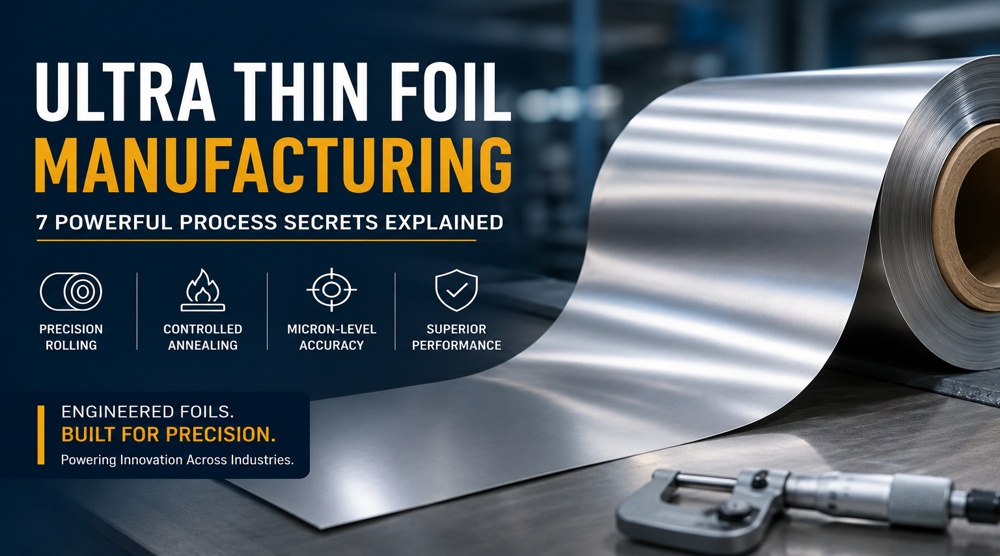
Ultra Thin Foil Manufacturing: 7 Powerful Process Secrets Explained
The Micron-Level Challenge Most Industries Never See
An electronics manufacturer once spent weeks troubleshooting signal instability in a high-frequency device. Engineers checked the PCB layout, shielding design, and connectors repeatedly.
The issue eventually came down to a microscopic inconsistency in the foil thickness used inside the assembly.
A variation so small it was barely measurable had created performance failures across an entire production batch.
This is why Ultra Thin Foil manufacturing has become one of the most precision-driven sectors in modern metallurgy.
From aerospace electronics to EV batteries and semiconductor shielding, industries today depend on foil materials engineered at micron-level accuracy.
At DOMADIA™, ultra-thin foil production combines metallurgy, rolling technology, surface science, and precision inspection to deliver reliable industrial performance.
What Is Ultra Thin Foil?
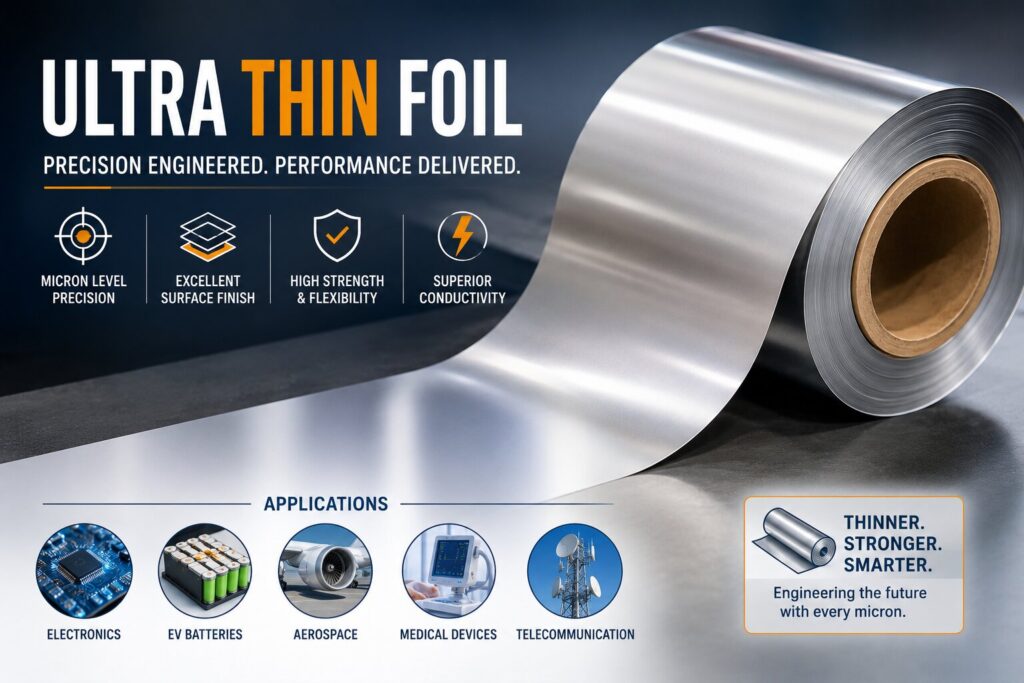
Ultra-thin foil refers to precision metallic foil manufactured in extremely low thicknesses, generally ranging from:
- 2 microns to 100 microns
- Ultra-tight tolerances
- High surface consistency
- Controlled mechanical properties
- Exceptional conductivity or shielding characteristics
These foils are widely used where traditional sheet metal becomes too thick, rigid, or inconsistent for modern engineering applications.
1. Raw Material Selection: The Foundation of Quality
The manufacturing process begins with selecting high-purity raw materials.
Depending on the application, different metals and alloys are used:
- Copper
- Nickel
- Stainless Steel
- Titanium
- Mu-Metal
- Aluminum
- Beryllium Copper
- Nickel Alloys
The purity and chemistry directly influence:
- Conductivity
- Corrosion resistance
- Magnetic properties
- Thermal performance
- Mechanical strength
DOMADIA™ ensures strict material traceability and chemical consistency before production begins.
Chemical Composition of Common Ultra Thin Foils
| Material | Chemical Composition |
| Copper Foil | Cu ≥ 99.9% |
| Nickel Foil | Ni ≥ 99% |
| Stainless Steel Foil | Fe-Cr-Ni |
| Mu-Metal Foil | Nickel-Iron Alloy |
| Titanium Foil | Ti ≥ 99% |
| Beryllium Copper Foil | Cu-Be Alloy |
The exact composition varies according to application and international standards.
2. Hot Rolling Process
The initial metal strip undergoes hot rolling to reduce thickness and improve material workability.
Purpose of Hot Rolling
- Thickness reduction
- Grain refinement
- Improved ductility
- Better rolling characteristics
This stage prepares the material for precision cold rolling operations.
3. Cold Rolling: The Real Precision Stage
Cold rolling is where ultra-thin foil truly takes shape.
The material passes through precision rolling mills multiple times until the required micron-level thickness is achieved.
Critical Process Controls
- Rolling pressure
- Roll alignment
- Speed consistency
- Lubrication control
- Temperature stability
Even a slight process deviation can affect:
- Conductivity
- Surface finish
- Mechanical performance
- Dimensional consistency
At DOMADIA™, precision rolling systems maintain strict thickness tolerances throughout production.
4. Annealing Process for Flexibility & Stability
Cold rolling hardens the material.
Annealing restores:
- Ductility
- Flexibility
- Grain balance
- Mechanical stability
Types of Annealing Used
Bright Annealing
Prevents oxidation while maintaining a clean metallic finish.
Vacuum Annealing
Used for contamination-sensitive applications.
Continuous Annealing
Ideal for high-volume Ultra Thin Foil production.
Proper annealing significantly improves Ultra Thin Foil performance in bending and forming applications.
5. Surface Finishing & Cleanliness Control
Ultra-thin foils require flawless surfaces.
Even microscopic contamination can impact:
- Electrical conductivity
- Adhesion properties
- Shielding effectiveness
- Product reliability
Surface Treatments Include
- Degreasing
- Polishing
- Surface cleaning
- Tension leveling
- Protective coating
DOMADIA™ emphasizes surface quality inspection to maintain consistency across every batch.
6. Precision Slitting Operations
After rolling and annealing, the foil is slit into precise widths.
Shapes Available
DOMADIA™ supplies:
- Coils
- Sheets
- Strips
- Precision slit rolls
- Custom punched parts
- Laminated foil structures
Slitting ultra-thin foil requires controlled tension systems to avoid:
- Burr formation
- Edge cracks
- Wrinkling
- Surface scratches
7. Final Inspection & Quality Testing
The final stage involves extensive testing and inspection.
Quality Checks Include
- Thickness measurement
- Surface inspection
- Hardness testing
- Tensile testing
- Composition verification
- Flatness inspection
Advanced quality systems ensure reliable industrial performance.
Properties of Ultra Thin Foils
Mechanical Properties
- High tensile strength
- Excellent flexibility
- Fatigue resistance
- Dimensional stability
Electrical Properties
- High conductivity
- EMI/RFI shielding capability
- Stable signal transfer
Thermal Properties
- Excellent heat dissipation
- Thermal stability
- Oxidation resistance
Magnetic Properties
Specialty foils can provide:
- High magnetic permeability
- Magnetic shielding
- Controlled electromagnetic behavior
Technical Specifications
| Parameter | Typical Range |
| Thickness | 2–100 microns |
| Width | Custom |
| Surface Finish | Bright / Matte |
| Temper | Annealed to Full Hard |
| Tolerance | ±1 to ±5 microns |
| Coil Form | Available |
Standards Followed
DOMADIA™ supplies ultra-thin foils according to:
- ASTM
- AMS
- DIN
- EN
- ISO
- JIS
Material standards depend on alloy type and application requirements.
Applications of Ultra Thin Foils
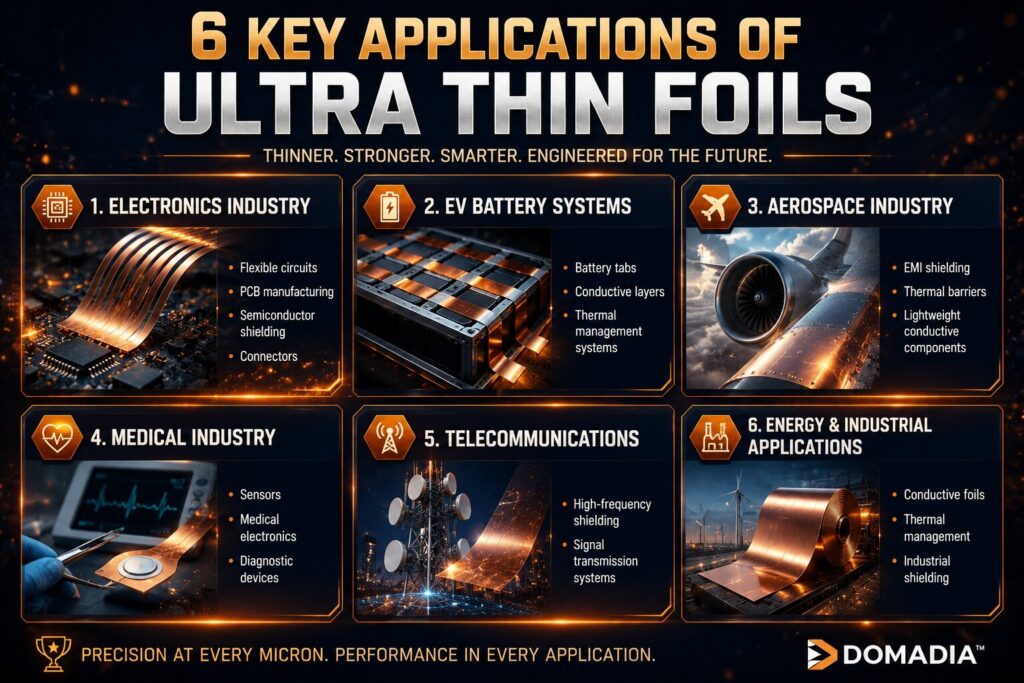
Electronics Industry
- Flexible circuits
- PCB manufacturing
- Semiconductor shielding
- Connectors
EV Battery Systems
- Battery tabs
- Conductive layers
- Thermal management systems
Aerospace Industry
- EMI shielding
- Thermal barriers
- Lightweight conductive components
Medical Industry
- Sensors
- Medical electronics
- Diagnostic devices
Telecommunications
- High-frequency shielding
- Signal transmission systems
The increasing demand for miniaturized electronics is rapidly expanding the ultra-thin foil market globally.
Why Ultra Thin Foil Is Becoming More Important
Modern devices are:
- Smaller
- Faster
- More powerful
- More heat-sensitive
This creates challenges involving:
- Signal interference
- Heat concentration
- Space limitations
- Reliability requirements
Ultra-thin foil helps industries solve these engineering problems efficiently.
Why DOMADIA™
Precision Manufacturing Expertise
DOMADIA™ specializes in high-precision foil solutions for demanding industries.
Consistent Quality
Every batch undergoes strict dimensional and surface inspection.
Wide Material Range
Available in copper, nickel, stainless steel, titanium, and specialty alloys.
Custom Solutions
Tailored specifications for advanced industrial applications.
Reliable Global Supply
DOMADIA™ supports industries worldwide with dependable material solutions.
Conclusion
Ultra Thin Foil manufacturing is far more advanced than traditional metal processing. Every stage — from rolling and annealing to finishing and inspection — requires extreme precision to maintain consistent Ultra Thin Foil quality and performance.
As industries continue moving toward miniaturization and high-performance systems, the demand for ultra-thin precision foils will continue to grow.
DOMADIA™ remains committed to delivering reliable, high-quality foil solutions engineered for the next generation of industrial innovation.
Ready to Upgrade Your Performance with Ultra Thin Foil Manufacturing: 7 Powerful Process Secrets Explained?
Partner with DOMADIA™ for precision-engineered ultra thin foil solutions designed for electronics, aerospace, EV batteries, shielding, and advanced industrial applications.
Contact DOMADIA™ today for custom specifications, expert guidance, and high-performance foil materials tailored to your requirements.
Talk to: Er.Pankaj Domadia | Kairav Domadia | Aadil Domadia | Pragati Sanap | Pooja N N
#UltraThinFoil #DOMADIA #PrecisionEngineering #MetalFoils #CopperFoil #NickelFoil #IndustrialManufacturing #AdvancedMaterials #FoilManufacturing #EngineeringSolutions
Directly whatsapp us for an Enquiry: https://wa.link/kairav
Our materials have reached Kolhapur, Sangli, Satara, Ratnagiri, and Sindhudurg across Maharashtra, Goa, Karnataka, and MP, exporting to Japan, South Korea, Taiwan, Hong Kong, and China