Blogs
Ultra-Thin Foils Lithium – 7 Powerful Advantages in Lithium-Ion Batteries
Ultra Thin Foils Lithium: The Silent Game-Changer in Battery Technology
A leading EV manufacturer once faced a serious challenge—battery overheating and reduced lifecycle. The issue wasn’t the design. It wasn’t the electronics.
It was the material.
Switching to Ultra Thin Foils Lithium transformed everything—higher energy density, improved conductivity, and longer battery life.
This is the shift industries are making today:
From bulky materials → to precision-engineered ultra-thin solutions.
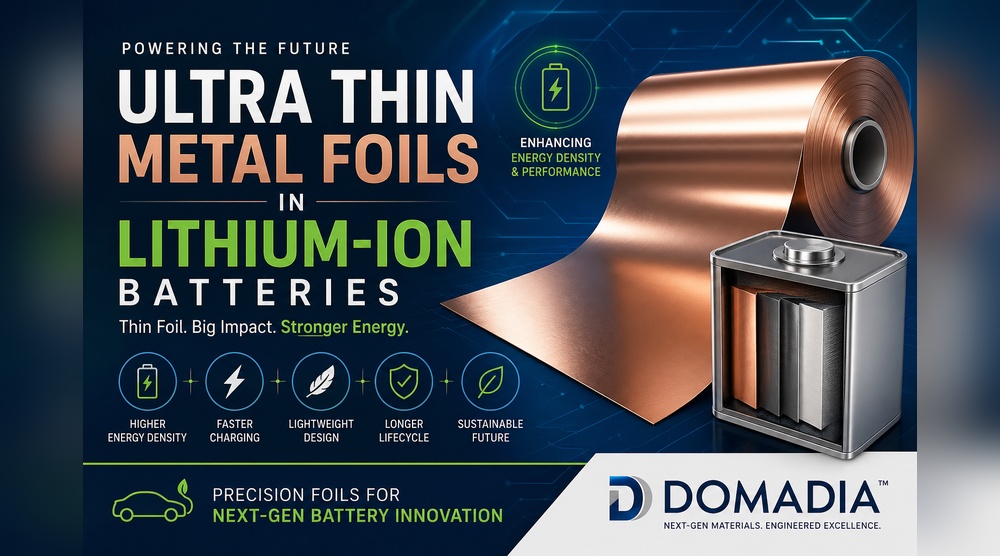
At DOMADIA™, Ultra Thin Foils Lithium are engineered to meet the evolving demands of next-gen lithium-ion batteries.
What are Ultra Thin Foils Lithium?
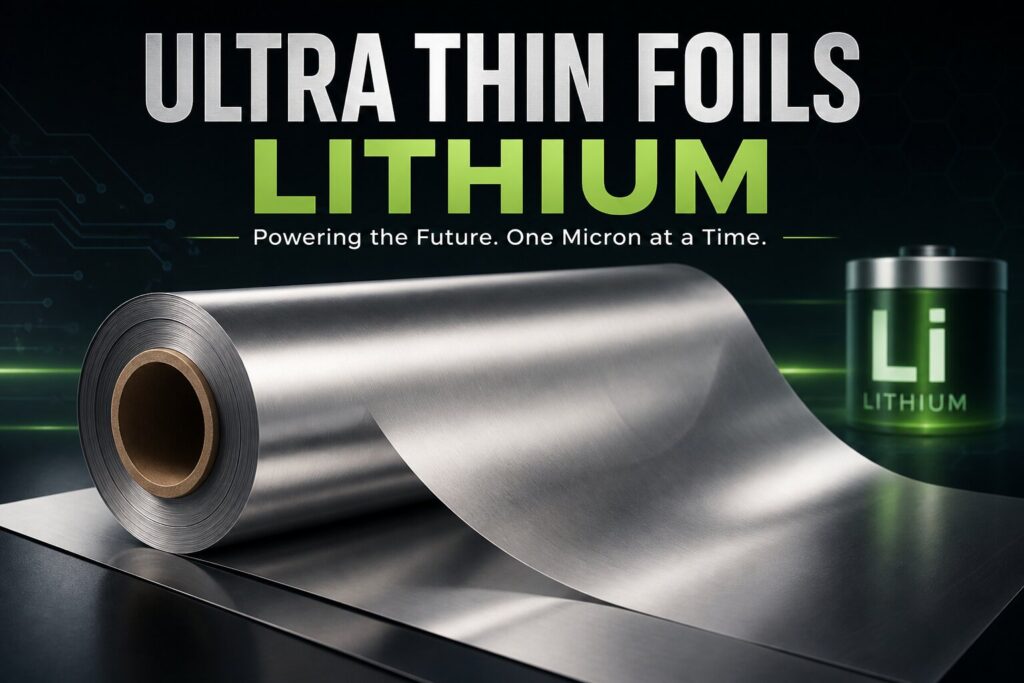
Ultra Thin Foils Lithium are precision-rolled metal foils—typically copper or aluminum—with thickness ranging from a few microns to sub-micron levels.
They act as current collectors in lithium-ion batteries, ensuring efficient electron flow while minimizing weight and resistance.
Chemical Composition
Depending on application, Ultra Thin Foils Lithium typically include:
- Copper (Cu): 99.9%+ purity (for anode current collectors)
- Aluminum (Al): High-purity grades (for cathode collectors)
- Trace elements:
- Iron (Fe)
- Silicon (Si)
- Nickel (Ni)
At DOMADIA™, strict impurity control ensures maximum conductivity and performance.
Properties of Ultra Thin Foils Lithium
High Electrical Conductivity
Ultra Thin Foils Lithium provide excellent electron flow, reducing internal resistance and improving overall battery efficiency and performance.
Ultra-Low Thickness (5–20 microns)
Their extremely thin structure minimizes weight while maximizing energy density, enabling compact and high-capacity battery designs.
Excellent Flexibility & Ductility
These foils can withstand bending and mechanical stress without cracking, making them ideal for flexible and compact battery applications.
High Thermal Stability
Ultra Thin Foils Lithium maintain structural integrity and performance even at elevated temperatures, ensuring safety and reliability in demanding environments.
Corrosion Resistance
They resist chemical degradation over time, enhancing battery lifespan and maintaining consistent performance under various operating conditions.
Lightweight Structure
The reduced material thickness contributes to lighter battery systems, which is crucial for applications like electric vehicles and portable electronics.
These properties make Ultra Thin Foils Lithium essential for high-performance battery systems.
Applications of Ultra Thin Foils Lithium
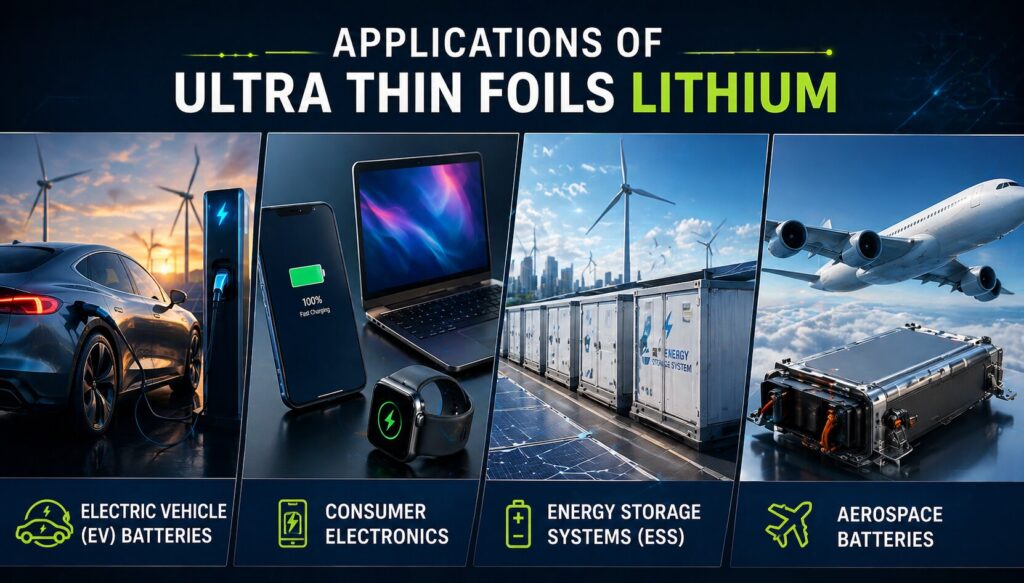
1. Electric Vehicle (EV) Batteries
Ultra Thin Foils Lithium enhance current collection efficiency, leading to higher energy density and extended driving range. Their reduced thickness also lowers overall battery weight, improving vehicle performance and efficiency.
2. Consumer Electronics
Used in smartphones, laptops, and wearables, Ultra Thin Foils Lithium enable compact battery designs while maintaining high performance, faster charging, and longer usage cycles.
3. Energy Storage Systems (ESS)
In renewable energy storage, Ultra Thin Foils Lithium improve charge-discharge efficiency and stability, ensuring reliable and consistent energy supply in solar and wind power systems.
4. Aerospace Batteries
These foils support lightweight and high-performance battery systems required in aerospace applications, where reliability, durability, and energy efficiency are critical under extreme conditions.
5. Medical Devices
They ensure dependable performance in life-critical devices by providing stable conductivity, long battery life, and precision reliability in compact medical equipment.
Standards & Compliance
Ultra Thin Foils Lithium from DOMADIA™ meet global standards:
- ASTM B152 / B152M (Copper Foils)
- ASTM B479 (Aluminum Foils)
- ISO 9001: Quality Management
- RoHS & REACH Compliance
Technical Specifications
- Thickness Range: 5 µm – 20 µm
- Purity: ≥ 99.9%
- Surface Roughness: Controlled for adhesion
- Tensile Strength: High for durability
- Conductivity: Excellent (IACS standard)
Shapes Available
- Rolls (standard industrial supply)
- Sheets (custom cut sizes)
- Precision strips
- Customized foil formats
Why DOMADIA™ for Ultra Thin Foils Lithium?
- Precision-engineered materials for battery efficiency
- Consistent thickness and uniformity
- High-purity metals for superior conductivity
- Custom solutions for advanced battery designs
- Reliable global supply chain
At DOMADIA™, these precision lithium foils are not just materials—they are performance enablers.
Mindset Shift: Material is the Real Innovation
Old thinking: Improve battery design
New thinking: Upgrade materials for better performance
Using Ultra Thin Foils Lithium results in:
- Lower internal resistance
- Faster charging
- Longer lifecycle
- Reduced weight
Conclusion: The Future is Ultra-Thin
Ultra Thin Foils Lithium are redefining lithium-ion battery performance by enabling higher efficiency, compact design, and extended lifecycle.
As industries move toward electrification and energy storage innovation, choosing the right material is no longer optional—it is critical.
With DOMADIA™, you gain access to precision-engineered lithium foils designed for reliability, consistency, and future-ready performance.
Power Your Battery Innovation with Ultra Thin Foils Lithium
Upgrade your energy systems with precision-engineered materials designed for performance, efficiency, and reliability.
DOMADIA™ delivers ultra-thin foil solutions that redefine battery performance.
Get in touch with us to explore customized solutions for your application.
Talk to: Er.Pankaj Domadia | Kairav Domadia | Aadil Domadia | Pragati Sanap | Pooja N N
#UltraThinFoils #LithiumBatteries #BatteryTechnology #DOMADIA #EnergyStorage #CopperFoil #EVBatteries
Directly whatsapp us for an Enquiry: https://wa.link/kairav
Our materials reached Bareilly, Pilibhit, Shahjahanpur, Hardoi, and Lakhimpur—supporting UP, Uttarakhand, Bihar, MP, and Jharkhand, with exports to Belgium, Netherlands, Luxembourg, Germany, and France.