Blogs
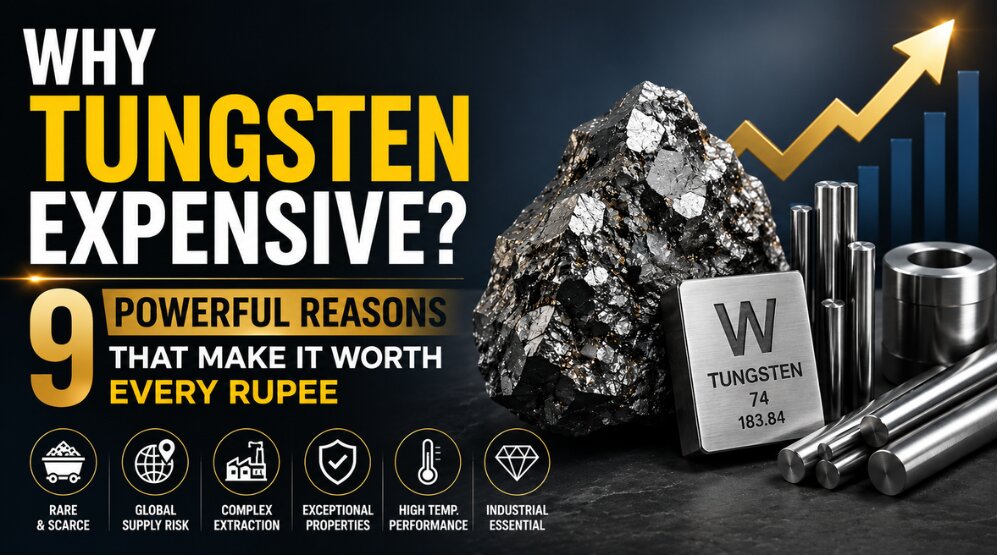
Why Tungsten Expensive? 9 Powerful Reasons That Make It Worth Every Rupee
Modern engineering constantly demands materials capable of surviving conditions that destroy conventional metals. Whether operating inside rocket engines, high-voltage electrical systems, aerospace components, radiation shielding, or semiconductor manufacturing equipment, only a handful of materials can deliver consistent performance.
Why Tungsten Expensive is a question frequently asked by engineers, purchasing teams, and manufacturers. At first glance, tungsten often appears significantly costlier than steel, copper, aluminum, or many specialty alloys. However, understanding Why Tungsten Expensive requires looking beyond the initial purchase price. The cost reflects far more than the raw material itself.
Tungsten possesses the highest melting point of all pure metals, exceptional density, outstanding hardness, remarkable wear resistance, and excellent high-temperature strength. Combined with an extremely difficult extraction and manufacturing process, these characteristics make tungsten one of the world’s most valuable engineering materials.
This guide explains Why Tungsten Expensive, along with its properties, production methods, applications, standards, available forms, and why industries continue investing in this extraordinary metal for long-term performance and reliability.
What is Tungsten?
Tungsten (chemical symbol W) is a rare refractory metal primarily extracted from the minerals wolframite and scheelite. The symbol “W” originates from Wolfram, the historical name for the metal.
Unlike common engineering metals, tungsten is extremely difficult to process because of its exceptionally high melting temperature. Most industrial tungsten products are manufactured using powder metallurgy rather than traditional casting methods, which is one of the key reasons Why Tungsten Expensive is a common question among manufacturers and engineers.
9 Powerful Reasons Why Tungsten Is Expensive
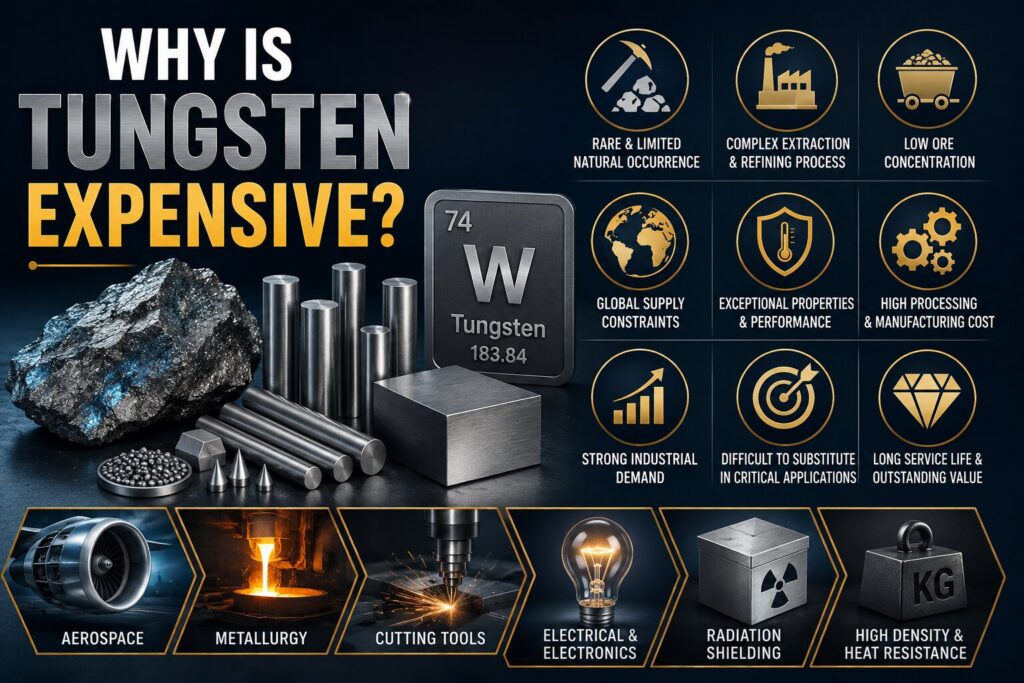
1. Rare Natural Resources
Commercial tungsten deposits are limited compared to iron, aluminum, or copper. Mining operations are concentrated in only a few countries, making global supply relatively restricted.
2. Difficult Mining Process
Recovering tungsten ore requires extensive crushing, grinding, flotation, gravity separation, and chemical processing before usable concentrates are obtained.
The extraction process is both energy-intensive and capital-intensive.
3. Complex Refining
Tungsten concentrate cannot simply be melted into finished products. It must undergo multiple chemical purification stages before being converted into tungsten oxide, ammonium paratungstate (APT), tungsten powder, and finally dense engineering components, further explaining Why Tungsten Expensive compared to conventional engineering metals.
4. Extremely High Melting Point
Tungsten melts at approximately 3422°C, the highest melting point of any pure metal.
Conventional foundries cannot process tungsten using ordinary melting equipment, requiring specialized powder metallurgy manufacturing.
5. Powder Metallurgy Manufacturing
Instead of casting, tungsten powders are pressed under high pressure and then sintered at extremely high temperatures. This manufacturing process requires sophisticated equipment, strict quality control, and significant production time, making it another important reason Why Tungsten Expensive in comparison to conventional engineering metals.
6. Difficult Machining
Once fully dense, tungsten becomes extremely hard.
Machining requires specialized cutting tools, EDM processes, grinding, or diamond tooling, increasing manufacturing costs considerably.
7. Exceptional Material Properties
Industries are paying not just for metal—but for unique engineering performance unavailable from ordinary materials.
These include:
- Highest melting point
- Very high density
- Excellent wear resistance
- High thermal stability
- Superior hardness
- Good electrical conductivity
- Excellent radiation shielding
8. Global Supply Chain Risks
Worldwide tungsten supply can fluctuate due to mining regulations, geopolitical developments, export controls, environmental regulations, and increasing industrial demand. This supply uncertainty often affects market pricing, further illustrating Why Tungsten Expensive in the global industrial metals market.
9. Long-Term Value
Although the initial purchase price may appear high, tungsten components frequently last much longer than conventional materials.
Reduced downtime, lower replacement frequency, improved reliability, and extended service life often reduce total ownership costs.
Chemical Composition
Commercial pure tungsten typically contains:
| Element | Composition |
| Tungsten (W) | ≥99.95% |
| Iron | Trace |
| Nickel | Trace |
| Oxygen | Controlled |
| Carbon | Controlled |
| Other Impurities | Very Low |
Composition varies depending on product grade and international standards.
Key Properties of Tungsten
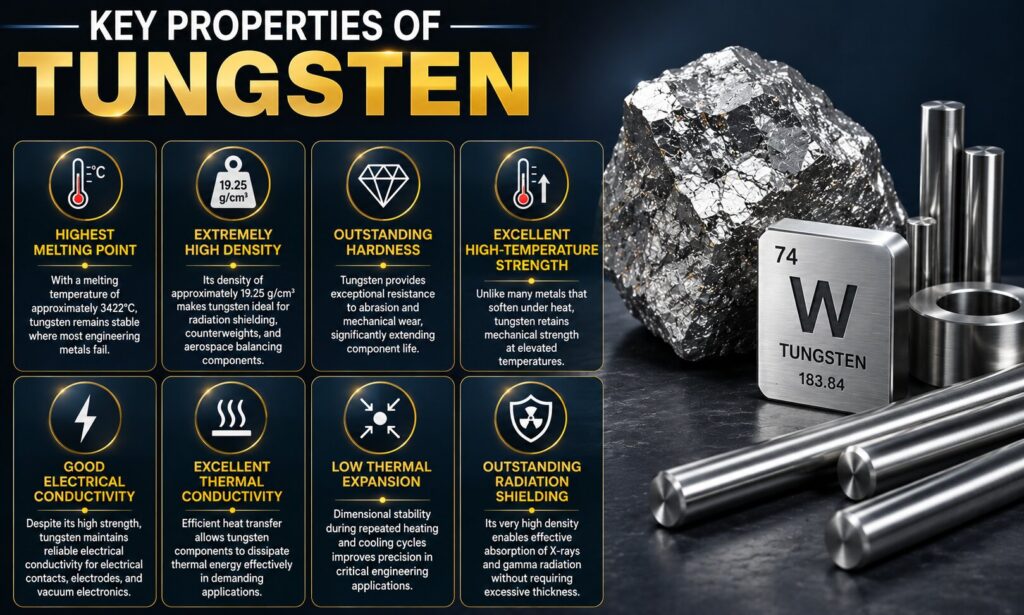
Highest Melting Point
With a melting temperature of approximately 3422°C, tungsten remains stable where most engineering metals fail.
Extremely High Density
Its density of approximately 19.25 g/cm³ makes tungsten ideal for radiation shielding, counterweights, and aerospace balancing components, further demonstrating Why Tungsten Expensive for high-performance engineering applications.
Outstanding Hardness
Tungsten provides exceptional resistance to abrasion and mechanical wear, significantly extending component life, which is another reason Why Tungsten Expensive is considered a worthwhile investment for demanding industrial applications.
Excellent High-Temperature Strength
Unlike many metals that soften under heat, tungsten retains mechanical strength at elevated temperatures.
Good Electrical Conductivity
Despite its high strength, tungsten maintains reliable electrical conductivity for electrical contacts, electrodes, and vacuum electronics.
Excellent Thermal Conductivity
Efficient heat transfer allows tungsten components to dissipate thermal energy effectively in demanding applications, further demonstrating Why Tungsten Expensive for industries that require superior thermal performance and reliability.
Low Thermal Expansion
Dimensional stability during repeated heating and cooling cycles improves precision in critical engineering applications.
Outstanding Radiation Shielding
Its very high density enables effective absorption of X-rays and gamma radiation without requiring excessive thickness, further highlighting Why Tungsten Expensive for radiation shielding and other critical industrial applications.
Technical Specifications
| Property | Value |
| UNS Number | K11000 |
| Density | 19.25 g/cm³ |
| Melting Point | 3422°C |
| Boiling Point | 5555°C |
| Hardness | Extremely High |
| Elastic Modulus | ~411 GPa |
| Thermal Conductivity | ~170 W/m·K |
| Electrical Conductivity | Good |
| Manufacturing | Powder Metallurgy |
Standards
Depending on application, tungsten products are manufactured according to various international standards including:
- ASTM Standards
- ISO Standards
- DIN Standards
- AMS Specifications
- MIL Specifications
- Customer Engineering Drawings
Applications
Tungsten serves numerous high-performance industries.
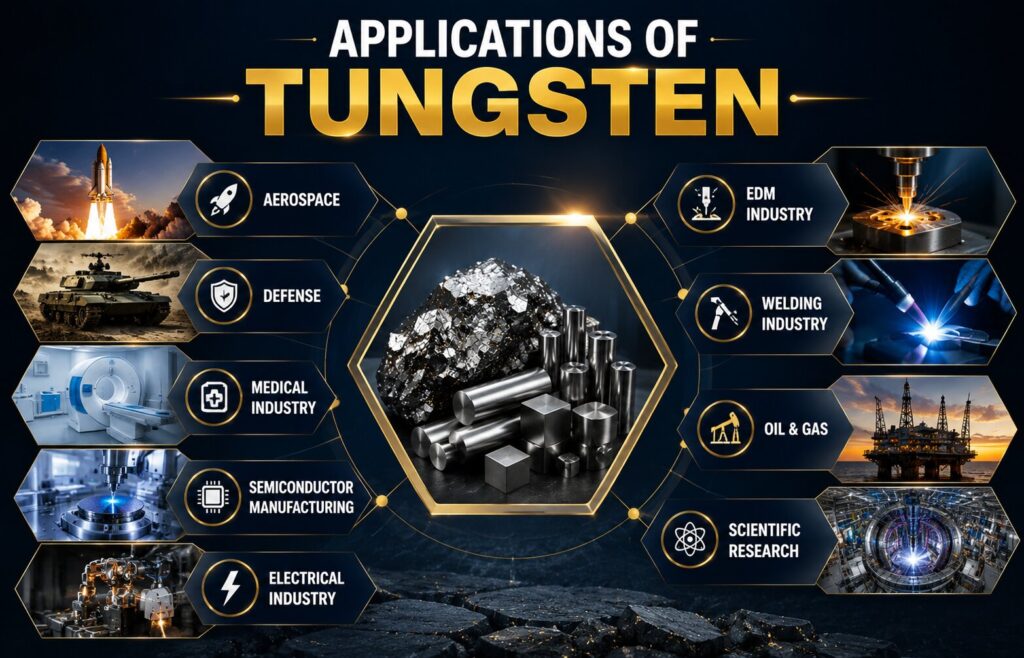
Aerospace
Rocket nozzles, balance weights, thermal protection systems, and high-temperature structural components.
Defense
Armor-piercing components, radiation shielding, missile systems, and military electronics rely on tungsten’s exceptional strength and durability, further explaining Why Tungsten Expensive for critical defense applications.
Medical Industry
Radiation shielding, CT scanners, X-ray equipment, and collimators.
Semiconductor Manufacturing
Ion implantation equipment, sputtering systems, and vacuum chamber components rely on tungsten’s exceptional thermal stability and precision, further demonstrating Why Tungsten Expensive for advanced semiconductor manufacturing.
Electrical Industry
Electrical contacts, switching components, electrodes, and high-current applications.
EDM Industry
EDM electrodes manufactured from tungsten and tungsten-copper composites provide exceptional wear resistance and machining accuracy.
Welding Industry
TIG welding electrodes rely on tungsten’s high-temperature stability for consistent arc performance.
Oil & Gas
High-temperature drilling tools, wear-resistant components, and specialized downhole equipment.
Scientific Research
Particle accelerators, fusion research equipment, laboratory furnaces, and high-vacuum systems depend on tungsten’s exceptional performance under extreme conditions, clearly demonstrating Why Tungsten Expensive for advanced scientific research and precision engineering.
Shapes Available
DOMADIA™ supplies tungsten in numerous engineering forms including:
- Rods
- Bars
- Plates
- Sheets
- Foils
- Tubes
- Wires
- Discs
- Blocks
- Powders
- Pellets
- Sputtering Targets
- Electrodes
- Machined Components
- Custom Precision Parts
Why DOMADIA™
Selecting a tungsten supplier involves far more than comparing material prices. Consistent quality, dimensional accuracy, dependable supply, and technical expertise all play a vital role in achieving reliable performance, especially when evaluating Why Tungsten Expensive for demanding industrial applications.
DOMADIA™ supplies premium tungsten materials for aerospace, electronics, semiconductor manufacturing, medical equipment, defense, power generation, and research laboratories. Our product range includes standard and custom-engineered tungsten forms manufactured to stringent quality requirements, helping customers understand Why Tungsten Expensive through superior quality, reliability, and long-term performance.
Backed by technical support, reliable sourcing, precision manufacturing, and customer-focused service, DOMADIA™ helps businesses select the right tungsten solution for maximum value and dependable operation.
Conclusion
When evaluating Why Tungsten Expensive, the answer lies in its rarity, challenging extraction process, sophisticated manufacturing methods, and unmatched engineering capabilities. Few materials combine such exceptional heat resistance, density, strength, wear resistance, and reliability in one metal.
Although tungsten carries a higher upfront cost than many conventional materials, its long service life, reduced maintenance, improved operational reliability, and outstanding performance often make it the most economical solution over the full lifecycle. For industries where failure is not an option, tungsten continues to justify its premium value. DOMADIA™ delivers high-quality tungsten products that help customers achieve dependable performance in the world’s most demanding applications.
Why Is Tungsten So Expensive? Get the Right Material, Not Just the Lowest Price
DOMADIA™ delivers premium tungsten solutions engineered for superior performance, exceptional reliability, and long-term value—get in touch with our experts today.
Get in Touch with Us today to discuss your application, and let DOMADIA™ help you select the ideal tungsten products with expert guidance, competitive pricing, and dependable global supply.
Talk to: Er.Pankaj Domadia | Kairav Domadia | Aadil Domadia | Pragati Sanap | Pooja N N
#Tungsten #RefractoryMetals #EngineeringMaterials #IndustrialMetals #Manufacturing #HighTemperature #MetalIndustry #MaterialsEngineering #DOMADIA #AdvancedMaterials
Directly whatsapp us for an Enquiry: https://wa.link/kairav
Our deliveries span Kochi, Ernakulam, Thrissur, Palakkad, and Kozhikode across Kerala, Tamil Nadu, Karnataka, Goa, and Andhra Pradesh, with exports to Italy, Portugal, Spain, Greece, and Malta.