Blogs
Faraday Fabric vs Faraday Cage: 7 Powerful Differences That Matter in EMI Shielding
Faraday Fabric vs Faraday Cage – Which Shielding Solution Truly Fits Modern Industries?

Faraday Fabric vs Faraday Cage became a critical discussion point when a defense laboratory faced a strange issue. Their sensitive communication devices kept failing during testing, even though the equipment itself was flawless. Engineers checked software, antennas, and power systems repeatedly. The actual culprit turned out to be invisible electromagnetic interference leaking into the testing environment.
Their first solution? A traditional Faraday cage.
It worked well — but only until mobility, flexibility, and lightweight integration became essential. That’s when Faraday fabric entered the conversation and changed the entire shielding strategy.
The comparison between Faraday Fabric vs Faraday Cage is no longer just about protection. It’s about adaptability, efficiency, weight reduction, scalability, and cost optimization in today’s high-frequency world.
DOMADIA™ supplies advanced shielding materials engineered for aerospace, military, electronics, telecom, defense, automotive, and medical industries where EMI/RFI protection is critical.
Understanding the Basics of Faraday Shielding
A Faraday shielding system blocks external electromagnetic fields using conductive materials.
The principle is simple:
When electromagnetic waves hit a conductive surface, the charges redistribute themselves and cancel the incoming fields.
This protects:
- Electronic equipment
- Communication systems
- Data centers
- Defense electronics
- Medical instruments
- Secure rooms
- Wearable electronics
Both Faraday cages and Faraday fabrics achieve this — but in very different ways.
What is a Faraday Cage?
A Faraday Cage is a rigid conductive enclosure made from:
- Copper mesh
- Aluminum sheets
- Stainless steel mesh
- Nickel-coated metals
- Conductive grids
It creates a fully enclosed conductive shell that blocks electromagnetic radiation.
Common Examples:
- EMI test chambers
- MRI rooms
- Military communication rooms
- Secure server rooms
- Aircraft shielding compartments
What is Faraday Fabric?
A Faraday Fabric is a flexible conductive textile designed to provide EMI/RFI shielding without rigid enclosures. In the evolving discussion around Faraday Fabric vs Faraday Cage, conductive fabrics are gaining significant attention for applications requiring lightweight protection, flexibility, portability, and easy integration into modern electronic systems.
It is typically made using:
- Silver-coated fibers
- Nickel-plated copper yarns
- Stainless steel fibers
- Conductive polyester blends
Faraday fabrics can be stitched, wrapped, laminated, draped, or integrated into products.
Common Examples:
- Signal-blocking pouches
- Wearable shielding garments
- Flexible electronics
- Cable wrapping
- Tent shielding
- Portable defense systems
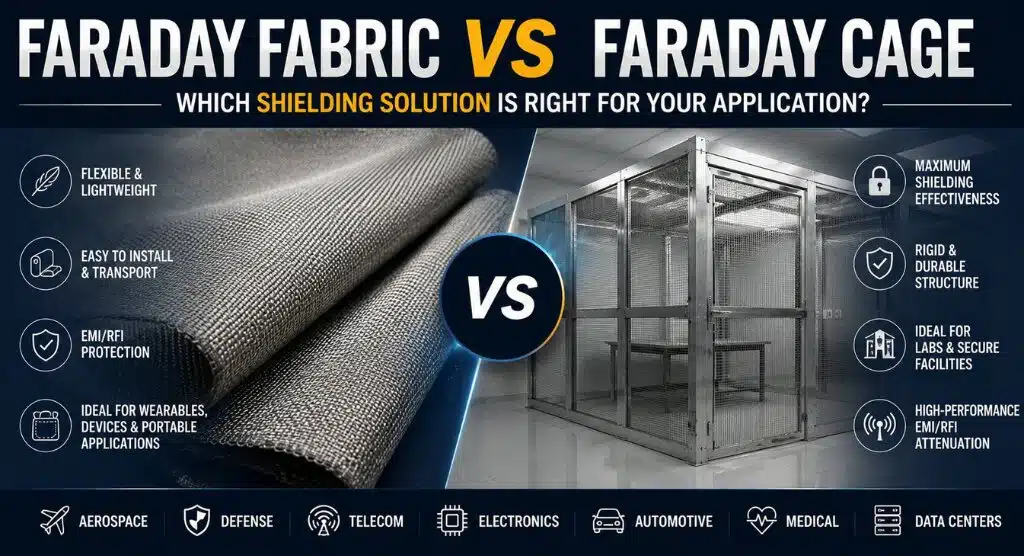
Faraday Fabric vs Faraday Cage – Major Differences
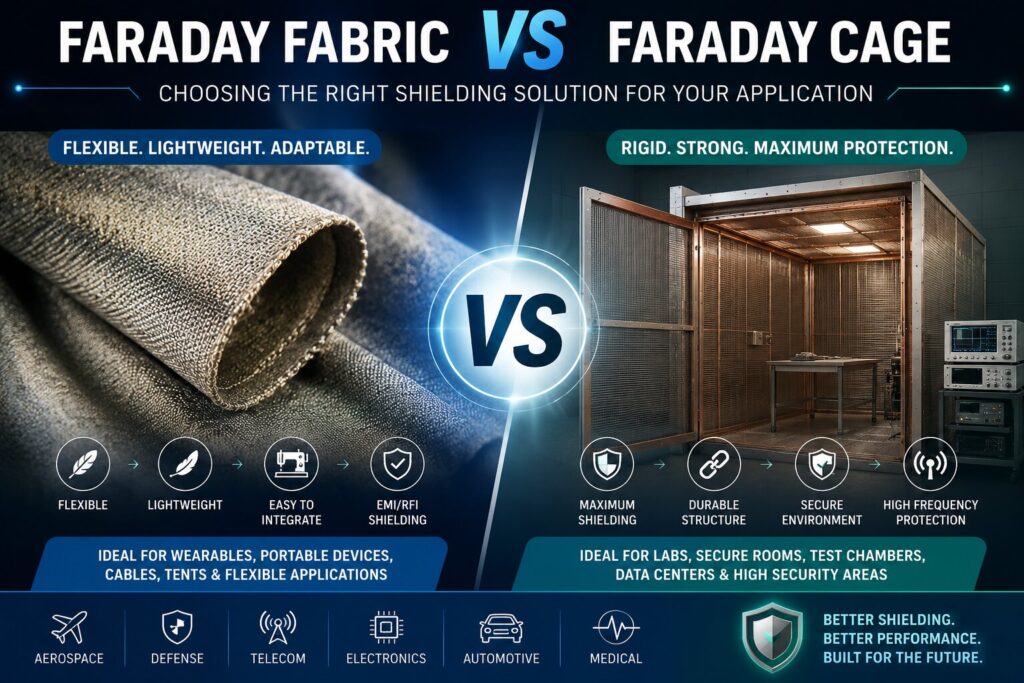
| Feature | Faraday Fabric | Faraday Cage |
| Flexibility | Highly flexible | Rigid structure |
| Weight | Lightweight | Heavy |
| Installation | Easy and portable | Permanent installation |
| Cost | Lower for portable applications | Higher infrastructure cost |
| Mobility | Excellent | Limited |
| Shielding Strength | Moderate to high | Extremely high |
| Scalability | Easy customization | Complex expansion |
| Maintenance | Easier replacement | Structural maintenance needed |
| Applications | Wearables, portable systems | Secure rooms, labs |
Chemical Composition of Faraday Fabric
The performance of shielding fabrics depends heavily on conductive coatings and metallic fibers.
Typical Chemical Composition
| Material | Composition |
| Silver-Coated Fabric | Silver + Polyester |
| Nickel Copper Fabric | Nickel + Copper + Polyester |
| Stainless Steel Fabric | Fe + Cr + Ni |
| Conductive Nylon | Nylon + Silver Plating |
DOMADIA™ Advanced Shielding Fabrics Include:
- Nickel-Copper conductive textiles
- Silver-plated EMI shielding fabrics
- Conductive mesh laminates
- RF attenuation composite fabrics
Properties of Faraday Fabric
1. Lightweight Construction
In the Faraday Fabric vs Faraday Cage comparison, Faraday fabrics are ideal for aerospace and wearable technologies where lightweight construction, flexibility, and high-performance EMI/RFI shielding are essential.
2. High Conductivity
Provides effective electromagnetic attenuation.
3. Corrosion Resistance
Nickel and silver coatings resist oxidation.
4. Flexibility
Can bend, fold, stitch, and wrap around irregular surfaces.
5. Portable Shielding
Perfect for temporary or mobile shielding applications.
6. Breathability
Important for protective garments and defense apparel.
Properties of Faraday Cage
1. Maximum Shielding Effectiveness
In the Faraday Fabric vs Faraday Cage comparison, Faraday cages remain excellent against high-intensity EMI/RFI environments requiring maximum shielding effectiveness and permanent electromagnetic isolation.
2. Structural Stability
Provides permanent secure environments.
3. Long-Term Durability
Designed for decades of operation.
4. High Frequency Isolation
Used in military and laboratory-grade environments.
5. Complete Enclosure Protection
Creates a continuous conductive barrier.
Technical Specifications
Faraday Fabric Technical Specifications
| Property | Typical Range |
| Shielding Effectiveness | 40–100 dB |
| Surface Resistivity | <0.05 Ω/sq |
| Frequency Range | MHz to GHz |
| Thickness | 0.05–1 mm |
| Operating Temperature | -40°C to 200°C |
Faraday Cage Technical Specifications
| Property | Typical Range |
| Shielding Effectiveness | 80–140 dB |
| Material Thickness | 0.5–5 mm |
| Structure Type | Mesh or Solid |
| Frequency Coverage | Broad Spectrum |
| Grounding Requirement | Essential |
Applications of Faraday Fabric
The rise of portable electronics and wearable defense systems has dramatically increased the demand for conductive fabrics.
Key Applications
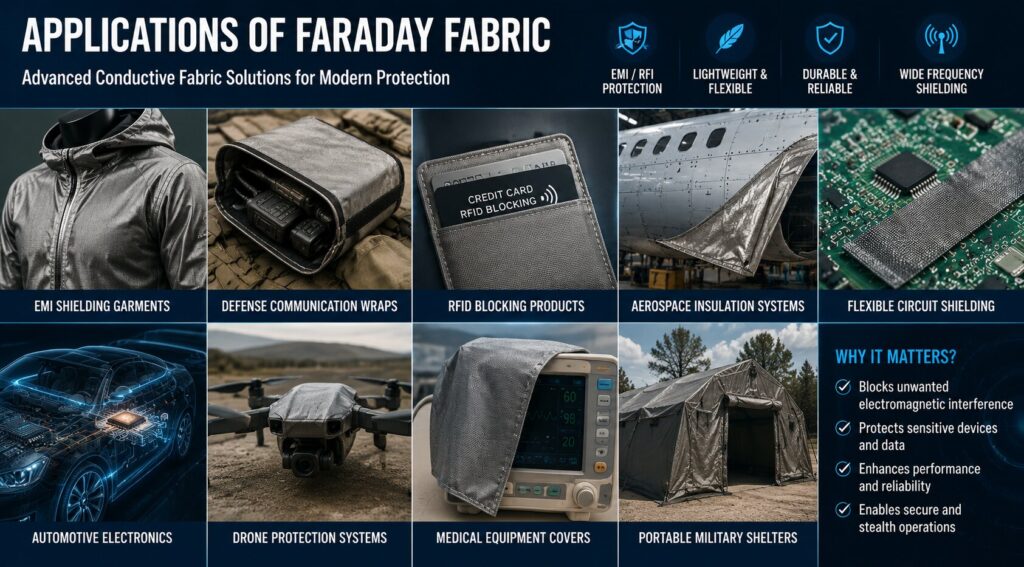
- EMI shielding garments
- Defense communication wraps
- RFID blocking products
- Aerospace insulation systems
- Flexible circuit shielding
- Automotive electronics
- Drone protection systems
- Medical equipment covers
- Portable military shelters
DOMADIA™ provides shielding fabrics suitable for both commercial and mission-critical environments.
Applications of Faraday Cage
In the Faraday Fabric vs Faraday Cage comparison, Faraday cages remain essential in industries requiring ultra-high shielding reliability, especially for defense laboratories, aerospace facilities, secure testing chambers, and high-sensitivity electronic environments.
Key Applications

- Anechoic chambers
- EMI testing labs
- Military command centers
- MRI rooms
- Secure communication facilities
- Satellite testing rooms
- Data center protection
- High-security research labs
Industry Standards for EMI Shielding
Faraday Fabric Standards
- ASTM D4935
- MIL-STD-285
- IEEE 299
- IEC 61000
- RoHS Compliance
Faraday Cage Standards
- NSA 94-106
- MIL-STD-188-125
- IEEE 299
- TEMPEST Standards
- CISPR Shielding Standards
DOMADIA™ materials are supplied with compliance-focused manufacturing suitable for demanding industrial environments.
Shapes Available in DOMADIA™ Faraday Shielding Materials
Faraday Fabric Forms
- Rolls
- Sheets
- Tapes
- Laminates
- Conductive curtains
- Custom stitched covers
- Flexible wraps
Faraday Cage Forms
- Mesh panels
- Shielding rooms
- Modular cabins
- Shielded enclosures
- Conductive partitions
- EMI shielding cabinets
The Mindset Shift Happening in Shielding Technology
For decades, industries believed stronger shielding always meant thicker metal structures. That thinking is rapidly changing. The debate around Faraday Fabric vs Faraday Cage has evolved as modern industries now prioritize lightweight systems, portable shielding, flexible integration, faster deployment, and lower infrastructure costs. In high-frequency environments where agility matters as much as protection, traditional rigid enclosures are no longer the only solution.
This is where conductive fabrics are reshaping EMI protection strategies globally. Instead of building an entire room, manufacturers now shield individual components, cables, garments, and devices directly using engineered conductive textiles. The shift from bulky metallic chambers to adaptive shielding materials has made the Faraday Fabric vs Faraday Cage comparison more relevant than ever for aerospace, defense, telecom, medical, and electronics industries.
Why DOMADIA™ for Faraday Shielding Solutions?
DOMADIA™ focuses on supplying high-performance EMI/RFI shielding materials engineered for reliability, flexibility, and long-term durability. From advanced conductive fabrics to precision shielding solutions, DOMADIA™ helps industries optimize protection while reducing weight, installation complexity, and operational costs. Whether the requirement involves portable shielding systems or industrial-grade enclosures, the Faraday Fabric vs Faraday Cage approach is carefully matched to the application for maximum efficiency.nce specialty materials for advanced industrial applications.
Why Industries Choose DOMADIA™
✔ Precision EMI/RFI Shielding Materials
Designed for critical shielding performance.
✔ Multiple Conductive Material Options
Nickel, copper, silver, stainless steel, and hybrid conductive textiles.
✔ Custom Shapes & Sizes
Tailored shielding formats for unique industrial needs.
✔ Industrial & Defense Supply Capability
Supporting aerospace, telecom, defense, and electronics industries.
✔ Technical Support
Material guidance based on shielding effectiveness requirements.
✔ Reliable Quality
Consistent conductivity, attenuation performance, and durability.
Conclusion
The debate around Faraday Fabric vs Faraday Cage is not about choosing one over the other universally. It’s about selecting the right shielding solution for the right environment. Industries today evaluate the Faraday Fabric vs Faraday Cage approach based on factors like mobility, installation complexity, shielding effectiveness, scalability, and operational flexibility.
If maximum permanent shielding is required for highly sensitive facilities, Faraday cages remain unmatched. Their rigid metallic enclosures provide exceptional EMI/RFI isolation for defense labs, aerospace facilities, testing chambers, and secure communication environments where even minor electromagnetic leakage can create serious risks.
But when industries demand flexibility, mobility, lightweight integration, and modern adaptability, Faraday fabrics offer a smarter and more scalable solution. As the conversation around Faraday Fabric vs Faraday Cage continues to evolve, conductive shielding fabrics are becoming increasingly important for wearable electronics, portable shielding systems, cable wrapping, smart devices, automotive electronics, and aerospace applications.
As electronic systems become smaller, faster, and more interconnected, advanced conductive fabrics are emerging as one of the most important materials in EMI shielding technology. DOMADIA™ continues to support industries with high-performance shielding materials engineered for evolving electromagnetic protection challenges across defense, telecom, medical, electronics, and industrial applications.
Upgrade Your EMI Shielding Strategy with DOMADIA™
From advanced Faraday Fabrics to industrial-grade Faraday Cage materials, DOMADIA™ supplies reliable shielding solutions engineered for aerospace, defense, telecom, electronics, and industrial applications. With the growing demand for adaptive EMI/RFI protection, the discussion around Faraday Fabric vs Faraday Cage continues to shape modern shielding strategies across high-performance industries.
Contact Us Today for Reliable EMI & RF Shielding Solutions.
Talk to: Er.Pankaj Domadia | Kairav Domadia | Aadil Domadia | Pragati Sanap | Pooja N N
#FaradayFabric #FaradayCage #EMIShielding #RFShielding #ConductiveFabric #SignalBlocking #DOMADIA #ElectromagneticShielding #IndustrialMaterials #DefenseTechnology #EMIProtection #ShieldingSolutions
Directly whatsapp us for an Enquiry: https://wa.link/kairav
We’ve supplied to Mumbai, Pune, Indore, Jaipur, and Surat—serving industries across Maharashtra, Madhya Pradesh, Rajasthan, Gujarat, and Goa, with exports to Germany, USA, Japan, South Korea, and Italy.