Blogs
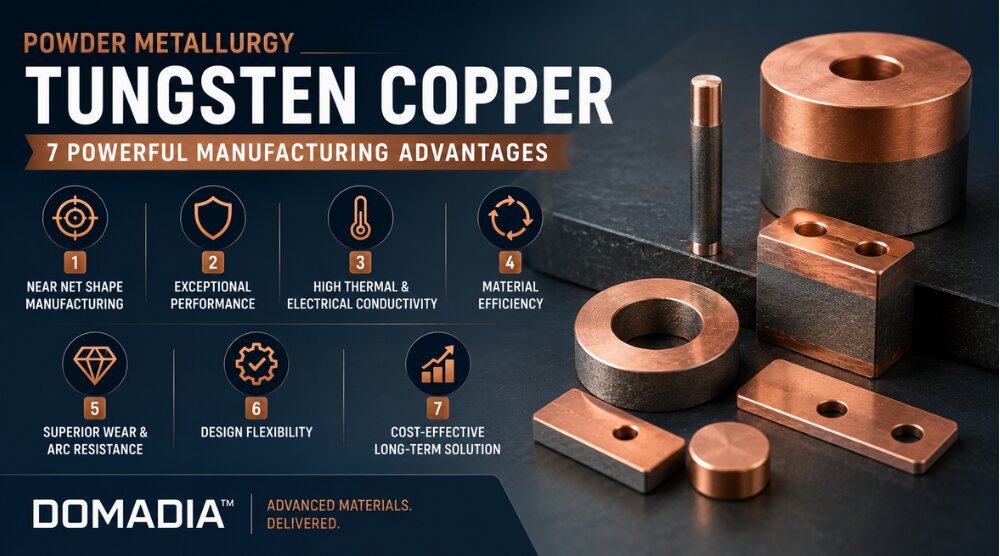
Powder Metallurgy Tungsten Copper: 7 Powerful Manufacturing Advantages
Powder Metallurgy Tungsten Copper – The Technology Behind High-Performance Components
A power distribution manufacturer was facing a recurring challenge. Traditional conductive materials were wearing out rapidly under high-current switching conditions, leading to costly maintenance and unexpected downtime. Engineers required a material that combined exceptional electrical conductivity with superior resistance to heat, wear, and arcing.
The solution came in the form of Tungsten Copper manufactured through powder metallurgy.
Unlike conventional casting methods, powder metallurgy enables precise control over composition, density, and microstructure, creating a unique material capable of delivering outstanding performance in some of the world’s most demanding applications.
At DOMADIA™, we supply high-quality Tungsten Copper materials engineered for electrical, thermal, aerospace, defense, semiconductor, and industrial applications where reliability is critical.
What is Tungsten Copper?
Tungsten Copper (WCu) is a composite material that combines:
- Tungsten (W) for strength, hardness, wear resistance, and high-temperature stability
- Copper (Cu) for excellent electrical and thermal conductivity
Since tungsten and copper have significantly different melting points and limited mutual solubility, conventional alloying methods are ineffective. This is why powder metallurgy is the preferred manufacturing process.
What is Powder Metallurgy?
Powder metallurgy is a manufacturing process where metal powders are compacted and sintered to create dense, high-performance components.
The process offers:
- Precise composition control
- Near-net-shape manufacturing
- Minimal material waste
- Uniform properties
- Excellent repeatability
For Tungsten Copper, powder metallurgy allows the creation of a composite structure that effectively combines the strengths of both metals.
Step-by-Step Powder Metallurgy Process of Tungsten Copper
1. Tungsten Powder Preparation
High-purity tungsten powder is carefully produced and controlled for:
- Particle size
- Shape
- Purity
- Distribution
These factors directly influence the final properties of the material.
2. Powder Compaction
The tungsten powder is compressed into a desired shape using high-pressure tooling.
This forms a “green compact” with sufficient strength for further processing.
3. Sintering
The compacted tungsten is heated in a controlled atmosphere furnace.
During sintering:
- Particles bond together
- Structural strength increases
- Controlled porosity remains
This porous structure is essential for the next manufacturing stage.
4. Copper Infiltration
Molten copper is introduced into the porous tungsten skeleton.
The copper fills the interconnected pores through capillary action, producing a dense Tungsten Copper composite.
5. Secondary Processing
After infiltration, components may undergo:
- Precision machining
- Grinding
- EDM processing
- Surface finishing
- Inspection and testing
The result is a highly engineered material with exceptional performance characteristics.
Chemical Composition
Typical Tungsten Copper grades include:
| Grade | Tungsten (%) | Copper (%) |
| W90Cu10 | 90 | 10 |
| W85Cu15 | 85 | 15 |
| W80Cu20 | 80 | 20 |
| W75Cu25 | 75 | 25 |
| W70Cu30 | 70 | 30 |
The exact ratio is selected based on conductivity, wear resistance, and thermal management requirements.
Key Properties of Tungsten Copper
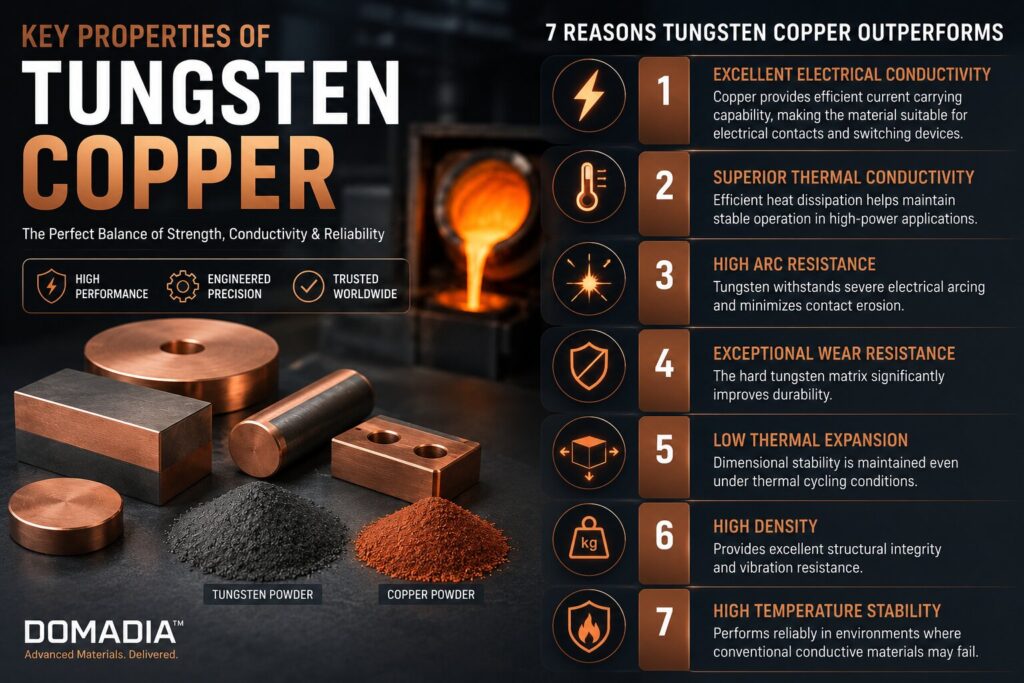
1. Excellent Electrical Conductivity
Copper provides efficient current carrying capability, making the material suitable for electrical contacts and switching devices.
2. Superior Thermal Conductivity
Efficient heat dissipation helps maintain stable operation in high-power applications.
3. High Arc Resistance
Powder Metallurgy Tungsten Copper withstands severe electrical arcing and minimizes contact erosion, making it ideal for high-current switching, EDM electrodes, and electrical contact applications.
4. Exceptional Wear Resistance
The hard tungsten matrix significantly improves durability.
5. Low Thermal Expansion
Dimensional stability is maintained even under thermal cycling conditions.
6. High Density
Powder Metallurgy Tungsten Copper provides excellent structural integrity and vibration resistance, ensuring reliable performance in demanding industrial and high-stress operating environments.
7. High Temperature Stability
Powder Metallurgy Tungsten Copper performs reliably in environments where conventional conductive materials may fail, delivering consistent electrical and thermal performance under extreme operating conditions.
Technical Specifications
| Property | Typical Range |
| Density | 11.5–17.5 g/cm³ |
| Electrical Conductivity | 30–60% IACS |
| Thermal Conductivity | 180–260 W/m·K |
| Hardness | 120–260 HB |
| Melting Behavior | Suitable for extreme temperatures |
| Thermal Expansion | Low to moderate |
| Arc Erosion Resistance | Excellent |
Actual values depend on the selected Tungsten Copper grade.
Available Shapes
DOMADIA™ supplies Tungsten Copper in multiple forms, including:
Rods
Suitable for electrical and EDM applications.
Plates
Widely used in heat sinks and electrical systems.
Blocks
Ideal for custom machining and industrial assemblies.
Sheets
Used in thermal management and shielding applications.
Discs
Suitable for specialized electrical contact systems.
Electrodes
Commonly used in resistance welding and EDM operations.
Custom Machined Components
Manufactured according to customer drawings and specifications.
Applications of Powder Metallurgy Tungsten Copper
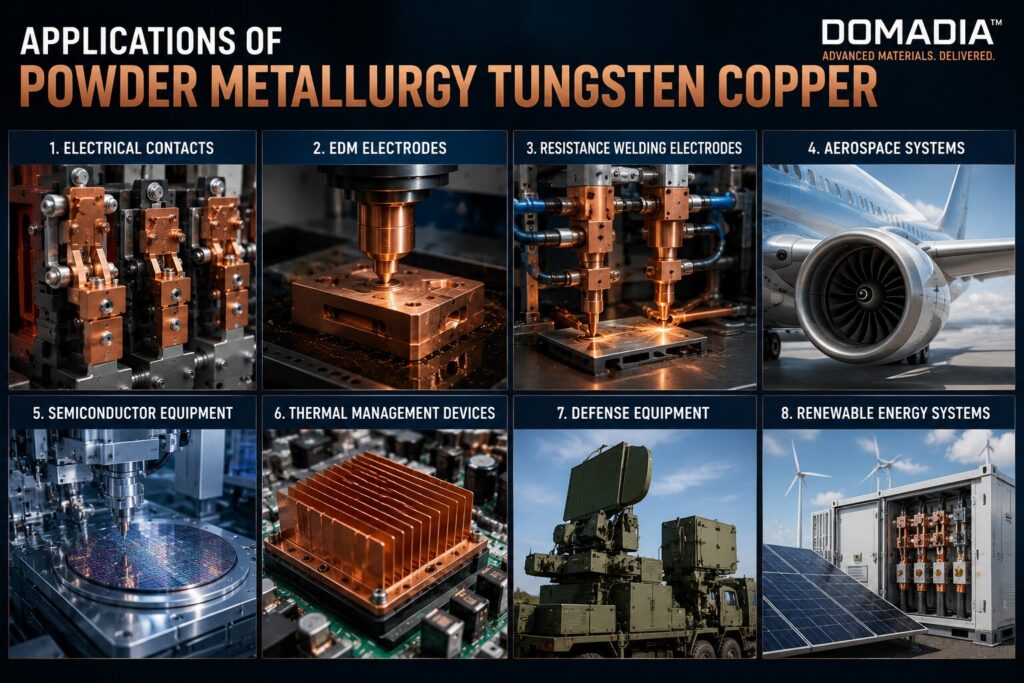
Electrical Contacts
Used in:
- Circuit breakers
- High-voltage switches
- Power distribution systems
EDM Electrodes
Powder Metallurgy Tungsten Copper provides excellent dimensional stability and wear resistance, ensuring precise performance and extended service life in demanding industrial applications.
Resistance Welding Electrodes
Powder Metallurgy Tungsten Copper maintains consistent performance under repeated thermal cycling, ensuring long-term reliability in applications exposed to frequent heating and cooling cycles.
Aerospace Systems
Powder Metallurgy Tungsten Copper is widely used in critical electrical and thermal management assemblies, delivering reliable performance in high-power and high-temperature applications.
Semiconductor Equipment
Powder Metallurgy Tungsten Copper supports efficient heat dissipation and precision operation, making it an ideal material for high-performance electrical, electronic, and thermal management systems.
Thermal Management Devices
Applied in:
- Heat sinks
- Power modules
- Electronic packaging
Defense Equipment
Powder Metallurgy Tungsten Copper is widely used where reliability under extreme conditions is essential, providing dependable performance in high-temperature, high-current, and mechanically demanding environments.
Renewable Energy Systems
Powder Metallurgy Tungsten Copper supports high-current electrical switching and power control, delivering exceptional arc resistance, conductivity, and long-term reliability in demanding electrical applications.
Relevant Standards
Depending on grade and application, Tungsten Copper materials may be manufactured to meet:
- ASTM standards
- ISO quality requirements
- Military specifications
- Aerospace industry requirements
- Customer-specific engineering standards
DOMADIA™ can provide material certifications and traceability documentation where required.
Why Powder Metallurgy is Preferred for Tungsten Copper
Precise Composition Control
Maintains consistent material performance.
Near-Net-Shape Manufacturing
Reduces machining costs and material waste.
High Density
Produces strong and reliable components.
Uniform Microstructure
Powder Metallurgy Tungsten Copper improves mechanical and electrical consistency, ensuring dependable performance, dimensional accuracy, and stable conductivity across demanding industrial applications.
Better Material Utilization
Supports efficient production with minimal scrap.
Scalability
Powder Metallurgy Tungsten Copper is suitable for both small and large production volumes, offering consistent quality, precision, and reliable performance across diverse manufacturing requirements.
Reliable Repeatability
Ensures consistent quality from batch to batch.
Why DOMADIA™?
DOMADIA™ supplies premium Tungsten Copper materials for demanding industrial applications.
Our advantages include:
- High-quality raw materials
- Precision manufacturing
- Multiple Tungsten Copper grades
- Custom machining capabilities
- Material certifications available
- Fast delivery support
- Technical assistance from experienced specialists
Whether the requirement is for EDM electrodes, electrical contacts, thermal management systems, or specialized engineering components, DOMADIA™ provides reliable solutions designed for long-term performance.
Conclusion
Powder Metallurgy Tungsten Copper remains one of the most effective manufacturing approaches for producing high-performance composite materials that combine the conductivity of copper with the strength and heat resistance of tungsten. Through precise control of composition, density, and microstructure, powder metallurgy delivers components capable of performing reliably in electrical, aerospace, semiconductor, defense, and industrial environments where failure is not an option.
Upgrade Your Engineering Performance with DOMADIA™
DOMADIA™ supplies Tungsten Copper, Beryllium Copper, MuMetal®, Conductive Fabrics, High-Temperature Cables, Precision Metal Foils, and specialized engineering materials for aerospace, defense, electronics, semiconductor, medical, and industrial sectors.
Contact our experts today for technical guidance and quotations.
Talk to: Er.Pankaj Domadia | Kairav Domadia | Aadil Domadia | Pragati Sanap | Pooja N N
#TungstenCopper #PowderMetallurgy #CopperTungsten #EDMElectrodes #ElectricalContacts #ThermalManagement #DOMADIA #RefractoryMetals #EngineeringMaterials #IndustrialApplications
Directly whatsapp us for an Enquiry: https://wa.link/kairav
We’ve supplied to Mumbai, Pune, Indore, Jaipur, and Surat—serving industries across Maharashtra, Madhya Pradesh, Rajasthan, Gujarat, and Goa, with exports to Germany, USA, Japan, South Korea, and Italy.