Blogs
Ultra Thin Foils Performance: 7 Powerful Advantages Revealed
A semiconductor manufacturer was facing a recurring challenge. Despite using high-quality conductive materials, thermal management and miniaturization requirements were becoming increasingly difficult to achieve. Engineers discovered that the limitation was not the equipment—it was the material thickness.
This is where Ultra Thin Foils Performance becomes a critical consideration.
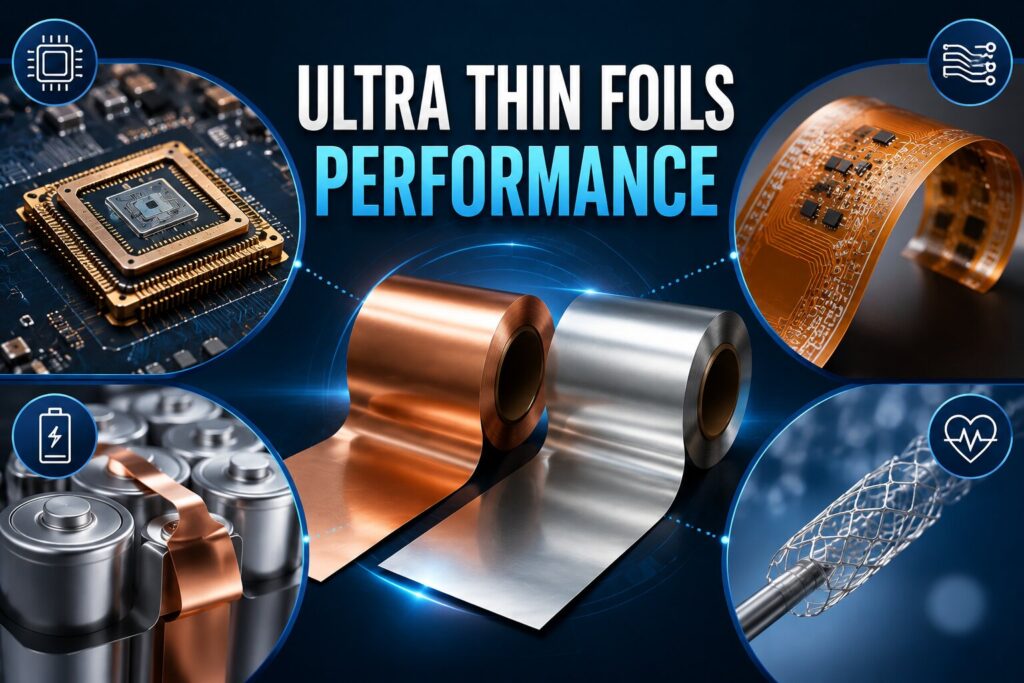
As industries move toward smaller, faster, and more efficient products, Ultra Thin Foils Performance plays a vital role in improving electrical conductivity, thermal management, weight reduction, manufacturing precision, and overall system reliability. Selecting the right foil thickness can significantly influence the efficiency and longevity of advanced electronic systems.
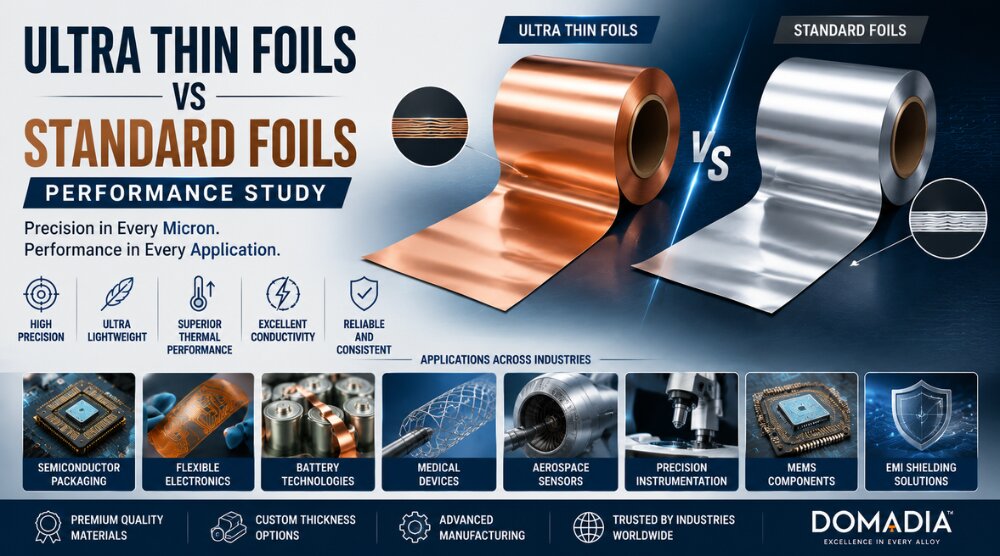
This Ultra Thin Foils Performance study explores the differences between ultra thin foils and standard foils, helping engineers choose the most suitable material for demanding applications while optimizing product performance and manufacturing efficiency.
Understanding Ultra Thin Foils and Standard Foils
Ultra Thin Foils
Ultra thin foils are precision-engineered metallic materials manufactured in extremely small thicknesses, often ranging from a few microns to several tens of microns.
These foils are commonly used in:
- Semiconductor manufacturing
- Flexible electronics
- Medical devices
- Aerospace systems
- Precision sensors
- Battery technologies
Standard Foils
Standard foils are comparatively thicker metallic sheets designed for general industrial applications.
Common applications include:
- Electrical grounding
- EMI shielding
- Industrial gaskets
- Heat exchangers
- Decorative applications
- Conventional electrical components
7 Powerful Performance Differences Between Ultra Thin Foils and Standard Foils
1. Superior Precision and Miniaturization
Ultra Thin Foils Performance enables manufacturers to develop highly compact, lightweight, and space-efficient products without sacrificing electrical or thermal efficiency. As electronic devices continue to shrink, Ultra Thin Foils Performance becomes essential for achieving greater design flexibility and superior functionality.
- Excellent for microelectronics
- Supports miniaturized components
- Enables higher circuit density
Standard Foils
Standard foils are better suited for larger assemblies where space constraints are less critical. Their greater thickness can limit flexibility and reduce suitability for highly compact electronic designs.
- Better suited for larger assemblies
- Limited flexibility in highly compact systems
Winner:Ultra Thin Foils
2. Enhanced Thermal Management
Efficient heat dissipation remains one of the biggest challenges in modern electronics. Ultra Thin Foils Performance improves thermal management by enabling faster heat dissipation while keeping components lightweight and compact. This makes Ultra Thin Foils Performance especially valuable for high-density electronic assemblies.
Ultra Thin Foils
- Faster thermal response
- Improved heat transfer
- Better thermal control in compact devices
Standard Foils
Standard foils provide effective heat transfer but may add unnecessary mass in advanced electronic assemblies.
Winner:Ultra Thin Foils
3. Greater Flexibility
Many modern applications require materials that can bend without losing performance. Ultra Thin Foils Performance provides exceptional flexibility while maintaining excellent electrical and mechanical properties, making it ideal for next-generation electronic products. Ultra Thin Foils Performance is especially valuable in compact and continuously flexing devices.
Ultra Thin Foils
- Excellent bendability
- Suitable for flexible circuits
- Ideal for wearable electronics
Standard Foils
Standard foils offer reduced flexibility and are generally better suited for rigid structures where repeated bending is not required.
Winner:Ultra Thin Foils
4. Weight Reduction Benefits
Weight reduction directly impacts efficiency in aerospace, automotive, and portable electronics.
Ultra thin foils help:
- Lower component weight
- Improve energy efficiency
- Reduce transportation costs
Standard foils generally increase total assembly weight.
Winner: Ultra Thin Foils
5. Electrical Performance
Both foil types can provide excellent conductivity depending on the material selected. Ultra Thin Foils Performance offers greater design flexibility, optimized signal transmission, and superior integration for compact electronic systems. As devices continue to shrink, Ultra Thin Foils Performance becomes increasingly important for achieving reliable electrical performance.
Ultra Thin Foils
- Greater design freedom
- Improved signal pathways
- High-performance electrical integration
Standard Foils
Standard foils remain highly effective for traditional power distribution systems where compactness and flexibility are less critical.
Winner:Application Dependent
6. Material Utilization Efficiency
Ultra thin foils maximize material usage by delivering high performance with significantly less metal. Ultra Thin Foils Performance helps manufacturers reduce material consumption, minimize production waste, and support sustainable manufacturing practices. This makes Ultra Thin Foils Performance an excellent choice for environmentally conscious, high-precision industries.
Benefits
- Reduced raw material consumption
- Lower manufacturing waste
- Better sustainability performance
Winner:Ultra Thin Foils
7. Advanced Manufacturing Compatibility
Modern manufacturing technologies increasingly demand precision materials.
Ultra thin foils support:
- Semiconductor fabrication
- Microelectronic packaging
- Flexible printed circuits
- Advanced battery production
Standard foils remain valuable in conventional industrial manufacturing.
Winner: Ultra Thin Foils
Chemical Composition
The composition depends on the selected alloy and application requirements.
Common foil materials include:
| Material | Primary Composition |
| Copper Foil | Cu ≥ 99.9% |
| Nickel Foil | Ni ≥ 99% |
| Stainless Steel Foil | Fe, Cr, Ni |
| Titanium Foil | Ti ≥ 99% |
| Aluminum Foil | Al ≥ 99% |
| Specialty Alloys | Custom compositions |
DOMADIA™ supplies various foil materials based on customer specifications and application requirements.
Key Properties Comparison
| Property | Ultra Thin Foils | Standard Foils |
| Thickness Precision | Excellent | Good |
| Flexibility | Excellent | Moderate |
| Weight | Very Low | Higher |
| Thermal Response | Faster | Moderate |
| Material Consumption | Lower | Higher |
| Miniaturization Capability | Excellent | Limited |
| Surface Uniformity | Superior | Good |
Technical Specifications
| Parameter | Ultra Thin Foils | Standard Foils |
| Thickness Range | 5–100 Microns | 100–1000+ Microns |
| Width Range | Custom | Custom |
| Surface Finish | Bright / Matte | Bright / Matte |
| Tolerance | Tight Precision | Standard Precision |
| Conductivity | Material Dependent | Material Dependent |
| Tensile Strength | Alloy Dependent | Alloy Dependent |
Applications
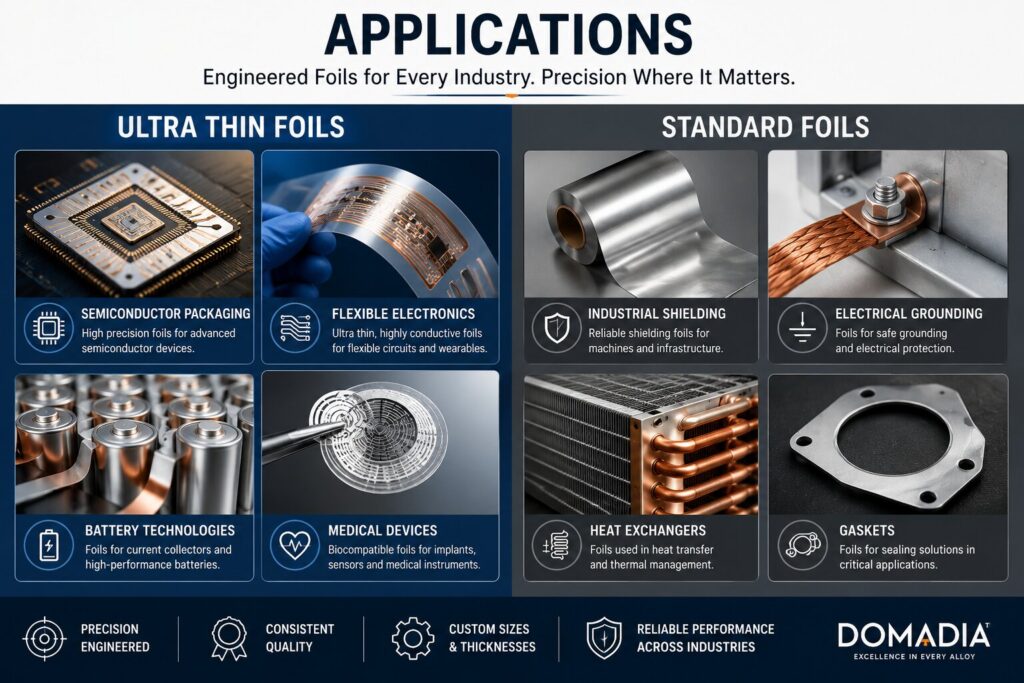
Ultra Thin Foils Applications
Semiconductor Packaging
Enables reliable chip interconnections with excellent electrical and thermal performance.
Flexible Electronics
Supports lightweight, bendable electronic devices without compromising conductivity.
Battery Technologies
Improves current collection and enhances energy storage efficiency in advanced batteries.
Medical Devices
Provides precision, biocompatibility, and reliability for critical medical components.
Aerospace Sensors
Delivers lightweight, high-precision materials for demanding aerospace sensing systems.
Precision Instrumentation
Ensures accurate performance in high-precision measuring and analytical equipment.
MEMS Components
Supports micro-scale fabrication with exceptional dimensional accuracy and consistency.
EMI Shielding Solutions
Reduces electromagnetic interference to protect sensitive electronic devices.
Standard Foils Applications
Industrial Shielding
Provides dependable protection against electrical and electromagnetic interference.
Electrical Grounding
Ultra Thin Foils Performance supports stable electrical grounding, improving equipment safety, signal integrity, and overall system performance in precision applications.
Heat Exchangers
Enhances thermal transfer efficiency in industrial heating and cooling systems.
Gaskets
Creates reliable sealing solutions for demanding industrial applications.
Industrial Equipment
Offers durability and consistent performance in heavy-duty manufacturing environments.
General Manufacturing
Used in a wide range of fabrication, forming, and industrial processing applications.
Standards
Depending on material selection, foils may comply with:
- ASTM Standards
- AMS Specifications
- DIN Standards
- JIS Standards
- ISO Standards
- Customer-Specific Requirements
DOMADIA™ can supply materials manufactured to international quality standards and customer specifications.
Shapes Available
DOMADIA™ supplies foils in multiple forms:
- Rolls
- Coils
- Sheets
- Precision Cut Strips
- Custom Blanks
- Laser-Cut Components
- Application-Specific Formats
Why DOMADIA™?
Choosing the right foil supplier is as important as selecting the right material.
DOMADIA™ offers:
Extensive Material Range
Multiple foil alloys and thickness options.
Precision Manufacturing Support
Solutions designed for demanding industrial applications.
Custom Thickness Availability
Ultra-thin and standard foil configurations.
Quality-Focused Supply
Materials sourced to meet stringent industry requirements.
Technical Assistance
Support for material selection and application requirements.
Global Supply Capability
Reliable sourcing and delivery across diverse industries.
Conclusion
When evaluating Ultra Thin Foils Performance, the results clearly show that ultra thin foils provide significant advantages in miniaturization, flexibility, thermal management, weight reduction, and advanced manufacturing compatibility. As industries continue to demand smaller, lighter, and more efficient components, Ultra Thin Foils Performance has become a key factor in achieving reliable and high-performance designs.
Standard foils continue to serve important industrial applications, but for next-generation technologies, Ultra Thin Foils Performance often delivers the competitive advantage needed to overcome evolving engineering challenges and optimize overall system efficiency.
By partnering with DOMADIA™, manufacturers gain access to precision foil solutions engineered to maximize Ultra Thin Foils Performance, supporting innovation, reliability, and long-term operational success.
Looking for precision-engineered Ultra Thin Foils for your next project?
Whether you need precision copper foils, nickel foils, stainless steel foils, or custom alloy foils, DOMADIA™ delivers reliable material solutions engineered for modern manufacturing challenges.
Contact DOMADIA™ today and discover the right foil solution for your industry.
Talk to: Er.Pankaj Domadia | Kairav Domadia | Aadil Domadia | Pragati Sanap | Pooja N N
#IoTDeviceShielding #EMIShielding #UNSN14080 #MuMetal #IoTDevices #ElectronicsDesign #ElectromagneticInterference #DOMADIA #IndustrialIoT #SmartDevices
Directly whatsapp us for an Enquiry: https://wa.link/kairav
Our materials have reached Nagpur, Aurangabad, Nashik, Kolhapur, and Solapur—strengthening Maharashtra, Goa, Karnataka, MP, and Gujarat industries, with exports to South Africa, Kenya, Egypt, Morocco, and Nigeria.