Blogs
Beryllium Copper Hammers: 9 Powerful UNS C17200 Benefits
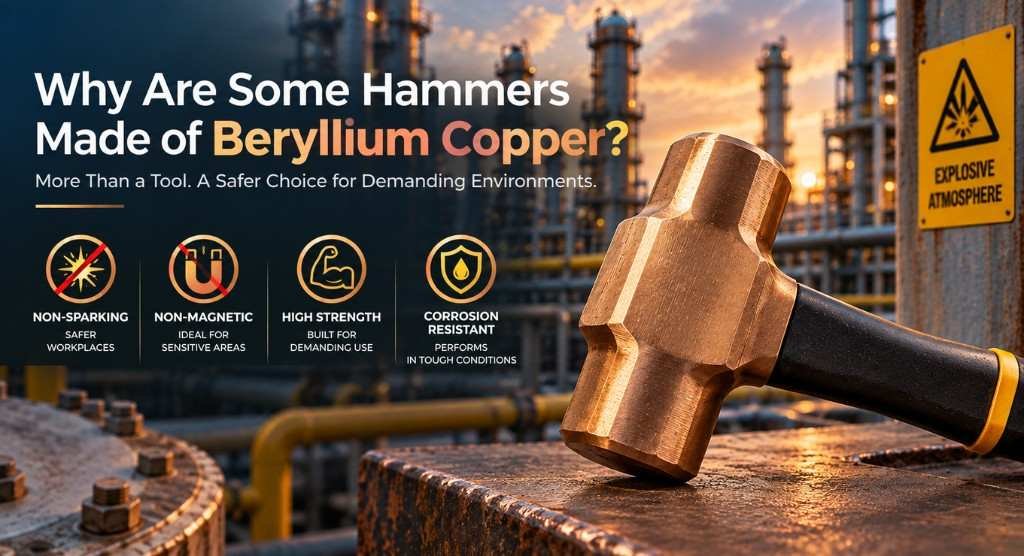
Why Are Some Hammers Made of Beryllium Copper?
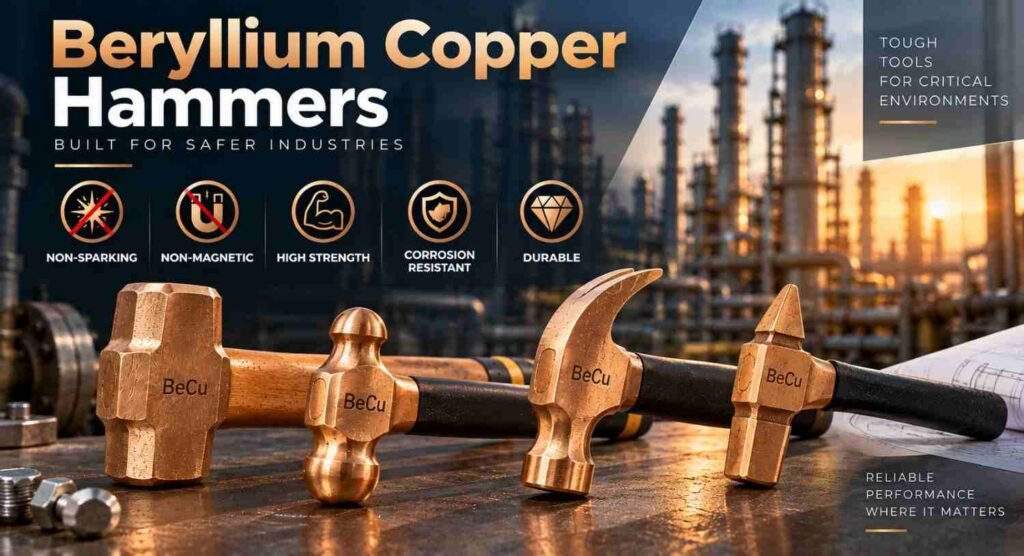
Beryllium Copper Hammers can look unusual beside an ordinary steel hammer. However, their value becomes much clearer when both tools are considered for use in a petrochemical plant, grain-processing facility, hazardous maintenance area, or magnetically sensitive environment. In these demanding settings, choosing a striking tool is not simply about hardness or price—it can also involve controlling ignition and magnetic risks.
Consider a maintenance technician who needs to loosen a stubborn component in an area where flammable vapours may be present. A conventional steel striking tool can be unsuitable because striking or scraping can create an ignition hazard. For applications requiring specially designed non-sparking tools, Beryllium Copper Hammers offer a very different combination of properties, including strength, corrosion resistance, non-magnetic behaviour, and suitability for specialized safety-tool applications.
Commercial safety-tool manufacturers offer copper-beryllium hammers specifically as non-sparking, non-magnetic, and corrosion-resistant striking tools. Such tools are marketed for petrochemical operations, explosive-dust environments, utilities, hazardous-material work, MRI/NMR environments, and other specialized applications where ordinary striking tools may not meet operational requirements.
This changes the question from “Why would anyone make a hammer from an expensive copper alloy?” to “What happens when controlling sparks or magnetic interference is more important than buying the cheapest hammer?” That is precisely where Beryllium Copper Hammers earn attention, because material selection becomes a question of application requirements, reliability, and safety rather than purchase price alone.
1. The Main Reason: Reduced Sparking Risk
The biggest reason for selecting copper-beryllium striking tools is their suitability for spark-sensitive environments.
Safety-tool manufacturers produce copper-beryllium and aluminum-bronze tools for hazardous areas where flammable gases, vapours, liquids, combustible dusts or residues may be present. Available tools include hammers, striking wrenches, wedges, sockets, screwdrivers and many other hand tools.
Think about facilities handling:
- petroleum products,
- natural gas,
- solvents,
- combustible powders,
- chemicals,
- fuels, or
- explosive materials.
In these environments, tool selection can become part of a much broader ignition-control strategy.
A hammer is no longer simply something that hits another object.
It becomes part of the safety engineering system.
Importantly, “non-sparking” should not be interpreted as an absolute guarantee that ignition is impossible. Tool selection must always follow the site’s hazard assessment, applicable regulations and approved safety procedures.
2. Why Not Just Make the Hammer From Ordinary Copper?
Pure copper has excellent electrical and thermal conductivity, but demanding striking tools need more than conductivity.
They require useful combinations of:
- strength,
- hardness,
- wear resistance,
- toughness,
- corrosion resistance,
- dimensional stability, and
- repeated-impact capability.
Adding a controlled amount of beryllium and applying appropriate heat treatment can transform copper into a remarkably high-strength copper alloy.
For reference, UNS C17200, commonly known as Alloy 25, is one of the best-known high-strength copper-beryllium grades.
Materion lists an elastic modulus of approximately 131 GPa, density of approximately 8.36 g/cm³, electrical conductivity around 25–30% IACS, and thermal conductivity around 105 W/m·K for precipitation-hardened C17200 rod and bar.
This helps explain the broader engineering appeal of high-strength copper beryllium.
However, an important distinction should be made:
A finished copper-beryllium hammer should not automatically be assumed to be manufactured from UNS C17200 unless the manufacturer’s material certification specifically identifies that grade.
Commercial CuBe safety-tool alloys may use compositions comparable to high-strength copper-beryllium families. For example, one safety-tool manufacturer identifies its CuBe2 tool alloy as approximately 1.9% Be, 0.4% combined Co + Ni, up to 0.5% other constituents and copper as the balance.
DOMADIA™ recommends confirming the required grade, certification and finished-tool specification for the actual application.
3. Chemical Composition of UNS C17200 Beryllium Copper
UNS C17200 belongs to the high-strength copper-beryllium alloy family.
A typical nominal composition is approximately:
| Element | Typical Range / Content |
| Copper (Cu) | Balance |
| Beryllium (Be) | Approximately 1.8–2.0% |
| Cobalt + Nickel | Controlled addition |
| Other elements | Restricted according to specification |
The exact permitted chemistry depends on the governing material specification and product form.
The relatively small beryllium addition produces a disproportionately large change in the mechanical performance that can be obtained after appropriate processing and age hardening.
That is what makes the material interesting.
It remains fundamentally a copper-based alloy, yet can provide mechanical characteristics far beyond ordinary pure copper.
4. 9 Powerful Reasons Beryllium Copper Is Used for Hammers
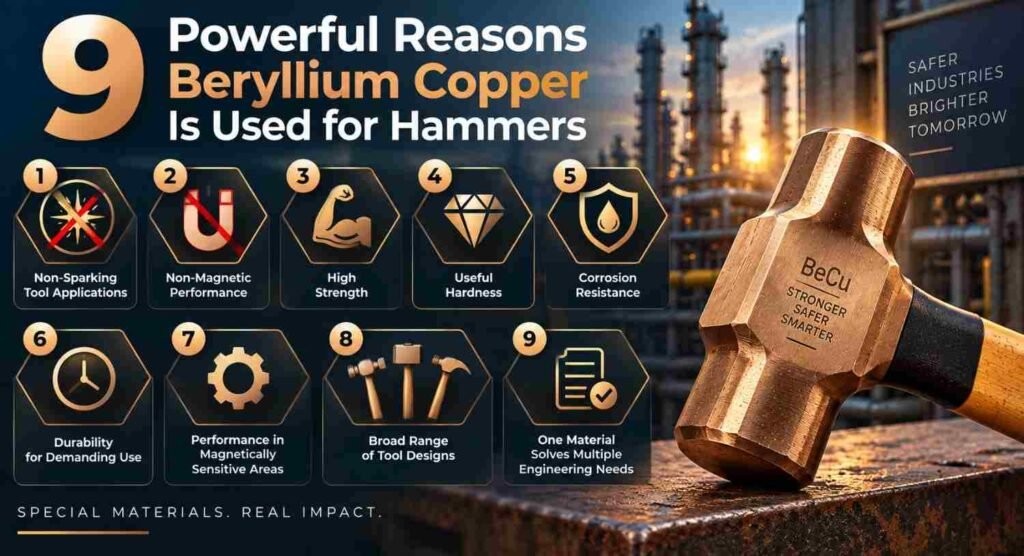
1. Non-Sparking Tool Applications
This is the most important reason.
Beryllium Copper Hammers are manufactured for operations where minimizing mechanically generated ignition sources is essential.
Certified non-sparking safety-tool ranges are specifically offered for hazardous environments and explosive atmospheres where appropriate tool selection can be an important part of workplace safety.
2. Non-Magnetic Performance
There is another industrial problem that has nothing to do with flames.
Magnetism.
A conventional ferrous tool may be inappropriate around powerful magnets or magnetically sensitive equipment. Beryllium Copper Hammers can be particularly useful in applications where non-magnetic characteristics are required.
Copper-beryllium tools are available for work associated with MRI/NMR equipment, electronic manufacturing, and other magnetically sensitive systems. This can make them valuable where both spark control and magnetic compatibility matter.
3. High Strength
A safety hammer still has to function as a hammer.
High-strength copper-beryllium alloys can achieve mechanical properties considerably greater than pure copper. This gives Beryllium Copper Hammers the mechanical strength needed to perform effectively in demanding industrial environments.
That allows designers to combine valuable copper-alloy characteristics with the strength required for specialized components and striking tools.
4. Useful Hardness
Copper beryllium is selected not simply because it contains copper, but because it can be hardened substantially. This enhanced hardness is one reason Beryllium Copper Hammers can be suitable for demanding industrial and safety-tool applications.
One commercial safety-tool manufacturer lists approximately 38 HRC for its CuBe2 alloy, compared with approximately 27 HRC for its aluminum-bronze alternative. The manufacturer consequently characterizes CuBe as the more durable option because of its hardness and tensile strength.
Exact hardness depends on the alloy, processing condition, heat treatment, and finished-tool specification.
5. Corrosion Resistance
Industrial tools don’t always enjoy comfortable lives.
They may encounter:
- marine atmospheres,
- chemical-processing areas,
- humid environments,
- desalination facilities,
- industrial washdown,
- shipyards, and
- aggressive process conditions.
Commercial copper-beryllium safety hammers are therefore also promoted for their corrosion-resistant characteristics.
6. Durability
Non-sparking performance would offer little value if the hammer quickly became unusable.
Copper beryllium’s combination of hardness and strength allows appropriately manufactured Beryllium Copper Hammers to withstand demanding industrial service while maintaining their functional performance.
That durability is particularly valuable for organizations where the tool forms part of a professional maintenance system rather than an occasional household toolbox.
7. Performance in Magnetically Sensitive Areas
A loose ferromagnetic tool near powerful magnetic equipment can create problems beyond ordinary tool handling.
That makes non-magnetic tooling important in selected:
- MRI/NMR environments,
- electronics facilities,
- laboratories,
- nuclear-related operations,
- specialized defense applications, and
- sensitive instrumentation environments.
Commercial CuBe safety tools are specifically offered for several such applications.
8. Broad Range of Tool Designs
Copper beryllium isn’t limited to one strange-looking safety hammer.
Commercial safety-tool ranges include numerous striking-tool configurations, allowing Beryllium Copper Hammers and related striking tools to be selected for different maintenance, repair, and industrial operations.
This versatility allows organizations to choose a tool configuration suited to the specific task while retaining the specialized properties associated with copper-beryllium safety tools.
9. One Material Can Address Several Engineering Problems
This may be the most interesting advantage.
The requirement may begin with:
“We need a non-sparking hammer.”
But the environment may simultaneously demand:
- low magnetic interaction,
- corrosion resistance,
- mechanical strength,
- hardness, and
- long service life.
Instead of solving each problem independently, a properly specified copper-beryllium safety tool can address several requirements at once.
Properties of Beryllium Copper Hammers
Beryllium Copper Hammers derive their value from a distinctive combination of engineering characteristics.
| Property | Engineering Importance |
| Non-sparking classification | Useful in properly assessed spark-sensitive environments |
| Non-magnetic behaviour | Valuable near magnetic equipment |
| High strength | Supports demanding mechanical use |
| High hardness | Helps resist deformation and wear |
| Corrosion resistance | Useful in aggressive industrial environments |
| Copper-alloy base | Provides characteristic copper-alloy physical properties |
| Durability | Supports repeated professional use |
| Heat-treatable alloy system | Enables substantial mechanical-property development |
For UNS C17200 specifically, published precipitation-hardened material data include approximately 131 GPa elastic modulus, 8.36 g/cm³ density, 25–30% IACS electrical conductivity and 105 W/m·K thermal conductivity.
These values describe the alloy material and should not automatically be treated as a certification for every finished hammer.
Technical Specifications to Consider
When specifying a copper-beryllium hammer, simply writing “BeCu hammer” on a purchase order may not provide enough information.
Engineers and purchasing teams should consider:
Alloy / Material Specification
Confirm the exact copper-beryllium grade or manufacturer’s certified tool alloy.
Hammer Type
Determine whether the operation requires a ball peen, cross peen, sledge, machinist’s, scaling or another configuration.
Head Weight
Head weight should match the intended striking operation.
Commercial CuBe ball-peen hammers, for example, are available across several head weights, while copper-beryllium sledge hammers can extend to substantially heavier configurations.
Handle Length
Handle dimensions influence leverage, striking force, reach and user control.
Hardness
Confirm the hardness requirements for Beryllium Copper Hammers directly with the tool manufacturer rather than assuming a value based on generic alloy data.
Non-Sparking Certification
For hazardous-area work, verify that the finished tool—not merely the raw alloy—is appropriately tested or certified for the intended environment.
Magnetic Requirements
Where magnetic compatibility is critical, obtain the required documentation for the finished Beryllium Copper Hammers rather than relying solely on the general non-magnetic characteristics of the alloy.
Corrosion Environment
Identify chemicals, saltwater, humidity and process conditions before selecting the tool.
Standards and Compliance
Safety-critical tooling deserves more attention than simply selecting a material name.
Commercial non-sparking tool systems may be supplied with certification relevant to explosive-atmosphere applications. For example, CS Unitec states that its copper-beryllium and aluminum-bronze safety tools are TÜV-certified and describes their suitability for explosive environments covered by ATEX workplace requirements.
Depending on geography and application, relevant considerations can include:
- ATEX requirements,
- workplace hazardous-area procedures,
- TÜV material/tool certification,
- ISO-based manufacturing quality systems,
- customer-specific specifications,
- defense or military requirements,
- material specifications applicable to copper-beryllium product forms, and
- local occupational health and safety regulations.
The applicable standard must be determined from the actual operating environment and finished tool, not merely from the alloy designation.
Shapes and Types of Beryllium Copper Hammers Available
Copper-beryllium striking tools can be manufactured in numerous configurations.
Common commercial types include:
Ball Peen Hammer
Useful for mechanical maintenance, forming and general industrial work.
Cross Peen Engineer’s Hammer
Provides a narrow peen for controlled striking and shaping.
Double-Face Machinist’s Hammer
Designed for general workshop and industrial striking operations.
Sledge Hammer
Used where considerably greater impact energy is required.
Scaling Hammer
Used for specialized scaling, weld-cleaning and surface-maintenance work.
Club Hammer
Compact heavy-duty striking tool.
Cutoff Hammer
Designed for specific industrial cutting or striking operations.
Bricklayer’s Hammer
Specialized geometry for masonry-related work where the operating environment requires appropriate safety tooling.
Commercial non-sparking tool ranges confirm availability of many of these configurations in both copper beryllium and aluminum bronze.
Where Are Beryllium Copper Hammers Used?
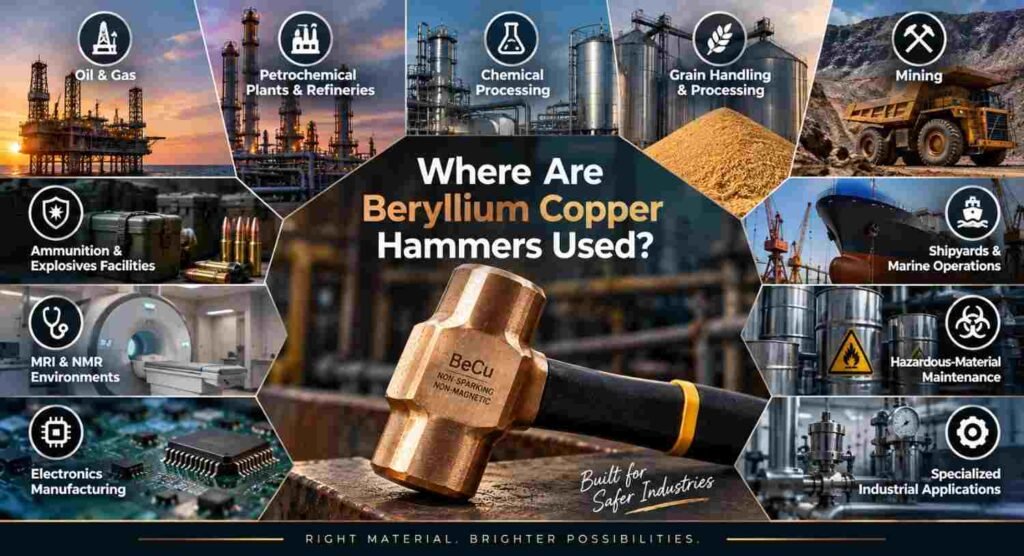
Oil & Gas
Oil and gas facilities can contain flammable gases and vapours, making ignition-source management critical.
Beryllium Copper Hammers and other specialized non-sparking hand tools are therefore used in appropriately designated operations where reducing the risk of mechanically generated ignition sources is important.
Petrochemical Plants and Refineries
Maintenance around hydrocarbons, solvents, and processing equipment may require certified safety tools. Beryllium Copper Hammers can be used in appropriately designated maintenance operations where non-sparking performance, strength, and reliability are important considerations.
Chemical Processing
Chemical environments can combine flammability risks with corrosion concerns. Beryllium Copper Hammers can be suitable for appropriately designated maintenance operations where non-sparking characteristics, corrosion resistance, and dependable mechanical performance are important.
Grain Handling and Processing
One easily overlooked hazard is combustible dust.
Grain and other fine organic materials can produce hazardous dust atmospheres under certain conditions. Beryllium Copper Hammers are specifically marketed for grain-production and explosive-dust applications where appropriately selected non-sparking tools can help manage mechanically generated ignition risks.
Mining
Mining operations can include hazardous gases, combustible materials, and specialized explosive-atmosphere classifications. Beryllium Copper Hammers can be used in appropriately designated mining operations where non-sparking characteristics and dependable mechanical performance are important for safer maintenance work.
Ammunition and Explosives Facilities
Spark control can become particularly important around energetic materials. Beryllium Copper Hammers can be used in appropriately designated operations where reducing mechanically generated ignition risks is a critical safety consideration.
MRI and NMR Environments
Here, the important characteristic may be non-magnetic performance rather than flammable-vapour protection. Beryllium Copper Hammers can be valuable around magnetically sensitive equipment where conventional ferrous striking tools may interfere with the surrounding magnetic environment.
Electronics Manufacturing
Sensitive equipment may benefit from specialized non-magnetic tooling. Beryllium Copper Hammers can be particularly useful in such environments, helping technicians perform necessary maintenance while minimizing unwanted magnetic interaction with sensitive systems.
Shipyards and Marine Operations
Corrosion resistance can add another useful advantage in marine environments. Beryllium Copper Hammers can be valuable for specialized marine and offshore maintenance applications where non-sparking performance, corrosion resistance, and dependable mechanical properties may all be important.
Hazardous-Material Maintenance
Hazmat operations can involve unpredictable combinations of chemicals, vapours, and ignition risks, requiring tools selected through an appropriate risk assessment. Beryllium Copper Hammers can be considered for appropriately designated operations where non-sparking characteristics, corrosion resistance, and reliable mechanical performance are important.
Beryllium Copper vs Steel Hammer
| Feature | Beryllium Copper Safety Hammer | Conventional Steel Hammer |
| Spark-sensitive applications | Specifically available as non-sparking safety tooling | Generally unsuitable where certified non-sparking tooling is required |
| Magnetic behaviour | Non-ferrous / available for non-magnetic applications | Usually ferromagnetic |
| Strength | High for a copper alloy | Typically high |
| Hardness | Can be relatively high | Typically high |
| Corrosion resistance | Generally good | Depends heavily on steel/coating |
| Initial cost | Higher | Lower |
| Hazardous-area specialization | Major advantage | Limited |
| Magnetic-sensitive environments | Major advantage | Often unsuitable |
The important point isn’t that copper beryllium is a universally “better hammer material.”
It isn’t.
For ordinary construction work, steel may remain the practical choice.
The value of copper beryllium appears when special operating conditions change the selection criteria.
Beryllium Copper vs Aluminum Bronze Hammers
Copper beryllium and aluminum bronze are both widely used in non-sparking safety-tool families.
But they aren’t identical.
A commercial safety-tool comparison lists CuBe2 at approximately 38 HRC versus approximately 27 HRC for its aluminum-bronze alloy and describes the CuBe tool alloy as more durable because of its higher hardness and tensile strength.
Copper beryllium can therefore be attractive when higher hardness, durability and demanding non-magnetic performance justify the additional cost.
And additional cost can be significant.
A published 2022 safety-tool price list, for example, showed several copper-beryllium hammer variants priced materially above corresponding aluminum-bronze versions.
But purchase price should not be evaluated alone.
In safety-critical industrial operations, engineers should consider:
Tool Cost + Service Life + Replacement Frequency + Downtime + Application Risk
A cheaper tool is not necessarily the lower-cost solution when downtime, premature replacement or failure to meet application requirements enters the calculation.
A Note About Beryllium Safety
The word beryllium naturally raises an important occupational-health question. When working with Beryllium Copper Hammers, the key issue is controlling exposure according to applicable occupational-safety requirements, particularly during operations that could generate respirable airborne particulate.
A finished tool should therefore be used and maintained according to the manufacturer’s instructions. Activities that may grind, sand, machine, weld, or otherwise create dust or fumes from beryllium-containing material require appropriate professional hazard assessment, exposure controls, and regulatory compliance.
For this reason, Beryllium Copper Hammers should never be casually ground, reshaped, machined, welded, or otherwise modified simply because they appear to be another piece of metal. Proper handling and maintenance are essential for preserving both tool performance and workplace safety.
Why Not Use a Beryllium Copper Hammer Everywhere?
Because engineering is about selecting the right material for the right environment. Beryllium Copper Hammers are specialized tools designed for applications where ordinary striking tools may not provide the required combination of characteristics.
For an ordinary workshop where there is no hazardous atmosphere, magnetic restriction, or specialized corrosion concern, a conventional hammer may be entirely appropriate and considerably less expensive. The case for copper beryllium becomes stronger when the operating environment requires several characteristics simultaneously.
For example, Beryllium Copper Hammers can bring together spark control + non-magnetic behaviour + strength + hardness + corrosion resistance in a single specialized striking tool. That is when the material’s premium becomes much easier to justify—not because it is needed everywhere, but because certain environments demand more from a hammer than simply striking effectively.
Why DOMADIA™?
DOMADIA™ works with specialized metals and engineering materials for applications where material selection matters.
When customers are evaluating UNS C17200 beryllium copper or related copper-beryllium material requirements, DOMADIA™ can support discussions around:
- required alloy grade,
- chemical composition,
- mechanical-property requirements,
- dimensions,
- product form,
- technical documentation,
- application conditions, and
- industrial sourcing requirements.
DOMADIA™ understands that a special alloy should not be selected simply because it sounds advanced.
It should solve a specific engineering problem.
For copper-beryllium applications, that means understanding whether the priority is mechanical strength, conductivity, corrosion resistance, non-magnetic behaviour, specialized tooling requirements or a combination of several properties.
For finished safety hammers, buyers should additionally confirm the manufacturer’s tool certification and suitability for the relevant hazardous area.
Choosing the Right Hammer: Ask These Questions First
Before purchasing a specialized safety hammer, determine:
- Is there a potentially explosive atmosphere?
- Are flammable gases, vapours or combustible dusts present?
- Is non-magnetic performance required?
- What impact force and head weight are needed?
- What material will the hammer strike?
- Is corrosion resistance important?
- Which hazardous-area classification applies?
- What certification must the finished tool carry?
- Does the site safety procedure approve copper-beryllium tooling?
These questions are far more useful than asking only:
“How much does the hammer cost?”
Conclusion
Beryllium Copper Hammers exist because some industrial environments turn a simple striking tool into a serious engineering decision. Copper beryllium offers a valuable combination of non-sparking tool capability, non-magnetic behaviour, high strength, useful hardness, corrosion resistance, and durability, making these specialized tools relevant where conventional striking tools may not meet operational requirements.
That combination explains why Beryllium Copper Hammers are used in applications ranging from petrochemical and explosive-dust environments to MRI/NMR facilities and sensitive industrial equipment. UNS C17200 also demonstrates why the copper-beryllium family is technically remarkable: a copper-based material can provide high strength while retaining useful conductivity and other characteristic copper-alloy properties.
The lesson is simple: The most expensive hammer isn’t automatically the best hammer—but in the wrong environment, choosing a hammer only because it is cheaper can be a very expensive decision. For specialized Beryllium Copper Hammers, copper-beryllium materials, and technical sourcing requirements, DOMADIA™ can help customers evaluate the appropriate grade, form, and specification for demanding industrial applications.
Need Reliable Beryllium Copper for Demanding Applications?
Looking for UNS C17200 Beryllium Copper for specialized industrial, non-sparking, non-magnetic, or high-strength applications? DOMADIA™ supplies quality special metals with technical support to help you select the right grade, form, and specification.
Contact DOMADIA™ todayto discuss your Beryllium Copper requirements and get the right material for your application.
Talk to: Er.Pankaj Domadia | Kairav Domadia | Aadil Domadia | Pragati Sanap | Pooja N N
#BerylliumCopper #BerylliumCopperHammers #UNSC17200 #CopperBeryllium #NonSparkingTools #NonMagneticTools #SafetyTools #IndustrialSafety #SpecialMetals #EngineeringMaterials #HazardousAreas #IndustrialMaintenance #DOMADIA
Directly whatsapp us for an Enquiry: https://wa.link/kairav
Our deliveries span Rohtak, Jhajjar, Bahadurgarh, Sampla, and Kosli across Haryana, Delhi, UP, Rajasthan, and Punjab, exporting to USA, Canada, Mexico, Cuba, and Dominican Republic.