Blogs
Long Distance Wire: Which High Temperature Type Is Best? 9 Powerful Factors | UNS C11000
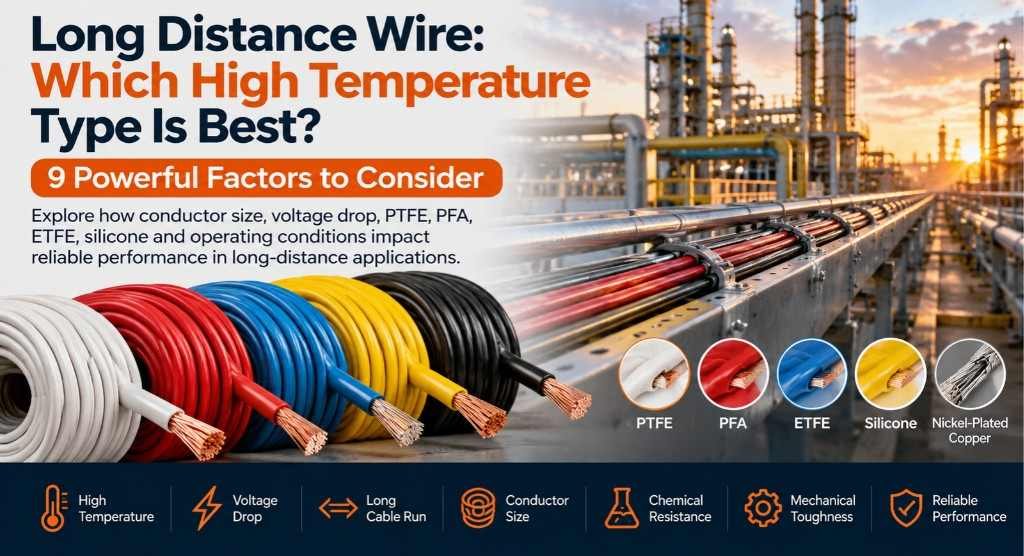
Long Distance Wire selection becomes more challenging when electrical power or signals must travel through environments exposed to continuous heat, chemicals, vibration, or demanding industrial conditions. A 200°C or 250°C temperature rating alone does not guarantee that a wire is suitable for a 50-metre, 100-metre, or longer run.
Consider an industrial heating system where the control panel is far from the equipment. The insulation may survive the heat perfectly, yet the equipment receives less voltage than expected because Long Distance Wire performance is also influenced by conductor resistance, voltage drop, current, and conductor cross-sectional area.

Selecting the right Long Distance Wire therefore requires engineers to evaluate temperature, conductor size, circuit length, voltage, current, insulation, installation conditions, and allowable voltage drop together. The best Long Distance Wire is not simply the one with the highest temperature rating—it is the one suited to the complete electrical and thermal environment.
Why Long Distance Wire Requires More Than a Temperature Rating
When a conductor becomes longer, its total electrical resistance increases.
A simplified DC relationship is:
R = ρL / A
Where:
- R = conductor resistance
- ρ = electrical resistivity
- L = conductor length
- A = conductor cross-sectional area
This tells us something extremely important.
Increase the distance while keeping the conductor material and size unchanged, and resistance increases.
Voltage drop can then be approximated by:
V = I × R
where I represents current.
This is why engineers should not select a high-temperature cable based on insulation alone.
The wire must survive the temperature and deliver the required electrical performance at the destination.
1. Copper Conductors: A Strong Starting Point
For many long-distance electrical applications, copper remains a practical conductor because of its high electrical conductivity.
A useful reference material is:
UNS C11000 – Electrolytic Tough Pitch Copper
Typical nominal composition includes:
| Element | Typical Requirement |
| Copper + Silver | 99.90% minimum |
| UNS Number | C11000 |
| Material Family | Electrolytic Tough Pitch Copper |
UNS C11000 provides high electrical conductivity and is widely used in electrical applications.
However, an important distinction must be made.
A finished high-temperature wire does not necessarily use bare UNS C11000.
Depending on temperature and environmental requirements, conductor constructions can include:
- Bare copper
- Tinned copper
- Silver-plated copper
- Nickel-plated copper
- Nickel conductors
- Nickel-alloy conductors
Therefore, the complete cable specification should always be evaluated.
2. Conductor Size Can Determine Long-Distance Performance
Here is where long-distance wiring differs significantly from short equipment connections.
Suppose two cables use exactly the same insulation and conductor material.
One is 5 metres long.
The other is 100 metres long.
Their electrical behaviour will not necessarily be the same.
The longer conductor introduces greater resistance.
For higher-current circuits, this can create:
- Increased voltage drop
- Greater power loss
- Additional conductor heating
- Reduced voltage available at the load
- Potential equipment-performance problems
Increasing conductor cross-sectional area reduces resistance for a given conductor material and length.
Therefore, sometimes the solution to a long-distance problem is not changing from PTFE to PFA or silicone.
It is selecting the correct conductor size.
3. PTFE-Insulated Wire for Heat and Chemical Exposure
PTFE is one of the most familiar fluoropolymer insulation materials used in demanding electrical applications.
It offers a valuable combination of thermal, electrical, and chemical characteristics.
Important PTFE Properties
Depending on the particular wire construction, PTFE can provide:
- High-temperature capability
- Strong dielectric performance
- Excellent chemical resistance
- Low moisture absorption
- Resistance to many oils and fluids
- Relatively thin insulation constructions
These properties can make PTFE-insulated copper wire suitable for demanding industrial cable routes.
Applications
PTFE wire may be considered for suitable:
- Industrial machinery
- Aerospace equipment
- Chemical-processing systems
- Instrumentation
- Heating equipment
- Sensors
- Control systems
But PTFE insulation does not reduce conductor resistance.
A 100-metre PTFE-insulated wire still needs an appropriately sized conductor.
4. PFA-Insulated Wire for More Severe Conditions
PFA is another fluoropolymer option used for demanding electrical insulation.
It can be particularly valuable where the cable must tolerate elevated temperatures while maintaining chemical and electrical performance.
Potential applications include:
- Semiconductor equipment
- Chemical processing
- Industrial ovens
- Laboratory equipment
- High-temperature sensors
- Process instrumentation
- Specialized industrial machinery
For Long Distance Wire, PFA may provide an excellent insulation system where its properties match the operating environment.
However, conductor sizing remains a separate engineering calculation.
Selecting premium insulation cannot compensate for excessive electrical resistance in an undersized conductor.
5. ETFE-Insulated Wire Where Mechanical Toughness Matters
Heat is rarely the only challenge in industrial wiring.
A cable may also experience:
- Abrasion
- Vibration
- Tight routing
- Mechanical contact
- Oils
- Chemicals
- Restricted installation space
ETFE can be useful where mechanical toughness, relatively thin insulation, and elevated-temperature performance are required within the limits of the specified construction.
Common Applications
ETFE-insulated wire can be considered for:
- Aerospace
- Automotive systems
- Industrial equipment
- Transportation
- Compact electrical assemblies
- Control systems
Its relatively thin-wall potential can also be valuable where cable diameter and weight matter.
6. Silicone-Insulated Wire When Flexibility Is Critical
Now consider a different application.
The cable has to travel through hot industrial machinery, but it also needs to bend around equipment, tolerate vibration, or remain highly flexible during installation.
Silicone insulation can become particularly attractive.
Key Advantages
Depending on the exact construction, silicone-insulated wire can offer:
- Excellent flexibility
- Elevated-temperature capability
- Easy routing
- Performance over a broad temperature range
- Suitability for vibrating equipment
Typical Applications
Silicone wire can be found in suitable:
- Industrial heaters
- Furnaces
- Lighting equipment
- Motors
- Appliances
- Machinery
- Flexible electrical connections
For a long cable route, however, flexibility should never replace proper conductor sizing.
7. Nickel-Plated Copper for Elevated-Temperature Service
As conductor temperature increases, engineers may need to consider more than the insulation.
The conductor surface itself becomes important.
Nickel-plated copper is used in specialized high-temperature wire constructions because the plating can provide advantages under elevated-temperature conditions.
Depending on the complete wire design, it may be combined with:
- PTFE
- PFA
- Fiberglass
- Mica-based systems
- Other high-temperature insulation
Potential applications include aerospace systems, industrial heating equipment, furnaces, engines, and severe process environments.
For long-distance applications, nickel-plated copper must still be evaluated for resistance, conductor size, termination compatibility, and permissible current.
8. Extremely High Temperatures Require Specialized Constructions
What if the environment is hotter than conventional polymer insulation can tolerate?
At this point, simply comparing PTFE, ETFE, PFA, and silicone may no longer be sufficient.
Specialized wire constructions can incorporate:
- Fiberglass
- Mica
- Ceramic materials
- Mineral insulation
- Nickel conductors
- Nickel-alloy conductors
- High-temperature braiding
These constructions may be required around:
- Furnaces
- Kilns
- Industrial ovens
- Heating elements
- Steel processing equipment
- Glass-processing machinery
- High-temperature test equipment
However, there is another engineering possibility.
Instead of running extreme-temperature cable for the entire distance, the installation may sometimes be designed so that conventional suitable cable covers the cooler portion while specialized high-temperature wire is used only in the severe thermal zone.
This can simplify the overall cable system where permitted by the application and governing standards.
9. Voltage Drop Is Critical for Long Distance Wire
This is one of the most important points in the entire selection process.
The longer the conductor, the greater the potential voltage drop.
The engineer should therefore evaluate:
Distance → Current → Conductor Material → Conductor Size → Operating Temperature → Resistance → Voltage Drop
Temperature matters because conductor resistance changes with temperature.
For AC power circuits, especially long runs or larger conductors, engineers may also need to consider:
- Reactance
- Power factor
- Cable arrangement
- Frequency
- Load characteristics
A simple resistance calculation may therefore not be sufficient for every installation.
Which High-Temperature Insulation Is Best?
There is no universal winner.
| Insulation / Construction | Major Advantage | Potential Long-Distance Use |
| PTFE | Heat + chemical resistance | Excellent when properly engineered |
| PFA | Severe thermal/chemical environments | Excellent for demanding applications |
| ETFE | Mechanical toughness | Good where abrasion and size matter |
| Silicone | Flexibility | Good for flexible hot-zone connections |
| Nickel-plated copper + high-temp insulation | Elevated conductor temperatures | Severe industrial applications |
| Fiberglass/Mica | Extreme heat capability | Specialized hot-zone wiring |
| Mineral-insulated cable | Very high-temperature environments | Specialized industrial installations |
The correct answer depends on the entire operating environment.
Technical Specifications to Consider
Before specifying a Long Distance Wire, engineers and procurement teams should define:
Electrical Requirements
- AC or DC
- Operating voltage
- Continuous current
- Peak current
- Maximum permissible voltage drop
- Required conductor cross-section
Distance
Specify both the physical cable route and the relevant electrical circuit length.
In DC circuits, for example, the return conductor may need to be included when calculating total loop resistance.
Temperature
Do not provide only the highest temperature ever measured.
Specify:
- Normal ambient temperature
- Continuous conductor/environment temperature
- Maximum temperature
- Short-duration peak temperature
- Duration of peak exposure
Environmental Conditions
Identify exposure to:
- Oil
- Water
- Moisture
- Chemicals
- Fuel
- UV
- Abrasion
- Vibration
- Flame
- Outdoor conditions
Mechanical Requirements
Specify whether the wire will be:
- Permanently fixed
- Occasionally moved
- Continuously flexed
- Routed through conduit
- Installed in cable trays
- Exposed to machinery vibration
Standards for High-Temperature Long-Distance Wiring
Applicable standards vary by industry, country, installation type, voltage, and equipment.
IEC 60228
IEC 60228 establishes requirements relating to conductors of insulated cables, including standardized conductor sizes and resistance.
UL Requirements
Numerous UL wire styles and cable categories exist with different conductor constructions, insulation materials, voltage ratings, and temperature ratings.
Therefore, simply specifying “UL wire” is usually insufficient.
The required UL style or product certification should be clearly identified.
NFPA 70 / NEC
Electrical installations subject to the U.S. National Electrical Code must comply with applicable conductor, ampacity, installation, temperature, and wiring-method requirements.
OEM Specifications
Aerospace, automotive, railway, defense, machinery, and industrial projects may have their own detailed specifications.
The project specification should always take priority over a generic cable recommendation.
Properties Engineers Should Compare
When selecting high-temperature wire for a long run, compare the following characteristics together:

Electrical Conductivity
Higher conductivity helps minimize conductor resistance, making it particularly important when selecting Long Distance Wire for applications where electrical power or signals must travel over extended cable runs.
Temperature Resistance
The complete Long Distance Wire construction must tolerate the required continuous operating temperature as well as short-duration peak temperature exposure without compromising performance.
Dielectric Strength
Insulation must safely isolate the conductor at the specified system voltage. For Long Distance Wire, dielectric performance should be evaluated alongside insulation thickness, voltage rating, temperature, and installation conditions.
Chemical Resistance
Long Distance Wire used around industrial machinery may encounter oils, fuels, solvents, cleaning agents, and process chemicals, making insulation compatibility an important selection factor.
Flexibility
Cable routing, vibration, tight installation spaces, and moving equipment may require highly flexible Long Distance Wire constructions that can accommodate mechanical movement without sacrificing electrical performance.
Abrasion Resistance
Long industrial routes can expose cables to mechanical wear from trays, machinery, conduits, and surrounding equipment. Therefore, Long Distance Wire may require insulation or protective constructions with suitable abrasion resistance.
Oxidation Resistance
Specialized conductor plating can become increasingly important at elevated temperatures. Depending on the operating environment, Long Distance Wire may use plated copper or other specialized conductor constructions.
Service Life
Cable selection should consider long-term thermal and mechanical ageing rather than initial performance alone. Properly specified Long Distance Wire should balance electrical performance, temperature resistance, environmental durability, and expected service life.
Shapes and Constructions Available
Depending on specifications and availability, DOMADIA™ can support requirements involving high-temperature electrical products in constructions such as:
- Single-core wire
- Multi-core cable
- Stranded wire
- Fine-stranded flexible wire
- Shielded cable
- Braided cable
- Twisted pair
- Sensor cable
- Instrumentation cable
- Power cable
- Custom cable constructions
Availability varies according to temperature rating, conductor, insulation, voltage, size, standard, and quantity.
Applications
Long-distance high-temperature wiring can be relevant across numerous industrial sectors.

Industrial Furnaces
Furnaces and heating systems may require Long Distance Wire for power, sensor, and control connections operating close to intense heat while maintaining reliable electrical performance.
Steel Processing
Heat-treatment equipment, rolling mills, and foundries combine elevated temperatures with demanding mechanical conditions. Properly selected Long Distance Wire can support electrical connections across large processing facilities.
Automotive and EV Systems
Motors, inverters, batteries, charging equipment, sensors, and power electronics create demanding electrical and thermal environments where Long Distance Wire may be required for suitable power, control, or monitoring circuits.
Aerospace
Aerospace wiring can require combinations of low weight, thermal stability, chemical resistance, mechanical durability, and stringent certification. Long Distance Wire selection must therefore consider both electrical performance and the applicable aerospace specification.
Chemical Processing
Chemical plants can expose wiring to heat, chemicals, moisture, and challenging installation conditions. The right Long Distance Wire should balance temperature resistance, chemical compatibility, conductor performance, and insulation durability.
Power Generation
Turbines, boilers, generators, heaters, and associated equipment can create demanding cable-routing conditions. Long Distance Wire may be required to carry power or signals between equipment and control systems positioned considerable distances apart.
Sensors and Instrumentation
Temperature, pressure, flow, and other sensors may require signals to travel considerable distances between process equipment and control systems. Selecting appropriate Long Distance Wire can help address conductor resistance, environmental exposure, temperature, and signal requirements across these extended runs.
A Better Engineering Approach
Instead of asking:
“Which wire has the highest temperature rating?”
ask:
“Which complete cable construction delivers the required electrical performance across my actual distance while surviving the operating environment?”
That question produces a much more useful specification.
A practical selection sequence is:
Operating environment → Temperature → Voltage → Current → Distance → Voltage-drop limit → Conductor material → Conductor size → Insulation → Mechanical requirements → Standard
This approach can prevent both over-specification and under-specification.
Why DOMADIA™
High-temperature cable selection becomes particularly challenging when long distance, electrical load, severe temperature, chemical exposure, and mechanical requirements appear in the same application.
DOMADIA™ supports industrial requirements where customers need to evaluate factors such as:
- Conductor material
- Conductor size
- Insulation system
- Operating temperature
- Voltage
- Current
- Cable length
- Flexibility
- Environmental conditions
- Required standards
- Quantity
The objective is not simply to supply the wire with the largest temperature number.
The objective is to identify a construction suited to the actual operating conditions.
Conclusion
Choosing Long Distance Wire for a high-temperature environment requires more than comparing PTFE, PFA, ETFE, silicone, or other insulation materials.
For many applications, a properly sized copper or plated-copper conductor combined with suitable high-temperature insulation can provide an effective solution. Selecting the right Long Distance Wire means balancing thermal performance with the electrical demands of the complete cable run.
PTFE can be valuable for demanding heat and chemical environments.
PFA can suit particularly severe fluoropolymer applications.
ETFE can provide mechanical toughness and compact insulation.
Silicone can offer excellent flexibility.
Nickel-plated copper and specialized insulation systems become increasingly relevant as operating conditions become more severe.
But distance changes the engineering calculation.
Conductor resistance, voltage drop, current, conductor cross-section, operating temperature, installation conditions, and applicable standards must all be evaluated together.
Ultimately, the best Long Distance Wire is not necessarily the wire that survives the highest temperature—it is the wire that safely delivers the required electrical performance throughout the entire operating environment.
Need Reliable Long-Distance High-Temperature Wire?
ChooseDOMADIA™for reliable high-temperature long-distance wire solutions tailored to demanding applications.
Contact DOMADIA™for high-temperature long-distance wire solutions tailored to your technical and application requirements.
Talk to: Er.Pankaj Domadia | Kairav Domadia | Aadil Domadia | Pragati Sanap | Pooja N N
#MuMetal #UNSN14080 #MagneticShielding #IronShielding #EMIShielding #ASTMA753 #NickelAlloy #EngineeringMaterials #DOMADIA
Directly whatsapp us for an Enquiry: https://wa.link/kairav
From Ahmedabad, Vadodara, Rajkot, Bhavnagar, and Jamnagar, we serve Gujarat’s industrial belt and nearby Maharashtra, Rajasthan, MP, and Daman, with global supply to Canada, Mexico, Brazil, Chile, and Argentina.