Blogs
What’s the Difference Between Copper and Silver Faraday Fabric? 9 Powerful Facts for Better EMI/RF Shielding
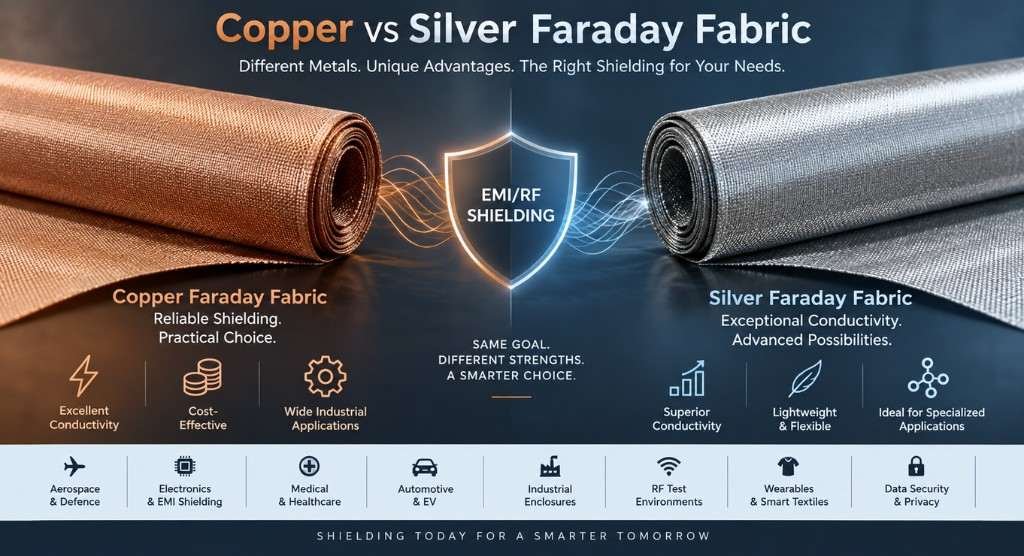
Copper vs Silver Faraday Fabric: Does the Metal Really Matter?
Copper vs Silver Faraday fabric can look like a simple choice between two conductive metals. In practice, the decision is more complicated.
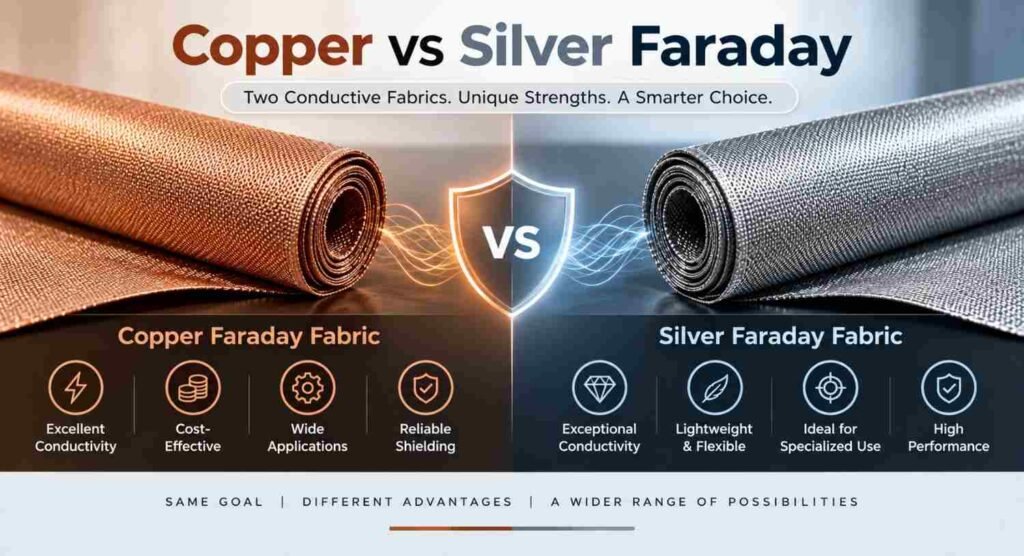
An engineer is developing a flexible RF-shielding enclosure. Two fabric samples arrive on the desk. One is copper-based; the other is silver-plated. Both are conductive. Both are sold for electromagnetic shielding. The silver option costs more, so the obvious assumption is that it must provide better protection.
But that conclusion can be misleading.
When evaluating Copper vs Silver Faraday Fabric, electrical conductivity is only one part of the equation. Silver has the highest electrical conductivity among pure metals, while copper combines excellent conductivity with considerably greater economic practicality. More importantly, the performance of a finished Faraday shield depends not only on the metal but also on coating thickness, textile construction, seams, openings, frequency range and electrical continuity.
So the correct question isn’t simply “Is silver better than copper?”
It is:
“Which conductive fabric meets the shielding, mechanical, environmental and cost requirements of this particular application?”
Understanding Copper vs Silver Faraday Fabric helps engineers move beyond material price and conductivity alone, focusing instead on shielding effectiveness, durability, application suitability and long-term performance.
That is the mindset shift that leads to better material selection.
1. What Is Copper Faraday Fabric?
Copper Faraday fabric is a flexible textile containing a conductive copper layer, copper-coated fibres, copper filaments, or—in many commercially available products—a combination such as copper and nickel.
A textile substrate such as polyester or nylon provides flexibility and mechanical structure, while the conductive metallic component creates an electrically conductive surface.
Conductive shielding materials primarily work by reflecting electromagnetic energy, while absorption and multiple reflections can also contribute to total shielding effectiveness.
Copper is particularly attractive because it combines:
- Very high electrical conductivity
- Good EMI/RF shielding potential
- Flexible manufacturing possibilities
- Practical cost compared with silver
- Suitability for large-area shielding
- Easy integration into tapes, pouches, curtains and enclosures
Research on copper-coated textiles has demonstrated their usefulness for EMI shielding, although oxidation and coating durability must be considered.
2. What Is Silver Faraday Fabric?
Silver Faraday fabric generally consists of textile fibres that are plated, coated, woven, or otherwise integrated with silver.
Its biggest technical attraction is conductivity.
Silver has extremely low electrical resistivity—approximately 1.6 µΩ·cm for the bulk metal—giving it the highest electrical conductivity among pure metals.
Silver-coated conductive textiles can therefore be attractive when engineers require:
high conductivity + low resistance + lightweight flexibility + strong shielding potential.
Silver fabrics are also particularly interesting for wearable electronics, sensors, garments and applications involving direct skin contact. Some silver conductive textiles are available as stretchable materials, expanding their usefulness beyond conventional rigid shielding designs.
3. Chemical Composition: Copper vs Silver Faraday Fabric
There is no universal chemical composition for either material.
That point is extremely important.
“Silver Faraday fabric” does not necessarily mean a sheet made from 100% solid silver, just as “copper Faraday fabric” does not necessarily mean a textile made entirely from pure copper wire.
Typical constructions may include:
| Fabric Type | Possible Construction |
| Copper fabric | Copper-coated polyester or nylon |
| Copper-nickel fabric | Copper and nickel metallization over textile |
| Silver fabric | Silver-plated nylon/polyamide |
| Silver-coated textile | Silver deposited over polymer fibres |
| Conductive woven fabric | Metallic fibres integrated with textile fibres |
The exact metal percentage, coating weight and substrate vary substantially by manufacturer and grade.
Therefore, DOMADIA™ recommends verifying the actual construction and technical datasheet rather than selecting a product based only on the words “copper” or “silver.”
4. Conductivity: Silver Wins—But That Isn’t the Whole Story
This is probably the most obvious difference.
Silver is a better electrical conductor than copper.
That gives silver a theoretical advantage where extremely low electrical resistance is important. Research reviewing metallized textiles has also reported stronger shielding for electroless silver-plated fabric than certain copper and nickel deposited fabrics, attributable to silver’s higher conductivity.
Does that automatically mean every silver Faraday fabric shields better than every copper fabric?
No.
Actual shielding effectiveness also depends on:
conductivity × coating thickness × textile structure × frequency × continuity × seams × openings × enclosure design.
TE Connectivity similarly notes that effectiveness depends on conductivity, thickness, continuity and overall system design.
A properly designed copper-based shield can therefore outperform a poorly constructed silver-based enclosure.
Material conductivity matters. System design matters more than many buyers realise.
5. Shielding Effectiveness: Never Compare by Metal Name Alone
Shielding effectiveness is normally expressed in decibels (dB) over a specified frequency range.
Suppose one supplier advertises:
Silver Fabric — 90 dB
while another offers:
Copper Fabric — 70 dB
It might seem obvious that the first product is superior.
But you still need to ask:
- At what frequency?
- Across what frequency range?
- Under which test method?
- Was it tested as a material sample or finished enclosure?
- What was the material thickness?
- Was it single-layer or multilayer?
- What were the seam and overlap conditions?
A single maximum dB figure should not be treated as a universal shielding rating.
For engineering procurement, compare frequency-specific shielding-effectiveness data obtained under comparable test conditions.
6. Oxidation and Environmental Stability
When comparing Copper vs Silver Faraday Fabric, environmental durability is an important factor.
Copper can develop surface oxidation when exposed to moisture, humidity and salt water, potentially reducing conductivity and shielding performance. Protective coatings such as nickel can improve durability.
Silver also tarnishes when exposed to sulfur-containing compounds and environmental contaminants, although protective treatments can help.
Therefore, Copper vs Silver Faraday Fabric selection should consider environmental exposure, maintenance and long-term reliability.
Ultimately, choosing Copper vs Silver Faraday Fabric requires balancing shielding effectiveness, corrosion resistance, durability and cost.
7. Cost: This Is Where Copper Becomes Extremely Competitive
Silver is a precious metal.
Copper isn’t.
That fundamental economic difference can become significant when shielding:
- Large rooms
- RF enclosures
- Equipment cabinets
- Curtains
- Test areas
- Industrial machinery
- Large bags and covers
- Walls and partitions
Silver can offer exceptional conductivity, but paying for maximum conductivity makes little sense when the application does not actually require it.
Academic literature on conductive textiles similarly recognizes silver’s excellent conductivity but identifies its higher cost as an important limitation for large-scale shielding structures.
For many industrial EMI/RF shielding projects, copper or copper-nickel fabric can therefore offer an attractive performance-to-cost balance.
8. Copper vs Silver Faraday Fabric: Technical Comparison
| Property | Copper-Based Fabric | Silver-Based Fabric |
| Electrical conductivity | Excellent | Exceptional |
| Raw-metal cost | Lower | Higher |
| EMI/RF shielding potential | Excellent | Excellent |
| Oxidation/tarnish consideration | Copper oxidation | Silver tarnishing |
| Large-area economics | Often advantageous | More expensive |
| Wearable applications | Depends on construction | Often attractive |
| Skin-contact applications | Grade dependent | Often preferred |
| Flexible shielding | Excellent | Excellent |
| Sensors/e-textiles | Possible | Particularly attractive |
| Industrial shielding | Very common/practical | Specialized/premium applications |
| Selection priority | Cost-performance balance | Maximum conductivity/special requirements |
The table should be treated as general guidance rather than a substitute for grade-specific test data.
9. Technical Specifications You Should Check Before Buying
Whether you select copper or silver, DOMADIA™ recommends checking more than the material name.
Shielding Effectiveness
Look for attenuation in dB across the required frequency range, rather than relying solely on a peak value.
Surface Resistance
Electrical surface resistance provides useful information about how readily current can move across the textile surface.
Frequency Range
When comparing Copper vs Silver Faraday Fabric, a material suitable for one RF band should not automatically be assumed to deliver the same shielding performance across every MHz or GHz frequency range.
Fabric Weight
Usually expressed as g/m².
Weight can become important for aerospace, wearable and portable shielding applications.
Thickness
Thin fabrics can be advantageous for:
- Compact electronics
- Layered enclosures
- Wearables
- Pouches
- Gaskets
- Space-constrained assemblies
Width and Roll Length
Industrial projects often require continuous fabric with minimal joining.
Mechanical Properties
Consider:
- Tensile strength
- Tear resistance
- Flexibility
- Folding endurance
- Abrasion resistance
Environmental Performance
Depending on the application, verify resistance to:
- Humidity
- Oxidation
- Chemicals
- Washing
- Temperature cycling
- Repeated handling
Standards and Test Methods for Faraday Fabric
There isn’t one universal “Faraday fabric standard” covering every possible product.
The applicable test method depends on whether you are evaluating the material itself or a complete shielding enclosure.
A frequently referenced method for planar shielding materials is ASTM D4935, while IEEE Std 299 is associated with measuring the effectiveness of electromagnetic shielding enclosures.
Test methods should never be mixed casually when comparing supplier data because different fixtures, frequencies and test configurations can produce different results.
For procurement, request the test method + frequency range + measured attenuation, not merely “blocks 99% of EMF.”
Shapes and Forms Available
Conductive Faraday fabrics can be supplied or fabricated in several practical forms depending on grade and construction:
- Rolls
- Sheets
- Cut pieces
- Conductive tapes
- Pouches
- Curtains
- Enclosure liners
- Gaskets
- Covers
- Canopies
- Garment materials
- Laminated shielding structures
- Custom-cut components
DOMADIA™ can help buyers evaluate the appropriate material form according to shielding frequency, dimensions, fabrication method and end-use requirements.
Applications: Where Copper and Silver Faraday Fabrics Are Used
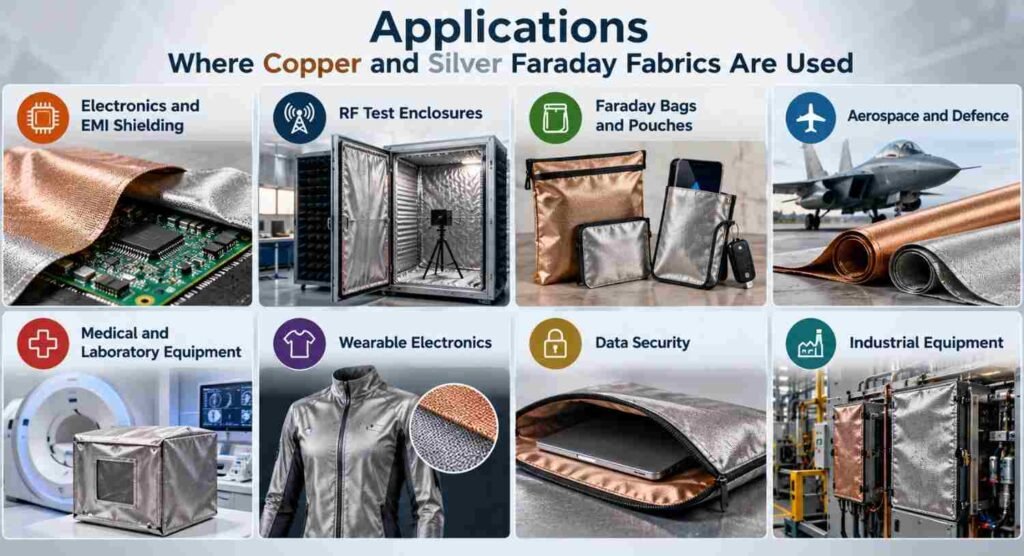
Electronics and EMI Shielding
In Copper vs Silver Faraday Fabric applications, conductive textiles can surround sensitive electronics and help reduce electromagnetic interference entering or leaving an enclosure.
RF Test Enclosures
Flexible conductive textiles can be incorporated into temporary or permanent RF-shielding structures. Copper vs Silver Faraday Fabric selection depends on frequency range, shielding effectiveness and durability.
Faraday Bags and Pouches
Phones, electronic devices, key fobs and specialized equipment may be enclosed within conductive materials to attenuate RF communication. Copper vs Silver Faraday Fabric performance depends on material construction and enclosure design.
Aerospace and Defence
Weight, flexibility, conductivity and space constraints make Copper vs Silver Faraday Fabric an important consideration for specialized aerospace and defence shielding systems.
Medical and Laboratory Equipment
Sensitive electronic instruments and measurement systems require reliable electromagnetic protection. Choosing Copper vs Silver Faraday Fabric involves evaluating shielding performance and environmental stability.
Wearable Electronics
Silver-plated textiles can be useful where conductivity, softness and flexibility are essential. In Copper vs Silver Faraday Fabric comparisons, comfort, durability and skin-contact suitability also matter.
Data Security
Shielded enclosures and pouches can help isolate wireless devices from external communication. Copper vs Silver Faraday Fabric selection should consider RF attenuation, electrical continuity and enclosure integrity.
Industrial Equipment
Conductive fabrics can protect electronic assemblies, control systems and cables from electromagnetic interference. Selecting Copper vs Silver Faraday Fabric requires balancing shielding effectiveness, mechanical flexibility and long-term reliability.
Copper or Silver: Which One Should You Choose?
Here is the practical answer to the Copper vs Silver Faraday Fabric comparison.
Choose Copper-Based Faraday Fabric When:
You need effective EMI/RF shielding, good electrical conductivity, large-area coverage and cost efficiency. In Copper vs Silver Faraday Fabric selection, copper offers a practical solution without the additional premium associated with silver.
Consider Silver-Based Faraday Fabric When:
High conductivity, low surface resistance, lightweight construction, flexibility or wearable applications justify the higher cost. Copper vs Silver Faraday Fabric performance should be evaluated against specific engineering requirements.
Choose Neither Until You Know Your Frequency and Attenuation Requirements
The Copper vs Silver Faraday Fabric decision should begin with frequency range, required shielding effectiveness and operating conditions.
Buying Faraday fabric based on metal alone is like selecting a high-temperature cable without knowing its operating temperature.
Ultimately, Copper vs Silver Faraday Fabric selection should prioritize tested performance, durability and application suitability over material price alone.
The specification comes first.
Why DOMADIA™?
At DOMADIA™, material selection starts with the application—not simply the product name.
When evaluating copper, copper-nickel, silver-plated or other conductive shielding materials, important purchasing information can include:
Required frequency range → Target shielding effectiveness → Fabric dimensions → Thickness → Surface resistance → Construction → Quantity → Environmental conditions → End application.
This approach helps customers identify materials that fit their actual technical requirements instead of automatically selecting the most expensive conductive metal.
For specialized EMI/RF shielding requirements, DOMADIA™ can support discussions around conductive fabrics, shielding materials and custom industrial requirements.
Conclusion: The Better Fabric Is the One That Meets the Specification
The Copper vs Silver Faraday decision isn’t simply about which metal conducts electricity better.
Silver has the conductivity advantage. Copper offers excellent conductivity combined with attractive economics and broad practicality. Silver can be particularly valuable for specialized thin, lightweight, wearable or low-resistance applications, while copper-based fabrics can be highly effective for industrial and large-area shielding.
Most importantly, Faraday fabric is part of a shielding system.
Frequency, attenuation, seams, overlap, apertures, conductive continuity, material construction and enclosure geometry can determine whether an apparently excellent conductive textile actually performs successfully.
So before asking DOMADIA™ for “the strongest Faraday fabric,” start with a better question:
“What shielding performance does my application actually require?”
That answer makes choosing between copper and silver considerably easier.
Need the Right Faraday Fabric for Your Application?
Choosing between copper and silver Faraday fabric depends on frequency, shielding effectiveness, conductivity, environment, dimensions, and application requirements.
DOMADIA™ can help you identify the right conductive shielding material for reliable EMI/RF protection.
Contact DOMADIA™ today for your Faraday fabric requirements.
Talk to: Er.Pankaj Domadia | Kairav Domadia | Aadil Domadia | Pragati Sanap | Pooja N N
#FaradayFabric #CopperFaradayFabric #SilverFaradayFabric #EMIShielding #RFShielding #ConductiveFabric #ElectromagneticShielding #EMIProtection #IndustrialMaterials #DOMADIA
Directly whatsapp us for an Enquiry: https://wa.link/kairav
We’ve supplied to Mumbai, Pune, Indore, Jaipur, and Surat—serving industries across Maharashtra, Madhya Pradesh, Rajasthan, Gujarat, and Goa, with exports to Germany, USA, Japan, South Korea, and Italy.