Blogs
Are High Temperature Cables Available in Different Colors? 9 Essential Facts About Cable Identification | UNS C11000
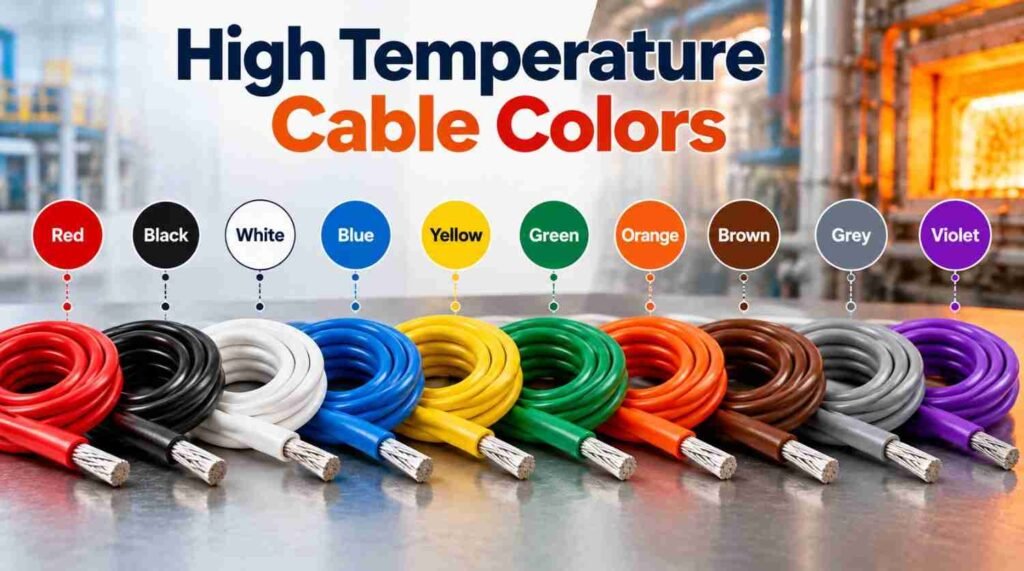
High Temperature Cable Colors are more than an aesthetic choice. In demanding industrial environments, cable colors help engineers, electricians, maintenance teams, and equipment manufacturers identify circuits, simplify installation, reduce wiring errors, and improve maintenance efficiency.
But there is an important question:
Are high-temperature cables available in different colors, or are they limited to white, red, and other traditional insulation shades?
The answer is yes. High Temperature Cable Colors can vary depending on the insulation material, manufacturing process, operating temperature, applicable standards, and supplier capabilities. However, not every color is suitable for every temperature rating.
For example, a red silicone cable, a white PTFE-insulated wire, and a fiberglass-braided cable may all be classified as high-temperature cables. Nevertheless, their thermal performance, insulation properties, flexibility, and available color options can differ considerably.
At DOMADIA™, understanding these differences helps industrial buyers and engineering teams select cables based on actual operating requirements rather than appearance alone.
This guide explores nine essential facts about High Temperature Cable Colors, including insulation materials, chemical composition, technical specifications, industry standards, industrial applications, and available configurations.
1. High Temperature Cable Colors: Why Are Different Colors Important?
Consider an industrial control panel containing dozens of electrical connections.
Several cables carry power, others transmit sensor signals, and some connect temperature-monitoring equipment.
Now consider what happens when every cable has exactly the same appearance.
Identifying the correct circuit during troubleshooting becomes more difficult, particularly when wiring diagrams are incomplete or maintenance work must be performed quickly.
This is where color identification becomes useful.
Different insulation colors can help distinguish:
- Power supply circuits
- Control wiring
- Temperature sensor connections
- Signal transmission lines
- Grounding and protective conductors
- Different voltage systems
- Equipment-specific wiring groups
- Maintenance and replacement circuits
Color identification can reduce confusion, but it must follow the applicable wiring standard and be supported by proper cable marking and documentation.
For example, green-and-yellow identification is reserved for protective conductors in many IEC-based installations. It should not be selected simply because a customer prefers that color combination.
The important distinction: Cable color assists identification, while insulation construction and certification determine whether the cable is technically suitable.
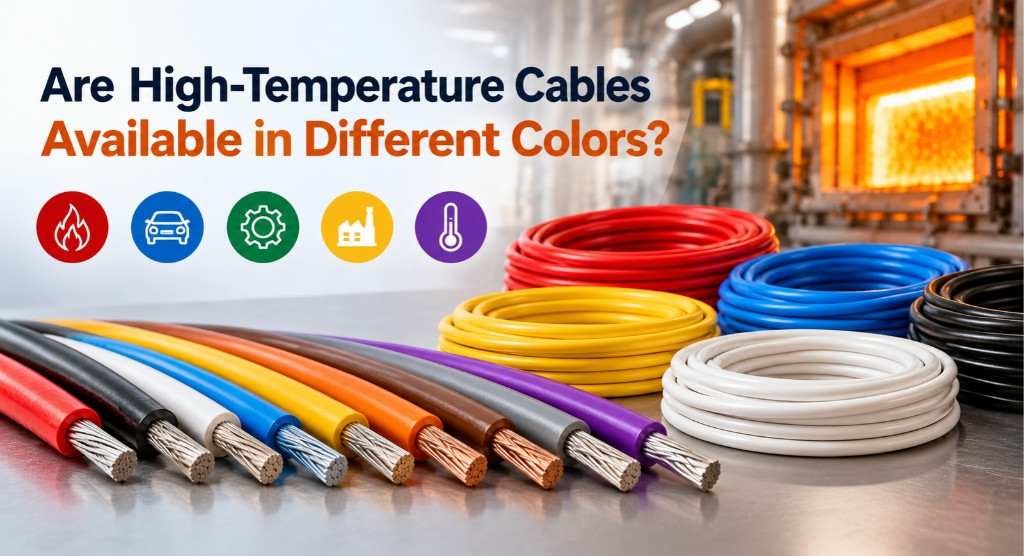
2. Which Colors Are Available for High-Temperature Cables?
High-temperature cables may be manufactured or supplied in various insulation colors.
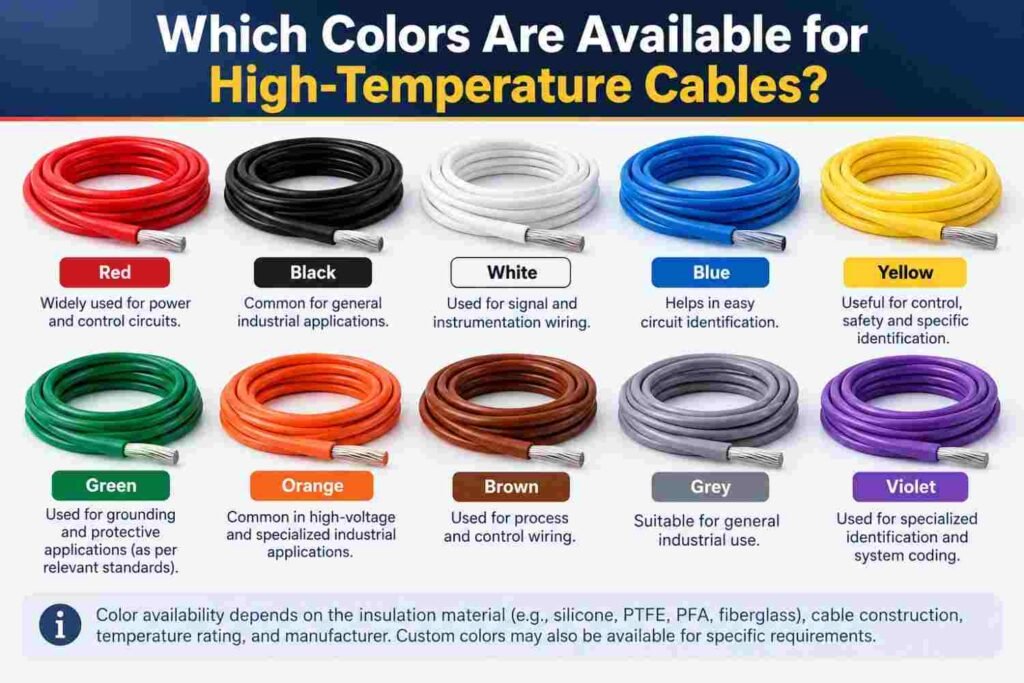
Other possibilities include grey, violet, pink, natural translucent insulation, striped identification, and multicolored cable constructions.
Does Every High-Temperature Cable Come in Every Color?
No.
The color range depends strongly on the insulation material.
For example:
- Silicone rubber: Often offers a relatively broad selection of colors.
- PTFE: Available in natural and selected pigmented colors, depending on manufacturer.
- PFA: Can be supplied in natural and selected colors.
- Fiberglass braid: Commonly supplied in natural, white, or coated finishes, with additional options depending on construction.
- Ceramic-fiber insulation: Usually has more restricted color choices because of the extremely high-temperature environment.
Consequently, engineers should confirm the required color and thermal rating together.
3. Chemical Composition of Different High-Temperature Cable Insulations
The chemical composition of insulation is one of the most important factors affecting temperature resistance, electrical properties, chemical compatibility, and color availability.
Silicone Rubber Insulation
Silicone rubber is based on polysiloxane polymers, whose molecular backbone contains alternating silicon and oxygen atoms.
Its general repeating backbone can be represented as:
\[ [-Si(R)_2-O-]_n \]
Here, R represents organic substituent groups, commonly methyl groups in conventional silicone rubber.
Silicone compounds may also contain reinforcing fillers, curing agents, pigments, and other additives.
Typical characteristics:
- Excellent flexibility
- Good resistance to elevated temperatures
- Useful electrical insulation properties
- Availability in multiple colors
- Suitability for selected industrial heating applications
Some silicone-insulated cables are rated for continuous service around 180–200°C, while specialized formulations may differ.
PTFE Insulation
Polytetrafluoroethylene is a fluoropolymer with the repeating chemical structure:
\[ [-CF_2-CF_2-]_n \]
PTFE offers excellent chemical resistance and electrical insulation performance.
It is widely used in demanding electrical, aerospace, instrumentation, and industrial applications.
Typical continuous-use ratings for appropriate PTFE wire constructions can reach approximately 260°C, subject to the complete cable design.
PFA Insulation
Perfluoroalkoxy polymer is another fluoropolymer offering high-temperature capability, chemical resistance, and useful dielectric performance.
Unlike PTFE, PFA is melt-processable, which can be advantageous for manufacturing certain insulated wire constructions.
Suitable PFA constructions may also be rated around 260°C.
Fiberglass Insulation
Fiberglass consists primarily of inorganic glass fibers based on silica and other metal oxides.
Its exact composition depends on the glass grade.
Fiberglass-braided cable constructions may include:
- Glass-fiber braid
- Silicone or other protective coatings
- Additional dielectric insulation layers
- High-temperature metallic conductors
Fiberglass provides thermal resistance, but the electrical insulation rating depends on the entire cable construction, not merely the glass fibers.
Ceramic-Fiber Insulation
Ceramic-fiber materials are used in certain extremely high-temperature cable constructions.
Depending on the product, they may contain alumina, silica, or other refractory constituents.
They can support applications beyond the practical temperature range of many polymer insulations, although flexibility, abrasion resistance, and electrical characteristics require careful evaluation.
4. High Temperature Cable Colors and Temperature Ratings
Color availability should never be confused with thermal performance.
The following table provides broad material-level guidance.
| Insulation material | Indicative temperature capability | Color availability |
| Silicone rubber | Around 180–200°C | Broad range |
| PTFE | Up to approximately 260°C | Natural and selected colors |
| PFA | Up to approximately 260°C | Natural and selected colors |
| Fiberglass-based systems | Approximately 250–550°C for selected constructions | Usually more limited |
| Ceramic-fiber systems | Can exceed 550°C in specialized constructions | Generally limited |
These are indicative ranges, not universal cable ratings. Actual continuous service limits depend on conductor material, coatings, insulation thickness, electrical load, environment, termination design, and manufacturer certification.
Can a Red Cable Handle More Heat Than a Blue Cable?
Not necessarily.
Two silicone-insulated wires manufactured using the same qualified compound may have identical thermal ratings despite different colors.
However, pigmentation can affect processing and performance if the formulation has not been properly qualified.
For that reason, customers should request technical confirmation for the exact colored insulation being supplied.
5. Technical Specifications of High-Temperature Cables
Before purchasing a colored high-temperature cable, engineers should evaluate the complete technical specification.
| Parameter | Typical options or considerations |
| Conductor material | Copper, tinned copper, nickel-plated copper, nickel, specialized alloys |
| Copper designation | UNS C11000 where applicable |
| Insulation | Silicone, PTFE, PFA, fiberglass, ceramic-fiber systems |
| Conductor size | AWG or mm² according to design |
| Voltage rating | Product-specific, such as 300 V, 600 V, or other qualified ratings |
| Operating temperature | Based on the complete cable construction |
| Insulation color | Standard or custom, subject to availability |
| Conductor configuration | Solid or stranded |
| Shielding | Unshielded, braided, foil-shielded or other constructions |
| Outer protection | Braid, jacket, coating or additional protective layers |
| Testing | Relevant electrical, mechanical and thermal requirements |
Why UNS C11000 Matters
UNS C11000 identifies electrolytic tough-pitch copper, a high-conductivity copper grade containing approximately 99.90% minimum copper, including silver.
It is used in many electrical conductor applications because of its excellent conductivity.
However, not every high-temperature cable uses UNS C11000. Certain designs use plated copper, nickel conductors, or other alloys to meet higher-temperature or environmental requirements.
At elevated temperatures, the conductor and its plating can become just as important as the insulation.
A cable cannot be assigned a safe temperature rating from its insulation material alone.
6. Applications of Different Colored High-Temperature Cables
Color-coded high-temperature wiring can provide practical benefits across many industrial sectors.
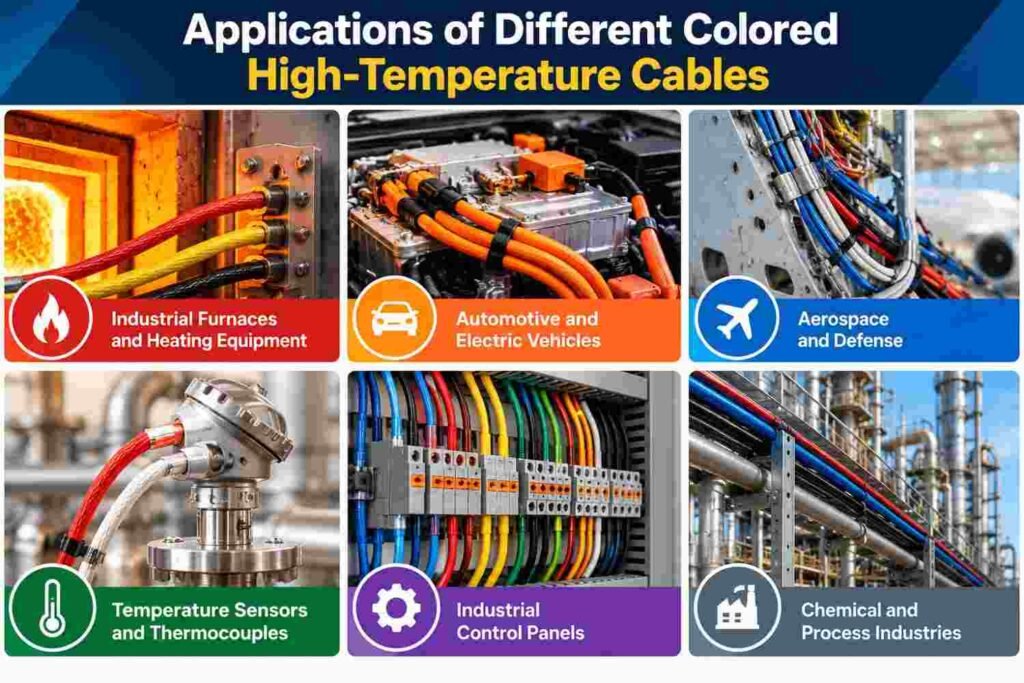
Industrial Furnaces and Heating Equipment
High Temperature Cable Colors help maintenance teams identify circuits connecting heaters, sensors, and control components. However, insulation and conductors must withstand actual operating temperatures.
Automotive and Electric Vehicles
Different High Temperature Cable Colors help organize wiring around motors, power electronics, and sensors. Orange is commonly used to identify high-voltage vehicle wiring under relevant automotive conventions.
Aerospace and Defense
High-performance cables support electrical systems in demanding environments. Identification may involve approved insulation colors, printed wire codes, and aerospace-specific construction requirements.
Temperature Sensors and Thermocouples
High Temperature Cable Colors help identify thermocouple types and polarity. However, IEC and ANSI color conventions differ and should not be mixed.
Industrial Control Panels
Proper High Temperature Cable Colors can simplify installation, troubleshooting, and maintenance. Wiring identification must follow approved electrical drawings and applicable standards.
Other Industrial Applications
Additional applications include laboratory equipment, food-processing machinery, chemical plants, industrial ovens, power-generation systems, heating assemblies, and specialized instrumentation.
7. Standards Governing High-Temperature Cable Identification
Selecting High Temperature Cable Colors requires careful consideration of insulation materials, electrical identification standards, and operating conditions.
IEC 60445
IEC 60445 establishes principles for identifying equipment terminals, conductor terminations, and conductors through colors and alphanumeric markings.
This standard is particularly important when selecting High Temperature Cable Colors for protective conductors and neutral identification.
IEC 60228
IEC 60228 defines nominal conductor cross-sectional areas and conductor classes for insulated cables.
Although useful for specifying conductor construction, it does not determine available insulation colors.
UL 758
UL 758 covers Appliance Wiring Material (AWM), including various recognized wire constructions with specific insulation, temperature, and voltage characteristics.
When selecting High Temperature Cable Colors, remember that changing insulation color does not automatically establish compliance with a UL-recognized AWM style.
IEC 60584-3
IEC 60584-3 addresses thermocouple extension and compensating cables, including identification requirements.
These requirements are important because thermocouple colors indicate conductor types and polarity.
SAE and Automotive Requirements
Automotive cable identification and construction may follow relevant SAE, ISO, and OEM specifications.
For example, orange is widely associated with high-voltage wiring in electric and hybrid vehicles. However, High Temperature Cable Colors must also meet the applicable thermal, electrical, and safety requirements.
ASTM and Conductor Specifications
Depending on conductor construction, relevant standards may include ASTM B3 for soft or annealed copper wire and ASTM B8 for concentric-lay-stranded copper conductors.
These specifications help ensure appropriate conductor properties but do not independently establish insulation color requirements.
Important: Compliance must be verified against the exact cable construction, intended application, market requirements, and applicable standard edition. Choosing High Temperature Cable Colors should never compromise electrical safety, insulation performance, or regulatory compliance.
8. Shapes and Configurations Available
High-temperature cables are not limited to a single round wire.
Depending on material and manufacturing capabilities, they may be supplied in several forms.
Single-Core Wires
For individual electrical connections, control circuits and equipment wiring.
Multicore Cables
Multiple individually insulated conductors within one cable assembly.
Fiberglass-Braided Wires
For selected high-heat industrial applications requiring appropriate thermal protection.
Shielded Cables
For instrumentation and signal circuits where electromagnetic interference must be managed.
Other possible constructions include flexible stranded wires, twisted pairs, flat or ribbon cables, thermocouple extension cables, and customized cable assemblies.
Availability depends on the insulation system, operating temperature, and manufacturing requirements.
9. Can High-Temperature Cables Be Customized in Specific Colors?
Yes, High Temperature Cable Colors can be customized for certain silicone and fluoropolymer-insulated wire constructions, depending on manufacturing capabilities and technical requirements.
However, custom color manufacturing involves more than simply adding pigments. Several important factors must be considered.
Pigment Compatibility
Colorants must be compatible with insulation materials and processing temperatures. For example, pigments suitable for silicone rubber may not withstand fluoropolymer processing conditions.
Thermal Stability
Custom High Temperature Cable Colors must maintain the required insulation properties throughout their specified operating temperature range and service life.
Electrical Performance
Pigments and additives must not compromise dielectric strength, insulation resistance, or other essential electrical properties.
Minimum Order Quantity
Special High Temperature Cable Colors may require minimum order quantities, depending on supplier capabilities, production methods, and material availability.
Documentation and Traceability
Custom-colored cables should maintain proper product identification, batch traceability, and relevant testing documentation to support quality and compliance.
Practical Procurement Example
An equipment manufacturer may require three different High Temperature Cable Colors for a heating assembly:
- Red: For one designated electrical circuit.
- Blue: For a second designated circuit.
- White: For sensor wiring.
These assignments are illustrative and must follow the applicable wiring identification standards.
Before ordering, manufacturers should confirm operating temperatures, voltage ratings, environmental conditions, and insulation requirements.
The supplier can then determine which High Temperature Cable Colors are available in the required qualified cable construction.
This approach helps manufacturers select High Temperature Cable Colors that support circuit identification, electrical safety, and reliable performance without compromising technical specifications.onditions.
Common Mistakes When Selecting Colored High-Temperature Cables
Common Mistakes When Selecting High Temperature Cable Colors
One of the biggest mistakes when selecting High Temperature Cable Colors is assuming that insulation color determines electrical function.
For example, a red wire is not automatically a positive conductor, and a black wire is not universally a negative conductor. Correct identification depends on applicable standards, system requirements, and wiring documentation.
Another common mistake is choosing cables solely because their insulation is advertised as heat resistant.
A cable installed near an industrial furnace may face radiant heat, abrasion, vibration, chemical exposure, and elevated conductor temperatures simultaneously. Therefore, selecting High Temperature Cable Colors must involve evaluating the complete operating environment, not just insulation appearance.
Finally, buyers should avoid assuming that every custom color is available at every temperature rating. Higher operating temperatures can restrict pigment compatibility, insulation materials, and manufacturing options.
Understanding these limitations helps engineers and procurement teams choose High Temperature Cable Colors that support reliable identification, electrical safety, and long-term performance.
Why DOMADIA™ for High-Temperature Cable Requirements?
At DOMADIA™, we understand that industrial cable selection involves more than choosing a conductor diameter and insulation color.
Engineers and procurement teams must consider operating temperature, electrical performance, flexibility, chemical exposure, installation conditions, identification requirements, and applicable technical standards.
DOMADIA™ can assist customers in discussing specialized high-temperature cable requirements, including:
- Silicone, PTFE, PFA, and other high-temperature insulation options
- Suitable conductor materials and constructions
- Single-core and multicore requirements
- Color identification and customization feasibility
- Application-specific temperature and voltage specifications
- Technical documentation and material requirements
Our approach emphasizes correct material selection, technical clarity, and suitability for the intended industrial application.
Custom colors, constructions, and certifications are subject to technical review and availability.
Conclusion
High Temperature Cable Colors play an important role in electrical identification, installation efficiency, equipment maintenance, and industrial wiring organization.
High-temperature cables can be available in red, black, white, blue, green, yellow, orange, and other colors, depending on the insulation material and cable construction.
However, the most important selection factors remain operating temperature, conductor material, insulation chemistry, voltage rating, environmental resistance, and compliance with relevant standards.
A colored cable should never be selected based on appearance alone.
Whether your application involves industrial furnaces, automotive equipment, aerospace systems, temperature sensors, or electrical control panels, the correct cable combines reliable thermal performance with an appropriate identification system.
DOMADIA™ helps engineers and procurement professionals explore specialized high-temperature cable solutions based on their technical and application requirements.
For assistance with material selection, insulation options, conductor specifications, or custom color requirements, contact DOMADIA™.
Contact DOMADIA™ for Colored High-Temperature Cables
Need high-temperature cables in red, blue, black, white, or a customized color?
Explore high-temperature cables in different colors and find the right solution for your industrial needs with DOMADIA™.
Contact DOMADIA™ with your required operating temperature, voltage rating, conductor size, insulation material, color preference, quantity, and applicable standards.
Talk to: Er.Pankaj Domadia | Kairav Domadia | Aadil Domadia | Pragati Sanap | Pooja N N
#HighTemperatureCables #HighTemperatureCableColors #HeatResistantWires #SiliconeCables #PTFEWires #IndustrialCables #ElectricalEngineering #CableInsulation #IndustrialMaterials #DOMADIA
Directly whatsapp us for an Enquiry: https://wa.link/kairav
We’ve supplied to Mumbai, Pune, Indore, Jaipur, and Surat—serving industries across Maharashtra, Madhya Pradesh, Rajasthan, Gujarat, and Goa, with exports to Germany, USA, Japan, South Korea, and Italy.