Blogs
Tungsten Electrode Colors: What Do They Mean? 9 Essential Facts
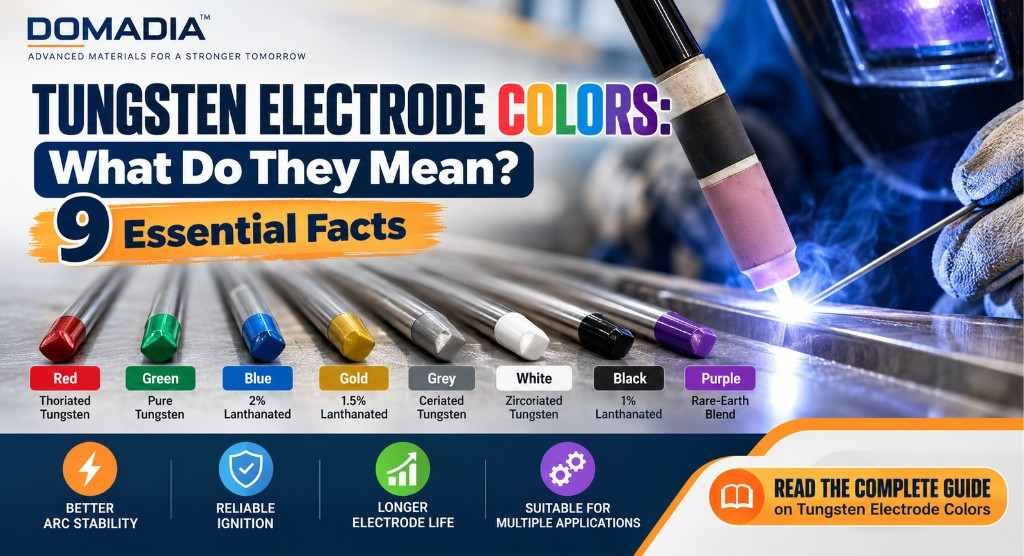
Tungsten Electrode Colors are more than simple identification marks. They help welders distinguish electrode compositions, understand their characteristics, and select suitable options for TIG welding applications. Understanding Tungsten Electrode Colors is essential for achieving consistent welding performance and making informed electrode selections.
Consider preparing to weld stainless steel, aluminium, or titanium. You open your welding kit and find tungsten electrodes marked in red, green, blue, gold, grey, and purple.
They look almost identical. So, which one should you choose?
Different Tungsten Electrode Colors indicate specific electrode classifications and compositions, although color conventions can vary by standard and manufacturer. Selecting an unsuitable electrode can contribute to unstable arc performance, difficult ignition, electrode deterioration, and inconsistent weld quality.
By understanding Tungsten Electrode Colors, welders can make better material selections, reduce welding problems, and improve overall efficiency.
In this guide, DOMADIA™ explains the most common Tungsten Electrode Colors, their chemical compositions, properties, applications, relevant standards, and important selection considerations for reliable TIG welding performance.
What Do Tungsten Electrode Colors Mean?
Tungsten electrodes are essential components in Tungsten Inert Gas (TIG) welding, also called Gas Tungsten Arc Welding (GTAW).
Unlike consumable welding wires, tungsten electrodes are designed to maintain their shape and provide a stable electrical arc rather than melt into the weld.
Different tungsten electrode compositions contain specific oxide additives that influence electron emission, arc starting, current capacity, and electrode durability.
Manufacturers use color markings to identify these compositions.
However, color identification is not completely universal. Certain colors can vary between standards and proprietary electrode products. Therefore, always verify the electrode’s classification and manufacturer’s specifications.
Tungsten Electrode Colors: Types and Applications
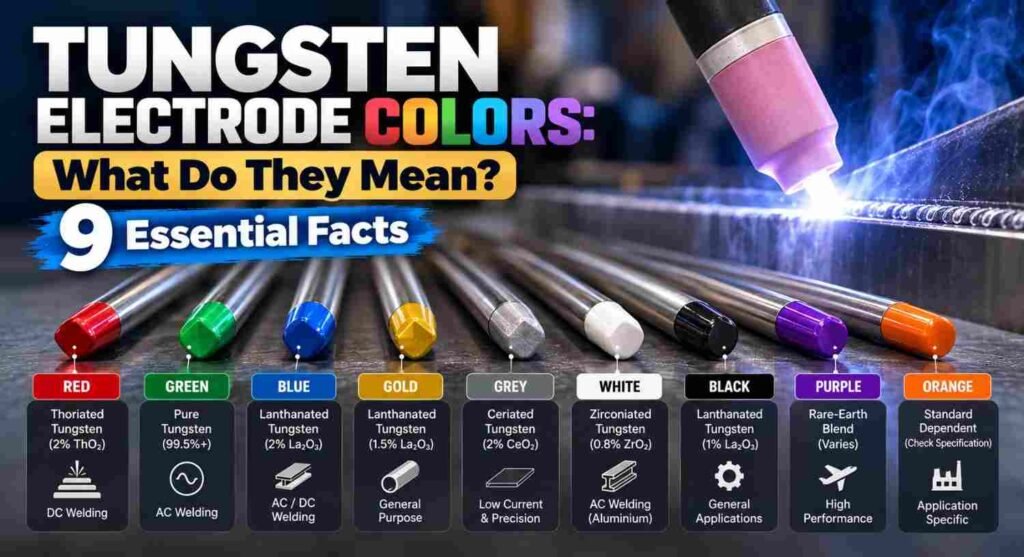
Different tungsten electrode tip colors help identify electrode compositions used in TIG welding.
| Electrode Color | Common Type | Typical Composition |
| Green | Pure tungsten (WP/EWP) | At least 99.5% tungsten |
| Red | Thoriated (WT20/EWTh-2) | Approximately 2% thorium oxide |
| Gold | Lanthanated (WL15/EWLa-1.5) | Approximately 1.5% lanthanum oxide |
| Blue | Lanthanated (WL20/EWLa-2) | Approximately 2% lanthanum oxide |
| Grey | Ceriated (WC20/EWCe-2) | Approximately 2% cerium oxide |
| White | Zirconiated (WZ8/EWZr-8) | Approximately 0.8% zirconium oxide |
| Black | Lanthanated (WL10/EWLa-1) | Approximately 1% lanthanum oxide |
| Purple | Rare-earth blend | Manufacturer-dependent |
| Orange | Thoriated or proprietary type | Standard-dependent |
Important: These are common identification conventions, not a substitute for checking the relevant ISO, AWS, or manufacturer classification.
9 Essential Facts About Tungsten Electrode Colors
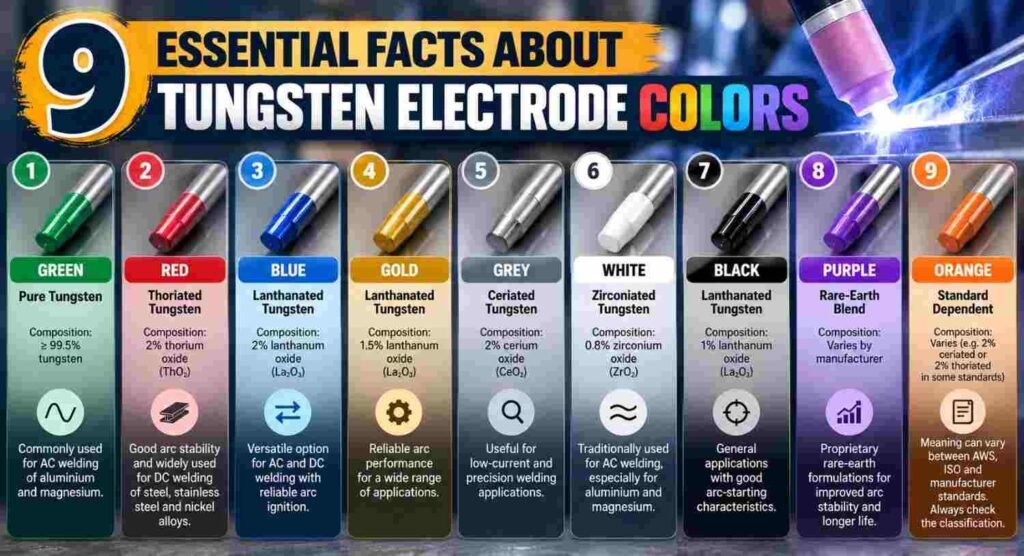
1. Green Tungsten Electrodes – Pure Tungsten
Green electrodes traditionally identify unalloyed tungsten. Among the various Tungsten Electrode Colors, green represents pure tungsten, which has historically been used for AC welding of aluminium and magnesium, particularly with conventional transformer-based welding equipment.
Pure tungsten generally offers lower current-carrying performance and less reliable arc starting than many modern alloyed electrodes.
For modern inverter TIG machines, lanthanated or other suitable electrodes are often preferred. Understanding Tungsten Electrode Colors helps welders select appropriate electrodes for improved arc stability, welding efficiency, and consistent weld quality.
2. Red Tungsten Electrodes – Thoriated Tungsten
Red electrodes commonly contain approximately 2% thorium oxide. Among the different Tungsten Electrode Colors, red identifies thoriated tungsten electrodes, which are recognised for reliable arc starting, excellent arc stability, and strong performance in DC TIG welding.
Typical applications include welding carbon steel, stainless steel, nickel alloys, and certain titanium components. Understanding Tungsten Electrode Colors helps welders identify suitable electrode compositions and achieve consistent welding performance across demanding industrial applications.
Safety Consideration: Thoriated tungsten contains radioactive thorium. Grinding can generate hazardous dust, making appropriate extraction, dust control, and safe handling essential. Non-thoriated alternatives are preferable where suitable.
3. Blue Tungsten Electrodes – 2% Lanthanated
Blue tungsten electrodes contain approximately 2% lanthanum oxide. Among the different Tungsten Electrode Colors, blue identifies 2% lanthanated tungsten electrodes, which are widely preferred for their excellent arc ignition, stable welding performance, and good electrode life.
These electrodes are suitable for both AC and DC TIG welding when the equipment and application requirements are compatible. They are frequently selected for welding stainless steel, carbon steel, aluminium, and other industrial metals.
Understanding Tungsten Electrode Colors helps welders choose versatile, non-thoriated electrodes that support consistent arc stability, improved welding efficiency, and reliable weld quality. For workshops seeking a practical alternative to thoriated tungsten, blue lanthanated electrodes are often an excellent choice.
4. Gold Tungsten Electrodes – 1.5% Lanthanated
Gold electrodes contain approximately 1.5% lanthanum oxide.
They provide reliable arc starting, good arc stability, and useful performance across a range of welding currents.
They are suitable for many AC and DC TIG welding applications.
Gold lanthanated electrodes are commonly used in fabrication, precision welding, and general industrial maintenance.
5. Grey Tungsten Electrodes – Ceriated Tungsten
Grey electrodes commonly indicate approximately 2% cerium oxide.
Ceriated tungsten is particularly useful for low-current welding and applications requiring controlled arc ignition.
It is often considered for thin sheet metal, delicate components, and precision welding.
However, electrode suitability depends on current, polarity, diameter, and operating conditions.
6. White Tungsten Electrodes – Zirconiated Tungsten
White tungsten electrodes commonly contain approximately 0.8% zirconium oxide.
They are traditionally associated with AC welding applications, especially aluminium and magnesium.
Zirconiated electrodes can provide good resistance to contamination and help maintain electrode integrity under suitable operating conditions.
They are particularly relevant to welders using equipment and procedures designed for this electrode type.
7. Black Tungsten Electrodes – 1% Lanthanated
Black tungsten electrodes commonly contain approximately 1% lanthanum oxide.
They offer useful arc-starting characteristics and are used in various DC and AC applications.
Their performance can be attractive for general fabrication and controlled welding operations.
However, the ideal selection should consider the welding machine, workpiece material, and current requirements.
8. Purple Tungsten Electrodes – Rare-Earth Blends
Purple electrodes are often associated with proprietary rare-earth formulations.
Some products contain combinations of lanthanum, cerium, yttrium, or other additives.
These formulations are developed to improve characteristics such as arc starting, stability, and electrode longevity.
Because purple is not a universal composition identifier, check the product classification and technical data sheet before purchasing.
9. Orange Tungsten Electrodes – Check the Standard
Orange is an especially important example of why color codes should not be interpreted without context.
In certain AWS identification systems, orange is associated with 2% ceriated tungsten, while some ISO-based identification conventions use grey for 2% ceriated tungsten.
Orange has also been used for 2% thoriated electrodes in certain older or alternative marking systems.
Always confirm the exact classification before use.
How to Choose the Right Tungsten Electrode
Selecting an electrode requires more than matching a color to a metal.
Consider the following factors:
- Workpiece material: Aluminium, stainless steel, titanium, and carbon steel can have different welding requirements.
- Welding current: Low-current precision welding and high-current fabrication place different demands on electrodes.
- AC or DC operation: Check whether the electrode is appropriate for the machine’s output and polarity.
- Electrode diameter: Select a diameter compatible with the required current and welding procedure.
- Tip preparation: Grinding direction, tip geometry, and cleanliness influence arc performance.
- Safety: Prefer appropriate non-thoriated alternatives where practical, and control grinding dust.
For example, a workshop performing varied TIG welding tasks may find 2% lanthanated electrodes practical, while a specialized low-current application may benefit from ceriated tungsten.
Common Mistakes to Avoid
Even experienced welders can encounter problems when electrode identification is overlooked.
Avoid selecting an electrode solely because its color looks familiar. Similarly, do not assume every electrode of the same color has identical performance across manufacturers.
Using contaminated electrodes, incorrect grinding techniques, or unsuitable current settings can also affect weld quality.
For critical applications, follow the approved welding procedure specification and verify the electrode classification.
Conclusion
Understanding Tungsten Electrode Colors helps welders make more informed decisions about electrode composition, arc characteristics, welding suitability, and overall performance.
Green, red, blue, gold, grey, white, black, purple, and orange markings provide useful identification clues, but their meanings must always be checked against the applicable standard. Knowing the differences between Tungsten Electrode Colors can help reduce electrode selection errors, improve arc stability, and support consistent weld quality across various industrial applications.
The best electrode is not necessarily the most popular color. It is the one that matches the welding equipment, base material, welding current, safety requirements, and intended application. Therefore, selecting the right electrode requires more than simply recognising its color.
By understanding Tungsten Electrode Colors, manufacturers and welding professionals can make better technical decisions, improve operational efficiency, and achieve reliable welding results.
For specialized tungsten materials and industrial requirements, contact DOMADIA™ with your required composition, dimensions, quantity, and technical specifications to discuss suitable material options.
Choose the Right Tungsten Electrode for Better Welding Performance!
Understanding Tungsten Electrode Colors is the first step towards selecting the right material for reliable TIG welding. Explore high-quality tungsten materials and industrial solutions with DOMADIA™.
Contact DOMADIA™ today with your material specifications and application requirements to discuss suitable tungsten solutions.
Talk to: Er.Pankaj Domadia | Kairav Domadia | Aadil Domadia | Pragati Sanap | Pooja N N
#TungstenElectrodeColors #TungstenElectrodes #TIGWelding #GTAW #WeldingTechnology #LanthanatedTungsten #ThoriatedTungsten #CeriatedTungsten #IndustrialMaterials #PrecisionWelding #DOMADIA
Directly whatsapp us for an Enquiry: https://wa.link/kairav
DOMADIA™ has supplied industrial materials to Mumbai, Pune, Indore, Jaipur, and Surat—supporting industries across Maharashtra, Madhya Pradesh, Rajasthan, Gujarat, and Goa, with international exports to Germany, the USA, Japan, South Korea, and Italy.