Blogs
Can You Anodize Beryllium Copper? 9 Essential Facts About UNS C17200 Surface Treatments
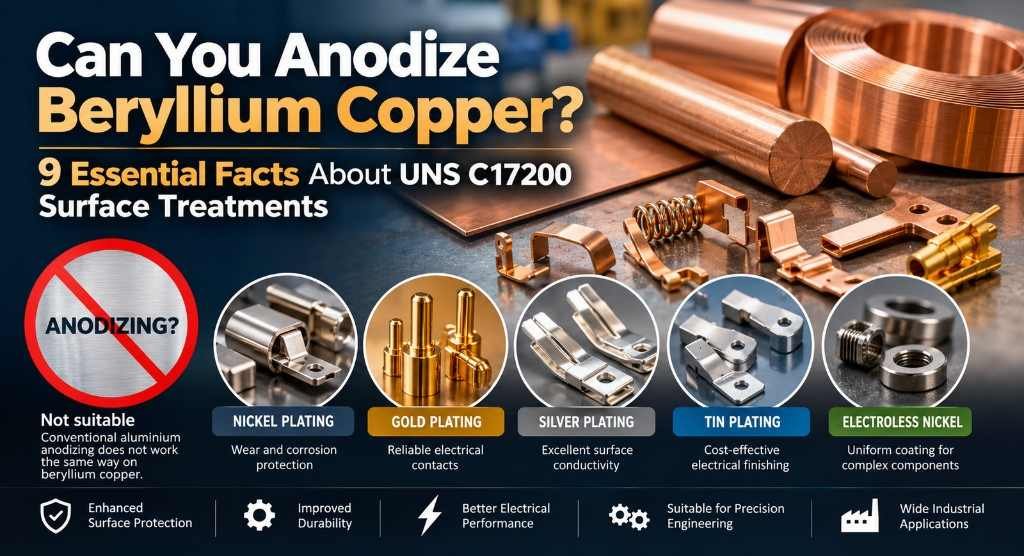
Beryllium Copper Anodizing sounds like an excellent way to improve surface protection, durability, and corrosion resistance. But there is one important technical problem: the anodizing process commonly used for aluminium does not work the same way on beryllium copper.
For engineers, manufacturers, and procurement professionals working with UNS C17200, understanding the limitations of Beryllium Copper Anodizing can prevent expensive coating failures, unnecessary processing costs, and premature component replacement.

The good news? Although conventional aluminium-style anodizing is generally unsuitable for beryllium copper, several effective surface treatments can deliver the desired results. Understanding Beryllium Copper Anodizing limitations helps engineers identify suitable alternatives without compromising material performance.
From nickel plating and tin coating to silver, gold, and specialised conversion treatments, the right finish can significantly influence the performance of this high-strength copper alloy.
In this detailed guide, DOMADIA™ explores nine essential facts about Beryllium Copper Anodizing and alternative surface treatments, including their technical properties, chemical compatibility, industrial applications, relevant standards, and practical selection considerations.
What Is Beryllium Copper UNS C17200?
Beryllium copper, commonly known as BeCu or copper beryllium, is a high-performance copper alloy valued for its exceptional combination of mechanical strength, electrical conductivity, fatigue resistance, and corrosion resistance.
Among the commercially important grades, UNS C17200, also known as Alloy 25, is particularly recognised for its precipitation-hardening capability.
Unlike ordinary copper, which is relatively soft, C17200 can achieve very high strength through carefully controlled heat treatment.
This makes it useful in demanding industrial environments where conventional copper materials may deform, lose spring force, or experience premature mechanical failure.
However, even a high-performance alloy may require additional surface protection when exposed to demanding electrical, chemical, or mechanical conditions.
That is where surface engineering becomes important.
Chemical Composition of UNS C17200 Beryllium Copper
The performance of C17200 begins with its chemical composition.
| Element | Typical Composition |
| Copper (Cu) | Balance |
| Beryllium (Be) | 1.80–2.00% |
| Cobalt (Co) + Nickel (Ni) | Minimum 0.20% |
| Co + Ni + Iron (Fe) | Maximum 0.60% |
| Other elements | Subject to applicable material specification |
Values reflect commonly published UNS C17200 composition limits. Confirm exact requirements against the applicable ASTM specification and supplier material certificate.
Beryllium is the principal alloying element responsible for enabling precipitation hardening.
Small additions of cobalt or nickel help control alloy behaviour during processing.
The result is a copper alloy that can deliver significantly higher strength than commercially pure copper while retaining useful electrical and thermal conductivity.
However, its copper-rich chemistry also explains why conventional aluminium anodizing is not an appropriate surface-finishing route.
9 Essential Facts About Beryllium Copper Anodizing and Surface Treatments

1. Conventional Aluminium Anodizing Is Not Suitable for UNS C17200
Can you anodize beryllium copper? Not in the conventional sense used for aluminium. Beryllium Copper Anodizing is challenging because copper-rich alloys do not form the same stable, protective oxide layers as aluminium.
Although copper can undergo electrochemical oxidation, its oxide films generally lack the controlled thickness, hardness, and corrosion protection achieved through aluminium anodizing. Therefore, conventional Beryllium Copper Anodizing is not a reliable surface treatment for UNS C17200.
Engineering Takeaway: Instead of relying on Beryllium Copper Anodizing, engineers should consider nickel plating, tin plating, or other suitable coatings based on corrosion resistance, wear protection, and electrical requirements.
2. Nickel Plating Provides Effective Surface Protection
Nickel plating is one of the most practical alternatives when engineers want to improve the surface characteristics of beryllium copper.
A properly specified nickel coating can provide improved surface hardness, wear resistance, corrosion protection, and a suitable barrier between the copper substrate and subsequent finishes.
Nickel plating is particularly useful where components experience repeated handling, sliding contact, or environmental exposure.
Common applications include:
- Industrial electrical connectors
- Precision mechanical components
- Instrumentation assemblies
- Contact springs and terminals
- Components requiring an underplate for gold finishing
Nickel can also reduce the migration of copper into certain top coatings.
However, nickel plating must be selected carefully for highly flexible or fatigue-loaded components because a relatively brittle coating can crack under repeated deformation.
Important consideration: Coating thickness, internal stress, adhesion, and component geometry must be evaluated before production.
3. Gold Plating Improves Electrical Contact Reliability
Gold plating provides excellent oxidation resistance and reliable electrical contact performance, making it ideal for aerospace electronics, telecommunications, and precision instruments. Although expensive, it can reduce connection failures and maintenance costs.
Unlike conventional Beryllium Copper Anodizing, gold plating offers a suitable surface finish for high-reliability UNS C17200 electrical contacts. A nickel barrier layer is often used beneath the gold to improve coating performance and limit diffusion.
Engineering Takeaway: Instead of considering Beryllium Copper Anodizing, engineers should evaluate gold plating for critical electrical connections where long-term reliability matters more than initial cost.
4. Tin Plating Is a Cost-Effective Choice for Electrical Components
Not every electrical connection requires gold.
In many commercial and industrial applications, tin plating provides an economical and technically suitable solution.
Tin coatings are commonly selected because they offer solderability, relatively low material cost, and useful electrical contact characteristics when correctly designed.
Tin-plated C17200 components may be used in terminals, connectors, electronic assemblies, and certain spring-contact applications.
However, tin plating also has limitations.
Fretting corrosion, contact resistance changes, tin whisker formation, and wear can become important depending on the service environment.
For this reason, tin plating should not automatically be considered interchangeable with gold plating.
A connector exposed to vibration, repeated mating, or low contact force may require a different surface finish.
Practical recommendation: Evaluate the mating material, normal contact force, vibration, operating temperature, and expected number of connection cycles before selecting tin plating.
5. Silver Plating Offers Excellent Electrical and Thermal Conductivity
Silver plating offers excellent electrical conductivity, making it suitable for high-current contacts, power distribution systems, switches, and RF applications. However, silver can tarnish in sulphur-containing environments, requiring careful consideration of operating conditions.
Unlike conventional Beryllium Copper Anodizing, silver plating provides a highly conductive surface finish for UNS C17200 components. Proper coating thickness and suitable underplating can further improve performance.
Engineering Takeaway: Instead of relying on Beryllium Copper Anodizing, engineers should consider silver plating when electrical conductivity and efficient current transfer are priorities, provided environmental conditions are suitable.
6. Electroless Nickel Plating Provides Uniform Coverage on Complex Shapes
Traditional electroplating uses an externally applied electric current to deposit metal.
Electroless nickel plating works differently.
It uses a controlled chemical reduction process to deposit a nickel-phosphorus alloy without an external plating current.
One of its major advantages is its ability to provide relatively uniform coating thickness across complex component geometries, subject to proper solution access and process control.
This makes electroless nickel particularly useful for:
- Precision machined parts
- Complex connector housings
- Instrumentation components
- Wear-resistant mechanical surfaces
- Components requiring dimensional consistency
The phosphorus content and subsequent heat treatment influence the coating’s hardness, corrosion behaviour, and other properties.
ASTM B733 provides requirements for electroless nickel-phosphorus coatings.
store.astm.org+1
However, engineers must consider the temperature sensitivity of precipitation-hardened C17200. Additional thermal exposure can alter the substrate’s mechanical properties.
Practical recommendation: Confirm that the plating and post-plating thermal cycles will not compromise the specified temper, hardness, or spring characteristics.
7. Surface Preparation Determines Coating Adhesion and Reliability
Proper surface preparation is essential for successful coating adhesion on UNS C17200. Heat treatment can produce copper and beryllium oxides that interfere with plating quality and solderability. Understanding Beryllium Copper Anodizing limitations helps engineers select suitable cleaning and coating processes.
Unlike conventional Beryllium Copper Anodizing, alternative surface treatments require carefully controlled degreasing, oxide removal, surface activation, and rinsing to achieve reliable results.
Safety Consideration: Beryllium-containing dust and fumes pose serious health risks. Surface finishing must be performed by qualified professionals using appropriate industrial safety controls.
Engineering Takeaway: Instead of focusing solely on Beryllium Copper Anodizing, prioritise proper surface preparation and qualified plating processes to improve coating adhesion, durability, and component reliability.
8. Coating Thickness and Heat Treatment Can Change Component Performance
One of the most overlooked aspects of surface finishing is dimensional control.
A coating does not simply change the appearance of a component.
It can influence:
- Final dimensions and tolerances
- Contact resistance
- Surface hardness
- Friction and wear
- Fatigue behaviour
- Corrosion protection
- Electrical performance
For example, adding a metallic coating to a precision contact changes the effective dimensions of the contact surface.
Likewise, excessive coating thickness or unsuitable coating stress may affect a spring component’s fatigue performance.
Another consideration is the sequence of precipitation hardening and surface finishing.
C17200 obtains its high strength through controlled ageing treatments. Subsequent high-temperature processing may change its mechanical condition.
For this reason, the manufacturing sequence should be planned before plating begins.
Engineering takeaway: A successful finish must preserve the functional characteristics of the complete component, not merely pass a visual inspection.
9. The Best Surface Treatment Depends on the Application
There is no universally superior surface finish for UNS C17200. While Beryllium Copper Anodizing is generally unsuitable, alternative coatings offer different advantages depending on industrial requirements.
Gold plating supports reliable electrical connections, silver improves surface conductivity, nickel enhances wear and corrosion resistance, and tin provides an economical finish for suitable electrical terminals. Selecting the right alternative to Beryllium Copper Anodizing depends on operating temperature, contact force, environmental exposure, and expected service life.
Engineering Takeaway: Rather than focusing on Beryllium Copper Anodizing, engineers should prioritise application requirements and select the most suitable surface treatment for long-term performance and reliability.
Technical Specifications and Properties of UNS C17200
Understanding the base alloy is essential before selecting a surface treatment.
| Property | Typical Value |
| UNS designation | C17200 |
| Commercial designation | Alloy 25 |
| Density | 8.26 g/cm³ |
| Electrical conductivity | Approximately 22% IACS, precipitation-hardened |
| Thermal conductivity | Approximately 105 W/m·K |
| Elastic modulus | Approximately 127 GPa |
| Tensile strength | Can exceed 1,300 MPa in suitable hardened product conditions |
| Corrosion resistance | Good in many environments |
| Heat treatment | Precipitation hardening |
| Magnetic behaviour | Essentially non-magnetic in typical conditions |
| Surface finishing | Nickel, gold, silver, tin and other qualified coatings |
Representative values, not guaranteed design limits. Properties depend on product form, temper, processing history, and testing conditions.
C17200 Alloy+2
The combination of strength, conductivity, and fatigue resistance is what makes this alloy valuable in specialised engineering applications.
Surface treatment should enhance the required functionality without compromising these underlying advantages.
Comparison of Surface Treatments for Beryllium Copper
| Surface Treatment | Primary Advantage | Typical Application |
| Conventional aluminium anodizing | Not a standard suitable process | Generally not recommended |
| Electroplated nickel | Wear and corrosion protection | Connectors, mechanical parts |
| Electroless nickel | Uniform coverage on complex shapes | Precision components |
| Gold plating | Stable low-level electrical contacts | Aerospace, electronics |
| Silver plating | High surface conductivity | Power and RF contacts |
| Tin plating | Cost-effective solderable finish | Terminals and connectors |
| Specialised oxide or conversion treatment | Application-specific surface modification | Qualified decorative or functional uses |
A copper oxide or conversion coating should not be assumed to provide the same protection as anodized aluminium. Its suitability requires application-specific validation.
Standards for UNS C17200 and Surface Finishing
Material selection and coating specification should be supported by recognised technical standards.
| Standard | General Scope |
| ASTM B194 | Copper-beryllium alloy plate, sheet, strip and rolled bar |
| ASTM B196/B196M | Copper-beryllium alloy rod and bar |
| ASTM B197/B197M | Copper-beryllium alloy wire |
| ASTM B488 | Electrodeposited gold coatings |
| ASTM B545 | Electrodeposited tin coatings |
| ASTM B689 | Electrodeposited nickel coatings |
| ASTM B700 | Electrodeposited silver coatings |
| ASTM B733 | Electroless nickel-phosphorus coatings |
These standards address different product forms or coating systems. They should not be interpreted as universal approval of every coating on C17200. The relevant specification, revision, thickness, adhesion requirements, and inspection criteria must be confirmed for the application.
voestalpine Specialty Metals Pac.+2
Industrial Applications of Surface-Treated Beryllium Copper

Beryllium Copper Anodizing is frequently discussed when manufacturers look for ways to improve the surface durability, corrosion resistance, and performance of UNS C17200 components. However, because conventional aluminium-style anodizing is unsuitable for this copper alloy, industries typically rely on specialised metallic coatings such as nickel, gold, silver, and tin.
Here are five important industrial applications where selecting the correct surface treatment can make a significant difference.
1. Electrical and Electronic Connectors
Electrical connectors require stable conductivity, reliable contact pressure, and resistance to repeated mechanical stress. When evaluating Beryllium Copper Anodizing, manufacturers often find that gold, tin, or nickel-based plating systems offer more suitable solutions. These coatings support dependable electrical connections in telecommunications equipment, industrial electronics, and precision connector assemblies.
2. Aerospace and Defence Equipment
Aerospace and defence systems require materials that withstand vibration, temperature fluctuations, and demanding operating conditions. Although Beryllium Copper Anodizing is not a conventional finishing solution, properly specified gold and nickel coatings can enhance contact reliability and surface protection in avionics connectors, precision instruments, and specialised electronic assemblies.
3. Precision Mechanical Components
Precision springs, bushings, and machined components require dimensional accuracy, mechanical strength, and wear resistance. Engineers exploring Beryllium Copper Anodizing may instead choose electroless nickel plating for complex geometries or nickel-based coatings for improved surface protection. Proper control of coating thickness, adhesion, and fatigue performance helps preserve the mechanical properties of UNS C17200.
4. Testing and Instrumentation Systems
Electronic testing equipment, spring-loaded contact probes, and precision instruments require consistent electrical performance. Unlike conventional Beryllium Copper Anodizing, gold or nickel-gold finishes provide more suitable solutions for maintaining reliable electrical contacts. These coatings support stable conductivity, while UNS C17200 delivers the spring force and mechanical resilience needed for repeated operation. Therefore, Beryllium Copper Anodizing alternatives are essential for high-performance testing and measurement applications.
5. Power Distribution and Switching Equipment
Industrial switches, electrical contacts, and power distribution systems require efficient current transfer and reliable mechanical performance. Unlike conventional Beryllium Copper Anodizing, silver plating offers excellent conductivity for suitable high-current applications, while nickel-based finishes provide surface protection and barrier properties. Choosing appropriate alternatives to Beryllium Copper Anodizing helps engineers balance electrical efficiency, contact wear, operating temperature, and long-term service life.
Key Takeaway: The industrial value of surface-treated UNS C17200 lies in combining the alloy’s high strength, fatigue resistance, and useful conductivity with a coating selected for the application. Rather than specifying conventional anodizing, engineers should focus on the surface properties that their components actually require.
At DOMADIA™, we help customers explore high-performance beryllium copper materials for electrical, aerospace, precision engineering, instrumentation, and industrial applications.
Available Shapes and Forms of UNS C17200
At DOMADIA™, material selection discussions can cover the product forms needed for manufacturing and component development, subject to specification and availability.
Common C17200 product forms include:
- Sheets and plates: For precision components, machined parts, and formed assemblies.
- Strips and coils: For spring contacts, electrical terminals, and stamped components.
- Rods and bars: For machined industrial parts, bushings, and mechanical assemblies.
- Wires: For specialised spring and electrical applications.
- Foils: For precision miniature components and thin-section engineering requirements.
- Custom-cut blanks: Subject to material dimensions, processing capability, and order requirements.
For plated components, the material form and temper should be selected together with the planned manufacturing and finishing sequence.
How to Select the Right Beryllium Copper Surface Treatment
Before choosing a coating, engineers should answer several important questions.
Engineering selection checklist
Before selecting a surface treatment, engineers should define the component’s electrical, mechanical, or protective function. When evaluating Beryllium Copper Anodizing, consider operating temperature, humidity, chemical exposure, corrosion resistance, solderability, contact resistance, and wear requirements.
Additionally, confirm the UNS C17200 product form, temper, and heat-treatment condition. Specify coating material, thickness, adhesion, and inspection requirements, then validate performance using representative production samples.
Engineering Takeaway: Following these steps helps manufacturers identify suitable Beryllium Copper Anodizing alternatives, minimise coating failures, and ensure reliable long-term component performance.
Why DOMADIA™ for UNS C17200 Beryllium Copper?
Selecting a high-performance copper alloy is more than a purchasing decision.
The material must match the component’s mechanical requirements, electrical performance, manufacturing process, and operating environment.
DOMADIA™ supports customers exploring specialised industrial materials, including beryllium copper and other high-performance alloys.
Our approach emphasises:
- Material selection based on engineering requirements
- Attention to UNS grades and relevant specifications
- Understanding of product form and temper requirements
- Consideration of subsequent manufacturing and surface treatments
- Coordination around dimensional and procurement specifications
- Long-term performance rather than initial material cost alone
A carefully selected alloy and coating combination can help reduce premature replacement, unnecessary material waste, and avoidable equipment downtime.
However, environmental benefits depend on actual component life, coating processes, waste treatment, and recycling arrangements. They should be assessed over the full product lifecycle rather than assumed from coating choice alone.
Conclusion: Choose the Right Surface Treatment, Not Just the Familiar One
Beryllium Copper Anodizing is an important subject because it highlights a common engineering misconception: a finishing process that works extremely well on one metal does not necessarily produce the same results on another.
For UNS C17200, conventional aluminium anodizing is generally not the appropriate route.
Instead, nickel, electroless nickel, gold, silver, and tin coatings offer different functional advantages depending on the intended application.
The key is to evaluate the complete component: its base alloy, temper, electrical requirements, mechanical loading, environment, manufacturing sequence, and expected service life.
By making the correct material and surface-treatment decisions early, engineers can improve product reliability, avoid unnecessary rework, and achieve better long-term value.
Looking for UNS C17200 Beryllium Copper for your next engineering project?
Whether your project involves electrical contacts, precision springs, aerospace components, or specialised industrial assemblies, DOMADIA™ can help you explore suitable beryllium copper material options.
Connect with DOMADIA™ to discuss your material grade, dimensions, temper, technical specifications, and application requirements.
Talk to: Er.Pankaj Domadia | Kairav Domadia | Aadil Domadia | Pragati Sanap | Pooja N N
#BerylliumCopper #UNSC17200 #SurfaceTreatment #MetalFinishing #Electroplating #EngineeringMaterials #DOMADIA
Directly whatsapp us for an Enquiry: https://wa.link/kairav
Our materials have reached Tiruppur, Erode, Salem, Namakkal, and Karur across Tamil Nadu, Karnataka, Kerala, Andhra Pradesh, and Telangana, with exports to Italy, Turkey, Tunisia, Morocco, and Algeria.