Blogs
Fiberglass vs Mica Tape: Which Handles 1000°C Better? 9 Powerful Differences – UNS C11000
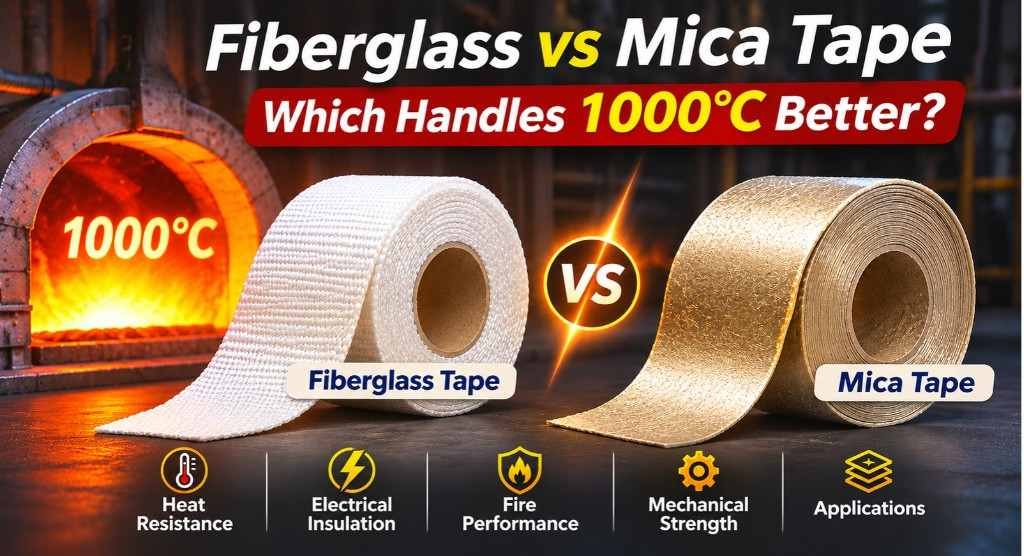
Fiberglass vs Mica Tape is an important comparison for engineers and manufacturers working with extreme temperatures approaching 1000°C.
Consider an industrial furnace operating at 1000°C, where electrical connections require reliable protection against heat and electrical failure.
When evaluating Fiberglass vs Mica Tape, both materials provide thermal resistance and electrical insulation, but their performance differs significantly under extreme conditions.
Fiberglass vs Mica Tape becomes a critical decision because a material that performs well at 300°C may fail during prolonged exposure to 1000°C.
Choosing the wrong insulation can cause equipment damage, costly maintenance, and unexpected downtime, especially when protecting UNS C11000 copper conductors in appropriately engineered thermal environments.
So, which material performs better under extreme conditions?
In this DOMADIA™ guide, we explore Fiberglass vs Mica Tape through nine important differences, chemical composition, thermal properties, technical specifications, international standards, and industrial applications to help you select the right insulation for extreme temperatures.
1. What Is Fiberglass Tape?
Fiberglass tape is a flexible insulation material manufactured from extremely fine glass filaments woven into a fabric-like structure.
The fibers are generally produced from specially formulated glass compositions, including E-glass and other high-temperature glass types.
Fiberglass tape is widely used because it offers a practical combination of thermal resistance, electrical insulation, mechanical strength, and flexibility.
Chemical Composition of Fiberglass
Typical E-glass contains several inorganic oxides.
| Chemical component | Approximate composition |
| Silicon dioxide (SiO₂) | 52–56% |
| Aluminium oxide (Al₂O₃) | 12–16% |
| Calcium oxide (CaO) | 16–25% |
| Boron oxide (B₂O₃) | 0–10% |
| Magnesium oxide (MgO) | 0–6% |
| Other oxides | Small quantities |
Indicative E-glass composition ranges; actual formulations vary by manufacturer and glass grade.
Important Properties of Fiberglass Tape
- Good electrical insulation when dry and appropriately constructed.
- Excellent tensile strength for its weight.
- Useful resistance to vibration and abrasion.
- Flexibility for wrapping wires, cables, and components.
- Noncombustible inorganic glass-fiber base.
- Availability with silicone, acrylic, and other coatings.
However, ordinary E-glass fiberglass tape is not automatically suitable for continuous operation at 1000°C.
Its performance is limited by the glass composition, softening behavior, coating, binder, and mechanical loading.
Engineering takeaway: Fiberglass may tolerate brief high-temperature exposure without immediate melting, but this does not establish its suitability as a functioning electrical insulation system at 1000°C.
2. What Is Mica Tape?
Mica tape is a specialized electrical insulation material manufactured using thin mica mineral layers or mica paper, often supported by fiberglass fabric or polymer film.
Mica is a naturally occurring group of silicate minerals known for their dielectric properties and thermal stability.
Two major mica types are used in industrial insulation.
Muscovite Mica
Muscovite has the approximate chemical formula:
\[ KAl_2(AlSi_3O_{10})(OH)_2 \]
It offers good dielectric properties, thermal stability, and resistance to electrical breakdown.
Phlogopite Mica
Phlogopite has the approximate chemical formula:
\[ KMg_3(AlSi_3O_{10})(OH)_2 \]
Phlogopite generally offers better high-temperature capability than muscovite and is commonly selected for severe thermal and fire-resistant applications.
Important Properties of Mica Tape
- Excellent electrical insulation characteristics.
- Strong resistance to elevated temperatures.
- Low flame propagation from the inorganic mica component.
- Good dielectric performance in appropriately designed constructions.
- Availability in flexible reinforced tape formats.
- Suitability for selected fire-resistant cable systems.
The critical distinction: Certain phlogopite-based mica constructions are designed for severe heat exposure approaching or exceeding 1000°C for specified durations. That does not mean every mica tape can continuously operate at 1000°C.
3. Fiberglass vs Mica Tape: Which Handles 1000°C Better?
Standard E-glass tape
Not normally rated for 1000°C
Common continuous-use ratings are substantially below 1000°C, depending on construction.
High-temperature mica tape
Better candidate for extreme heat
Selected phlogopite systems can withstand severe short-duration fire exposure.
The difference becomes clearer when comparing typical temperature capabilities.
| Material | Indicative temperature performance |
| Standard E-glass tape | Often around 450–550°C continuous, depending on product |
| High-silica glass tape | Selected products may be rated around 900–1000°C |
| Muscovite mica tape | Useful at elevated temperatures; limits depend on construction |
| Phlogopite mica tape | Selected grades tolerate fire exposure near 1000°C or higher for specified durations |
| Reinforced mica tape | Performance depends on mica, backing, binder, and complete assembly |
These figures are general product-family indicators, not universal certified ratings.
A high-temperature material can survive exposure while losing mechanical strength, flexibility, or electrical insulation performance.
Therefore, engineers should distinguish between three separate concepts:
- Continuous operating temperature: The temperature at which the product is rated to function for an extended service life.
- Short-term exposure temperature: A higher temperature tolerated for a limited period.
- Fire-survival performance: The ability of a complete cable or assembly to maintain a defined function during a standardized fire test.
At 1000°C, selected high-temperature mica systems generally provide a stronger starting point for electrical insulation design than conventional fiberglass tape.
However, a suitable high-silica fiberglass product may still be useful for thermal protection where maintaining electrical circuit integrity is not the primary requirement.
4. Fiberglass vs Mica Tape: 9 Important Technical Differences
| Property | Fiberglass tape | Mica tape |
| 1. Base material | Woven glass fibers | Mica paper or flakes, often reinforced |
| 2. Temperature resistance | Moderate to very high, depending on glass type | High, especially selected phlogopite grades |
| 3. Electrical insulation | Good when correctly specified | Excellent dielectric characteristics |
| 4. Fire resistance | Inorganic glass resists combustion | Mica is well suited to fire-resistant insulation systems |
| 5. Flexibility | Generally excellent | Depends on reinforcement and binder |
| 6. Mechanical strength | Strong woven structure | Often requires reinforcement |
| 7. Thermal protection | Useful for wraps and barriers | Useful for electrical insulation under severe heat |
| 8. Cost | Standard grades often economical | Specialized grades generally more expensive |
| 9. Primary applications | Cable wrapping, sleeves, thermal barriers | Fire-resistant cables, heaters, electrical insulation |
Difference 1: Thermal Stability
In the Fiberglass vs Mica Tape comparison, ordinary fiberglass becomes less suitable as temperatures approach its softening range.
Mica maintains its layered mineral structure under severe thermal conditions, although dehydration, decomposition, and dielectric deterioration can occur depending on mica type and temperature.
Difference 2: Electrical Performance
When evaluating Fiberglass vs Mica Tape, mica is particularly valuable where electrical insulation must remain effective during fire exposure.
Fiberglass also provides electrical insulation, but its performance depends on moisture, coatings, contamination, temperature, and the surrounding assembly.
Therefore, Fiberglass vs Mica Tape selection should prioritize electrical reliability under actual operating conditions.
Difference 3: Mechanical Durability
In the Fiberglass vs Mica Tape comparison, fiberglass tape generally provides excellent mechanical reinforcement and abrasion resistance.
Mica paper alone can be fragile, which is why many industrial mica tapes incorporate fiberglass backing to improve mechanical strength and durability.
Difference 4: Flexibility
In the Fiberglass vs Mica Tape comparison, fiberglass is often easier to wrap around irregular surfaces.
Mica tape flexibility depends on its thickness, binder system, reinforcement, and minimum bending radius.
Difference 5: Fire Performance
When evaluating Fiberglass vs Mica Tape, mica-based insulation is preferred in cables designed to maintain electrical circuit integrity during fire.
Fiberglass may remain noncombustible while failing to provide the required electrical insulation at extreme temperatures.
Difference 6: Chemical Resistance
Both materials offer useful resistance to selected chemicals.
However, acids, alkalis, moisture, coatings, and operating temperature can affect performance.
Difference 7: Installation
In the Fiberglass vs Mica Tape comparison, fiberglass tape is often more convenient for mechanical wrapping and protective insulation.
Mica tape requires careful attention to overlap, tension, wrapping angle, and potential damage during processing.
Difference 8: Cost
When evaluating Fiberglass vs Mica Tape, conventional fiberglass is generally more economical.
High-performance mica tape may cost more initially, but its suitability for specialized fire-resistant applications and potential long-term reliability can justify the investment.
Difference 9: Service Life
Neither material has a universal service-life advantage.
Actual longevity depends on thermal cycling, vibration, electrical stress, moisture, mechanical movement, and exposure duration.
For extreme-temperature electrical insulation, mica is often the more appropriate material. For mechanical reinforcement and conventional heat protection, fiberglass can remain an excellent choice.
5. Technical Specifications of Fiberglass and Mica Tape
Engineers should evaluate measurable properties rather than relying exclusively on temperature ratings.
| Technical parameter | Fiberglass tape | Mica tape |
| Common construction | Woven glass fabric | Mica paper with optional backing |
| Typical tape thickness | Approximately 0.05–0.50 mm | Approximately 0.08–0.25 mm |
| Electrical insulation | Grade-dependent | Grade-dependent, generally strong |
| Thermal capability | Depends on glass and coating | Depends on mica and binder |
| Mechanical reinforcement | Woven fibers | Often fiberglass-backed |
| Moisture sensitivity | Can affect insulation resistance | Can affect insulation and binder |
| Fire-resistant cable use | As part of qualified systems | Widely used in qualified systems |
| Available widths | Multiple standard/custom widths | Multiple standard/custom widths |
Illustrative dimensions only. These are not guaranteed DOMADIA™ inventory specifications or universal industry tolerances.
Why Thickness Matters
Increasing tape thickness may improve physical coverage, but it does not automatically increase the maximum operating temperature.
For electrical applications, thickness also affects dielectric withstand, flexibility, overlap, and cable diameter.
For example, a 0.15 mm mica tape with proper overlap may provide a different insulation build from a single-layer application.
The required thickness should be established through electrical, mechanical, and thermal design calculations.
6. Applications of Fiberglass and Mica Tape in High-Temperature Industries

Industrial Furnaces and Heating Equipment
The Fiberglass vs Mica Tape comparison highlights mica’s suitability for heating components and electrical assemblies, while high-silica fiberglass provides thermal barriers within its rated limits.
Fire-Resistant Electrical Cables
When comparing Fiberglass vs Mica Tape, mica is preferred in qualified fire-survival cable designs for emergency systems, fire alarms, and critical power circuits.
Motors and Generators
In Fiberglass vs Mica Tape selection, mica provides electrical insulation for high-voltage rotating machinery, while fiberglass offers mechanical reinforcement and insulation support.
Thermocouples and Temperature Sensors
The Fiberglass vs Mica Tape comparison helps identify suitable sensor insulation, although extreme-temperature installations often require ceramic insulation or specialized constructions.
Aerospace and Industrial Thermal Protection
Evaluating Fiberglass vs Mica Tape helps engineers select suitable materials for advanced thermal-management systems based on temperature resistance, mechanical properties, and operational requirements.
7. Can Fiberglass or Mica Tape Protect UNS C11000 Copper Conductors at 1000°C?
This is a particularly important consideration for manufacturers designing high-temperature electrical systems.
UNS C11000 is an electrolytic tough pitch copper grade widely used for electrical conductors because of its excellent electrical conductivity.
Typical characteristics include:
| Property | UNS C11000 copper |
| Copper content | Minimum approximately 99.90% |
| Electrical conductivity | Approximately 100% IACS in standard annealed reference conditions |
| Density | Approximately 8.89 g/cm³ |
| Melting range | Approximately 1083–1085°C |
| Thermal conductivity | Approximately 390 W/m·K near room temperature |
Although copper has a melting point above 1000°C, this does not make a conventional UNS C11000 conductor suitable for continuous service at 1000°C.
At elevated temperatures, copper can experience severe loss of mechanical strength, creep, oxidation, and deterioration of electrical connections.
Important Design Considerations
Engineers should assess:
- Actual conductor temperature rather than furnace temperature alone.
- Duration of exposure.
- Oxidizing or controlled atmosphere.
- Electrical current and voltage.
- Insulation resistance at temperature.
- Thermal expansion and mechanical support.
- Fire-survival requirements.
Mica insulation may help provide an electrical barrier during specified fire exposure, but it cannot eliminate the thermal limitations of the conductor itself.
For continuous 1000°C environments, alternative conductor materials, ceramic insulation, thermal separation, or specialized engineered assemblies may be necessary.
DOMADIA™ recommends evaluating the complete cable system rather than choosing insulation based solely on the maximum temperature printed on a datasheet.
8. International Standards for Fiberglass and Mica Tape
Several international standards are relevant to these insulation materials.
| Standard | Relevance |
| IEC 60371 series | Specifications for insulating materials based on mica |
| IEC 60317 series | Specifications for particular types of winding wires |
| IEC 60216 series | Electrical insulating materials — thermal endurance |
| IEC 60331 series | Tests for electric cables under fire conditions — circuit integrity |
| IEC 60332 series | Tests on electric and optical fibre cables under fire conditions |
| IEC 60085 | Electrical insulation — thermal evaluation and designation |
| ASTM D149 | Dielectric breakdown voltage and dielectric strength of solid electrical insulating materials |
| ASTM D1000 | Test methods for pressure-sensitive adhesive-coated tapes used for electrical and electronic applications |
| ASTM B152/B152M | Copper sheet, strip, plate, and rolled bar, including applicable copper grades |
A critical point is that these standards serve different purposes.
For example, IEC 60331 addresses circuit integrity of complete cables under specified fire-test conditions. It does not establish a universal continuous-use temperature rating for a roll of mica tape.
Similarly, IEC 60216 evaluates thermal endurance characteristics under defined test conditions.
Manufacturers should confirm the applicable standard edition, testing method, certification, and product-specific compliance.
9. Which Material Offers Better Long-Term Value?
A common purchasing mistake is choosing insulation based on the lowest initial price.
Consider two hypothetical installations.
Illustrative purchasing comparison
Option A
Standard fiberglass tape
Lower
Initial material cost
May require replacement if used beyond its qualified thermal limits.
Option B
Qualified mica tape system
Higher
Initial material cost
May reduce failure risk in applications for which it is properly qualified.
Actual savings depend on service conditions, qualification results, replacement intervals, and installation costs.
A cheaper material becomes expensive when premature failure causes equipment shutdown, cable replacement, maintenance labor, or production losses.
However, using premium mica tape where standard fiberglass is fully suitable can also increase costs unnecessarily.
The best purchasing decision is based on total lifecycle cost, including initial material cost, installation, inspection, maintenance, replacement, and downtime.
Environmental Considerations
Longer-lasting insulation systems can also support more responsible resource use.
When an appropriately specified material reduces replacement frequency, it may reduce:
- Consumption of replacement materials.
- Industrial waste generation.
- Transportation and maintenance activities.
- Energy associated with repeated manufacturing and installation.
However, the environmental advantage must be evaluated across the actual lifecycle. Mica mining, glass manufacturing, binders, and disposal methods all have environmental impacts.
At DOMADIA™, encouraging appropriate material selection is one practical way to support efficient resource utilization and reduce avoidable industrial waste.
10. Shapes and Forms Available
Both materials are available in different configurations for industrial requirements.
Fiberglass Products
- Woven fiberglass tapes
- Braided fiberglass sleeves
- Fiberglass fabrics and cloth
- Coated fiberglass tapes
- High-silica tapes
- Fiberglass ropes and cords
Mica Products
- Muscovite mica tapes
- Phlogopite mica tapes
- Fiberglass-backed mica tapes
- Polymer-film-backed mica tapes
- Mica sheets and plates
- Flexible and rigid mica insulation products
For custom industrial applications, material thickness, tape width, roll length, reinforcement, binder content, and certification requirements should be confirmed before ordering.
Why Choose DOMADIA™ for High-Temperature Insulation Requirements?
Selecting industrial insulation requires more than comparing product descriptions.
Engineers need materials that match the operating temperature, electrical requirements, mechanical conditions, and applicable standards.
DOMADIA™ focuses on helping industrial buyers identify appropriate specialty materials for demanding applications.
Advantages of Working With DOMADIA™

Technical Material Discussions: DOMADIA™ helps customers evaluate Fiberglass vs Mica Tape based on operating temperatures, application details, dimensions, and technical specifications.
Specialized Industrial Sourcing: DOMADIA™ supports requirements involving specialty metals, high-temperature materials, and advanced electrical insulation solutions.
Application-Oriented Selection: The Fiberglass vs Mica Tape comparison helps identify suitable materials based on actual performance requirements rather than temperature claims alone.
Custom Specification Support: Customers comparing Fiberglass vs Mica Tape can enquire about tape thickness, width, material grade, reinforcement, and technical documentation.
Long-Term Industrial Perspective: DOMADIA™ encourages Fiberglass vs Mica Tape selection based on durability, maintenance requirements, operational reliability, and lifecycle performance.
For 1000°C applications, customers should confirm actual product availability, certified operating limits, and suitability for the intended service conditions.
Conclusion: Fiberglass vs Mica Tape – Which Is the Winner at 1000°C?

The Fiberglass vs Mica Tape comparison highlights the importance of choosing the right insulation for extreme environments.
Fiberglass tape offers flexibility, durability, and cost-effective thermal protection, while specialized high-silica fiberglass withstands higher temperatures.
In the Fiberglass vs Mica Tape comparison, properly qualified mica-based systems offer a stronger choice for electrical insulation and fire survival at temperatures approaching 1000°C.
Ultimately, Fiberglass vs Mica Tape selection depends on verified temperature ratings, electrical performance, and operating conditions.
Choose insulation engineered for real-world performance, not just impressive temperature ratings.
Need High-Temperature Insulation for Your Industrial Application?
Choose the right material before extreme heat becomes an expensive problem.
Whether your requirement involves fiberglass tape, mica insulation, UNS C11000 copper conductors, or specialized high-temperature cable assemblies, DOMADIA™ can help you discuss suitable material grades, dimensions, and technical requirements.
Contact DOMADIA™ today to explore material sourcing options for demanding industrial applications.
Talk to: Er.Pankaj Domadia | Kairav Domadia | Aadil Domadia | Pragati Sanap | Pooja N N
#FiberglassVsMicaTape #MicaTape #FiberglassTape #HighTemperatureInsulation #1000DegreeInsulation #FireResistantCables #ElectricalInsulation #IndustrialMaterials #ThermalProtection #UNSC11000 #DOMADIA
Directly whatsapp us for an Enquiry: https://wa.link/kairav
We’ve supplied to Mumbai, Pune, Indore, Jaipur, and Surat—serving industries across Maharashtra, Madhya Pradesh, Rajasthan, Gujarat, and Goa, with exports to Germany, USA, Japan, South Korea, and Italy.