Blogs
Thermal Expansion Materials: 7 Powerful Insights for Electronics
Thermal Expansion Materials: 7 Powerful Insights for Electronics
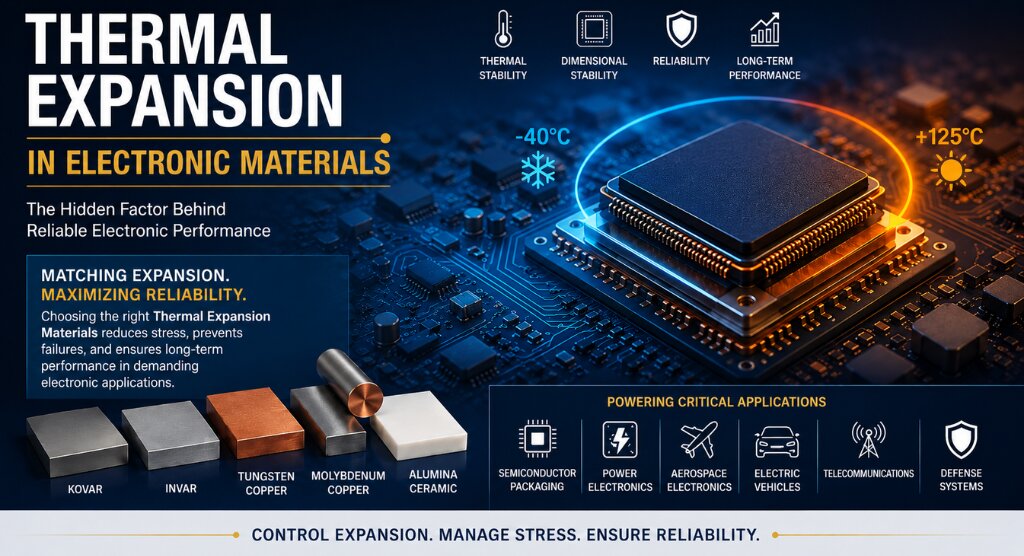
Electronic devices continue to become smaller, faster, and more powerful. While performance improvements attract most of the attention, one hidden factor often determines long-term reliability: Thermal Expansion Materials.
A semiconductor package fails unexpectedly after months of flawless operation. The root cause is not electrical overload or manufacturing defects. Instead, repeated heating and cooling cycles created mechanical stress between materials with different expansion rates, eventually causing cracks, delamination, and failure.
As modern electronics operate at higher power densities and temperatures, understanding thermal expansion has become essential for engineers, manufacturers, and designers seeking reliable performance.
Understanding Thermal Expansion in Electronic Materials
Thermal expansion refers to the tendency of a material to change its dimensions when temperature changes.
When electronic systems heat up during operation:
- Metals expand
- Ceramics expand
- Polymers expand
- Semiconductor materials expand
The challenge occurs because different materials expand at different rates.
This property is measured using the Coefficient of Thermal Expansion (CTE), typically expressed in parts per million per degree Celsius (ppm/°C).
Proper selection of Thermal Expansion Materials helps minimize stress between components and improves long-term reliability.
Why Thermal Expansion Matters in Electronics
Electronic assemblies often combine multiple materials within a single package:
- Silicon chips
- Copper conductors
- Ceramic substrates
- Solder joints
- Polymer encapsulants
- Heat sinks
When temperatures fluctuate, each material expands differently.
Potential consequences include:
- Cracked solder joints
- Delamination
- Warping
- Mechanical fatigue
- Reduced signal integrity
- Premature component failure
Careful material selection helps maintain dimensional stability and reliability throughout the product lifecycle.
Chemical Composition of Common Thermal Expansion Materials
Copper-Tungsten (WCu)
Typical Composition:
- Tungsten: 70–90%
- Copper: 10–30%
Provides low thermal expansion with excellent thermal conductivity.
Molybdenum-Copper (MoCu)
Typical Composition:
- Molybdenum: 50–90%
- Copper: Balance
Widely used for semiconductor packaging and thermal management.
Kovar (UNS K94610)
Typical Composition:
- Iron: Balance
- Nickel: ~29%
- Cobalt: ~17%
Offers expansion characteristics closely matched to glass and ceramics.
Invar (UNS K93600)
Typical Composition:
- Iron: Balance
- Nickel: ~36%
Known for extremely low thermal expansion.
Alumina Ceramics
Typical Composition:
- Aluminum Oxide (Al₂O₃): 92–99.9%
Provides excellent dimensional stability and electrical insulation.
Key Properties of Thermal Expansion Materials
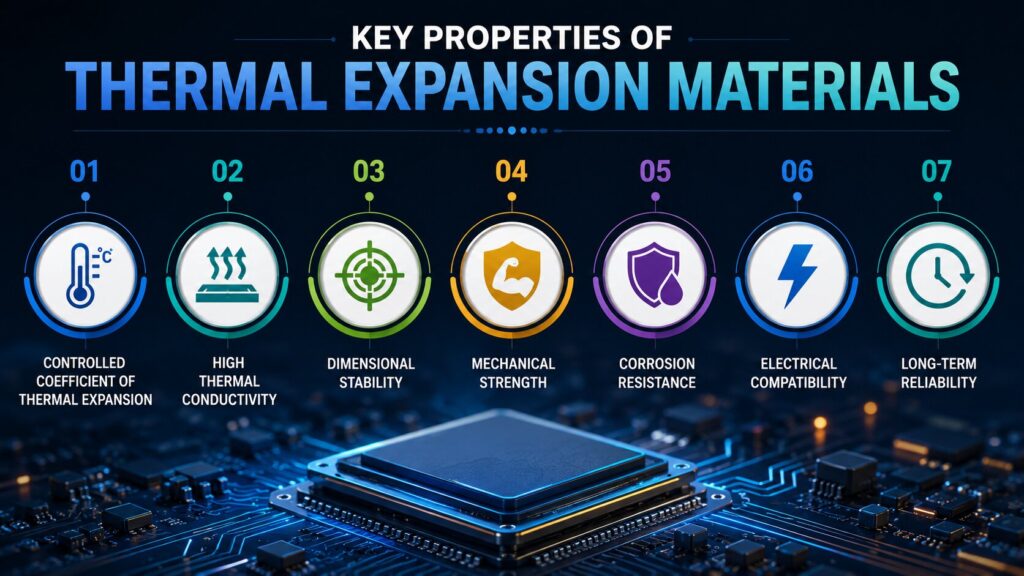
1. Controlled Coefficient of Thermal Expansion
Thermal Expansion Materials with a low and predictable CTE help minimize mechanical stress during repeated heating and cooling cycles.
2. High Thermal Conductivity
Thermal Expansion Materials efficiently transfer heat, reducing temperature gradients and localized thermal stresses within electronic assemblies.
3. Dimensional Stability
Thermal Expansion Materials maintain precise component alignment and dimensional accuracy throughout varying operating temperatures.
4. Mechanical Strength
Thermal Expansion Materials provide the structural durability required to withstand continuous thermal cycling without deformation.
5. Corrosion Resistance
Thermal Expansion Materials offer reliable performance in harsh environments by resisting oxidation, moisture, and chemical exposure.
6. Electrical Compatibility
Many Thermal Expansion Materials combine thermal stability with the electrical conductivity required for advanced electronic applications.
7. Long-Term Reliability
Thermal Expansion Materials are engineered to maintain consistent performance over years of thermal cycling and demanding service conditions.
Technical Specifications
| Material | CTE (ppm/°C) | Thermal Conductivity (W/m·K) | Density (g/cm³) |
| Copper | 16.5 | 390 | 8.96 |
| Aluminum | 23.0 | 237 | 2.70 |
| Kovar | 5.0–6.0 | 17 | 8.36 |
| Invar | 1.2–1.5 | 13 | 8.05 |
| Tungsten Copper | 6–9 | 180–220 | 15–17 |
| Molybdenum Copper | 6–8 | 170–210 | 9–10 |
| Alumina Ceramic | 6–8 | 20–35 | 3.8–3.9 |
Standards Relevant to Thermal Expansion Materials
Several international standards guide material selection and testing:
ASTM Standards
- ASTM E228 – Linear Thermal Expansion Testing
- ASTM B702 – Copper-Tungsten Materials
- ASTM F15 – Iron-Nickel-Cobalt Alloys
ISO Standards
- ISO 11359 – Thermal Analysis
- ISO 80000 – Physical Quantities and Units
Electronic Industry Standards
- JEDEC Thermal Cycling Standards
- IPC Electronic Assembly Standards
- MIL Specifications for Aerospace Electronics
Compliance ensures consistent material performance and reliability.
Applications of Thermal Expansion Materials
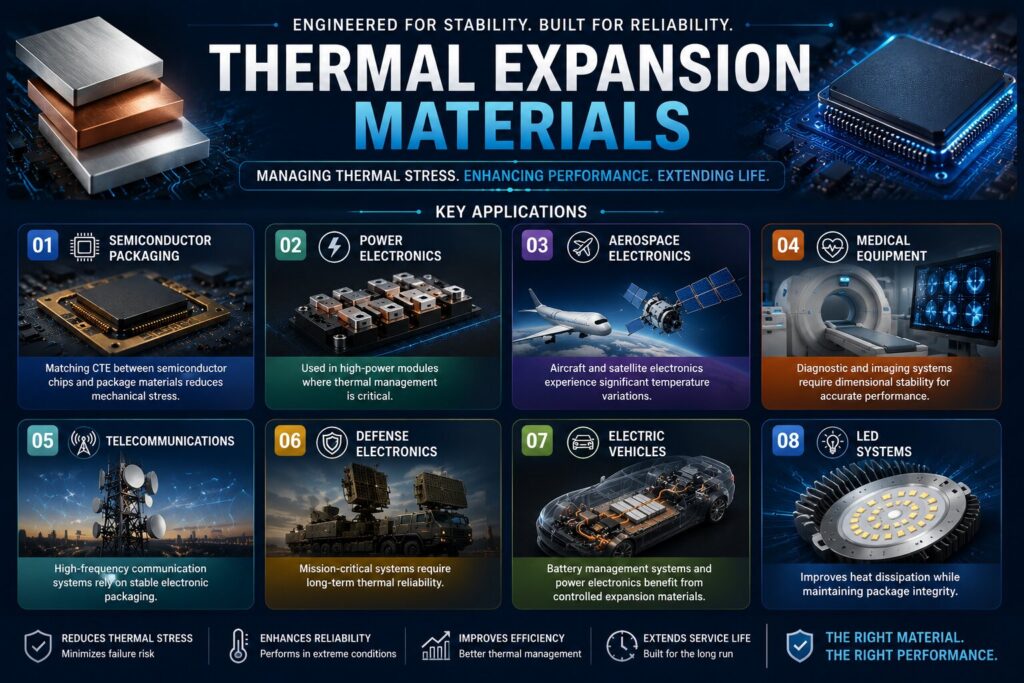
Semiconductor Packaging
Thermal Expansion Materials help match the CTE of semiconductor chips and package components, reducing mechanical stress and improving reliability.
Power Electronics
High-power modules rely on effective thermal management to maintain performance, reliability, and long service life.
Aerospace Electronics
Thermal Expansion Materials provide dimensional stability in aircraft and satellite systems exposed to extreme temperature fluctuations.
Medical Equipment
Thermal Expansion Materials support the precision and accuracy required in diagnostic, imaging, and healthcare monitoring systems.
Telecommunications
Thermal Expansion Materials enhance the stability of high-frequency communication equipment by minimizing thermal-induced distortion.
Defense Electronics
Thermal Expansion Materials deliver the long-term thermal reliability needed for mission-critical military and defense applications.
Electric Vehicles
Thermal Expansion Materials improve the durability and efficiency of battery management systems and power electronics in EVs.
LED Systems
Thermal Expansion Materials promote efficient heat dissipation while maintaining the structural integrity of LED packages and assemblies.
Shapes Available
DOMADIA™ supplies thermal expansion control materials in various forms:
- Sheets
- Plates
- Foils
- Strips
- Rods
- Bars
- Blocks
- Rings
- Custom Machined Components
- Semiconductor Base Plates
- Heat Sink Assemblies
- Precision Fabricated Parts
Custom dimensions can be manufactured according to project requirements.
The Engineering Mindset Shift
Many engineers focus primarily on electrical performance and thermal conductivity. However, Thermal Expansion Materials compatibility often determines whether a product survives thousands of thermal cycles or fails prematurely.
A material with excellent conductivity but mismatched expansion characteristics may create reliability problems that far outweigh its electrical advantages. This is why selecting the right Thermal Expansion Materials is a critical part of modern electronic design.
The most successful electronic designs balance:
• Thermal conductivity
• Mechanical strength
• Electrical performance
• Expansion compatibility
By carefully integrating Thermal Expansion Materials into electronic assemblies, engineers can improve long-term reliability, minimize thermal stress, and enhance overall system performance. This integrated approach reduces maintenance costs, warranty claims, and unexpected downtime.
Why DOMADIA™
DOMADIA™ supports industries requiring advanced thermal management and dimensional stability solutions.
What Sets DOMADIA™ Apart?
✔ Extensive material expertise
✔ High-performance thermal expansion control materials
✔ Precision machining capabilities
✔ Custom sizes and configurations
✔ Consistent quality standards
✔ Fast delivery support
✔ Technical guidance for material selection
✔ Solutions for semiconductor, aerospace, medical, telecom, and power electronics industries
Whether your application requires Kovar, Invar, tungsten copper, molybdenum copper, or other engineered materials, DOMADIA™ delivers dependable solutions tailored to demanding electronic environments.
Conclusion
Thermal Expansion Materials play a vital role in ensuring the reliability and longevity of modern electronic systems. As devices become more compact and powerful, managing thermal stresses through the proper selection of Thermal Expansion Materials becomes increasingly important.
By selecting materials with compatible expansion characteristics, engineers can reduce failures, improve durability, and enhance overall system performance. From semiconductor packaging and aerospace electronics to EV systems and telecommunications, Thermal Expansion Materials help minimize mechanical stress, maintain dimensional stability, and support long-term operational reliability.
DOMADIA™ continues to support advanced industries with high-quality thermal management and expansion-control materials engineered for demanding applications. With extensive expertise in Thermal Expansion Materials, DOMADIA™ helps manufacturers achieve improved performance, greater reliability, and extended service life in critical electronic systems.
Looking for High-Performance Thermal Expansion Materials?
Reduce thermal stress, improve component lifespan, and enhance electronic reliability with DOMADIA™advanced material solutions.
Talk to our material specialists today and find the ideal solution for your application.
Talk to: Er.Pankaj Domadia | Kairav Domadia | Aadil Domadia | Pragati Sanap | Pooja N N
#ThermalExpansionMaterials #ElectronicMaterials #ThermalManagement #SemiconductorPackaging #AdvancedMaterials #EngineeringMaterials #DOMADIA #ElectronicsIndustry
Directly whatsapp us for an Enquiry: https://wa.link/kairav
We’ve supplied to Mumbai, Pune, Indore, Jaipur, and Surat—serving industries across Maharashtra, Madhya Pradesh, Rajasthan, Gujarat, and Goa, with exports to Germany, USA, Japan, South Korea, and Italy.