Blogs
Tungsten vs Copper: Complete Comparison Guide for Engineers
Selecting the right engineering material directly impacts equipment performance, operating costs, and long-term reliability. Tungsten vs Copper is one of the most common comparisons because both metals are widely used across electrical, thermal, aerospace, defense, semiconductor, and industrial manufacturing applications.
Although both materials possess excellent characteristics, they are designed for entirely different operating conditions. In the Tungsten vs Copper comparison, copper is recognized for its exceptional electrical and thermal conductivity, while tungsten delivers unmatched strength, hardness, and outstanding resistance to extremely high temperatures.
Understanding where each material excels helps engineers avoid costly design mistakes, improve efficiency, and extend equipment life. Whether your project demands superior conductivity or exceptional heat resistance, evaluating Tungsten vs Copper ensures the right material selection for long-term performance and reliability.
At DOMADIA™, we supply premium-quality tungsten products, copper products, and custom tungsten-copper composites for demanding industrial applications worldwide, helping customers choose the ideal material for every engineering challenge.
What is Tungsten?
Tungsten is a refractory metal identified by UNS R05200 with the highest melting point of any pure metal at 3,422°C. It possesses extremely high density, remarkable hardness, and outstanding wear resistance.
These properties make tungsten indispensable where components operate under severe heat, heavy mechanical loads, or intense electrical conditions.
What is Copper?
Copper, commonly designated as UNS C11000 (Electrolytic Tough Pitch Copper), is one of the world’s best electrical and thermal conductors.
It is soft, highly ductile, corrosion resistant, and easy to fabricate, making it ideal for electrical wiring, power transmission, heat exchangers, and countless industrial applications.
Chemical Composition
Tungsten (UNS R05200)
| Element | Percentage |
| Tungsten (W) | ≥99.95% |
| Impurities | ≤0.05% |
Copper (UNS C11000)
| Element | Percentage |
| Copper (Cu) | ≥99.90% |
| Oxygen | Approximately 0.02–0.04% |
9 Major Differences Between Tungsten vs Copper
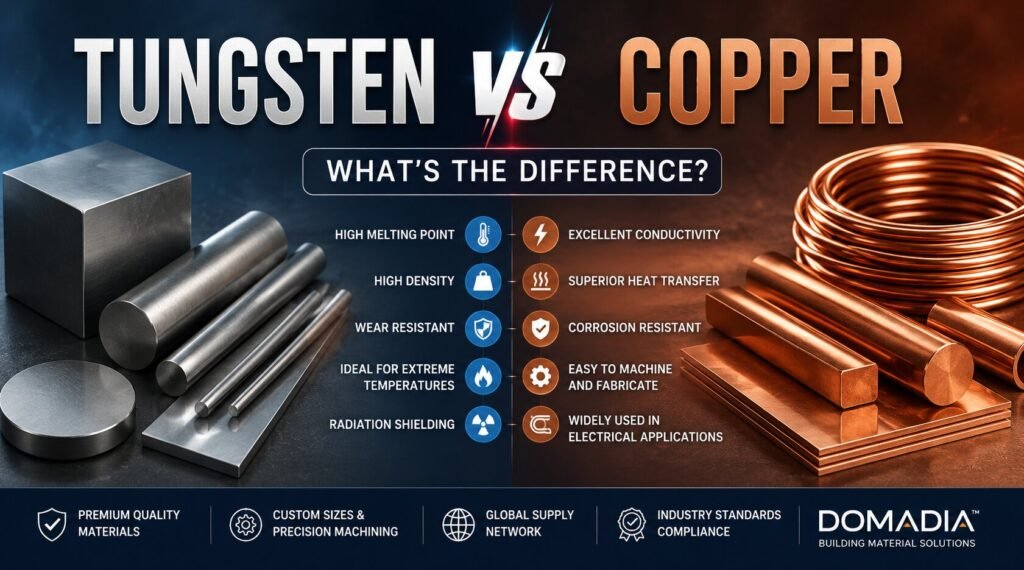
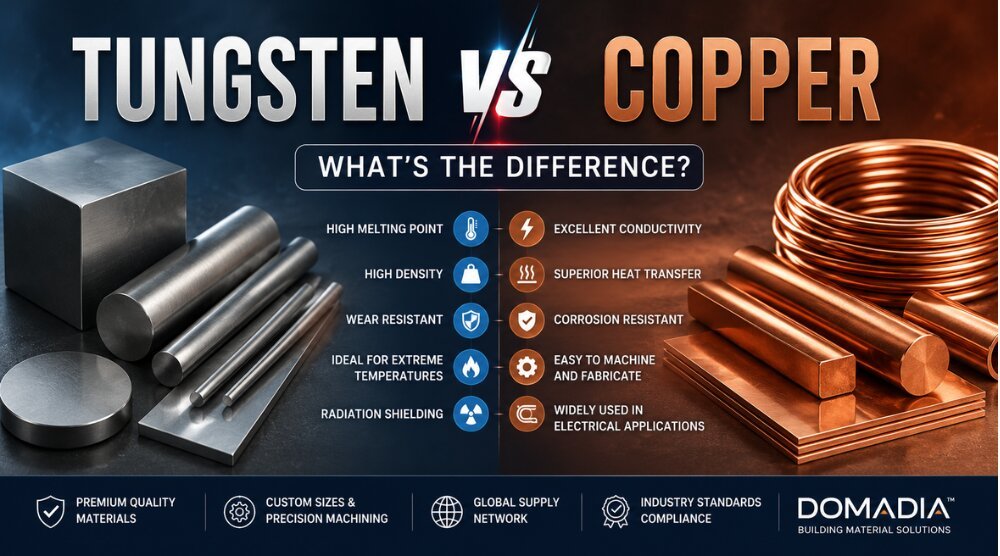
1. Melting Point
This is the biggest difference.
- Tungsten: 3,422°C
- Copper: 1,085°C
Tungsten easily withstands environments where copper would soften or melt.
2. Electrical Conductivity
Copper is one of the world’s best electrical conductors.
- Copper: Excellent conductivity
- Tungsten: Moderate conductivity
For electrical wiring and busbars, copper remains the preferred choice.
3. Thermal Conductivity
Copper transfers heat extremely efficiently.
Approximate values:
- Copper: 390–400 W/m·K
- Tungsten: 170–175 W/m·K
Heat sinks and cooling systems generally use copper.
4. Mechanical Strength
Tungsten offers exceptional strength.
Its high tensile strength makes it ideal for:
- Heavy-duty components
- High-pressure applications
- Aerospace hardware
- Industrial tooling
Copper is comparatively soft and easily formed.
5. Density
Density affects vibration control, balancing, and radiation shielding.
- Tungsten: 19.3 g/cm³
- Copper: 8.96 g/cm³
Tungsten is more than twice as dense as copper.
6. Wear Resistance
Tungsten resists abrasion, erosion, and deformation far better than copper.
This significantly increases service life in demanding industrial environments.
7. Machinability
Copper is easy to machine, bend, weld, and fabricate.
Tungsten requires specialized machining due to its hardness and brittleness.
8. Cost
Copper generally has a lower purchase price.
Tungsten costs more because of:
- Difficult extraction
- Powder metallurgy manufacturing
- High melting point processing
- Precision machining
However, in many demanding applications, tungsten’s extended service life reduces replacement frequency and downtime, lowering the overall lifecycle cost.
9. Typical Applications
Copper dominates electrical and thermal systems.
Tungsten dominates extreme-temperature and high-wear environments.
Choosing the correct material depends entirely on the application’s operating conditions.
Properties of Tungsten
Extremely High Melting Point
Maintains structural integrity even in the most demanding high-temperature industrial environments.
Exceptional Hardness
Provides outstanding resistance against scratching, deformation, and wear.
High Density
Tungsten vs Copper: Tungsten is ideal for balancing weights, radiation shielding, and aerospace components due to its exceptional density, high strength, and outstanding performance in demanding environments.
Excellent Wear Resistance
Delivers a long operational life under abrasive conditions.
Good Electrical Conductivity
Suitable for specialized electrical contacts and electrodes.
High Temperature Stability
Maintains mechanical properties under continuous thermal loading.
Corrosion Resistance
Offers reliable performance in many industrial environments.
Long Service Life
Reduces maintenance, downtime, and replacement costs.
Properties of Copper
Outstanding Electrical Conductivity
Tungsten vs Copper: Copper is one of the best electrical conductors available, making it the preferred material for power transmission, electrical wiring, and high-conductivity systems.
Excellent Thermal Conductivity
Tungsten vs Copper: Copper transfers heat efficiently in cooling applications, making it an excellent choice where rapid thermal conductivity is required.
High Ductility
Can be drawn into wires and formed into complex shapes.
Good Corrosion Resistance
Performs reliably in many indoor and outdoor environments.
Easy Fabrication
Tungsten vs Copper: Copper can be machined, welded, soldered, and formed with ease, whereas tungsten requires specialized machining techniques due to its exceptional hardness and high melting point.
Excellent Recyclability
Tungsten vs Copper: Both metals maintain excellent value through repeated recycling, supporting cost-effective manufacturing and more sustainable engineering practices.
Antimicrobial Surface
Tungsten vs Copper: Copper naturally inhibits the growth of many microorganisms, making it a preferred material for hygienic surfaces and applications where antimicrobial properties are beneficial.
Cost Effective
Offers outstanding value for numerous industrial applications.
Technical Specifications
| Property | Tungsten | Copper |
| UNS Number | R05200 | C11000 |
| Density | 19.3 g/cm³ | 8.96 g/cm³ |
| Melting Point | 3422°C | 1085°C |
| Electrical Conductivity | Moderate | Excellent |
| Thermal Conductivity | Good | Excellent |
| Hardness | Very High | Low |
| Wear Resistance | Excellent | Moderate |
| Machinability | Difficult | Easy |
Applications of Tungsten
Aerospace Components
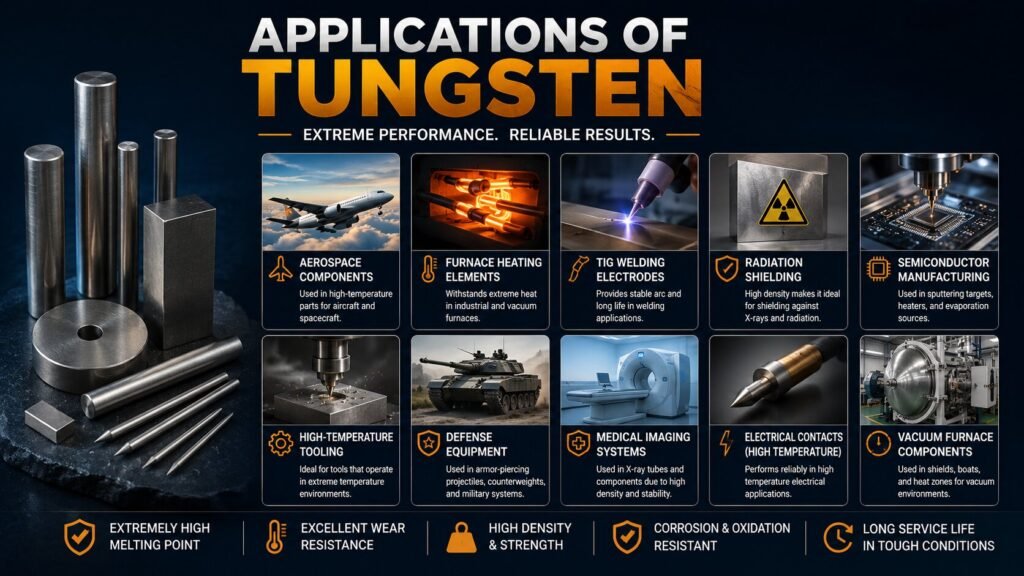
Applications of Tungsten include aerospace components, where its exceptional strength and extremely high melting point ensure reliable performance in aircraft engines, turbines, and space exploration systems.
Rocket Nozzles
Tungsten vs Copper: Among the advanced applications of tungsten, rocket nozzles rely on its exceptional heat resistance, high melting point, and dimensional stability to withstand the extreme temperatures and mechanical stresses encountered during rocket launches.
TIG Welding Electrodes
Applications of Tungsten in TIG welding electrodes provide stable arc performance, precise weld quality, and excellent durability for stainless steel, aluminum, and specialty alloy welding.
Radiation Shielding
One of the most critical Applications of Tungsten is radiation shielding, where its high density effectively absorbs X-rays and gamma rays in medical, industrial, and nuclear environments.
Medical Equipment
Tungsten vs Copper: Tungsten is widely used in medical equipment because its exceptional density, high strength, and radiation-shielding properties support imaging systems, surgical instruments, radiation therapy devices, and other precision medical applications.
Semiconductor Manufacturing
Modern electronics depend on Applications of Tungsten in semiconductor manufacturing for sputtering targets, wafer processing equipment, and high-temperature components requiring exceptional stability.
High-Temperature Furnaces
Applications of Tungsten in high-temperature furnaces enable reliable operation under extreme heat, making it ideal for heating elements, furnace components, and vacuum processing systems.
Defense Systems
Tungsten vs Copper: Tungsten plays a vital role in defense systems, where its exceptional density, hardness, and wear resistance make it suitable for armor-piercing components, counterweights, and other high-performance military equipment.
X-ray Targets
Applications of Tungsten in X-ray targets produce high-quality diagnostic images because tungsten efficiently converts high-energy electrons into X-rays while withstanding intense heat.
EDM Electrodes
Applications of Tungsten include EDM electrodes, where excellent electrical conductivity, wear resistance, and thermal stability enable highly accurate machining of complex industrial components.
Applications of Copper
Electrical Wiring
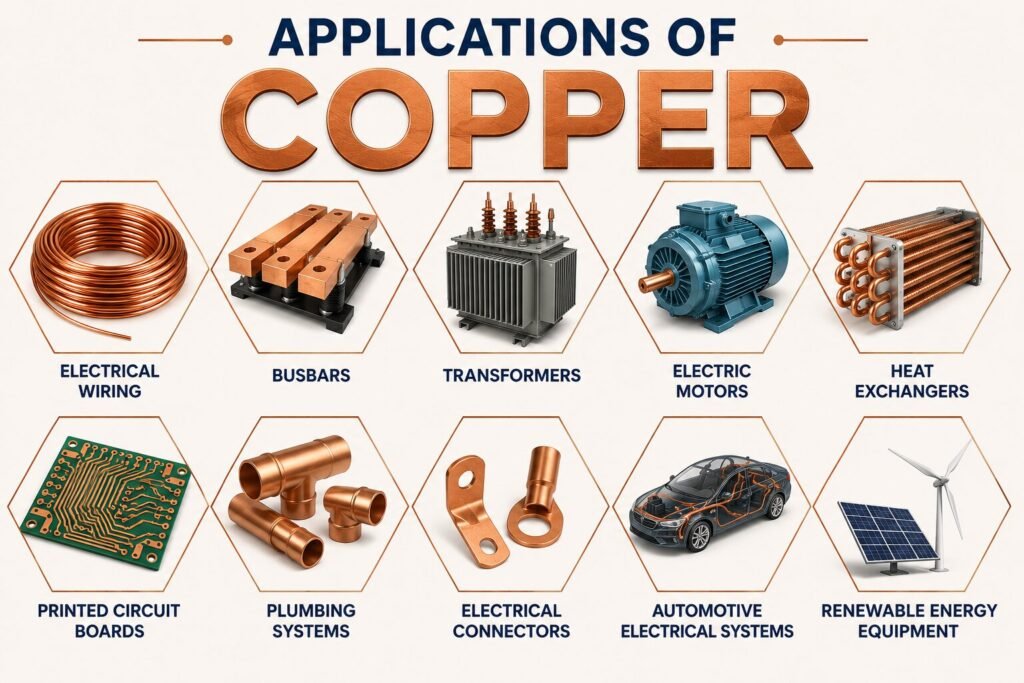
Applications of Copper include electrical wiring because copper offers outstanding electrical conductivity, ensuring efficient power transmission with minimal energy loss in residential, commercial, and industrial electrical systems.
Power Distribution
Tungsten vs Copper: Copper is widely used in power distribution systems, including switchgear, substations, busbars, and transmission equipment, where its outstanding electrical conductivity and durability ensure reliable and efficient power delivery.
Busbars
One of the most important Applications of Copper is in busbars, which provide low-resistance current distribution for electrical panels, power plants, and industrial automation systems.
Heat Exchangers
Applications of Copper extend to heat exchangers, where its exceptional thermal conductivity enables rapid heat transfer, improving energy efficiency in HVAC, refrigeration, and industrial cooling equipment.
Transformers
Tungsten vs Copper: Copper is extensively used in transformer windings because its superior electrical conductivity enables efficient energy transfer, minimizes power losses, and provides long-term operational reliability.
Electric Motors
Applications of Copper in electric motors improve efficiency, torque, and reliability by providing highly conductive windings for automotive, industrial, and renewable energy equipment.
Printed Circuit Boards
Modern electronics rely on Applications of Copper in printed circuit boards, where copper traces ensure fast electrical signal transmission and dependable performance in electronic devices.
Plumbing Systems
Applications of Copper in plumbing systems provide corrosion resistance, excellent durability, and safe water transportation for residential, commercial, and industrial infrastructure.
Renewable Energy Equipment
Growing Applications of Copper in renewable energy equipment include solar panels, wind turbines, battery systems, and energy storage solutions that require efficient electrical conductivity.
Industrial Cooling Systems
Tungsten vs Copper: Copper is widely used in industrial cooling systems because its excellent thermal conductivity enables rapid heat dissipation, improving equipment efficiency, reliability, and overall service life.
Industry Standards
Tungsten
- ASTM B760
- ASTM B777
- ASTM F288
- ISO 6848
Copper
- ASTM B152
- ASTM B170
- ASTM B187
- ASTM B115
- ASTM B75
Shapes Available
Tungsten
- Rods
- Sheets
- Plates
- Bars
- Wires
- Foils
- Tubes
- Discs
- Blocks
- Custom Machined Components
Copper
- Sheets
- Plates
- Rods
- Bars
- Tubes
- Pipes
- Wires
- Strips
- Foils
- Busbars
Which Material Should You Choose?
Choose Copper if your priority is:
- Maximum electrical conductivity
- Superior heat transfer
- Easy fabrication
- Lower initial cost
Choose Tungsten if your application requires:
- Extreme temperatures
- High mechanical strength
- Exceptional wear resistance
- Long operational life
- High-density components
Why Choose DOMADIA™?
DOMADIA™ supplies premium industrial metals that meet demanding engineering requirements across global industries.
Our advantages include:
- High-purity tungsten and copper materials
- Precision machining capabilities
- Custom dimensions
- International quality standards
- Technical material selection support
- Reliable global logistics
- Competitive pricing
- Fast delivery schedules
- Experienced engineering assistance
Whether your project requires pure tungsten, oxygen-free copper, or tungsten-copper composites, DOMADIA™ helps you select the right material for maximum performance and long-term reliability.
Conclusion
Choosing Tungsten vs Copper is not about deciding which material is universally better—it is about selecting the one that best meets your application’s technical requirements. In the Tungsten vs Copper comparison, copper remains the preferred choice for superior electrical conductivity, efficient heat transfer, and easy fabrication, while tungsten excels in high-temperature environments, heavy-duty applications, and situations requiring exceptional strength and wear resistance.
By understanding the unique properties, applications, and lifecycle benefits of each material, engineers can improve equipment reliability, reduce maintenance costs, and maximize operational efficiency. Whether you’re evaluating Tungsten vs Copper for electrical systems, aerospace components, or industrial manufacturing, selecting the right material delivers long-term value. With extensive experience in supplying high-performance industrial materials, DOMADIA™ provides expert guidance along with premium-quality tungsten, copper, and tungsten-copper composite products tailored to demanding industrial applications worldwide.
Need Expert Guidance in Choosing Between Tungsten and Copper?
DOMADIA™ supplies premium tungsten and copper materials with expert technical support and reliable global delivery.
Contact DOMADIA™ today to discuss your project requirements and discover the right material solution for your application.
Talk to: Er.Pankaj Domadia | Kairav Domadia | Aadil Domadia | Pragati Sanap | Pooja N N
#TungstenVsCopper #Tungsten #Copper #IndustrialMaterials #Engineering #Manufacturing #MetalComparison #DOMADIA #HighPerformanceMaterials #IndustrialSolutions
Directly whatsapp us for an Enquiry: https://wa.link/kairav
We’ve supplied to Mumbai, Pune, Indore, Jaipur, and Surat—serving industries across Maharashtra, Madhya Pradesh, Rajasthan, Gujarat, and Goa, with exports to Germany, USA, Japan, South Korea, and Italy.