Blogs
Mu Metal Shielding (UNS N14080): 7 Powerful Reasons It Really Protects Electronics
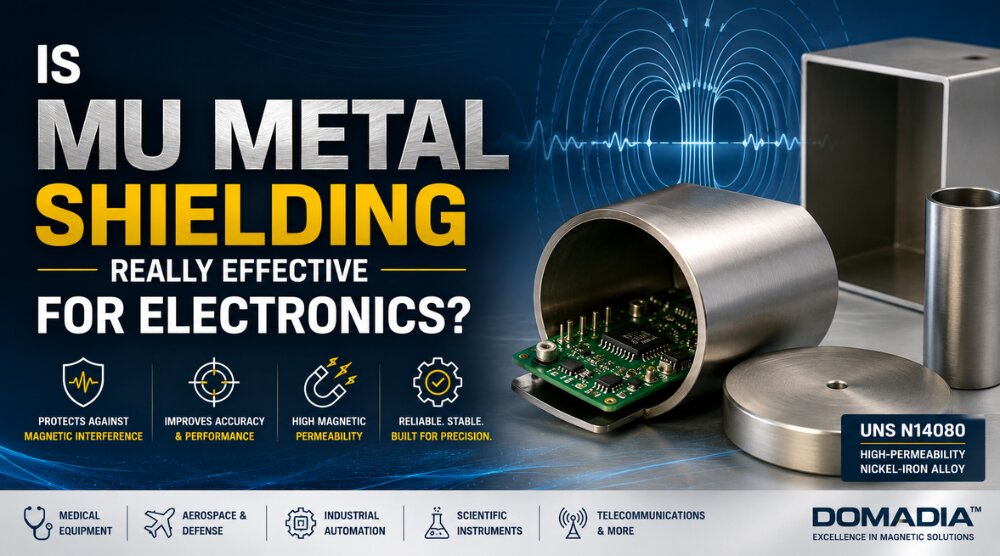
Modern electronic devices are becoming smaller, faster, and significantly more sensitive than ever before. While this advancement improves performance, it also makes electronics increasingly vulnerable to external magnetic fields. Even weak magnetic interference can disrupt sensors, distort measurement accuracy, introduce unwanted noise, or reduce the reliability of critical equipment. Mu Metal Shielding plays a vital role in preventing these issues by redirecting low-frequency magnetic fields away from sensitive electronic components.
This naturally raises an important engineering question:
Is Mu Metal Shielding actually effective for protecting electronics?
The short answer is yes—when properly designed and manufactured, Mu Metal Shielding is one of the most effective solutions available for low-frequency magnetic field protection.
In this guide, we’ll explain why Mu Metal Shielding works so well, how it protects electronic systems, where it is used, and why engineers around the world rely on UNS N14080 for demanding magnetic shielding applications. Whether used in medical devices, aerospace systems, semiconductor equipment, or precision scientific instruments, Mu Metal Shielding helps ensure reliable performance by minimizing magnetic interference in critical environments.
What Is Mu Metal?
Mu Metal is a high-permeability nickel-iron soft magnetic alloy specifically developed to redirect and absorb magnetic flux rather than allowing it to pass through protected equipment.
Unlike electrical shielding materials that block electromagnetic waves, Mu Metal is designed primarily for low-frequency magnetic field shielding, making it ideal for precision electronics.
The most widely recognized specification is:
UNS N14080
Its exceptionally high magnetic permeability allows magnetic lines of force to travel through the alloy instead of nearby electronic components.
Why Do Electronics Need Magnetic Shielding?
Many electronic devices operate with extremely small electrical signals.
External magnetic fields generated by motors, transformers, generators, power cables, or industrial machinery may interfere with these signals.
Common problems include:
- Sensor inaccuracies
- Signal distortion
- Increased electrical noise
- Data corruption
- Calibration drift
- Reduced equipment reliability
- Unstable measurements
As electronic systems become more precise, protecting them from magnetic interference becomes increasingly important.
How Does Mu Metal Shielding Work?
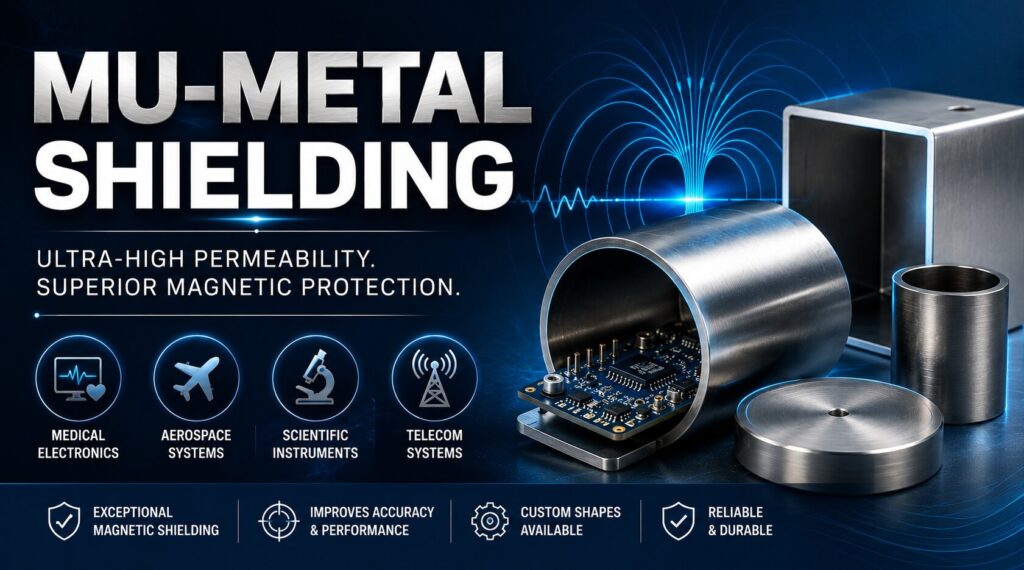
Unlike conventional metals, Mu Metal does not simply block magnetic fields.
Instead, it provides an easier path for magnetic flux.
When an external magnetic field approaches the shield:
- Magnetic lines enter the Mu Metal.
- The field follows the highly permeable material.
- Magnetic energy is redirected around the protected equipment.
- The internal magnetic field is dramatically reduced.
This simple principle makes Mu Metal one of the most effective passive magnetic shielding materials available.
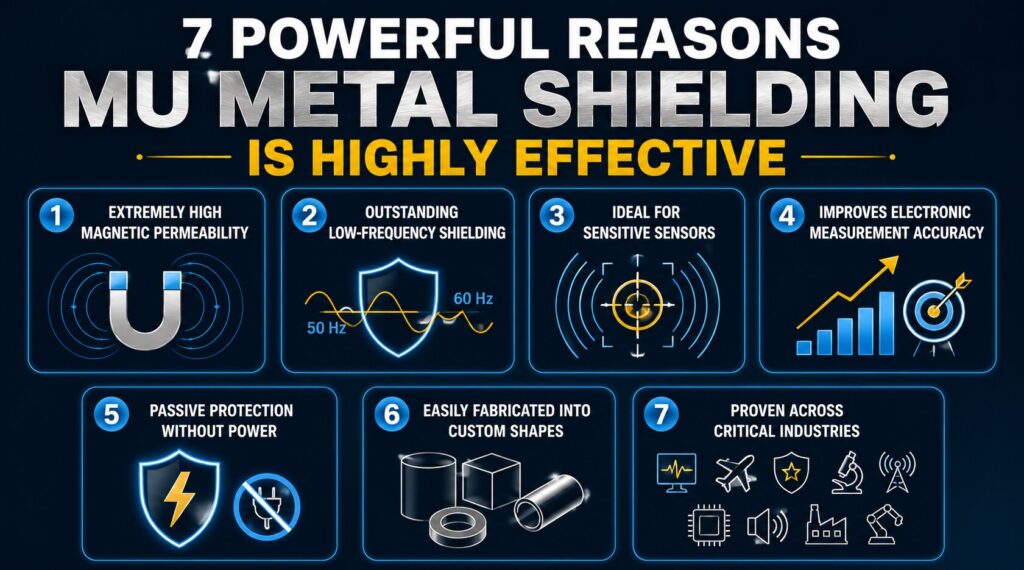
7 Powerful Reasons Mu Metal Shielding Is Highly Effective
1. Extremely High Magnetic Permeability
The primary advantage of UNS N14080 is its exceptionally high magnetic permeability.
Compared with ordinary steels or stainless steels, Mu Metal attracts magnetic flux much more efficiently.
Benefits include:
- Excellent shielding efficiency
- Improved protection of sensitive circuits
- Better low-field performance
- Reduced magnetic leakage
This property forms the foundation of its shielding performance.
2. Outstanding Low-Frequency Shielding
Many shielding materials perform well only against high-frequency electromagnetic interference.
However, low-frequency magnetic fields are much more difficult to control.
Mu Metal excels in shielding:
- 50 Hz power systems
- 60 Hz electrical equipment
- Transformer fields
- Motor-generated magnetic fields
- Permanent magnet leakage fields
This makes it particularly valuable in industrial and laboratory electronics.
3. Ideal for Sensitive Sensors
Modern sensors often detect incredibly small changes in magnetic fields.
Examples include:
- Hall-effect sensors
- Fluxgate sensors
- Magnetometers
- Medical sensors
- Scientific instruments
Even minor magnetic disturbances may affect measurement accuracy.
Proper Mu Metal shielding significantly improves sensor stability and repeatability.
4. Improves Electronic Measurement Accuracy
Precision electronic instruments depend on stable operating environments.
Magnetic interference may introduce:
- Offset errors
- Signal fluctuations
- Noise
- Drift
By reducing external magnetic influence, Mu Metal helps instruments maintain higher measurement accuracy over long operating periods.
5. Passive Protection Without Power
One major advantage is simplicity.
Mu Metal requires:
- No electrical supply
- No maintenance power
- No active cooling
- No electronic controls
Once installed correctly, the shield continuously protects nearby electronics throughout its service life.
6. Easily Fabricated into Custom Shapes
Electronic equipment comes in countless configurations.
Mu Metal can be manufactured into various shielding forms, including:
- Cylindrical shields
- Boxes
- Sleeves
- Enclosures
- Covers
- Precision fabricated components
Custom geometries allow engineers to protect specific electronic assemblies while maintaining compact designs.
7. Proven Across Critical Industries
Perhaps the strongest evidence of its effectiveness is its widespread industrial adoption.
Mu Metal shielding protects electronics used in:
- Medical imaging equipment
- Aerospace electronics
- Defense systems
- Laboratory instruments
- Audio equipment
- Scientific research
- Telecommunications
- Semiconductor manufacturing
- Industrial automation
- Precision control systems
These industries demand exceptional reliability, making Mu Metal the preferred choice.
Chemical Composition (Typical)
UNS N14080 generally contains:
| Element | Typical Content |
| Nickel (Ni) | ~77% |
| Iron (Fe) | Balance |
| Copper (Cu) | ~5% |
| Molybdenum (Mo) | ~4% |
| Manganese (Mn) | Small amount |
The exact composition may vary slightly depending on manufacturing specifications.
Properties of UNS N14080
- Extremely high magnetic permeability
- Very low coercivity
- Excellent low-frequency magnetic shielding
- High magnetic flux absorption capability
- Soft magnetic behavior
- Good formability
- Excellent stability after magnetic annealing
- Suitable for precision fabrication
- Reliable long-term magnetic performance
Technical Specifications
| Property | Typical Value |
| UNS Number | N14080 |
| Material Type | Soft Magnetic Nickel-Iron Alloy |
| Nickel Content | Approximately 77% |
| Magnetic Permeability | Extremely High |
| Coercive Force | Very Low |
| Density | ~8.7 g/cm³ |
| Operating Application | Low-frequency magnetic shielding |
| Heat Treatment | Hydrogen Annealed for optimum permeability |
Standards
Common industry references include:
- UNS N14080
- ASTM specifications (where applicable)
- MIL specifications for defense applications
- Customer-specific engineering standards
- International soft magnetic alloy specifications
Applications
Mu Metal shielding is widely used in:

Medical Electronics
MRI components, diagnostic equipment, and laboratory devices.
Aerospace Systems
Navigation electronics, avionics, and satellite instruments.
Scientific Instruments
Electron microscopes, spectroscopy equipment, and research laboratories.
Semiconductor Manufacturing
Protection for highly sensitive process equipment requiring reliable Mu Metal Shielding to minimize magnetic interference and ensure precise, stable operation.
Audio Equipment
Microphones, transformers, recording systems, and studio electronics.
Telecommunications
Precision communication systems and signal processing equipment.
Defense Electronics
Radar, surveillance, secure communication, and navigation systems.
Industrial Automation
Sensors, encoders, control systems, and robotic equipment.
Shapes Available
DOMADIA™ supplies Mu Metal in multiple forms, including:
- Sheets
- Foils
- Strips
- Coils
- Plates
- Tubes
- Cylinders
- Fabricated Shields
- Precision Components
- Custom Engineered Shield Assemblies
Does Thickness Alone Make Shielding Better?
This is a common misconception.
A thicker shield does not automatically provide better performance.
Shielding effectiveness depends on several engineering factors:
- Material permeability
- Shield geometry
- Distance from magnetic source
- Field strength
- Saturation limits
- Proper annealing process
An optimized design often outperforms a thicker but poorly engineered shield.
Why Choose DOMADIA™?
SSelecting the right shielding material is only part of the solution. Manufacturing quality, material consistency, and engineering support are equally important.
DOMADIA™ supplies high-performance Mu Metal Shielding solutions designed for demanding industrial applications.
With DOMADIA™, customers benefit from:
- Premium-quality UNS N14080 materials
- Precision manufacturing
- Custom fabrication capabilities
- Consistent magnetic performance
- Strict quality control
- Reliable technical support
- Global supply capabilities
- Solutions tailored to customer specifications
Whether the requirement involves laboratory instruments, aerospace electronics, medical systems, or industrial automation, DOMADIA™ delivers dependable Mu Metal Shielding solutions built for long-term performance. Backed by technical expertise and a commitment to quality, our Mu Metal Shielding products help customers achieve superior magnetic protection, improved equipment reliability, and consistent results in critical applications.
Conclusion
As electronic systems continue becoming more compact and increasingly sensitive, magnetic interference becomes a greater engineering challenge. Mu Metal Shielding remains one of the most trusted solutions because it redirects low-frequency magnetic fields away from critical components without requiring external power or complex maintenance.
Its exceptional magnetic permeability, proven performance, and versatility make UNS N14080 the preferred choice across industries where precision and reliability are essential. From medical equipment and aerospace electronics to semiconductor manufacturing and scientific research, Mu Metal Shielding delivers dependable protection against unwanted magnetic interference. By partnering with DOMADIA™, manufacturers gain access to expertly engineered Mu Metal Shielding solutions that help improve equipment accuracy, operational stability, and long-term reliability.
Protect Your Electronics with Proven Mu Metal Shielding
DOMADIA™ delivers high-quality magnetic shielding materials and custom-engineered solutions designed to minimize magnetic interference and maximize performance.
Contact DOMADIA™ today to discuss your application or request a customized quote for Mu Metal sheets, foils, fabricated shields, and precision components.
Talk to: Er.Pankaj Domadia | Kairav Domadia | Aadil Domadia | Pragati Sanap | Pooja N N
#MuMetalShielding #UNSN14080 #MagneticShielding #Electronics #EMIProtection #Engineering #IndustrialMaterials #DOMADIA #PrecisionEngineering #ElectronicsManufacturing
Directly whatsapp us for an Enquiry: https://wa.link/kairav
From Hyderabad, Secunderabad, Warangal, Karimnagar, and Nizamabad, we serve Telangana, Andhra Pradesh, Karnataka, Maharashtra, and Chhattisgarh, with global reach to Turkey, Greece, Poland, Hungary, and Czech Republic.