Blogs
Mu Metal Thickness Guide: 7 Smart Ways to Choose the Right Thickness (UNS N14080)
Mu Metal Thickness Guide
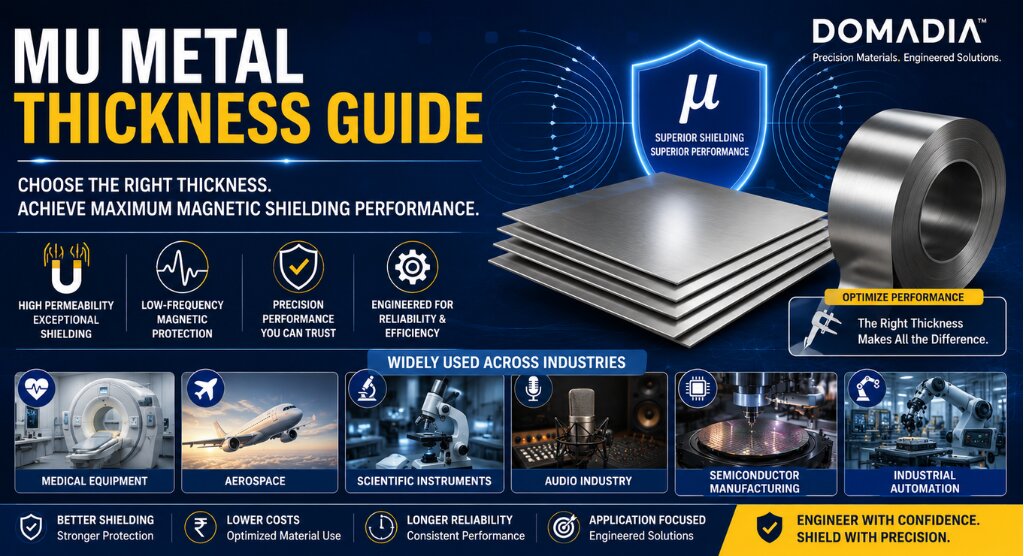
Selecting the proper Mu Metal Thickness Guide is one of the most common challenges engineers face when designing magnetic shielding. Many people assume that using the thickest sheet automatically provides the best shielding performance. In reality, shielding effectiveness depends on several factors, including magnetic field strength, frequency, geometry, the number of shielding layers, and proper heat treatment.
A carefully selected Mu Metal Thickness Guide often delivers better performance while reducing weight, manufacturing cost, and fabrication complexity. Understanding the principles behind a Mu Metal Thickness Guide helps engineers choose the right material thickness for medical equipment, aerospace systems, laboratory instruments, audio equipment, and sensitive electronic devices, ensuring reliable and cost-effective magnetic shielding.
Why Thickness Matters
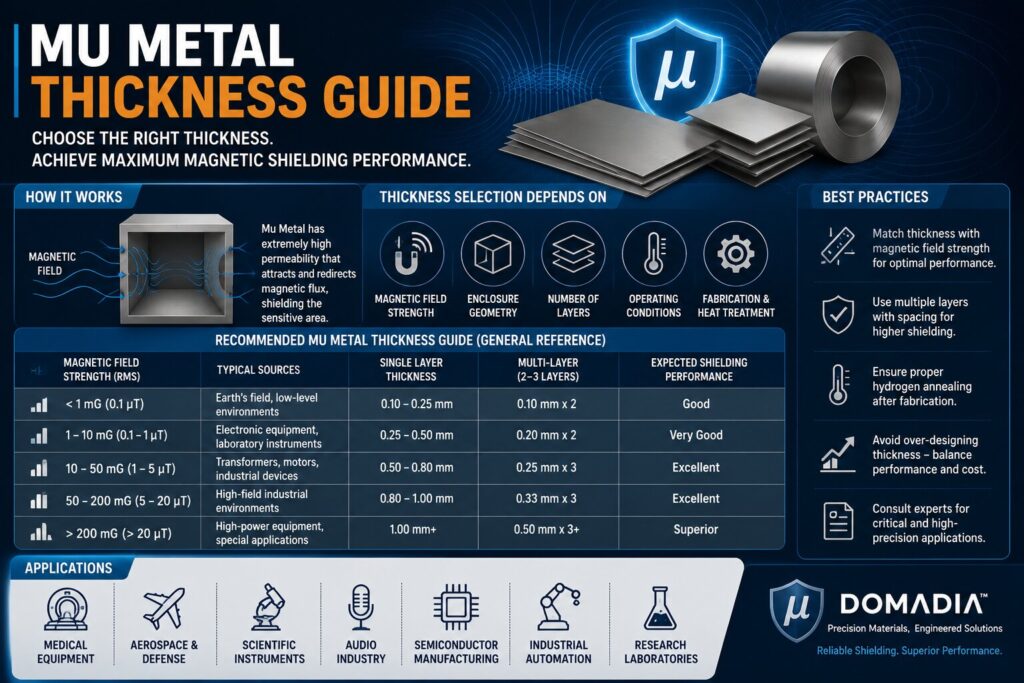
Mu Metal works differently from ordinary metals because it does not block magnetic fields; instead, it redirects magnetic flux through its exceptionally high magnetic permeability. This unique property makes it one of the most effective materials for shielding low-frequency magnetic fields. A well-designed Mu Metal Thickness Guide helps engineers select the optimum thickness based on the magnetic field strength, operating environment, and required shielding performance.
If the material is too thin, it may become magnetically saturated under stronger magnetic fields, reducing its effectiveness. On the other hand, choosing an unnecessarily thick sheet can increase material costs, weight, and fabrication complexity without delivering significant additional shielding in many applications. Following the right Mu Metal Thickness Guide enables engineers to achieve the ideal balance between magnetic performance, mechanical strength, manufacturing requirements, and overall project budget.
Typical Mu Metal Thickness Recommendations
Although every application should be evaluated individually, these general guidelines are widely used.
| Thickness | Typical Applications |
| 0.10–0.20 mm | Precision sensors, laboratory instruments, electronics |
| 0.20–0.35 mm | Audio equipment, scientific instruments, medical devices |
| 0.35–0.50 mm | Industrial electronics, transformers, shielding enclosures |
| 0.50–1.00 mm | Stronger magnetic environments and heavy-duty industrial shielding |
| Above 1.00 mm | Specialized shielding requiring high mechanical strength or multiple shielding stages |
Factors That Determine Required Thickness
1. Magnetic Field Strength
Low magnetic fields generally require thinner materials.
Higher magnetic fields may require thicker shields or multiple shielding layers to prevent magnetic saturation.
2. Distance from the Source
Shielding placed closer to the magnetic source experiences stronger magnetic flux.
Increasing distance often allows thinner shielding to perform effectively.
3. Shield Geometry
Closed enclosures generally perform better than flat sheets because magnetic flux follows a continuous path.
Proper enclosure design often contributes more to shielding effectiveness than simply increasing thickness.
4. Number of Shielding Layers
Several thinner layers separated by small air gaps frequently outperform one thick sheet.
Multiple-layer shielding is widely used in:
- MRI equipment
- Scientific laboratories
- Aerospace electronics
- Precision measurement instruments
5. Mechanical Requirements
Some applications require thicker material primarily for structural rigidity rather than magnetic performance.
Industrial cabinets and large enclosures often fall into this category.
Chemical Composition (Typical UNS N14080)
| Element | Typical % |
| Nickel (Ni) | 77–80 |
| Iron (Fe) | Balance |
| Molybdenum (Mo) | 4–5 |
| Copper (Cu) | ≤0.5 |
| Manganese (Mn) | ≤0.8 |
| Silicon (Si) | ≤0.3 |
| Carbon (C) | Low |
The high nickel content gives Mu Metal its exceptionally high magnetic permeability, making it ideal for low-frequency magnetic shielding.
Properties
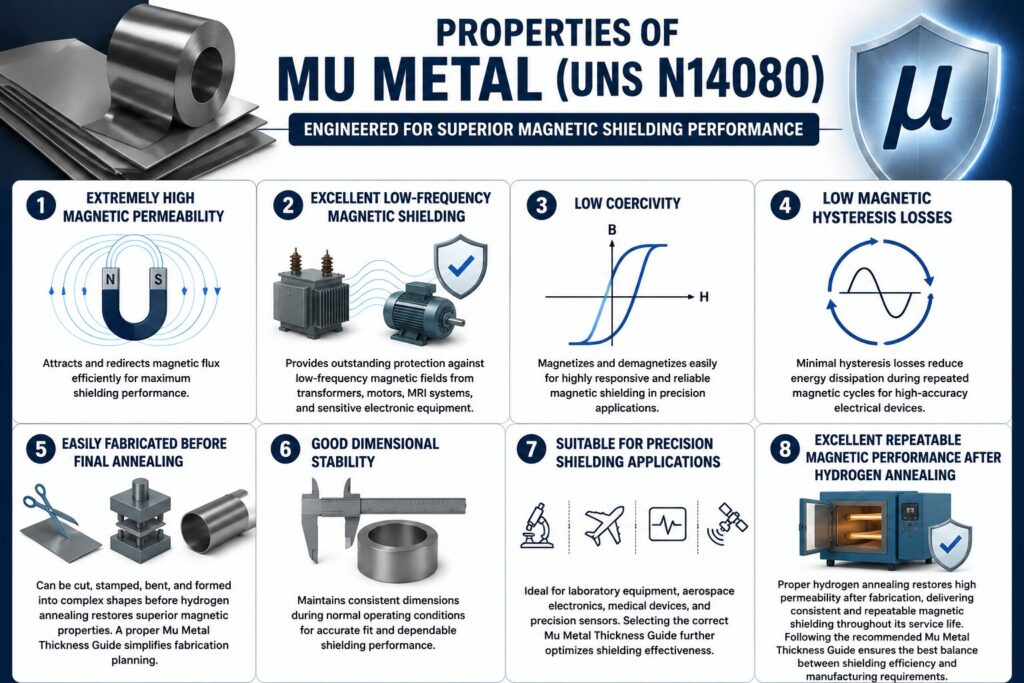
Extremely High Magnetic Permeability
The exceptional magnetic permeability of Mu Metal allows it to attract and redirect magnetic flux efficiently, making the Mu Metal Thickness Guide an important factor in achieving maximum shielding performance.
Excellent Low-Frequency Magnetic Shielding
Mu Metal provides outstanding protection against low-frequency magnetic fields generated by transformers, motors, MRI systems, and sensitive electronic equipment.
Low Coercivity
Its low coercivity enables Mu Metal to magnetize and demagnetize easily, ensuring highly responsive and reliable magnetic shielding in precision applications.
Low Magnetic Hysteresis Losses
Minimal hysteresis losses reduce energy dissipation during repeated magnetic cycles, making Mu Metal ideal for scientific instruments and high-accuracy electrical devices.
Easily Fabricated Before Final Annealing
Mu Metal can be cut, stamped, bent, and formed into complex shapes before hydrogen annealing restores its superior magnetic properties. A proper Mu Metal Thickness Guide also helps simplify fabrication planning.
Good Dimensional Stability
The material maintains consistent dimensions during normal operating conditions, ensuring accurate fit and dependable shielding performance in precision assemblies.
Suitable for Precision Shielding Applications
Its unique magnetic characteristics make Mu Metal the preferred choice for laboratory equipment, aerospace electronics, medical devices, and precision sensors. Selecting the correct Mu Metal Thickness Guide further optimizes shielding effectiveness.
Excellent Repeatable Magnetic Performance After Hydrogen Annealing
Proper hydrogen annealing restores the alloy’s high permeability after fabrication, delivering consistent and repeatable magnetic shielding throughout its service life. Following the recommended Mu Metal Thickness Guide ensures the best balance between shielding efficiency and manufacturing requirements.
Technical Specifications
Material: Mu Metal
UNS: N14080
Density: Approximately 8.7 g/cm³
Relative Permeability: Up to 100,000+ after proper annealing
Magnetic Saturation: Approximately 0.75 Tesla
Operating Temperature: Depends on application requirements
Available Condition: Annealed and non-annealed
Standards
- UNS N14080
- ASTM A753
- ASTM A34
- ASTM E1447 (Magnetic Testing)
- ISO quality manufacturing standards
Available Shapes
DOMADIA™ supplies Mu Metal in numerous forms including:
- Sheets
- Foils
- Coils
- Strips
- Plates
- Rings
- Cylinders
- Tubes
- Custom fabricated shielding enclosures
- Precision laser-cut components
Applications
Selecting the right Mu Metal Thickness Guide is essential because shielding performance varies depending on magnetic field strength, equipment sensitivity, and operating conditions. An appropriate Mu Metal Thickness Guide helps optimize protection, reduce material costs, and improve long-term reliability across numerous industries.

Medical Equipment
Mu Metal is widely used in MRI systems, diagnostic instruments, laboratory analyzers, and medical sensors to minimize magnetic interference and improve measurement accuracy. A proper Mu Metal Thickness Guide ensures reliable shielding for highly sensitive healthcare equipment.
Aerospace
Aircraft navigation systems, avionics, satellites, spacecraft, and defense electronics rely on Mu Metal to protect critical components from external magnetic fields and maintain operational precision.
Scientific Instruments
Electron microscopes, spectroscopy systems, particle detectors, and precision sensors use Mu Metal shielding to achieve stable and highly accurate experimental results. Following a Mu Metal Thickness Guide helps engineers select the optimum shielding configuration.
Audio Industry
Professional microphones, transformers, recording equipment, studio amplifiers, and high-end audio systems use Mu Metal to reduce unwanted magnetic hum and signal distortion, delivering cleaner sound quality.
Semiconductor Manufacturing
Wafer inspection systems, electron beam equipment, lithography machines, and fabrication tools depend on Mu Metal shielding to maintain precision during advanced semiconductor manufacturing. A carefully selected Mu Metal Thickness Guide enhances shielding efficiency in these demanding environments.
Industrial Automation
Sensitive control systems, instrumentation panels, robotics, PLCs, and precision measurement equipment use Mu Metal to improve operational stability by minimizing electromagnetic interference.
Research Laboratories
Quantum research facilities, magnetic testing laboratories, calibration equipment, and advanced experimental systems require exceptional magnetic shielding for consistent and repeatable results. Using the correct Mu Metal Thickness Guide helps maximize shielding performance while maintaining cost-effective system design.
Common Thickness Selection Mistakes
Engineers sometimes make avoidable errors when selecting Mu Metal.
- Assuming thicker always means better shielding.
- Ignoring magnetic saturation.
- Forgetting the importance of hydrogen annealing.
- Selecting based only on cost.
- Overlooking enclosure design.
- Using a single layer where multiple layers perform better.
Avoiding these mistakes improves shielding efficiency while controlling manufacturing costs.
Why DOMADIA™
Choosing the right supplier is as important as choosing the right material.
DOMADIA™ provides high-quality UNS N14080 Mu Metal solutions engineered for demanding industrial applications.
Our capabilities include:
- Premium-quality Mu Metal materials
- Precision thickness control
- Custom fabrication
- Laser cutting
- Annealed and non-annealed options
- Consistent magnetic performance
- Strict quality inspection
- Technical application support
- Global supply capabilities
- Fast and dependable delivery
Conclusion
Choosing the correct Mu Metal Thickness Guide involves much more than selecting the thickest available sheet. Magnetic field strength, enclosure geometry, layer configuration, fabrication requirements, and heat treatment all influence the final shielding performance. Following the right Mu Metal Thickness Guide enables engineers to achieve the ideal balance between shielding efficiency, mechanical strength, and overall project cost.
By working with experienced specialists and sourcing high-quality Mu Metal from DOMADIA™, engineers can implement the most suitable Mu Metal Thickness Guide for their applications, resulting in reliable magnetic shielding, longer service life, lower lifecycle costs, and consistent performance across demanding industrial, medical, aerospace, and scientific environments.
Need the Right Mu Metal Thickness for Your Application?
Choosing the correct Mu Metal thickness can significantly improve magnetic shielding performance while reducing unnecessary material costs and fabrication challenges.
DOMADIA™ supplies premium UNS N14080 Mu Metal in sheets, foils, strips, coils, and custom-fabricated components, backed by expert technical guidance to help you select the ideal thickness for your specific application.
Contact DOMADIA™ today to discuss your shielding requirements and receive a customized solution that delivers reliable, high-performance results.
Talk to: Er.Pankaj Domadia | Kairav Domadia | Aadil Domadia | Pragati Sanap | Pooja N N
#MuMetal #MagneticShielding #UNSN14080 #EMIShielding #Engineering #Electronics #MedicalEquipment #DOMADIA #IndustrialMaterials #SoftMagneticAlloy
Directly whatsapp us for an Enquiry: https://wa.link/kairav
From Hyderabad, Secunderabad, Warangal, Karimnagar, and Nizamabad, we serve Telangana, Andhra Pradesh, Karnataka, Maharashtra, and Chhattisgarh, with global reach to Turkey, Greece, Poland, Hungary, and Czech Republic.